
Topic Summary
Any Valid UAE License Lets You Invoice Abroad
Both free zone and mainland UAE trade licenses allow you to bill international clients legally. The license type determines your legal structure, not your ability to send invoices across borders.
Free Zone Licenses Start From AED 12,500
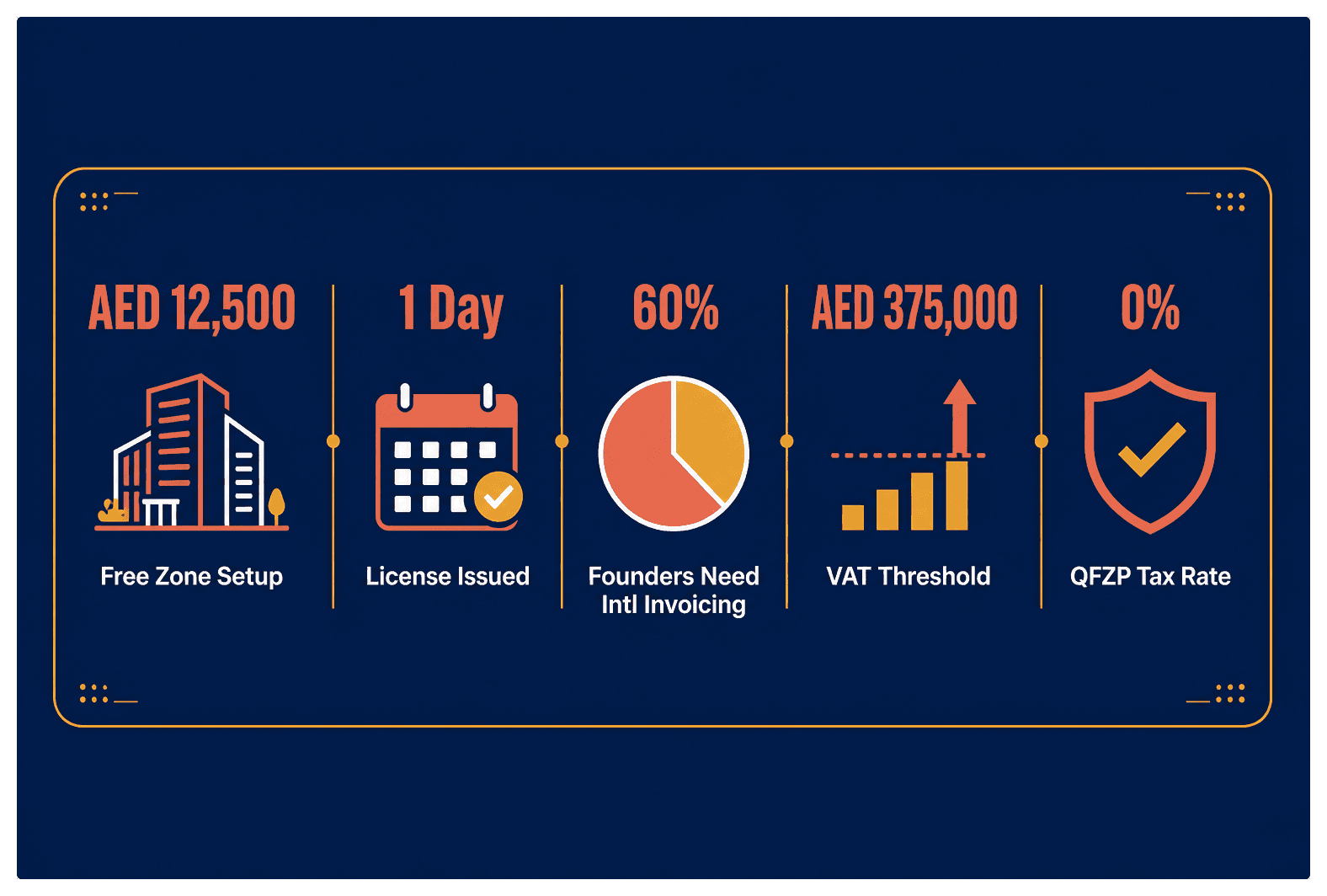
Dubai South Business Hub issues free zone licenses from AED 12,500, with no paid-up share capital required and approval in as little as one business day. A sole founder adding one investor visa can expect a first-year total from AED 18,350.
VAT Registration Triggers at AED 375,000 Turnover
Once annual revenue crosses AED 375,000, VAT registration with the Federal Tax Authority becomes mandatory regardless of license type. Including a Tax Registration Number on international invoices is essential at that threshold.
Unlicensed Activities Are the Real Invoicing Blocker
The most common friction in cross-border billing comes from invoicing for an activity not listed on the trade license, not from choosing free zone over mainland. Verifying that your services match your licensed activities before registering prevents costly amendments later.
Free Zones Restrict Direct UAE Market Sales
Free zone entities generally cannot sell directly to UAE-based clients without a local distributor or a separate mainland branch. Founders whose revenue is primarily international face fewer constraints with a free zone structure.
Qualifying Free Zone Status Is Not Automatic
The 0% corporate tax rate available to Qualifying Free Zone Persons depends on meeting four specific statutory conditions, not simply holding a free zone license. Founders should confirm eligibility with a tax adviser before assuming the benefit applies.
In 2026, over 60% of first-time founders arriving in Dubai list international invoicing as their primary business requirement from day one (Dubai Chamber, 2025). Yet a significant share initially choose a license structure that creates unnecessary friction when billing foreign clients. The good news: any validly issued UAE trade license lets you invoice internationally [1]. The real question is which structure gives you the lowest cost [2], the right activity scope [3], and the cleanest paper trail for cross-border billing. Free zone licenses at Dubai South Business Hub start from AED 12,500 [4], issued in one business day [5], with zero paid-up share capital required. VAT registration becomes mandatory at AED 375,000 annual turnover (Federal Tax Authority, 2026) [6]. This article explains which license lets you invoice internationally from Dubai, compares free zone and mainland options across cost, scope, visa impact, and fit, and gives a clear recommendation by founder scenario so you can choose the right structure before you register.
What a License That Lets You Invoice Internationally Actually Means
Any validly issued UAE trade license lets you invoice international clients. The real question is which license structure gives you the lowest cost, the right activity scope, and the cleanest paper trail for cross-border billing. Free zone and mainland licenses both qualify; the differences lie in setup cost, visa capacity, and local market access.
Why the License Type Is Not the Barrier to International Invoicing
Both free zone and mainland licenses produce a legally incorporated UAE entity with a commercial registration number. That registration number is what foreign clients and their banks need to see on an invoice. The invoice itself is a commercial document; the license type determines your legal personality, not your ability to bill abroad.
What actually limits international invoicing has nothing to do with free zone versus mainland. The real blockers are:
An unlicensed activity appearing on the invoice
An expired or suspended trade license
A missing VAT registration once annual turnover crosses AED 375,000 (Federal Tax Authority, 2026)
Here's a concrete example. A Dubai South Business Hub Free Zone consultancy billing a London-based fintech firm for strategy work carries the UAE company name, the Tax Registration Number (TRN) if VAT-registered, and the free zone license number on the invoice. The London client pays in GBP; the UAE entity receives it into a UAE corporate account. The license type is entirely irrelevant to that transaction. What matters is that the activity is licensed, the license is current, and VAT obligations are met.
What the License Type Does Affect for International Founders
The license lets you invoice from Dubai regardless of structure, but the structure shapes everything else:
Formation and renewal cost: Free zone licenses start from AED 12,500 at Dubai South Business Hub, typically lower than mainland equivalents for single-activity service businesses
UAE market access: Free zone companies generally need a local distributor or mainland branch to sell directly to UAE-based clients; mainland companies trade freely across the UAE
Visa quota: Visa entitlements flow from the license, not from where you send invoices
Corporate tax positioning: Qualifying Free Zone Person (QFZP) status, which allows 0% on qualifying income, depends on four specific conditions and is not automatic
First-year cost for a sole founder with one investor visa starts from AED 18,350 at Dubai South Business Hub. That figure covers the license and visa; the two costs are always separate, never bundled. You can explore business activities in Dubai to confirm your services are covered before committing to a structure.
Free Zone License: What It Covers and What It Costs
A free zone license lets you invoice international clients with zero paid-up share capital required, 100% foreign ownership, and formation costs starting from AED 12,500 at Dubai South Business Hub. Visas are an additional cost. The trade-off is that selling directly into the UAE mainland requires a local commercial agent or a mainland branch.
Core Features of a Free Zone License for International Work
100% foreign ownership: No UAE national shareholder required (this right is now also available on the mainland for most activities)
Zero paid-up share capital: Dubai South Business Hub, launched September 2025, requires no minimum capital deposit
One business day issuance: Once documents are in order, the license is live the next working day
Duty-suspended, not duty-exempt: Goods held in a free zone are not subject to UAE customs duty while they remain there; duty applies when goods cross into the UAE mainland
No bonded warehousing or customs integration: Dubai South Business Hub does not provide these facilities
Dubai South Business Hub Free Zone licenses start from AED 12,500. Each activity beyond the first five costs AED 2,000. A professional license in Dubai covering consulting or advisory work is a common starting point for service-led founders billing abroad.
First-Year Cost Breakdown for a Sole Founder
The license fee of AED 12,500 covers up to five activities. If you need a sixth or seventh activity, add AED 2,000 per activity. Visa costs are always additional and never included in the license fee.
A solo UX designer invoicing European SaaS companies, for instance, needs one professional activity and one investor visa. First-year all-in cost from AED 18,350 at Dubai South Business Hub. Year two carries a renewal fee rather than a setup fee, so ongoing costs are lower. Use the business setup cost calculator to get a precise figure based on your activity count and visa requirement.
What a Free Zone License Cannot Do in the UAE Market
Cannot sell directly to UAE mainland customers without a local commercial agent or a separately licensed mainland branch
Cannot participate in UAE government tenders that require a mainland DET license
For regulated activities such as healthcare or financial services, the free zone license grants the commercial registration; the named regulator (Dubai Health Authority for healthcare, Central Bank of the UAE for financial services) approves the activity separately
Mainland License: When the Dubai Department of Economic Tourism Route Makes Sense
A mainland license issued by the Dubai Department of Economic Tourism (DET) lets you invoice international clients and sell directly to UAE-based customers without a local agent. It suits founders who need UAE government contracts, walk-in retail presence, or activities restricted to mainland jurisdiction. Setup costs and annual fees are typically higher than free zone equivalents.
Advantages of a Mainland License for International Billing
Unrestricted access to the UAE mainland market alongside international invoicing: one entity covers both
Eligible for UAE government and semi-government tenders
100% foreign ownership now available for most activities under mainland rules, removing the previous requirement for a UAE national partner
Broader activity list for certain regulated sectors that require mainland jurisdiction by law
A UK-based founder running a facilities management company, for example, needs walk-in access to UAE corporate clients and wants to bid on government building contracts. A mainland DET license is the only structure that covers both requirements without an intermediary.
Cost and Complexity Differences Versus a Free Zone License
DET license fees vary by activity type and legal form. Professional licenses on the mainland are generally comparable to free zone rates. Commercial and industrial licenses carry higher fees, and certain legal forms such as Limited Liability Companies (LLCs) require paid-up share capital, adding to the initial outlay.
Office space requirements on the mainland are typically more stringent than free zone flexi-desk arrangements. Annual renewal involves DET and, for some activities, additional ministry approvals, which extends the administrative cycle. For founders whose revenue is predominantly international with limited UAE-side sales, that additional complexity rarely pays off.
Free Zone vs. Mainland License for International Invoicing: Full Comparison
Feature | Free Zone License (Dubai South Business Hub) | Mainland License (DET) |
|---|---|---|
Formation cost | From AED 12,500 | Variable by activity and legal form; typically higher for commercial and industrial categories |
Paid-up share capital | Zero required | Required for LLC and certain other legal forms |
Time to issue | One business day once documents are complete | Typically 3–7 business days depending on activity and approvals |
International invoicing | Yes, full cross-border billing capability | Yes, full cross-border billing capability |
Direct UAE mainland sales | Requires local commercial agent or mainland branch | Yes, unrestricted direct access |
UAE government tenders | Not eligible for tenders requiring a DET license | Eligible for federal and emirate-level tenders |
100% foreign ownership | Yes | Yes, available for most activities under current mainland rules |
Side-by-Side Comparison: Free Zone vs. Mainland for International Invoicing
Free zone and mainland licenses both support international invoicing. Free zone wins on cost and speed for service-led founders billing abroad. Mainland wins when you need direct UAE market access, government contracts, or a physical retail presence. The right choice depends on your revenue split between UAE and international clients.
Reading the Numbers: Three Founder Profiles and What They Should Choose
Profile 1: Digital service founder, 100% international clients. A free zone license is the clear choice. Lower cost, one-day issuance, no need for UAE mainland access. A management consultant billing 80% international and 20% UAE corporate clients, for instance, can cover the international revenue cleanly through a free zone entity and handle UAE-side sales through a local distributor agreement or mainland branch if volume eventually justifies it.
Profile 2: B2B consultant split between UAE and international clients. Start with a free zone license for the international work. Then evaluate whether your UAE revenue volume justifies the additional cost of a mainland branch or agent arrangement. Many founders in this position run comfortably on a free zone license for the first two years.
Profile 3: Founder needing UAE government contracts plus international billing. A mainland DET license is necessary. The additional cost and complexity buy unrestricted tender eligibility and direct UAE market access, which are non-negotiable for this business model.
Five Steps to Get the Right License and Start Invoicing Internationally
Getting a Dubai license that lets you invoice internationally takes five steps: confirm your activity is on the license, choose your jurisdiction, register the company, open a UAE corporate bank account, and issue your first invoice with the correct legal details. A free zone license can be live in one business day.
Steps to Set Up and Invoice from Day One
Map your billable services to licensed activities. Every service you plan to invoice must appear on your license. Check the business activities list to confirm coverage before you apply. Each activity beyond the first five costs AED 2,000 at Dubai South Business Hub.
Choose your jurisdiction. If your revenue is predominantly international and you don't need direct UAE mainland sales, a free zone license is the faster and lower-cost path. If UAE government tenders or direct retail access are central to your model, go mainland.
Register the company. At Dubai South Business Hub, the license is issued in one business day once documents are complete. Apply for your UAE residency visa separately; it's always an additional cost, never included in the license fee.
Open a UAE corporate bank account. Banks require your trade license, passport, and Emirates ID. Timelines vary by bank; some accounts are active within a week. Guidance on bank account opening in the UAE can help you prepare the right documents upfront.
Issue your first invoice. Include your company name, UAE address, trade license number, and TRN if you're VAT-registered. That's all a foreign client needs to process payment.
An e-learning platform founder invoicing corporate training clients in Germany and Singapore, for example, registers a professional license at Dubai South Business Hub on day one, opens a multi-currency account, and issues the first invoice within the same week. The whole sequence is genuinely that fast when documents are prepared in advance.
Is a free zone license enough to invoice clients in Europe?
Yes. A validly issued free zone trade license creates a UAE legal entity with a commercial registration number. European clients and their banks accept UAE invoices carrying that registration number, the company name, UAE address, and TRN (if VAT-registered). The license type, free zone or mainland, does not affect cross-border billing capability.
Corporate Tax and VAT: What International Invoicing Triggers
Invoicing international clients from a UAE entity does not make you automatically tax-exempt. Corporate tax at 9% applies to taxable income above AED 375,000. Free zone companies may qualify for 0% on qualifying income under four specific conditions. VAT registration is mandatory when turnover exceeds AED 375,000. Late registration carries an AED 10,000 penalty for each obligation.
Corporate Tax: The Four Conditions for a Free Zone Company to Access 0%
A free zone company can access the 0% rate on qualifying income only if it meets all four Qualifying Free Zone Person (QFZP) conditions set out in UAE Corporate Tax Law: it must maintain adequate substance in the UAE; derive qualifying income as defined in the legislation; not have elected to be subject to the standard corporate tax regime; and comply with transfer pricing rules (Federal Tax Authority, 2026).
Failing any single condition subjects the entire entity to the standard 9% rate on taxable income above AED 375,000. Income earned from UAE mainland transactions by a free zone company is generally not qualifying income. Late corporate tax registration carries a one-time flat penalty of AED 10,000, not a monthly charge.
VAT on International Invoices: Zero-Rated vs. Out of Scope
Services exported to clients outside the UAE are generally zero-rated for VAT purposes: VAT is charged at 0% rather than 5%, but VAT registration is still mandatory once turnover crosses AED 375,000 (Federal Tax Authority, 2026)
Late VAT registration carries an AED 10,000 penalty
Goods crossing from a free zone into the UAE mainland trigger import VAT and customs duty; free zone duty-suspension applies only while goods remain within the zone
For regulated financial services activities, the Central Bank of the UAE approves the activity; VAT treatment of financial services follows specific rules separate from standard export services
Do I need to register for VAT if all my clients are outside the UAE?
Yes, if your annual turnover exceeds AED 375,000. Exporting services to foreign clients qualifies as zero-rated, not exempt from VAT registration. You still register, file returns, and charge 0% rather than 5%. Missing the registration threshold triggers an AED 10,000 penalty from the Federal Tax Authority.
Which License Lets You Invoice Internationally: Clear Recommendations by Scenario
For founders billing predominantly international clients with services or digital products, a free zone license is the faster and lower-cost choice. For founders who need direct UAE mainland sales alongside international invoicing, a mainland DET license removes the need for a local agent. Choose based on where your revenue actually comes from, not where you are physically based.
When a Free Zone License Is the Right Answer
Your clients are predominantly outside the UAE: the license lets you invoice Dubai-registered from day one, and the free zone structure handles it cleanly
You want the fastest path to a live company: Dubai South Business Hub issues the license in one business day
Your first-year budget is AED 18,350 all-in as a sole founder with
References
Frequently Asked Questions