
Topic Summary
Match Your License to Your Client Base
Free zone licenses suit digital founders serving international clients, while mainland DET licenses are required to contract directly with UAE government entities or sell freely into the local market. Choosing the wrong structure in year one often means paying to restructure within 18 months.
Dubai South Free Zone Offers the Lowest Entry Cost
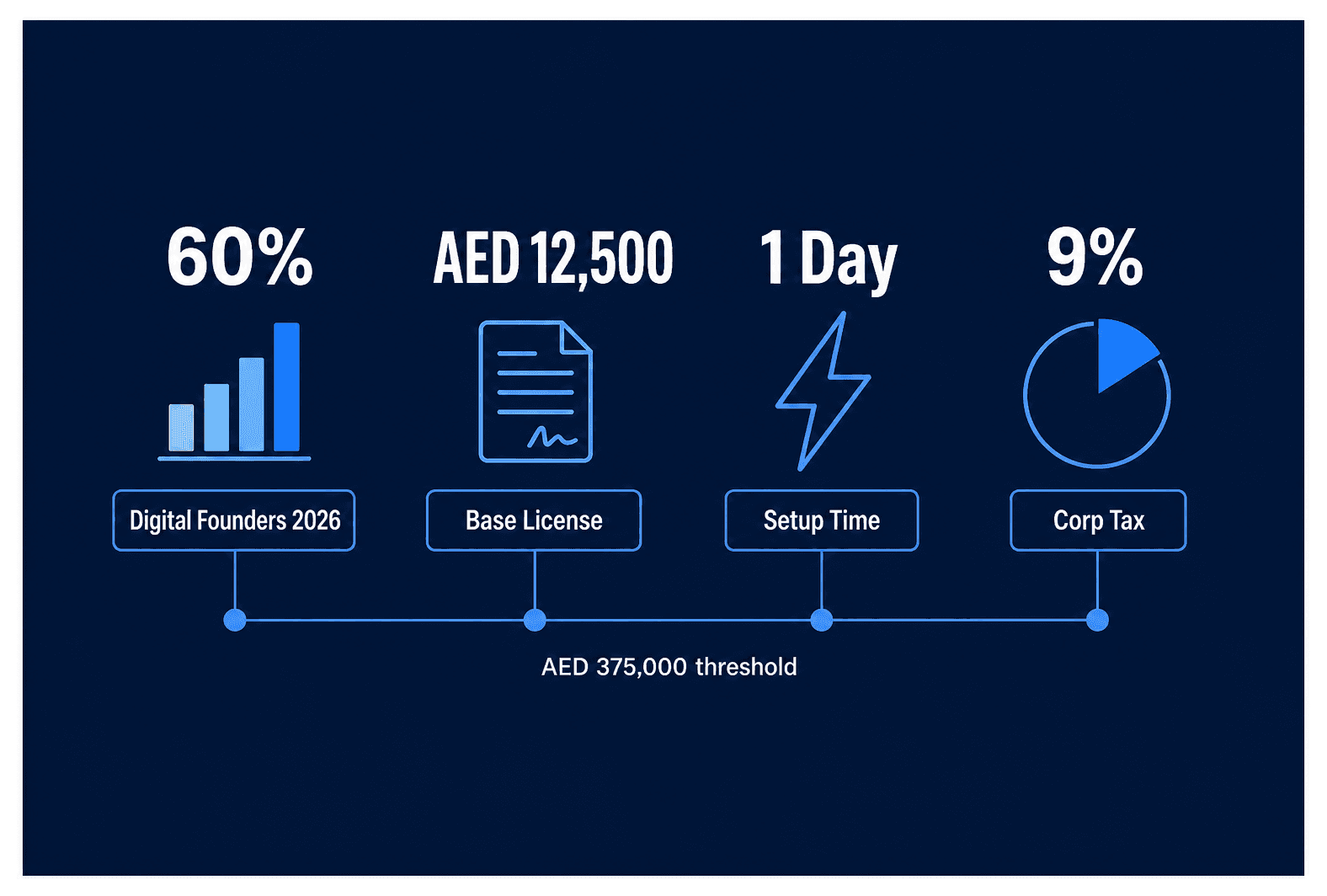
Dubai South Business Hub Free Zone issues digital business licenses from AED 12,500, with a first-year total from AED 18,350 for a sole founder with one visa. Setup takes just one day and requires zero paid-up share capital.
Define Your Activities List Before You Apply
Dubai includes up to five business activities in the base license fee, with each additional activity costing AED 2,000. Mapping your full scope upfront — for example, Software Development plus IT Consultancy for a SaaS platform — avoids costly amendments later.
Foreign Ownership Is 100% in Both Structures
Under Federal Decree-Law No. 26 of 2020, full foreign ownership is available on both free zone and mainland licenses across the UAE. This is no longer a differentiating factor when choosing between the two structures.
Know When Corporate Tax and VAT Kick In
UAE corporate tax applies at 9% on taxable income above AED 375,000, and VAT registration becomes mandatory once annual turnover crosses the same threshold. Missing the VAT registration deadline carries a AED 10,000 penalty, so tracking revenue milestones early matters.
ICT Licenses Cover Most Core Digital Activities
Software development, IT consultancy, digital marketing, SaaS, and content creation each fall under the ICT license category available at DSBH from AED 12,500. Online retail is classified separately, so founders combining e-commerce with tech services should verify their full activities list before committing.
In 2026, more than 60% of new business license applications in Dubai come from founders running fully digital operations. The Dubai South Business Hub Free Zone (DSBH) issues licenses from AED 12,500 [1], with a first-year total from AED 18,350 for a sole founder with one visa [2]. Setup takes one day [3]. UAE corporate tax applies at 9% on taxable income above AED 375,000 [4]. VAT registration is mandatory once annual turnover crosses AED 375,000, with a AED 10,000 penalty for late registration [5]. Yet a significant share of first-time founders still choose the wrong license structure in year one and pay to restructure within 18 months.
This guide breaks down which license suits a digital business in Dubai, compares free zone and mainland options across cost, scope, visa impact, and practical fit, and gives you a clear recommendation by founder scenario, not a neutral summary that leaves you guessing.
What a Digital Business License in Dubai Actually Means
A digital business license in Dubai authorizes online and technology-driven commercial activities. Founders can choose a free zone license or a mainland license issued by DET. The right choice depends on whether you sell to UAE-based clients directly, need physical office space, or operate across borders from a remote setup. Knowing which license suits a digital Dubai business from day one saves you the cost and friction of restructuring later.
How Dubai Classifies Digital and Technology Activities
Dubai doesn't issue a single catch-all "digital license." Instead, it classifies digital activities across ICT, professional services, and e-commerce categories. Your activities list, the specific commercial activities you're authorized to conduct, determines which license category applies.
Common digital activities include software development, IT consultancy, digital marketing, SaaS, content creation, and online retail. Each of those sits in a different classification bucket. The first five activities are included in the base license fee. Each activity you add beyond five costs AED 2,000, so defining your full list before you apply is critical, amending it later costs more.
A founder launching a SaaS analytics platform, for example, would list "Software Development" and "IT Consultancy" as primary activities. Both are available under an ICT license in Dubai at DSBH from AED 12,500. Review the business activities list before you commit to any structure.
Free Zone vs. Mainland: The Core Structural Difference
A free zone license is issued by the free zone authority. A mainland license is issued by DET (Dubai's Department of Economy and Tourism). That distinction drives nearly every practical difference between the two structures.
Free zone companies trade freely internationally and with other free zone entities. Mainland companies can contract directly with UAE government entities and sell freely into the local market without any intermediary arrangement. Both structures now allow 100% foreign ownership, that's a UAE-wide rule under Federal Decree-Law No. 26 of 2020, and it has nothing to do with designated-zone status.
A digital agency serving UAE government contracts needs a mainland DET license to qualify as a direct contractor. The same agency serving only international clients can operate efficiently from a free zone at a lower first-year cost.
Free Zone License for Digital Businesses: What It Covers
A free zone license suits digital founders who serve international clients, want fast setup, and need minimal overhead. At Dubai South Business Hub Free Zone, a license starts from AED 12,500, is issued in one day, requires zero paid-up share capital, and launched in September 2025. This is the license that suits most digital Dubai founders in year one.
Cost Structure and First-Year Commitment
Here's what the numbers actually look like at DSBH:
License from AED 12,500
First-year total for a sole founder with one visa from AED 18,350
Zero paid-up share capital required
License issued in one day
Launched September 2025
A solo digital consultant relocating from Europe can have a valid license and begin invoicing clients within 24 hours of completing the application. No share capital deposit, no weeks-long approval queue. That speed advantage is real and meaningful for founders who need to start generating revenue fast.
Visa Allocation and Residency for Digital Founders
Visas are always a separate cost, they're never bundled into the license price. Your visa quota is tied to the license package you choose, and additional visas are priced separately. The AED 18,350 first-year figure for a sole founder includes one visa; a second visa adds to that total.
A two-person digital startup with a founder and one remote employee can apply for two UAE residency visas under their DSBH license, with each visa processed as a separate cost item. Factor in Emirates ID fees and medical insurance before you finalize your budget. The total first-year cost for a two-visa setup will be higher than AED 18,350, and running the numbers in advance avoids surprises.
What a Free Zone License Does Not Cover
Worth flagging before you commit: DSBH is not a designated zone, so no designated-zone customs or VAT benefits apply. Free zone goods are duty-suspended, not duty-exempt, a distinction that matters if you ever ship physical products into or through the UAE.
No bonded warehousing or customs integration at DSBH (not relevant to most digital businesses)
No designated-zone customs or VAT benefit
Duty-suspended, not duty-exempt, on physical goods
Selling at retail scale into the UAE local market may need a mainland arrangement
A digital founder who also sells branded merchandise in UAE retail outlets would need a separate mainland trading arrangement for that physical product line. For pure digital operations, none of these limitations apply in practice.
Mainland License for Digital Businesses: What Changes
A mainland license issued by DET suits digital businesses that need direct contracts with UAE government entities, unrestricted local market access, or a physical retail or office presence within Dubai. Setup costs are typically higher than a free zone license, and the process involves DET approval plus activity-specific regulatory sign-off. This is the license suits Dubai comparison that matters most for government-facing digital businesses.
When the Local Market Access Argument Actually Holds
Mainland licenses allow direct B2B contracts with UAE federal and emirate-level government entities. If your digital business is pitching to Dubai government departments or state-linked enterprises, a mainland DET license is usually a prerequisite to being listed as a direct contractor.
A digital transformation consultancy bidding on a Dubai Smart City government tender would need a mainland DET license to be eligible. That's a concrete, non-negotiable requirement, not a preference. Founders serving purely international clients or UAE private-sector clients gain little practical advantage from mainland over free zone.
100% foreign ownership is available on the mainland under Federal Decree-Law No. 26 of 2020 (UAE Cabinet, 2020). It's unrelated to free zone or designated-zone status. Don't let anyone tell you a mainland license limits your ownership stake, it doesn't.
Regulated Digital Activities and Dual Approval
Here's a point that catches founders off guard: certain digital activities require regulator approval in addition to the DET or free zone license. The license authorizes the activity. The named regulator approves your right to practice. Both parts are always required.
Fintech and payment services require Central Bank of UAE approval regardless of license type. Digital health platforms require Dubai Health Authority (DHA) or the relevant emirate health authority approval before the platform can operate commercially.
A founder launching a digital health monitoring app needs both a valid license listing the health activity and separate DHA approval. Skipping the second step means the platform can't legally operate, regardless of which license type you hold.
Free Zone vs. Mainland License: Digital Business Comparison
Feature | Free Zone License (DSBH) | Mainland License (DET) |
|---|---|---|
License cost | From AED 12,500 | Varies by activity and office requirement; typically higher than free zone |
Setup speed | License issued in one day | DET approval plus activity-specific sign-off; typically longer |
Paid-up share capital | Zero required | May be required depending on activity and company structure |
UAE local market access | International clients and UAE private-sector clients; retail scale may need a mainland arrangement | Unrestricted access to UAE local market including B2C retail |
Government contract eligibility | Not eligible as a direct contractor for UAE government tenders | Eligible for direct contracts with UAE federal and emirate-level government entities |
Designated-zone customs or VAT benefit | None, DSBH is not a designated zone; free zone goods are duty-suspended, not duty-exempt | Standard UAE VAT rules apply; no designated-zone benefit |
Visa allocation | Tied to license package; additional visas priced separately; first-year sole founder with one visa from AED 18,350 | Tied to office space and activity; visa quota set by DET and activity approval |
License Suits Dubai Comparison: Side-by-Side Table
Comparing free zone and mainland licenses across cost, visa impact, market access, and regulatory fit shows that most digital founders targeting international clients save time and money with a free zone license. Mainland suits government-facing or high-volume UAE retail digital businesses. The right license suits your Dubai operation based on one thing above all: your primary revenue source.
Reading the Comparison: Four Criteria That Matter Most
Before you make a decision, run through these four filters:
Cost: Free zone license from AED 12,500 at DSBH; mainland varies by activity and office requirement
Scope: Free zone covers international and UAE private-sector clients; mainland adds direct government contracts
Visa impact: Both license types support UAE residency visa applications; quota and cost differ by package
Who it suits: Free zone suits solo founders, remote teams, SaaS, agencies, consultants; mainland suits government contractors and high-volume UAE retail digital operations
Each activity beyond your first five costs AED 2,000. Use the cost of setting up a company in Dubai calculator at DSBH to model your specific activity count and visa quota before comparing total first-year figures. That single step will give you a concrete number to work with rather than a range.
Five Scenarios: Which License Wins for Your Digital Business
Matching your business model to the right license in Dubai comes down to five common founder scenarios: solo consultant, SaaS founder, digital agency, fintech startup, and e-commerce operator. Each scenario points clearly to either a free zone or mainland license based on client type, regulatory need, and cost efficiency. Here's where the license suits digital Dubai analysis gets practical.
Scenario 1 Through 3: Solo Consultant, SaaS Founder, and Digital Agency
Scenario 1, Solo consultant billing international clients: Free zone license from AED 12,500, one visa, issued in one day. Clear winner. Zero paid-up share capital means you're not tying up cash before your first invoice clears.
Scenario 2, SaaS founder with global users: Free zone license works. List "Software Development" and "IT Consultancy" as your activities. No physical UAE retail means no mainland requirement. DSBH issued in one day, no share capital deposit needed.
Scenario 3, Digital agency with UAE private-sector clients: Free zone works unless government tenders are on your roadmap. A digital marketing agency serving UAE private retail brands can operate on a free zone license, invoice in AED, and open a UAE corporate bank account without a mainland entity. If government work becomes a target in year two, you can add a mainland entity then rather than paying for it upfront.
Scenario 4 and 5: Fintech Startup and E-Commerce Operator
Scenario 4, Fintech startup: The license (free zone or mainland) is only step one. Central Bank of UAE approval is mandatory for fintech and payment services regardless of which license type you hold. The license alone is not sufficient to operate commercially. Confirm the Central Bank's specific licensing pathway for your product category before choosing your structure.
Dubai South Business Hub Free Zone licenses start from AED 12,500. That covers cross-border digital sales to UAE and regional consumers. Worth noting: free zone goods are duty-suspended, not duty-exempt, if physical stock moves through UAE. Founders with physical fulfillment inside UAE should model whether a mainland arrangement is needed for that logistics layer specifically.
Is a free zone license sufficient for selling to UAE customers online?
Yes, for most digital and e-commerce businesses. A free zone license at DSBH covers sales to UAE private-sector and international customers online. Mainland is only required when you need direct government contracts or physical retail distribution at scale inside the UAE. Dubai South Business Hub Free Zone licenses start from AED 12,500.
Tax and Compliance Considerations for Digital Founders
Digital businesses in Dubai are subject to UAE VAT at 5% if annual taxable turnover exceeds AED 375,000, and to corporate tax at 9% on taxable income above AED 375,000. Corporate tax late registration carries a one-time AED 10,000 flat penalty. VAT late registration carries a separate AED 10,000 penalty. Neither obligation is optional, and neither applies only to mainland companies.
VAT and Corporate Tax Obligations
Both free zone and mainland digital businesses are subject to the same thresholds:
VAT registration mandatory above AED 375,000 annual taxable turnover
VAT late registration penalty: AED 10,000 (Federal Tax Authority)
Corporate tax at 9% on taxable income above AED 375,000
Corporate tax late registration penalty: AED 10,000 one-time flat charge, not a monthly fee
A SaaS founder generating AED 400,000 in annual revenue must register for both VAT and corporate tax. Missing either registration triggers a AED 10,000 penalty per obligation. Don't describe the UAE as a tax-efficient environment, it isn't, and that framing creates compliance risk for founders who take it literally.
Qualifying Free Zone Person Conditions and What They Require
Free zone companies may qualify for 0% corporate tax on qualifying income, but only if all four Qualifying Free Zone Person (QFZP) conditions are met:
Adequate substance maintained in the free zone
Income qualifies as "qualifying income" under the rules
No election made to be subject to standard corporate tax
Full compliance with transfer pricing rules
Not all free zone digital businesses automatically qualify. A SaaS company with servers, staff, and genuine operations in a UAE free zone may meet the substance test. A shell entity with no local operations would not. Get professional tax advice before assuming 0% applies to your specific model, the Federal Tax Authority's QFZP guidance sets out the income-type and substance tests in detail.
How to Choose and Set Up the Right License for Your Digital Business
Choosing the right license for a digital business in Dubai takes three steps: define your activity list, identify your primary client type, and calculate total first-year cost including visas. Most digital founders
References
Frequently Asked Questions