
Topic Summary
Free Zone Holding License Is the Default Choice
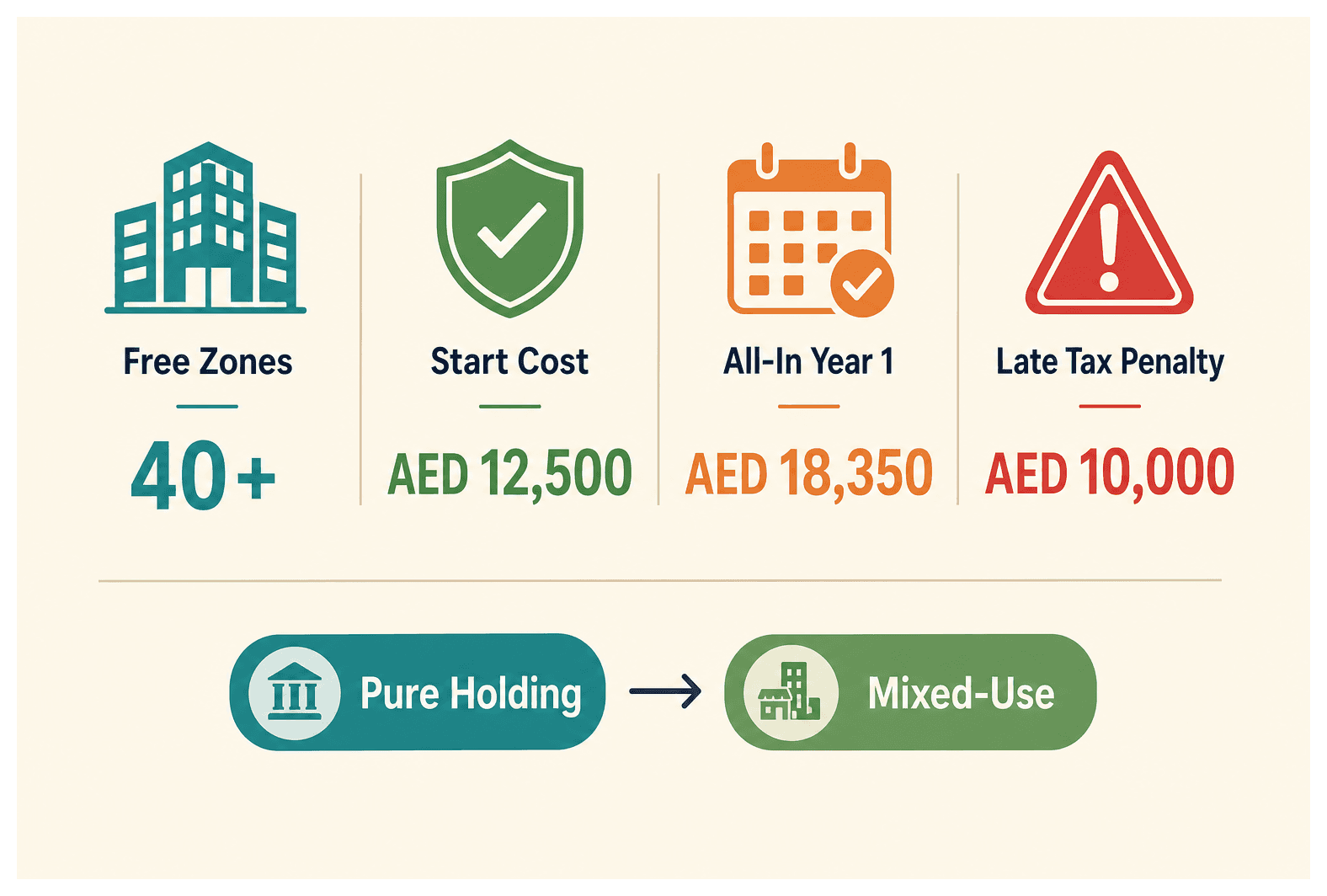
A free zone holding license, such as one from Dubai South Business Hub Free Zone, starts from AED 12,500 with zero paid-up share capital required. It allows ownership of equity in both UAE and foreign entities, making it the most practical starting point for most holding structures.
Pure Holding vs. Mixed-Use Structures Differ Legally
A pure holding entity owns shares or IP without conducting underlying trade, while a mixed-use structure combines holding with management services. These two models attract different license types, so founders must decide their operating model before registering.
Wrong License Can Invalidate Your Structure Immediately
A trading license, for example, may not legally permit ownership of foreign-company shares, rendering the holding structure invalid from day one. One founder faced a costly full restructure after discovering this six months post-registration.
Tax Penalties for Compliance Errors Compound Fast
Late corporate tax registration carries a flat AED 10,000 penalty from the Federal Tax Authority, and late VAT registration adds a separate AED 10,000 penalty on top. Choosing the correct license at formation is far cheaper than correcting errors after the fact.
QFZP Status Unlocks a 0% Corporate Tax Rate
A holding entity can access a 0% corporate tax rate if it meets the four Qualified Free Zone Person conditions under UAE Corporate Tax Law. The license type directly determines whether the entity is eligible to pursue this status.
Visa Allocation Depends Heavily on License Type
The number of residency visas a holding company qualifies for is governed by its license category, not just its office space. Founders who underestimate visa needs at setup may face restrictions that require a costly upgrade later.
First-Year All-In Cost Starts Around AED 18,350
For a sole founder with one visa, the first-year all-in cost at Dubai South Business Hub Free Zone starts from AED 18,350. Over 40 free zones compete for holding structures in the UAE, but realistic options for a true holding vehicle narrow quickly to two main paths.
In 2026, the UAE operates over 40 free zones alongside a mainland licensing regime administered by the Department of Economy and Tourism (DET), giving founders more structural options than almost any comparable jurisdiction. The UAE ranked 22nd globally on the World Bank's Ease of Doing Business index before the index was retired, and the country continues to attract international holding structures at pace (World Bank, 2020). A free zone holding license at Dubai South Business Hub Free Zone starts from AED 12,500 [1], with zero paid-up share capital required [2]. The first-year all-in cost for a sole founder with one visa starts from AED 18,350 [3]. Late corporate tax registration carries a flat AED 10,000 penalty from the Federal Tax Authority [4]. Late VAT registration adds a separate AED 10,000 penalty [5]. Yet when the goal is a holding structure, most of that jurisdictional choice collapses to two realistic paths, and picking the wrong one costs you in visa allocation, tax positioning, and asset-protection clarity before you've earned a dirham.
This guide compares every license type relevant to a Dubai holding structure, places them in a single reference table covering cost, scope, visa impact, and ideal use case, and gives you a clear scenario-by-scenario recommendation so you leave with a decision, not a shortlist.
What Is a Holding Structure in Dubai and Why the License Choice Matters
A Dubai holding structure is a parent company that owns shares, intellectual property, or other assets in subsidiary entities rather than trading directly. The license type determines which assets it can hold, how many residency visas it qualifies for, and whether it can access a 0% corporate tax rate under the four Qualified Free Zone Person (QFZP) conditions. Getting this decision right at formation is far cheaper than restructuring six months later.
What a Holding Company Actually Does in UAE Law
A holding entity owns equity stakes, intellectual property rights, or real-estate assets in one or more subsidiaries and does not itself conduct the underlying trade. Under UAE law, the holding entity still requires a valid commercial license, it cannot exist as a bare shell without one. The license category then governs which asset classes the entity may legally own and which regulated approvals are required on top of the license itself.
Asset classes a holding entity may own include:
Equity shares in UAE mainland or free zone subsidiaries
Equity shares in foreign incorporated entities
Intellectual property rights (patents, trademarks, software)
Real estate (subject to license type and location restrictions)
Intercompany loans to subsidiaries
Distinguish clearly between a pure holding structure (no revenue generation) and a mixed-use structure (holding plus management services), because they attract different license types. A founder who owns a logistics subsidiary and a technology subsidiary, for example, might set up a single holding entity that owns shares in both, consolidating governance and profit distribution without the holding entity trading itself. The UAE Corporate Tax Law distinguishes between qualifying and non-qualifying income at the holding entity level, so that distinction matters for tax positioning from day one.
Why Getting the License Wrong Is Expensive
A license that does not permit equity ownership of foreign entities can invalidate the holding structure from day one. One founder registered a trading license intending to use it as a holding vehicle, only to discover six months later that it did not permit ownership of foreign-company shares, requiring a full restructure at significant cost and administrative delay.
The financial penalties for compliance errors compound quickly. Late corporate tax registration carries a one-time flat penalty of AED 10,000 from the Federal Tax Authority (Federal Tax Authority, 2023). Late VAT registration carries a separate AED 10,000 penalty. Choosing a license with insufficient visa allocation forces a second entity or a license upgrade. And a holding entity that also provides management services to subsidiaries may need a professional license component in addition to the holding license, a regulatory mismatch that's entirely avoidable with the right structure upfront.
License Types That Work for a Holding Structure: A Dubai Comparison
Three license types are commonly used for Dubai holding structures: a free zone holding license, a mainland holding or investment license issued via DET, and a free zone professional license where the holding entity also provides management services. Each differs in cost, permitted asset classes, visa allocation, and corporate tax positioning. Here's how each one works in practice.
Free Zone Holding License
A free zone holding license permits ownership of shares in UAE and foreign entities; intellectual property ownership is also standard. The 0% corporate tax rate is available only if the entity meets all four QFZP conditions: adequate substance in the UAE, qualifying income only, no election for standard-rate taxation, and non-qualifying revenue within the de-minimis threshold set by the Federal Tax Authority.
Worth flagging: DSBH is not a designated zone and carries no designated-zone customs or VAT benefit. Free zone goods are duty-suspended, not duty-exempt. 100% foreign ownership is available in free zones, but it's also available on the mainland under the 2021 Commercial Companies Law amendments, it's unrelated to designated-zone status.
A holding entity at a Dubai free zone that owns 100% of a UK subsidiary and a UAE trading company, earning dividend income from both, may qualify for the 0% rate, provided all four QFZP conditions are satisfied for that tax period. Key DSBH figures for this license type:
License from AED 12,500
First-year all-in cost for a sole founder with one visa: from AED 18,350
Each activity beyond the first five: AED 2,000
Zero paid-up share capital required
License issued in one business day
Visas always an additional cost, never included in the license fee
Mainland Holding or Investment License via DET
DET issues investment and holding licenses that permit ownership of shares in other UAE mainland and free zone entities. The mainland path is subject to the standard 9% corporate tax on taxable income above AED 375,000 (Federal Tax Authority, 2023), there is no QFZP pathway available for mainland entities.
Visa allocation under a mainland license is generally more flexible and not tied to physical office size in the same way as free zones. Mainland holding entities can also own real estate directly, which free zone entities generally cannot do outside their own zone. A founder who needs the holding entity to own both a Dubai real estate asset and shares in a free zone subsidiary may find a mainland holding license the only structure that permits both in a single entity.
The 2021 amendments to the UAE Commercial Companies Law opened 100% foreign ownership to most mainland activities (UAE Ministry of Economy, 2021), so foreign founders are no longer disadvantaged by choosing the mainland path on ownership grounds alone. The real trade-off is the corporate tax positioning, not the ownership structure.
Free Zone Professional License With Holding Activities
This option suits a mixed-use structure where the holding entity also charges management fees or provides shared services to subsidiaries. The professional license covers the service activities; the holding activity should be explicitly listed in the business activities to avoid scope mismatch.
Here's the critical risk: management fee income from subsidiaries is revenue. It must be assessed against the de-minimis non-qualifying income threshold for QFZP purposes. A holding entity that charges its three subsidiaries a 5% management fee must check whether that fee income breaches the threshold, if it does, the 0% rate is lost for that entire tax period. Confirm with the free zone authority that both holding and management activities are permitted under the same license before relying on this structure.
Holding Structure License Comparison Table: Cost, Scope, Visa Impact, and Best Fit
The comparison table below maps each Dubai license type against four decision criteria: first-year cost, permitted asset scope, visa allocation mechanics, and the scenario each option suits best. Use it to filter your choice before engaging a formation agent or legal adviser. Think of it as an elimination tool: if your holding entity must own UAE real estate directly, the mainland column is the only row that passes.
How to Read the Table
The cost column reflects first-year all-in figures where DSBH data is available; mainland figures vary by DET activity and office requirement. The scope column identifies which asset classes each license permits. The visa column notes whether allocation is office-size-driven or headcount-driven, visas are always an additional cost under both paths. The best-fit column maps each license to the founder profile it suits, not a neutral summary.
Dubai Holding Structure License Comparison: Cost, Scope, Visa Impact, and Best Fit
Feature | Free Zone Holding License (e.g., DSBH) | Mainland Holding License (DET) |
|---|---|---|
First-year indicative cost | From AED 18,350 (sole founder, one visa); license from AED 12,500 | Varies by DET activity and office type; typically higher first-year outlay due to office requirements |
Shares in UAE entities permitted | Yes, ownership of shares in UAE free zone and mainland subsidiaries is standard | Yes, DET holding license permits ownership of UAE mainland and free zone entity shares |
Shares in foreign entities permitted | Yes, standard feature of free zone holding licenses; no additional approval required for most jurisdictions | Yes, DET investment and holding licenses permit foreign entity ownership |
Intellectual property ownership | Yes, patents, trademarks, and software IP can be held in a free zone entity | Yes, mainland entities can hold IP, though free zone structures are more commonly used for IP holding |
Direct real estate ownership outside free zone | No, free zone entities generally cannot own Dubai real estate outside their own zone | Yes, mainland holding entities can own Dubai real estate directly; the only single-entity option for this |
QFZP corporate tax (0%) pathway | Available, subject to all four QFZP conditions: UAE substance, qualifying income, no standard-rate election, de-minimis non-qualifying revenue | Not available, mainland entities have no QFZP pathway under the Corporate Tax Law |
Standard corporate tax rate | 9% on taxable income above AED 375,000 if QFZP conditions are not met or not pursued | 9% on taxable income above AED 375,000, applies as the standard rate with no alternative pathway |
A UK-based founder consolidating two European subsidiaries under a Dubai holding entity, with no plans to own UAE real estate, would be eliminated down to the free zone column immediately. The mainland column only becomes the clear answer when real estate ownership or unconstrained visa headcount is on the requirements list.
Corporate Tax and the Holding Structure: What Founders Must Know
A Dubai free zone holding entity can access a 0% corporate tax rate only if it meets all four Qualified Free Zone Person conditions: sufficient UAE substance, qualifying income only, no standard-rate election, and non-qualifying revenue within the de-minimis threshold. Mainland holding entities pay the standard 9% rate on taxable income above AED 375,000. The gap between these two outcomes makes the license choice a tax decision, not just an administrative one.
The Four QFZP Conditions Every Free Zone Holding Entity Must Satisfy
The four conditions are not a checklist you satisfy once, they apply to each tax period independently:
Adequate UAE substance: Genuine economic activity, management, and operations must be present in the free zone. A dormant entity with no real activity does not qualify.
Qualifying income only: Income must meet the definition of qualifying income under the Corporate Tax Law, which includes dividends and capital gains from subsidiaries in most cases.
No standard-rate election: The entity must not have elected to be subject to the standard 9% corporate tax rate.
De-minimis non-qualifying revenue: Non-qualifying revenue must not exceed the threshold set by the Federal Tax Authority (Federal Tax Authority, 2023).
Failing any single condition removes QFZP status for that entire tax period. The entity then pays 9% on all taxable income above AED 375,000, the same rate as a mainland entity. A free zone holding entity that earns AED 2 million in dividends from subsidiaries and AED 600,000 in management fees must check whether that fee income breaches the de-minimis threshold before relying on the 0% rate. If it does, the tax outcome for that year is identical to a mainland structure.
Penalties for Missing Tax Registration Deadlines
Register with the Federal Tax Authority as soon as the license is issued. A holding entity that generates income from the first day of formation starts its registration clock immediately, founders consistently underestimate how quickly the deadline arrives.
Late corporate tax registration: AED 10,000 one-time flat penalty (not a monthly charge). Late VAT registration: AED 10,000 separate penalty. A founder who delays corporate tax registration by 90 days while setting up banking faces the AED 10,000 flat penalty on top of any VAT registration penalty if that registration is also outstanding. Both can run simultaneously. You can manage banking and taxation requirements in parallel to avoid this scenario.
Five Steps to Choose the Right License for Your Holding Structure
Choosing the right Dubai holding license takes five steps: define the assets you need to hold, confirm visa headcount requirements, assess corporate tax positioning against the four QFZP conditions, verify regulated-activity approvals needed beyond the license, and calculate total first-year cost before committing to a jurisdiction or license category. Here's how to work through each one.
Step 1: Map the Assets Your Holding Entity Will Own
List every asset class the holding entity will own: shares in UAE entities, shares in foreign entities, intellectual property, real estate, loans to subsidiaries. Then cross-reference that asset list against the permitted scope of each license type before shortlisting. Any license with a single "No" for a required asset class is eliminated.
If real estate ownership outside a free zone is on the list, a mainland license is likely the only option that permits it in a single entity. Run this exercise before you speak to a formation agent, it halves the conversation time and prevents you from being steered toward a license that doesn't fit your structure.
Step 2: Calculate Visa Headcount and Cost
Holding structures often start lean, but founders, co-investors, and dependants all need UAE residency visas. At DSBH, visas are always an additional cost on top of the license fee. Key figures to model:
Sole founder with one visa: first-year from AED 18,350 at DSBH
Each additional visa holder adds cost, model this before committing
Mainland visa allocation is generally not tied to physical office size in the same way
A founder plus two co-investors all needing UAE residency should model the visa cost for three holders and compare free zone versus mainland total first-year outlay. Use the company setup cost calculator to run these scenarios before committing.
Step 3: Verify Regulated-Activity Approvals
Certain holding activities require approval from a named regulator in addition to the free zone or DET license. DSBH licenses the activity; the named regulator approves it separately. For financial holding or investment management, that regulator is typically the Securities and Commodities Authority or the Central Bank of the UAE (Central Bank of the UAE).
Failure to obtain the regulatory approval does not invalidate the license, but it does prevent the entity from legally conducting the regulated activity. A holding entity that intends to act as a fund manager for third-party capital needs both a DSBH license covering the activity and separate approval from the relevant financial regulator before accepting investor funds. Always confirm the dual-approval requirement before selecting a license category.
Step 4: Confirm QFZP Eligibility and Step 5: Calculate Total First-Year Cost
Step 4 is free-zone-specific: run the four QFZP conditions against the holding entity's projected income mix before choosing a free zone license. If the entity cannot satisfy all four, the 0% rate is unavailable and the mainland may offer a simpler tax profile with no QFZP compliance overhead.
Step 5 applies to both paths. Add license fee, visa fees, office package, and registration costs to get the true first-year number. Cost components to include:
License fee (DSBH: from AED 12,500)
Visa fees (always additional; first-year from AED 18,350 with one visa at DSBH)
Office package costs
Corporate tax and VAT registration (no fee, but deadline-sensitive)
Year-two renewal cost, holding structures are long-term, so annual renewal matters as much as setup
Zero paid-up share capital is required at DSBH, which reduces upfront capital commitment for holding entities whose value sits in subsidiary equity rather than cash.
References
Frequently Asked Questions