
Topic Summary
Your License Determines Your Visa Quota
Every active Dubai business license carries a maximum number of employee residence visas the company can sponsor at one time. Quota size depends on office space, license type, and paid-up capital, so understanding this before hiring is critical.
Free Zone Licenses Allow Staff Sponsorship With Limits
A free zone license lets you hire staff and sponsor their residence visas within that entity. However, permanently deploying staff at a mainland client's office typically requires a mainland presence or a formally reviewed service agreement.
License Activities Define Which Roles You Can Hire
The business activities listed on your license determine which roles you can legally employ under that entity. Regulated roles such as healthcare practitioners or financial advisors require separate approval from the relevant sector regulator, beyond the standard MoHRE work permit.
Visas Are Always a Separate, Additional Cost
Visa costs are never bundled with any license fee in Dubai, regardless of the free zone or mainland option you choose. For a sole founder with one visa at Dubai South Business Hub Free Zone, first-year costs start from AED 18,350.
A Lapsed License Immediately Freezes All Hiring
If your license lapses or is suspended, all visa renewals are frozen and new work permit applications are blocked instantly. Keeping your license active and valid is a non-negotiable prerequisite for any legal employment activity.
Adding Business Activities Carries a Per-Activity Fee
At Dubai South Business Hub Free Zone, each activity listed beyond the first five costs an additional AED 2,000. Getting your activity list right at formation avoids expensive amendments and hiring scope problems down the line.
Late Tax Registration Adds a Costly Penalty
Failing to register for corporate tax on time carries a one-time AED 10,000 penalty from the Federal Tax Authority. The 9% corporate tax rate applies to taxable income above AED 375,000, making compliance planning essential from day one.
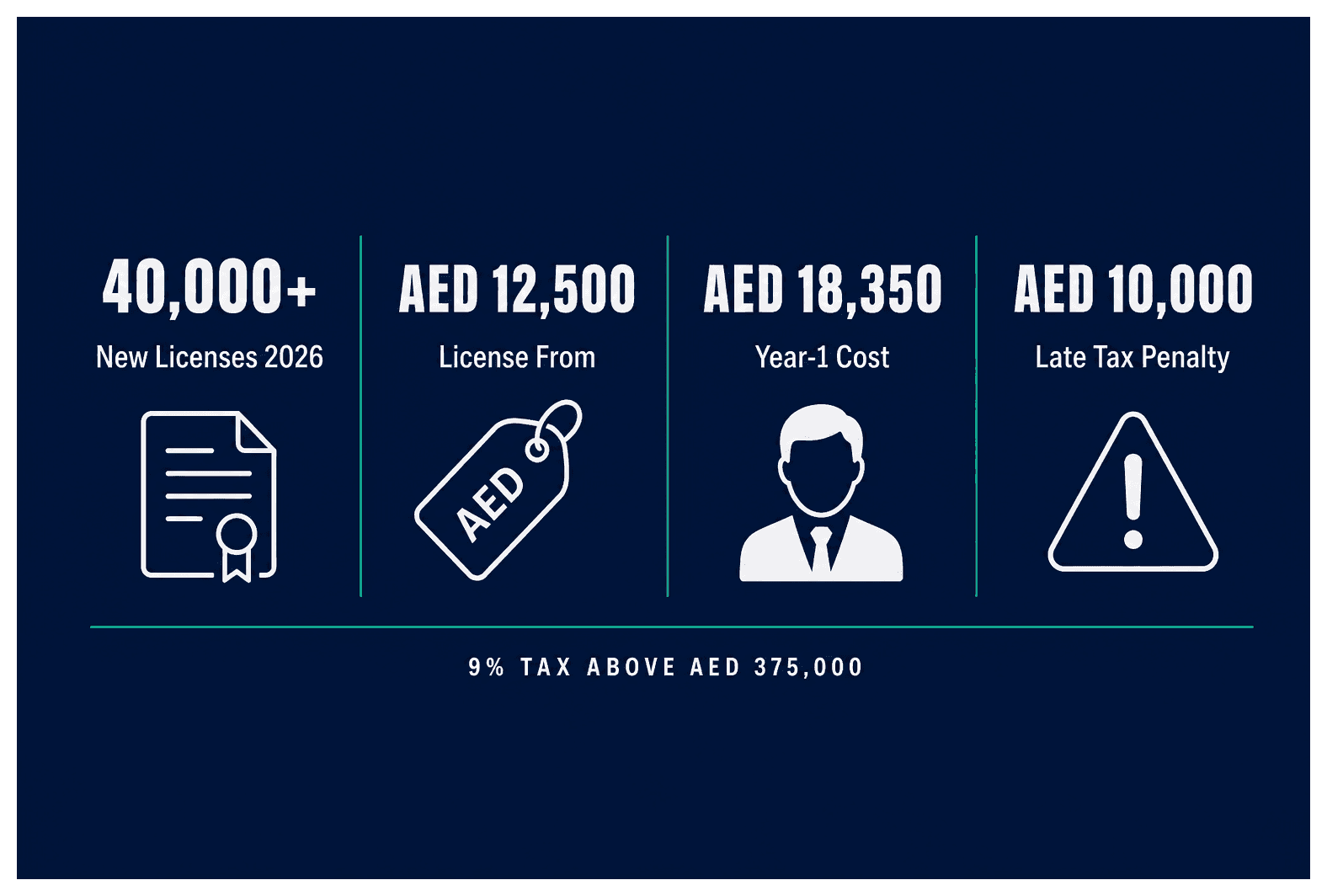
In 2026, over 40,000 new business licenses were issued in Dubai (Dubai Chamber of Commerce, 2025), yet a significant share of founders only discovered their visa quota constraints after signing their first employment offer letter. The license fee starts from AED 12,500 at Dubai South Business Hub Free Zone. First-year cost for a sole founder with one visa starts from AED 18,350. Late corporate tax registration carries a one-time AED 10,000 penalty (Federal Tax Authority, 2023). The 9% corporate tax rate applies to taxable income above AED 375,000 for most entities. Visas are always an additional cost, never bundled with any license fee.
This article breaks down which license hire staff dubai decisions hinge on, compares free zone and mainland options across cost, scope, and visa impact, and gives you a clear recommendation by scenario so you can hire without hitting a compliance wall.
What a Dubai Business License Actually Authorizes When You Hire Staff
A Dubai business license authorizes a company to sponsor employee residence visas and register work permits under that entity. Without an active, valid license, you cannot legally hire staff, apply for work permits through MoHRE, or sponsor residence visas through ICP, regardless of whether you operate in a free zone or on the mainland.
The Link Between Your License and Your Visa Quota
Every active license in Dubai carries a visa quota, the maximum number of employee residence visas the company can sponsor at one time.
Quota size is set by the licensing authority and is linked to office space, license type, and paid-up capital in some jurisdictions.
A lapsed or suspended license freezes all visa renewals and blocks new work permit applications immediately.
Visas are always an additional cost on top of the license fee, never bundled automatically.
Visa allocations vary by free zone and package. When they win a contract requiring a fourth hire, they must formally apply to expand the quota before issuing the offer letter. At DSBH, licenses are issued in one business day, meaning quota registration can begin almost immediately after formation, with first-year costs for a sole founder with one visa starting from AED 18,350.
Ancillary Activities and Their Impact on Hiring Scope
The activities listed on your license determine which roles you can legally employ. A trading license does not automatically permit you to hire licensed engineers for regulated outputs.
Regulated roles, healthcare practitioners, financial advisors, education professionals, require the named sector regulator to approve the individual hire separately, in addition to the MoHRE work permit. DSBH licenses the activity; the named regulator (DHA for health, CBUAE for finance, KHDA for education) approves the regulated practitioner independently.
Worth flagging: each activity beyond the first five costs AED 2,000 at DSBH (launched September 2025). Listing the correct business activities in Dubai at formation avoids costly amendments later. A healthcare company licensed through a free zone must still obtain DHA approval for each clinician it hires, even after MoHRE issues the work permit.
Free Zone License and Hiring Staff in Dubai: What You Can and Cannot Do
A free zone license lets you hire staff and sponsor their residence visas within the free zone entity. Staff can work at the free zone premises or at client sites under a service agreement. To deploy staff permanently at a mainland client's office, you typically need a mainland presence or a service agreement reviewed by the relevant authority.
Dubai South Business Hub Free Zone License: Costs and Visa Impact
License from AED 12,500; zero paid-up share capital required.
First-year cost for a sole founder with one visa starts from AED 18,350, visas are always an additional cost, not included in the license fee.
License issued in one business day, making it one of the fastest formations for founders who need to hire quickly.
DSBH launched September 2025 and is not a designated zone, so it carries no designated-zone customs or VAT benefit, free zone goods are duty-suspended, not duty-exempt.
100% foreign ownership is available; this is not unique to free zones, it is also available on the mainland.
A US-based founder setting up a B2C e-commerce consultancy through DSBH can have a license issued on day one and begin the visa application for their first Dubai-based hire on day two, with total first-year outlay starting from AED 18,350. You can check your business setup cost in Dubai using the DSBH cost calculator before committing.
Staffing Limitations Specific to Free Zone Entities
Free zone staff working directly and permanently at a mainland third-party site may require a dual-license structure or a formal secondment arrangement. In practice, most service businesses handle this through a well-drafted service contract, but the arrangement needs to match the actual work pattern.
DSBH does not provide bonded warehousing or customs integration, so companies hiring warehouse or customs-clearance staff for mainland logistics operations should factor in additional licensing. An ICT company licensed in Dubai placing three software engineers on-site at a mainland bank works cleanly under a service contract, the engineers' visas remain sponsored by the free zone entity, and no dual license is required as long as the arrangement is contractually structured.
Mainland License and Hiring Staff in Dubai: Scope, Cost, and Compliance
A mainland license issued by DET allows you to hire staff who can work anywhere in the UAE without geographic restriction. It suits businesses deploying staff at client sites across Dubai or other emirates, running retail outlets, or operating in sectors where a mainland presence is mandatory for regulatory approval.
Where Mainland Hiring Has a Structural Advantage
Mainland staff can be deployed to any UAE location without a service agreement workaround.
Some regulated sectors, certain financial services, government contracting, healthcare facilities, require a mainland DET license as a condition of regulatory approval.
Mainland entities can bid directly on federal and emirate government tenders, opening roles that a free zone entity cannot fill.
100% foreign ownership is available on the mainland for most activities, this is not a free zone exclusive.
A facility management company deploying cleaning and maintenance staff to five different mainland client sites will find a mainland license operationally simpler than managing multiple service agreements from a free zone entity. The deployment is unrestricted; the compliance overhead is predictable.
Free Zone vs. Mainland License for Hiring Staff in Dubai: Full Comparison
Feature | Free Zone License (DSBH) | Mainland License (DET) |
|---|---|---|
License cost | From AED 12,500 | Higher; varies by activity and office lease requirement |
First-year cost (sole founder + 1 visa) | From AED 18,350 (visa always additional) | Higher; office lease and DET approval add to outlay |
License issuance speed | 1 business day | Typically several business days; DET approval required |
Paid-up share capital | Zero required | Varies by activity; some sectors require minimum capital |
Staff deployment geography | Free zone premises or mainland client sites via service agreement | Unrestricted across all UAE emirates |
Emiratisation obligation | Generally outside Nafis mandate at small headcount, verify with MoHRE | Mandatory Nafis targets above defined headcount thresholds |
Government tender eligibility | Limited; most federal and emirate tenders require mainland entity | Full eligibility for federal and emirate government tenders |
Mainland companies are subject to MoHRE's Emiratisation (Nafis) targets once headcount crosses defined thresholds, this directly affects your hiring budget and HR planning.
Work permits for mainland staff are processed through MoHRE; residence visas through ICP.
Mainland setup costs are typically higher than free zone formation, with office lease requirements and DET approval adding to the first-year outlay.
Late corporate tax registration carries a one-time AED 10,000 penalty; VAT late registration also carries AED 10,000, plan your tax registration timeline alongside your hiring ramp.
A mainland professional services firm hiring its tenth employee must simultaneously review its Emiratisation ratio under the Nafis framework to avoid MoHRE penalties. This isn't a surprise if you plan for it from year one, it's only a problem if you don't.
Head-to-Head Comparison: Free Zone vs. Mainland License for Hiring in Dubai
Free zone licenses cost less, issue faster, and suit companies hiring staff for remote or service-contract deployment. Mainland licenses cost more but allow unrestricted geographic deployment across the UAE and are required for government contracts and certain regulated sectors. Both structures allow 100% foreign ownership and full MoHRE work permit processing.
Comparison Table: Cost, Scope, Visa Impact, and Best Fit
A digital marketing agency with five remote staff and two on-site at a client's mainland office can operate cleanly under a free zone license via service agreement. A construction contractor supplying labor to a government project needs a mainland DET license, no workaround applies there.
The table in Section 3 above covers all seven comparison axes. The short version: if your staff work remotely or under service contracts, DSBH wins on cost and speed. If your staff must be permanently on-site at mainland locations or you're bidding on government work, DET is the structurally correct choice.
Which Structure Wins on Visa Speed and Quota Flexibility
Free zone licenses issued in one day at DSBH mean visa applications can begin almost immediately after formation. Quota expansion at free zones is typically faster and involves fewer parties than mainland quota reviews.
Mainland quota adjustments may involve MoHRE inspection and office-space verification, adding days to the hiring timeline. A founder who closes a client contract on Monday and needs a hired consultant on-site by the following week will find the DSBH one-day license issuance critical to meeting that timeline. That speed advantage is real and measurable, not a marketing claim.
Is a free zone license valid for hiring staff in Dubai?
Yes. A free zone license issued by an authority such as DSBH is fully valid for sponsoring employee residence visas and registering work permits through MoHRE. Staff can work at free zone premises or at mainland client sites under a service agreement. Permanent on-site deployment at a mainland third-party location may require a dual-license structure.
Five Steps to Choose the Right License to Hire Staff in Dubai
To choose the right license to hire staff in Dubai: identify where your staff will physically work, check whether your activity requires mainland regulatory approval, calculate your first-year visa and license cost, confirm your Emiratisation exposure, then select the structure that matches your deployment model and budget before you incorporate.
Step 1 Through Step 3: Deployment, Regulation, and Cost
Map where your staff will work. If all roles are remote or at your own premises, a free zone license covers you. If staff must be on-site at mainland clients permanently, assess the service-agreement route or a mainland license.
Check your activity's regulatory status. Visit the named regulator's website, DHA for health, CBUAE for finance, KHDA for education, to confirm whether individual practitioner approval is required on top of the commercial license.
Calculate your true first-year cost. Include the license fee, each additional activity beyond the first five at AED 2,000, and all visa fees separately. For DSBH, the combined first-year cost for a sole founder with one visa starts from AED 18,350, with zero paid-up share capital required.
A sole founder launching an ICT consultancy with one hired developer: DSBH license (AED 12,500) plus developer visa costs brings the total first-year outlay from AED 18,350, no paid-up share capital, no office lease, license in hand on day one.
Step 4 Through Step 5: Emiratisation and Final Incorporation
Assess your Emiratisation exposure. Mainland companies above defined headcount thresholds face mandatory Nafis targets. Free zone companies at small headcount are generally outside the current Emiratisation mandate, but verify current thresholds with MoHRE before hiring, as these rules are updated periodically.
Incorporate and register with MoHRE. Once the license is issued, register the company with MoHRE to open your work permit quota, then begin visa applications through ICP for each hire. Do not issue offer letters before the quota is confirmed in writing.
A mainland retail company reaching 50 employees triggers a mandatory Emiratisation ratio review under Nafis. Planning this into the hiring budget from year one avoids a compliance surprise, and a potential MoHRE penalty that could freeze your work permit quota entirely.
Scenario-Based Recommendations: Which License to Choose for Hiring in Dubai
For a small team working remotely or under service agreements, a free zone license at DSBH delivers the lowest cost and fastest issuance. For businesses deploying staff
References
Frequently Asked Questions