
Topic Summary
Understand Dubai Has No Dedicated Seasonal License
Dubai issues only standard annual trade or service licenses, regardless of whether a business earns year-round or in a 90-day burst. Founders manage the cost mismatch between peak revenue and year-round fixed costs through smart structure choices, not a special license category.
Map Your Revenue Season Before Comparing Structures
Identify which peak window drives your income, whether Ramadan, the Dubai Shopping Festival, summer staycations, or year-end holidays, before selecting a license type. Knowing your exact operating window helps you avoid over-committing to visa packages and facilities you won't use off-peak.
Free Zone Licenses Offer the Lowest Fixed-Cost Base
A free zone license at Dubai South Business Hub Free Zone starts from AED 12,500, with a first-year cost of around AED 18,350 for a sole founder with one visa. Zero paid-up share capital is required, eliminating capital that would otherwise sit idle during slow months.
Mainland Licenses Unlock Unrestricted UAE Market Access
DET-issued mainland licenses allow direct retail and wholesale activity across the UAE with no channel restrictions. Seasonal businesses whose customers are spread across the mainland, such as pop-up retailers or event caterers, may find this access worth the higher cost structure.
Control Visa Count to Minimize Off-Peak Overhead
Visa costs are always additional to the license fee and represent the biggest variable in annual expenses. A Ramadan gifting business needing three to four staff visas in peak months but none in August should structure visa allocation at setup rather than over-committing to a large package.
Factor VAT and Corporate Tax Thresholds Into Planning
The VAT registration threshold sits at AED 375,000, and late registration carries a flat AED 10,000 penalty for both VAT and corporate tax. Seasonal businesses concentrating revenue into short windows can cross this threshold quickly, making early compliance planning essential.
Use Fast License Issuance to Hit Seasonal Launch Windows
Dubai South Business Hub Free Zone issues licenses in one business day, meaning founders targeting a specific seasonal peak do not need to begin the setup process months in advance. This speed advantage is particularly valuable for businesses built around fixed calendar events like DSF or Eid.
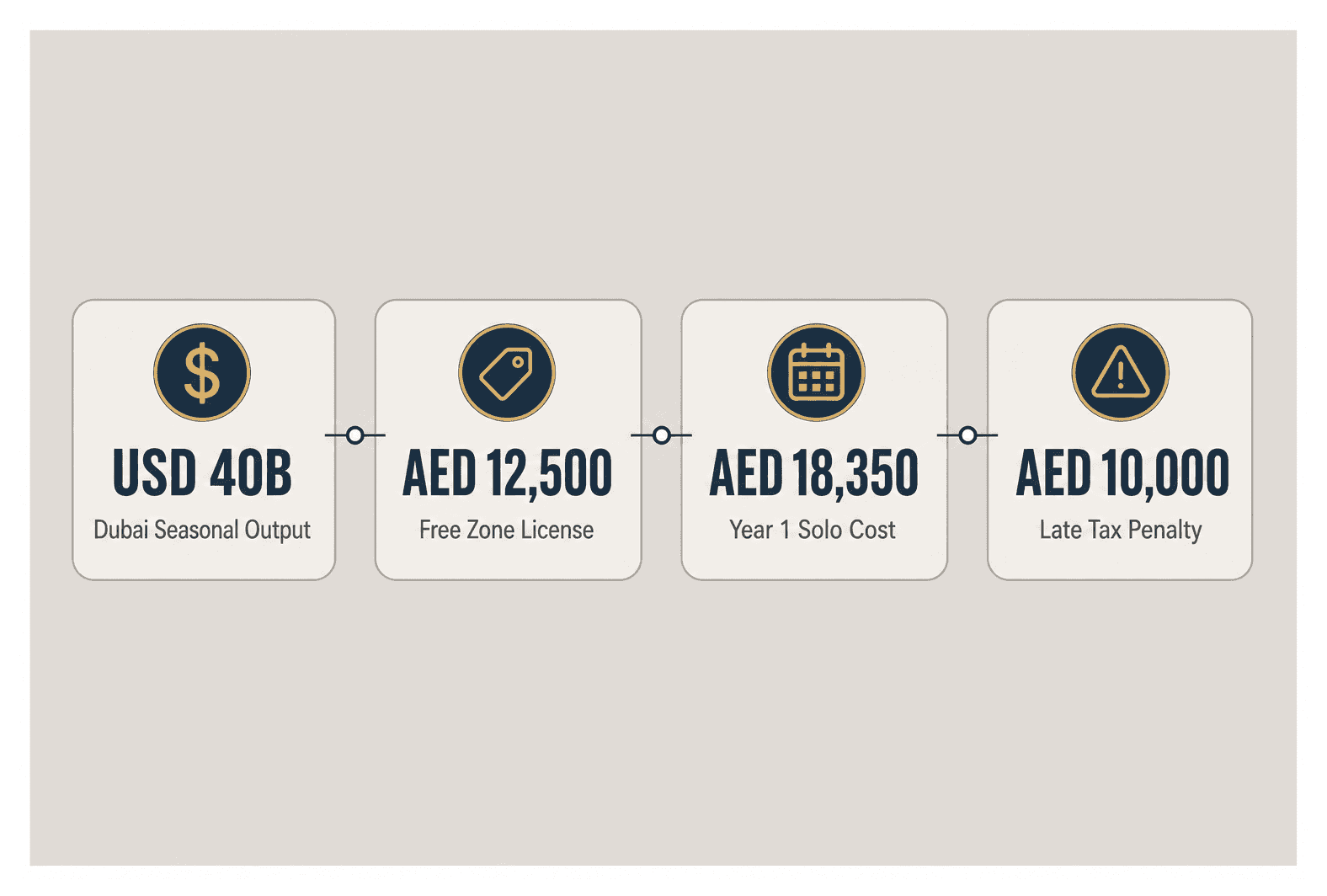
In 2026, Dubai's retail and tourism sectors collectively drive over USD 40 billion in annual economic output, with a significant share generated in concentrated seasonal windows, Ramadan, the Dubai Shopping Festival (DSF), summer staycations, and year-end holidays (Statista, 2025). The VAT registration threshold sits at AED 375,000. A free zone license at Dubai South Business Hub Free Zone starts from AED 12,500. The first-year cost for a sole founder with one visa starts from AED 18,350. And the late registration penalty for both VAT and corporate tax is a flat AED 10,000 each, one-time, not monthly. If you're planning to set up a company in Dubai around one of those peaks, choosing the wrong license structure leaves you paying fixed overhead during months when revenue flatlines. This guide tells you exactly which license suits a seasonal business in Dubai, compares free zone and mainland options across cost, visa impact, and market access, and gives you a clear recommendation by scenario.
What a Seasonal Business License in Dubai Actually Means
A seasonal business license in Dubai is a standard trade or service license, free zone or mainland, held by a company whose revenue peaks in specific periods. Dubai does not issue a dedicated seasonal license; founders choose the structure that best matches their operating window, cost base, and visa requirements. The license that suits a seasonal Dubai business is the one with the lowest fixed-cost burden in off-peak months and full trading rights when revenue is flowing.
Why Dubai Has No Dedicated Seasonal License
UAE commercial law does not distinguish a seasonal license category. Every business, whether it earns year-round or in a 90-day burst, holds a standard annual license subject to the same renewal cycle. That's not a limitation; it's a design feature that puts the cost-management decision squarely with the founder.
Seasonal operators manage the mismatch between peak revenue and year-round fixed costs through structure choice: free zone versus mainland, activity scope, and visa count. A pop-up gifting brand generating 80% of revenue in Q4 still holds a year-round license, but the right structure keeps non-peak fixed costs below AED 20,000 annually. At Dubai South Business Hub Free Zone, zero paid-up share capital is required, removing one capital lock-up that would otherwise sit idle in off-peak months.
Defining Your Season Before Choosing Your License
Before you compare structures, map your revenue window precisely. The key questions are:
Which season drives your revenue? Ramadan/Eid, DSF (January to February), summer staycation, or year-end?
Do you need a physical retail presence, warehouse access, or purely service/digital delivery?
How many visas do you need during peak versus off-peak? Visa count is the biggest variable in annual cost, and visa costs are always additional to the license fee, never included.
A Ramadan food gifting business needs 3 to 4 operational staff visas in March to April but zero in August. Structuring visa allocation correctly at setup, rather than over-committing to a large visa package, can save thousands in annual renewal fees. At Dubai South Business Hub Free Zone, the license is issued in one business day, so founders working toward a seasonal launch window don't need to start the process months in advance.
Mainland vs Free Zone: What the Difference Means for Seasonal Operators
Mainland licenses issued by DET let you trade anywhere in the UAE without restrictions on customers or channels. Free zone licenses are lower cost and faster to obtain, but direct sale to UAE mainland customers typically requires a local distributor or branch. For seasonal businesses, the choice turns on where your customers are.
Mainland Licensing Through DET: Scope and Cost Reality
DET issues mainland trade and service licenses. These permit direct retail and wholesale activity across the UAE with no channel restrictions, no distributor required, no intermediary between you and your customer. A seasonal event-décor supplier serving Dubai Mall pop-ups needs exactly this: direct mainland trading rights that a DET license covers without a distributor intermediary.
Worth flagging: 100% foreign ownership is available on the mainland. Federal Decree-Law No. 26 of 2020 addressed 100% foreign ownership for mainland companies. Free zone ownership comes from the relevant free zone regulations and is not granted by that decree. Mainland setup typically involves higher entry costs and longer processing timelines than free zone alternatives. The mandatory Ejari office lease adds a recurring fixed cost that hits hardest in off-peak months when the space sits underused.
Free Zone Licensing: Lower Fixed Costs, Targeted Market Reach
For seasonal businesses that sell online, export, or move goods through UAE distributors, a free zone license is the leaner option. At Dubai South Business Hub Free Zone:
License from AED 12,500
First-year cost for a sole founder with one visa from AED 18,350
License issued in one business day
No paid-up share capital required
Each activity beyond the first five costs AED 2,000
Two things to be clear about. First, free zone goods move under duty-suspension arrangements, not duty-exemption. Customs duty applies when goods enter the UAE mainland market. Second, Dubai South Business Hub Free Zone is not a designated zone, no designated-zone VAT or customs benefit applies. An online seasonal gifting brand shipping to UAE customers via a mainland distributor can hold a free zone license at AED 12,500 and avoid the cost of a mainland Ejari entirely.
Free Zone vs Mainland License: Cost, Scope, Visa Impact, and Who Each Suits
Feature | Free Zone License (Dubai South Business Hub Free Zone) | Mainland License (DET) |
|---|---|---|
License cost | From AED 12,500; first-year total from AED 18,350 with one visa | Higher entry cost; varies by activity and approvals required |
Processing time | License issued in 1 business day | Multi-day processing; timeline varies by activity and external approvals |
Office/Ejari requirement | No mandatory Ejari lease, reduces fixed overhead in off-peak months | Ejari lease mandatory for most activities; adds recurring annual fixed cost |
UAE market access | Free zone and international sales; UAE mainland sales require a local distributor or branch | Unrestricted direct retail and wholesale across the UAE, no distributor needed |
Visa cost structure | Visas always additional; UAE residency visa available; start with minimum allocation | Visas always additional; allocation tied to office space size under Ejari |
Paid-up share capital | Zero paid-up share capital required | Capital requirements vary by activity type |
Customs/duty treatment | Goods duty-suspended within the free zone; customs duty applies on mainland entry, not a designated zone | Standard UAE customs rules apply; no duty-suspension benefit |
The Full Cost and Scope Comparison: Free Zone vs Mainland for Seasonal Businesses
Free zone licenses cost less upfront and carry no mandatory office lease, making them lower-risk for businesses with concentrated revenue peaks. Mainland licenses give unrestricted UAE market access but require an Ejari lease and typically higher setup fees. The right choice depends on where your customers are and how many visas you need.
How Visa Count Changes the Annual Cost Equation
Visas are always an additional cost on top of license fees, regardless of structure. This is the line item that most first-time founders underestimate. A seasonal wellness retreat operator running a 90-day summer programme at a UAE hotel needs a mainland service license; an online Ramadan subscription box brand works well under a free zone trading license, but both pay visa costs separately.
Seasonal businesses with lean off-peak headcount benefit from starting with the minimum visa allocation and adding during peak season. A Christmas-season gift hamper brand might need one founder visa year-round plus two or three short-term employment visas during Q4 only. Planning this at setup prevents over-committing to visa packages that cost money even when staff aren't needed. A UAE residency visa tied to a company license also gives the founder Emirates ID and residency rights, relevant for founders not yet resident in the UAE. Investor visa eligibility is linked to an active, valid license; seasonal downtime doesn't affect visa validity as long as the license is renewed annually.
Five Steps to Choose the Right License for Your Seasonal Business in Dubai
To choose which license suits a seasonal business in Dubai: map your customer location, calculate peak visa needs, assess whether you need direct retail access or can use a distributor, compare total annual fixed costs across structures, then apply for the license that minimises off-peak overhead without limiting peak-season revenue.
Step 1: Map Where Your Revenue Actually Comes From
If 80% or more of your sales go to UAE mainland retail or hospitality buyers who require direct invoicing, a mainland DET license is the practical choice. A seasonal Eid fashion brand selling via its own website and UAE third-party e-tailers can operate under a free zone trading license in Dubai without a mainland presence at all.
Mixed models, online plus occasional pop-up, can sometimes be structured under a free zone license with a mainland distributor agreement. Just remember: free zone goods enter the mainland under duty-suspension, not duty-exemption, and DSBH is not a designated zone. Know your sales channel before you choose your structure.
Step 2: Calculate Your Peak and Off-Peak Fixed Cost Exposure
List every recurring annual fixed cost: license renewal, visa renewals, Ejari (if applicable), insurance.
Free zone total for a sole founder with one visa starts from AED 18,350 in year one at DSBH.
Mainland adds an Ejari lease to the base license fee, factor this into your off-peak cost model.
If off-peak fixed costs exceed projected off-peak revenue by more than 30%, reconsider the structure.
Each activity beyond the first five at DSBH costs AED 2,000, keep the list tight.
A DSF pop-up brand generating AED 180,000 in January to February but near-zero in summer should minimise Ejari obligation. A free zone license is the leaner fit for that revenue profile.
Step 3: Confirm Your Activity List and Regulatory Approvals
Check every revenue-generating activity against the free zone or mainland business activities list before applying. For regulated activities, food, health, events, education, DSBH licenses the activity and the named regulator approves it separately. Both steps are required; the DSBH license alone is not sufficient for regulated sectors.
A seasonal wellness retreat brand adding both health consultation and retail product sales needs two activities listed on the license, and the health activity requires separate regulator sign-off. Keep the activity list to five or fewer where possible; each additional activity beyond five costs AED 2,000 at DSBH.
Step 4: Apply, Receive Your License, and Activate Operations
At Dubai South Business Hub Free Zone, the license is issued in one business day.
Open a UAE corporate bank account as soon as the license is issued, it's essential for receiving seasonal revenue. Explore bank account opening in UAE options early.
Register for VAT if taxable turnover exceeds or is expected to exceed AED 375,000 in any 12-month period. Late registration: flat AED 10,000 penalty (Federal Tax Authority, 2023).
Corporate tax registration is also required. Late registration: flat AED 10,000, one-time, not monthly.
A founder launching a Ramadan gifting company in January 2026 can have a free zone license in hand by the next business day and a bank account active within a week, well ahead of the March peak window.
Tax and Compliance Obligations for Seasonal Businesses in Dubai
Seasonal businesses in Dubai face the same VAT and corporate tax obligations as year-round operators. VAT applies if taxable turnover exceeds AED 375,000 in 12 months. Corporate tax at 9% applies to taxable income above AED 375,000. Both carry AED 10,000 flat penalties for late registration. Seasonal revenue peaks do not create exemptions.
VAT Registration: When Your Peak Season Triggers the Threshold
VAT registration is mandatory once taxable supplies and imports exceed AED 375,000 in the preceding 12 months, or are expected to in the next 30 days (Federal Tax Authority, 2023). A concentrated seasonal revenue peak can push a business over the threshold in a single quarter. A DSF pop-up generating AED 420,000 in January to February crosses the threshold in its first season, late registration at year-end costs AED 10,000 that could have been avoided entirely with proactive planning.
Corporate Tax: What Seasonal Profits Mean for Your Filing
Corporate tax at 9% applies to taxable income above AED 375,000 for financial years starting on or after 1 June 2023. A free zone seasonal events brand earning AED 600,000 in one quarter needs to reserve for 9% corporate tax on the portion above AED 375,000, approximately AED 20,250, before distributing profits.
Qualifying Free Zone Persons (QFZPs) may access a 0% rate on qualifying income, but only if all four conditions are met: adequate substance in the free zone, qualifying income, no mainland business election, and audited financials. QFZP status is not automatic for DSBH license holders. Consult a qualified tax adviser before assuming eligibility. Corporate tax returns must be filed within 9 months of the tax period end; late filing triggers a flat AED 10,000 penalty.
Is a seasonal business liable for corporate tax in its first year?
Yes. Corporate tax applies from the first financial year starting on or after 1 June 2023, regardless of how long the business has been trading or whether it earned revenue in all 12 months. Seasonal businesses with lumpy income should set aside tax provisions during peak months rather than waiting until the filing deadline approaches.
Clear Recommendations: Which License Suits Your Seasonal Scenario in Dubai
Choose a free zone license at Dubai South Business Hub Free Zone if you sell online, export, or use a UAE distributor, lower fixed costs protect you in off-peak months. Choose a mainland DET license if you need direct retail or wholesale access to UAE customers without a distributor. Never choose structure based on ownership alone, 100% foreign ownership is available on both mainland and free zone structures.
Scenario A: E-Commerce, Product Brands, and Online-First Seasonal Businesses
The recommendation here is a free zone license at Dubai South Business Hub Free Zone. The rationale is straightforward: lower annual fixed cost from AED 18,350 in year one, no mandatory Ejari, one-day issuance, and UAE distribution via third-party logistics partners. This suits Ramadan gifting brands, DSF product drops, seasonal subscription boxes, and online fashion or home-décor brands.
A founder launching a Ramadan luxury dates brand shipping across the UAE via a third-party fulfillment centre is well-suited to a DSBH free zone trading license at AED 12,500, with zero paid-up capital required. One caution: if you plan a physical retail space on the UAE mainland, you'll need either a mainland license or a separate retail arrangement. Plan this before applying, not after.
Scenario B: Physical Retail, Events, and F&B Seasonal Operators
Here the recommendation is a mainland DET license. Unrestricted direct sale to UAE retail, hospitality, and event clients without a distributor intermediary is the defining requirement, and only a mainland license delivers it. A Christmas market pop-up operator with a confirmed mall tenancy agreement needs a mainland DET license; a free zone license alone does not cover direct UAE retail without a distributor.
Accept the higher fixed cost, Ejari plus higher license fee, as the cost of direct market access. Factor it into your peak-season margin model from day one. The good news: 100% foreign ownership is available on the mainland, so there's no ownership trade-off for choosing this route.
References
Frequently Asked Questions