
Topic Summary
Free Zone Costs Are Genuinely Accessible in 2026
A sole founder with one visa at Dubai South Business Hub Free Zone can get started from AED 18,350 in the first year, with license fees beginning at AED 12,500. Dubai South Business Hub Free Zone licenses start from AED 12,500.
One-Day Issuance Makes Free Zones Fast
Dubai South Business Hub Free Zone issues licenses in a single business day, which suits side founders who want to get legally structured quickly. Zero paid-up share capital is required, removing another common barrier to entry.
100% Foreign Ownership Is Not a Free Zone Exclusive
Many founders assume full foreign ownership is only available in free zones, but 2020 amendments to the UAE Commercial Companies Law extended it to most mainland categories too. Ownership preference alone should not drive your route decision.
Your Customer Base Should Drive the Decision
Mainland licenses allow unrestricted trading across the UAE, including government contracts, while free zone licenses may limit which clients you can invoice directly. If your corporate clients require a mainland-licensed vendor, a free zone structure could create friction.
Visa Eligibility Is Often Underweighted by Side Founders
A salaried expat who wants to remain legally independent of an employer-sponsored visa needs a license that also supports a residency visa application. Checking visa eligibility before committing to a structure can save significant time and cost later.
Activity Scope Can Limit Growth If Chosen Narrowly
A cheaper, narrowly scoped license may not cover all your revenue streams as the business expands. Reviewing the full list of permitted business activities before applying helps avoid the need for a costly license amendment down the line.
Annual Renewal and Compliance Load Matter Long-Term
Free zones generally carry lower ongoing compliance overhead compared to mainland setups, which is a meaningful advantage for part-time founders managing a side income. Factor renewal costs and admin burden into your total cost of ownership, not just the first-year setup figure.
In 2026, more than 40,000 new commercial licenses are expected to be issued in Dubai, with a growing share going to part-time founders and solo operators building a legitimate structure around a side income stream. The first-year total for a sole founder with one visa at Dubai South Business Hub Free Zone starts from AED 18,350, a figure that makes the free zone route genuinely accessible for side businesses. License fees there start from AED 12,500. Issuance takes one business day. Zero paid-up share capital is required. And both the free zone and mainland routes now permit 100% foreign ownership (u.ae, 2024). This article explains which setup route suits Dubai side businesses by comparing free zone and mainland options across cost, scope, visa impact, and fit, giving you a direct recommendation for each founder scenario.
What Is a Setup Route and Why the Choice Matters for a Side Business
A setup route is the legal jurisdiction and structure you choose when registering a business in Dubai, either a free zone or the mainland. For a side business, this choice determines your license cost, the clients you can serve, whether you qualify for a residency visa, and your annual compliance burden.
The Two Main Routes Available to Side Business Founders
A free zone license is issued by the zone authority itself. It offers streamlined registration, fixed-fee licensing, and visa eligibility tied to the license. A mainland license is issued by DET (Dubai's Department of Economy and Tourism) and allows unrestricted trading anywhere in the UAE, including government contracts.
One point that surprises many first-time founders: 100% foreign ownership is available on both routes. It's not a free zone exclusive. The 2020 amendments to the UAE Commercial Companies Law extended full foreign ownership to most mainland business categories. So ownership preference alone should not drive your decision.
The right setup route suits Dubai founders who base their choice on who their customers are. A freelance marketing consultant billing UAE-based corporate clients, for instance, needs to check whether those clients require a mainland-licensed vendor for invoicing purposes before committing to a free zone structure.
Why Side Businesses Face a Different Set of Trade-Offs
Side founders typically want low entry cost and minimal admin overhead. That's a reasonable priority when you're generating part-time income and don't yet know whether the business will scale. But there are two factors that often get underweighted at the start: visa eligibility and activity scope.
A salaried expat running a weekend e-commerce store doesn't need a physical office, but does need a license that covers online retail. And if that founder wants to stay legally independent of an employer-sponsored visa, the license must also support a residency visa application. First-year costs at Dubai South Business Hub Free Zone start from AED 18,350 for a sole founder with one visa, making it one of the more accessible entry points for this profile.
Annual renewal cost and compliance load matter too. A narrowly scoped license is cheaper but may not cover all your revenue streams as the business grows. Check the list of business activities before you apply to confirm your activity is covered and whether any sector regulator approval applies.
Comparing Your Setup Route Options in Dubai
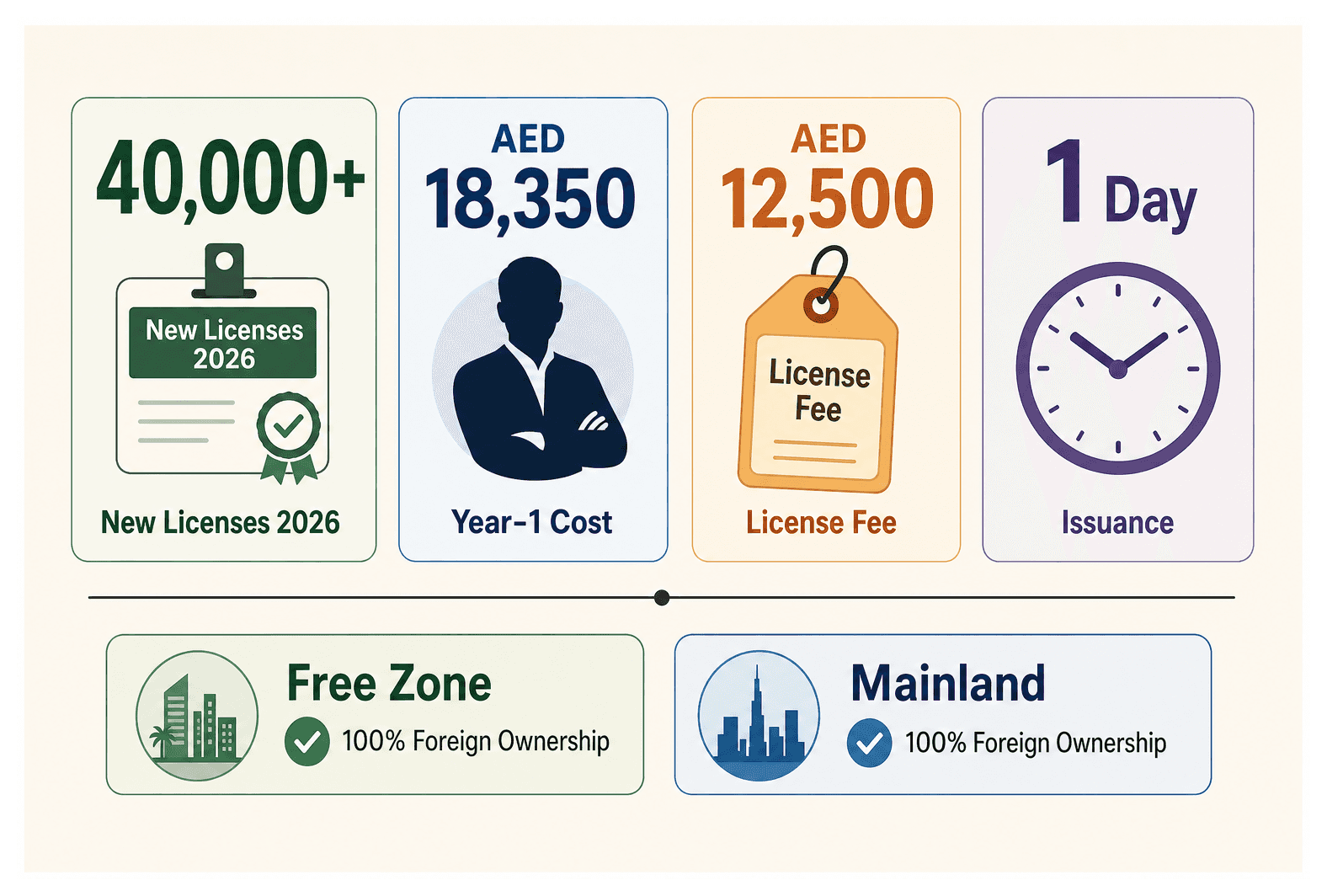
The two primary setup routes in Dubai for a side business are a free zone license and a mainland license. Free zones offer lower entry costs, one-day issuance, and zero paid-up share capital. Mainland licenses give unrestricted UAE market access and eligibility for government contracts, at a higher setup and compliance cost.
Free Zone vs Mainland: Side Business Setup Route Comparison
Feature | Free Zone (Dubai South Business Hub) | Mainland (DET) |
|---|---|---|
License fee | From AED 12,500 | UNVERIFIED: <mainland license entry cost range>. Confirm before publishing. |
First-year total cost | From AED 18,350 for sole founder with one visa (visa is additional, not included) | Higher; includes DET fee, office lease, and agent fees where applicable |
Visa eligibility | Yes, residency visa available as a separate, additional cost | Yes, residency visa available as a separate, additional cost |
UAE market access scope | International clients and UAE businesses that accept free zone invoices; goods to mainland requires distributor arrangement | Unrestricted, direct trade with UAE consumers, retailers, and government entities |
Paid-up share capital | Zero, no capital locked away | Varies by activity and structure; some categories require minimum capital |
Issuance speed | One business day | Typically longer; varies by activity and DET processing queue |
Best suited for | Digital, service, and consulting side businesses; founders seeking visa independence at low cost | Goods-based businesses selling directly to UAE consumers, retailers, or government |
A solo founder setting up a digital consulting side business at Dubai South Business Hub Free Zone pays a first-year total from AED 18,350, receives a license in one business day, and can apply for a UAE residency visa as a separate cost, giving her full legal independence from an employer-sponsored visa. Worth flagging: DSBH is not a designated zone, so no designated-zone customs or VAT benefit applies. Free zone goods are duty-suspended, not duty-exempt.
Each business activity beyond the first five costs AED 2,000 at DSBH. If your side business spans multiple revenue streams, say, digital marketing plus content production plus training, check that all activities are covered before you apply, or budget for the additional activity fees.
What Each Route Does Not Cover
DSBH does not provide bonded warehousing or customs integration. Side businesses needing physical goods clearance must arrange this separately through a third-party logistics provider.
Mainland licenses carry higher annual compliance obligations, including Emiratisation requirements for businesses above a headcount threshold. UNVERIFIED: <Emiratisation threshold headcount for mainland SMEs>. Confirm before publishing.
Free zone companies cannot directly distribute goods to UAE mainland customers without a mainland distributor or relevant DET approval in some cases. Service businesses face fewer restrictions.
Neither route eliminates VAT obligations once taxable supplies cross AED 375,000 per year. A founder importing and reselling physical products to UAE retail stores would find a free zone license limiting for direct mainland distribution and may need a mainland structure or a local distribution arrangement.
Tax and Compliance Obligations by Route
Both free zone and mainland side businesses in Dubai are subject to UAE corporate tax and VAT rules. A free zone entity may qualify for a 0% corporate tax rate as a Qualifying Free Zone Person only if it meets four specific QFZP conditions set by the Federal Tax Authority. Mainland entities are taxed at 9% on profits above AED 375,000; profits below that threshold attract 0%.
Corporate Tax: What Side Business Founders Must Know
UAE corporate tax applies to both routes. A free zone entity qualifies for the 0% rate only as a Qualifying Free Zone Person (QFZP), and all four conditions must be met simultaneously: adequate substance in the UAE, qualifying income only, no mainland permanent establishment, and audited financial statements. Miss any one of them and the 9% rate applies.
Here's a practical illustration. A side business earning AED 200,000 net profit per year falls below the AED 375,000 threshold and pays 0% corporate tax on the mainland anyway. The QFZP route is only advantageous once profits are significant and all four conditions can be maintained year on year. Never describe either route as tax-free. Late registration for corporate tax carries a one-time flat penalty of AED 10,000, not a recurring monthly charge (Federal Tax Authority, 2023).
VAT Registration and Ongoing Filing
VAT registration is mandatory once taxable supplies exceed AED 375,000 per year on either route. The late registration penalty is AED 10,000. A UK founder running a side consultancy from Dubai, billing both European and UAE clients, must register for VAT once that threshold is crossed, free zone status does not exempt supplies made to UAE mainland customers from VAT. You can open a bank account in the UAE and set up your accounting structure early to track turnover against this threshold from day one.
Four Steps to Choosing the Right Setup Route for Your Side Business
To choose the right setup route in Dubai for a side business: first, identify who your customers are and where they are located; second, assess your visa needs; third, calculate your first-year cost including visa fees; fourth, check whether your activity requires a sector regulator's approval in addition to the license authority.
Step 1: Map Your Customer Base
If most of your revenue comes from international clients or UAE-based businesses that accept free zone invoices, a free zone license is sufficient. Service businesses, consulting, digital, creative, face fewer restrictions under free zone structures than goods-based businesses do. But if you plan to sell goods directly to UAE mainland retail consumers or bid on government tenders, a mainland license from DET gives you unrestricted access that a free zone license simply can't match.
Step 2: Decide on Your Visa Strategy
A free zone license at DSBH supports a UAE residency visa application, visa costs are always additional to the license fee, never included.
A residency visa tied to your own company gives independence from an employer-sponsored visa, which matters for salaried expats running a side business.
Factor in visas for staff or dependants early, each one adds to your annual cost and should be part of your initial budget, not an afterthought.
Step 3: Calculate Your True First-Year Cost
DSBH free zone license: from AED 12,500
First-year total for a sole founder with one visa: from AED 18,350
Each business activity beyond the first five:AED 2,000 per additional activity
Zero paid-up share capital required, no capital locked away at DSBH
Mainland costs include the DET license fee, office lease, and local service agent or partner fees where applicable, UNVERIFIED: <mainland first-year total range for sole founder>. Confirm before publishing.
Use the business setup cost calculator to model your exact scenario before committing to a route.
Step 4: Check for Sector Regulator Requirements
Some activities require approval from a named sector regulator in addition to the license authority. The license alone is not sufficient. DSBH licenses the activity; the named regulator approves it separately, both steps are required. A side business offering online health coaching, for example, must hold both a DSBH license for the activity and a separate DHA (Dubai Health Authority) approval. Skipping either step makes the operation non-compliant, regardless of which route you chose.
Key regulators to know: DHA for healthcare, KHDA for education and training, CBUAE (Central Bank of UAE) or SCA (Securities and Commodities Authority) for financial services. Identify your regulator before you apply to avoid delays and unexpected costs.
Clear Recommendations by Founder Scenario
For a salaried expat running a digital side business, a free zone license at Dubai South Business Hub Free Zone suits best: low cost, one-day issuance, and visa optionality. For a founder selling physical goods to UAE mainland retailers, a mainland DET license gives the unrestricted market access the business model requires.
Scenario A: Digital or Service Side Business with International or Free Zone Clients
Recommended route: free zone license at Dubai South Business Hub Free Zone. This setup route suits Dubai-based digital and service founders because it combines the lowest entry cost (license from AED 12,500), one-day issuance, zero paid-up share capital, and visa eligibility. A UX designer billing European and GCC tech firms from Dubai is a strong fit, the client base doesn't require a mainland-licensed vendor, so the free zone structure covers the full scope of the business.
Before applying, confirm your specific activity is listed and check whether any sector regulator sign-off is required in addition to the DSBH license. You can explore the full list of business activities in Dubai on the DSBH site. DSBH launched in September 2025, so all licensing processes and fee structures reflect that date.
Scenario B: Physical Goods or UAE Mainland Retail Business
Recommended route: mainland DET license. A founder importing artisan food products for sale to Dubai supermarkets needs direct mainland trading rights. A free zone license alone would require routing through a mainland distributor, adding cost and complexity that erodes the margin advantage the free zone route seems to offer at first glance. The higher first-year cost and greater compliance overhead of a mainland license are justified when the revenue model depends on direct access to UAE consumers, retailers, or government procurement.
Worth noting: DSBH does not provide bonded warehousing or customs integration. Goods-heavy models may need additional logistics arrangements regardless of which route they choose.
Scenario C: Side Business Where Residency Independence Is the Priority
Recommended route: free zone license at DSBH with a visa package added.
A license-linked residency visa severs dependence on an employer visa, critical for expats whose side income may eventually become their primary income.
Visa costs are always additional to the license fee, budget for this from day one, not as an afterthought.
The AED 18,350 first-year total for a sole founder with one visa makes this the most cost-efficient path to both a license and UAE residency.
Zero paid-up share capital means no capital is locked away while the side business finds its footing.
Regulated Activities: What Side Business Founders Often Miss
Many side business activities in Dubai require approval from a sector regulator in addition to the commercial license. The license authority, whether free zone or DET, permits the activity in principle; the sector regulator grants the operational approval. Skipping either step results in a non-compliant business regardless of route chosen.
Common Regulated Categories and Their Governing Bodies
Healthcare and wellness: DHA (Dubai Health Authority) approval required in addition to a DSBH or DET license. See DHA for current requirements.
Education and training: KHDA (Knowledge and Human Development Authority) approval required. An education business license in Dubai covers the activity; KHDA approval authorises the operation.
Financial services and investment: Central Bank of UAE (CBUAE) or Securities and Commodities Authority (SCA) approval required.
ICT activities involving telecom infrastructure: TDRA (Telecommunications and Digital Government Regulatory Authority) approval may apply.
Real estate brokerage: RERA (Real Estate Regulatory Agency) registration required.
A side business offering online tutoring to school-age students in Dubai must hold a DSBH education license AND a KHDA approval. The license alone does not authorise the business to operate. Both steps are mandatory.
How to Verify Your Activity's Regulatory Status Before You Apply
Check the DSBH business activities list to see whether your activity carries a regulatory note.
Contact the relevant regulator directly to confirm pre-approval requirements and timelines.
Factor regulator approval timelines into your launch plan, some approvals involve inspections and take several weeks.
References
Frequently Asked Questions