
Topic Summary
Vague Activity Descriptions Trigger Automatic Declines
Banks require specific, clearly defined business activity descriptions to assess risk accurately. A broad label like 'management consulting' with no further detail is routinely flagged for enhanced due diligence or outright rejection.
Incomplete UBO Disclosure Blocks Account Opening
Central Bank Notice 2919/2021 requires all legal entities to maintain Ultimate Beneficial Owner registers, and banks must verify these before opening any account. A sole shareholder based outside the GCC with incomplete disclosure is a common reason for automatic decline.
A Valid Trade License Does Not Guarantee Banking Access
Many founders are surprised to learn that being legally incorporated and fully licensed is not enough to open a corporate bank account. The license authority and the bank are entirely separate gatekeepers applying different standards.
Missing Tax Registrations Create Costly Compliance Gaps
Failing to register for corporate tax or VAT on time each carries a flat AED 10,000 penalty from the Federal Tax Authority. Banks also view missing tax registrations as a compliance red flag during their KYC review.
Free Zone Companies Must Prove Real Business Activity
UAE banks require free zone applicants to demonstrate a genuine business purpose and UAE nexus, such as signed client contracts, a working website, or a physical office. A company with only a P.O. box address and no staff faces significant scrutiny.
High-Risk Sector Flags Add Weeks to the Process
Certain business activities are automatically assigned a high-risk rating under FATF Recommendation 10 customer due diligence standards. Companies in these sectors face extended enhanced due diligence reviews that can delay or permanently block account opening.
Preparation, Not Just Incorporation, Gets You Banked
Having a resident visa-holder as manager, a clearly described activity, and a signed client agreement ready before approaching a bank significantly accelerates KYC approval. Founders who treat banking preparation as an afterthought face the rejections that derail many new businesses.
In 2026, the UAE hosts over 595,000 active commercial entities (Ministry of Economy, 2024). Yet a significant share of first-time founders discover, only after incorporation, that some companies cannot open a bank account in Dubai because their structure, activity list, or compliance record fails the standards UAE banks apply under Central Bank guidelines. The UAE is a FATF member state. Banks apply FATF Recommendation 10 customer due diligence standards to every new applicant. Corporate tax late registration carries a one-time AED 10,000 flat penalty (Federal Tax Authority, 2023). VAT late registration carries the same AED 10,000 penalty. And Dubai South Business Hub Free Zone (DSBH) issues trade licenses from AED 12,500 in one business day, meaning the license is the easy part.
This article explains why some companies cannot get past the banking gate in Dubai, what requirements you must satisfy before you approach a bank, the full first-year cost of getting it right from the start, and a step-by-step process for setting up a company and opening a corporate account without the rejections that derail so many new founders.
What Is Corporate Banking Compliance in the UAE and Why It Blocks Some Companies
Corporate banking compliance in the UAE is the set of anti-money-laundering, know-your-customer, and regulatory checks that UAE banks apply before opening a business account. Some companies cannot open a bank account in Dubai because their ownership structure, licensed activities, or missing tax registrations fail these checks, triggering an automatic decline.
How UAE Banks Assess New Corporate Applicants
UAE banks operate under Central Bank of the UAE Anti-Money Laundering (AML) and Know Your Customer (KYC) frameworks. Every new corporate account application is a compliance review, not just an administrative formality. Central Bank Notice 2919/2021 mandates UBO (Ultimate Beneficial Owner) registers for all legal entities, and banks are required to verify these registers before account opening.
Banks score applicants on four main axes: beneficial ownership transparency, source of funds, activity risk rating, and the quality of supporting documents. A company with vague activity descriptions, incomplete UBO disclosure, or a high-risk sector flag can be declined even if it is legally incorporated and fully licensed. That last point surprises many founders, a valid trade license does not guarantee a bank account.
Consider a consultancy licensed under a broad "management consulting" activity with no further description and a sole shareholder based outside the GCC. That profile is routinely flagged for enhanced due diligence, adding weeks to the process or ending in outright rejection. Specificity in your activity description is not a bureaucratic nicety; it is a banking requirement.
Why Free Zone and Mainland Companies Face Different Scrutiny
Free zone companies can bank with UAE banks but must demonstrate a genuine business purpose and UAE nexus. Banks ask for client contracts, website evidence, or a physical office to confirm the company is operational. Mainland companies licensed by DET often move through initial checks more readily because their activity scope is directly visible through the trade license, but they face identical UBO and AML checks.
Neither free zone nor mainland status exempts a company from banking compliance. The license authority and the bank are entirely separate gatekeepers. A Dubai South Business Hub Free Zone company with a clearly described ICT activity, a resident visa-holder as manager, and a signed client agreement in hand will move through bank KYC significantly faster than a company with no staff, no contracts, and a P.O. box address only. The license gets you incorporated; preparation gets you banked.
Requirements Every Dubai Company Must Meet Before Approaching a Bank
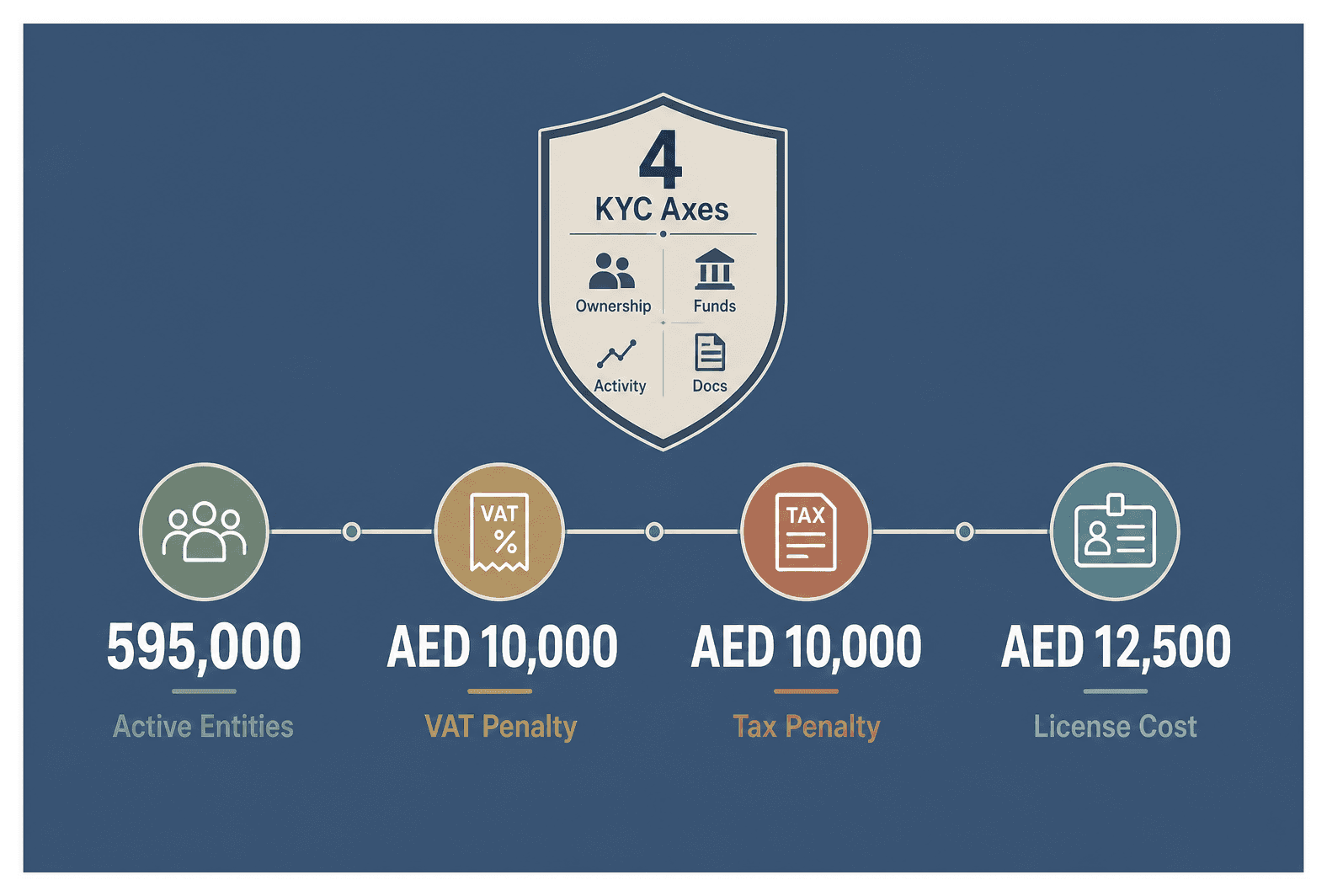
Before a bank will open an account, a Dubai company must hold a valid trade license, register for corporate tax, maintain a UBO register, provide certified constitutional documents, and show evidence of genuine business activity. Some companies cannot open a bank account in Dubai simply because one or more of these items is missing or incomplete.
Mandatory Legal and Regulatory Documents
Here is what banks require from every new corporate applicant:
Valid trade license: Current, not expired, and listing activities that match your intended transactions. Banks cross-check transactions against the licensed scope.
Memorandum and Articles of Association (or equivalent constitutional document): Must be attested and translated into Arabic where required.
UBO register: Any individual owning 25% or more must be declared. Banks ask for passport copies, proof of address, and source-of-wealth statements. UAE Cabinet Resolution No. 58 of 2020 mandates these registers.
Corporate tax registration number: Banks increasingly require this as proof of compliance with UAE law. Late registration carries a one-time AED 10,000 flat penalty (Federal Tax Authority, 2023).
VAT registration certificate (if applicable): Mandatory at AED 375,000 in annual taxable supplies. Late registration also carries an AED 10,000 penalty.
A sole founder who incorporated in October 2025 but did not register for corporate tax before approaching a bank in January 2026 faces both the AED 10,000 penalty and a bank that views the compliance gap as a red flag. Register on the same day you receive your license, not when the bank asks for the number.
Operational Evidence Banks Require Beyond the License
Documents prove you exist. Operational evidence proves you are actually trading. Banks want a business plan, at least one signed client contract or letter of intent, a functional website, and a physical or registered office address. A company with none of these is, from the bank's perspective, a shell.
Having a UAE-resident signatory is one of the most decisive factors. A company where every director lives outside the UAE faces enhanced due diligence that many banks simply decline to carry out for new clients. Securing a UAE investor visa through your DSBH license before you approach any bank removes this objection entirely. Visa packages at DSBH are always an additional cost, separate from the license fee.
Banks also require a source of funds declaration: six months of bank statements from the founder's home-country account is standard. For regulated activities, financial services, healthcare, education, the bank will also ask for the secondary regulator's approval certificate alongside the trade license. DSBH licenses the activity; the named regulator (for example, the Dubai Health Authority for healthcare) approves it separately. Both documents are non-negotiable.
Top Reasons Some Companies Cannot Open a Bank Account in Dubai
The most common reasons some companies cannot open a bank account in Dubai include incomplete UBO disclosure, vague or high-risk licensed activities, no UAE-resident signatory, missing tax registrations, no evidence of real operations, and a mismatch between the company's stated business and the transactions it plans to run through the account.
The Seven Most Common Rejection Triggers
Incomplete or inconsistent UBO disclosure: A shareholder structure with nominee layers or undisclosed beneficiaries triggers an automatic AML flag under UAE Cabinet Resolution No. 58 of 2020.
Vague activity descriptions: "General trading" or "management consulting" without specifics gives the bank nothing to benchmark your transactions against.
No UAE-resident director or signatory: Companies where every director lives outside the UAE face enhanced due diligence that many banks decline to carry out for new clients.
Missing corporate tax registration: Banks view an unregistered company as non-compliant with UAE law, regardless of whether taxable income has been earned.
No operational proof: No website, no contracts, no invoices, no staff. The bank cannot confirm the company is trading.
Transaction-activity mismatch: A company licensed for IT consulting that wants to receive payments for commodity trading will face immediate scrutiny.
High-risk jurisdiction shareholders: Beneficial owners from FATF-listed high-risk jurisdictions trigger mandatory enhanced due diligence, which many retail banks decline to complete for new relationships.
A holding company formed to own intellectual property, with no employees, no UAE-resident director, and no operational activity, is the profile most likely to receive a flat decline from retail banks. Specialist banks or a structured account with compliance support are the realistic path for that profile. Most first-time founders, though, are not in that category, they simply arrive underprepared.
Bank-Ready Company Setup: Cost and Compliance Summary for a Sole Founder at DSBH (2026)
Item | Detail |
|---|---|
Trade license (B2B) | From AED 12,500 |
Trade license (B2C) | From AED 12,500 |
First-year total (sole founder, one visa) | From AED 18,350 (visa always an additional cost) |
Each activity beyond first five | AED 2,000 per activity |
Paid-up share capital required | Zero |
License issuance time | One business day |
Corporate tax late registration penalty | AED 10,000 (one-time flat, Federal Tax Authority) |
What Can Some Companies Do Differently?
The answer is straightforward: prepare the compliance pack before you book the bank appointment, not after. Explore the full list of business activities in Dubai available at DSBH and select the narrowest accurate descriptions of what you will actually invoice for. That single decision eliminates rejection triggers two, six, and seven from the list above in one step.
Cost of Getting Your Dubai Company Bank-Ready in 2026
A sole founder using Dubai South Business Hub Free Zone pays from AED 12,500 for a trade license, with a first-year total from AED 18,350 when one visa package is added. Each licensed activity beyond the first five costs AED 2,000. Zero paid-up share capital is required. Visas are always an additional cost.
DSBH License and Visa Costs for a Sole Founder
Dubai South Business Hub Free Zone, launched September 2025, issues trade licenses in one business day. Here is the cost structure for a sole founder in 2026:
B2B trade license: from AED 12,500
B2C trade license: from AED 12,500
First-year total with one visa package: from AED 18,350
Each activity beyond the first five: AED 2,000
Paid-up share capital required: zero
A founder setting up an ICT license in Dubai with three specific activities, software development, IT project management, and cybersecurity consulting, pays the base license fee and presents a clean, bank-friendly activity list without paying for unnecessary additions. Keeping the activity list precise serves two purposes: it controls cost and it satisfies the bank's need to benchmark your transactions against a defined scope.
Hidden Compliance Costs That Catch Founders Off Guard
The license fee is not the only number you need to budget for:
Corporate tax late registration: AED 10,000 one-time flat penalty. Register immediately after incorporation, not when the bank asks for the number.
VAT late registration: AED 10,000 penalty. Monitor your taxable supplies against the AED 375,000 annual threshold from day one.
Document attestation and legal translation: Real costs outside the license price. Budget AED 1,500 to AED 3,000 for a standard document pack (UNVERIFIED: confirm before publishing).
Bank account opening fees: Vary by bank and account type. Some banks charge zero; others charge up to AED 1,000 for business current accounts (UNVERIFIED: confirm before publishing).
A founder who registers for corporate tax on the same day as license issuance avoids the AED 10,000 penalty entirely and arrives at the bank with a clean compliance record. Relationship managers notice. That detail, a tax registration number dated the same week as the license, signals a prepared founder, and it changes the tone of the initial meeting. Use the business setup cost calculator to map your full first-year outlay before you commit.
How Structuring Your Company Correctly Prevents Banking Rejections
Choosing precise licensed activities, appointing a UAE-resident signatory, registering for corporate tax immediately after incorporation, and preparing operational evidence before the first bank meeting are the structural decisions that determine whether some companies cannot open a bank account in Dubai or move through the process in days.
Choosing the Right Activities and Legal Structure
Activity precision is the single most controllable factor in your banking outcome. Choose the narrowest accurate description of what you will actually invoice for. Banks benchmark your transactions against your licensed scope, and a mismatch, even an innocent one, triggers a compliance query that can stall your account opening for weeks.
If your business spans multiple sectors, list each relevant activity explicitly rather than relying on a broad catch-all. The AED 2,000 cost per activity beyond the first five at DSBH is far cheaper than a banking rejection and the weeks of remediation that follow. For regulated activities, financial services, healthcare, education, confirm that you hold both the DSBH trade license and the named regulator's approval before approaching any bank. One without the other is a guaranteed decline.
A healthcare technology company that lists both "software development" and "health information management" as activities, and holds both its DSBH license and a Dubai Health Authority (DHA) approval, presents a complete compliance picture that a single-activity license never could. That completeness is what moves a bank from "pending further review" to "approved."
Building a UAE Operational Footprint Before the Bank Meeting
Before you book your first bank appointment, work through this checklist:
Secure a UAE investor visa through your DSBH license. A UAE-resident director or signatory removes one of the most common rejection triggers.
Launch a basic website with your company name, licensed activities, and contact details. This is the minimum operational evidence most banks require.
Prepare a one-page business plan and, if possible, a signed letter of intent from your first client or supplier.
If you are relocating personally, open a personal UAE bank account first. Relationship history with a bank makes the corporate account application materially easier.
A founder who arrives at the bank with a DSBH license issued the previous week, a UAE investor visa, a live website, a corporate tax registration number, and a signed client agreement is presenting a profile that most UAE banks will approve within five to ten business days. That is not an optimistic scenario, it is the standard outcome for a prepared applicant. The bank account opening support available through DSBH's Beyond Hub service can help you assemble that pack correctly.
Step-by-Step Guide to Setting Up and Banking a Dubai Company in 2026
Setting up a bank-ready Dubai company involves choosing a precise licensed activity, incorporating through a licensed free zone, registering for corporate tax, securing a UAE residency visa, assembling your KYC document pack, and submitting a complete bank application with operational evidence. Following this sequence is how some companies avoid the rejections that others cannot.
The Bank-Ready Company Formation Process
Define your business activities precisely. List every activity you will invoice for, check availability at DSBH, and confirm whether any require secondary regulator approval.
Check your proposed trade name availability. Reserve it before submitting your application using the company name availability check at DSBH.
Submit your DSBH company formation application. License issued in one business day. First-year cost for a sole founder with one visa from AED 18,350 (license from AED 12,500 plus visa package).
Register for corporate tax immediately. File with the Federal Tax Authority on the same day your license is issued. The AED 10,000 flat penalty for late registration applies regardless of whether you have earned income.
Apply for your UAE investor visa. This gives you UAE residency status and an Emirates ID, both required by most banks for the account signatory. Visa processing timelines follow ICP and GDRFA procedures.
Build your operational evidence pack. Live website, business plan, signed client letter of intent or service agreement, and six months of personal bank statements showing source of funds.
Assemble your KYC document pack. Trade license, Memorandum of Association, UBO register, passport copies, Emirates ID, corporate tax registration number, and proof of registered address.
Submit your bank account application. Present the complete pack at your chosen bank. With all documents in order, most UAE banks complete their review within five to ten business days.
A founder who completes Steps 1 through 7 before walking into a bank has a materially different experience than one who arrives with only the trade license. The former is approved; the latter is typically sent away with a document checklist and a two-to-four week delay. The sequence matters as much as the individual steps.
A process timeline showing eight steps from defining business activities to submitting a bank account application, with key costs and timelines for DSBH founders in 2026.Bank-Ready Dubai Company: 8-Step Process (2026)1DefineActivities2NameCheck3GetLicense4TaxRegister5GetVisa
References
Frequently Asked Questions