
Topic Summary
Incomplete KYC Documents Sink Applications Fast
Banks require a fully prepared document pack before they begin review, and any missing item triggers an immediate rejection. Foreign document attestation can cost AED 150–600 per document, but assembling the pack correctly costs nothing if your paperwork is already in order.
Vague Business Plans Fail Plausibility Checks
A business plan listing 12 unrelated product categories signals poor model coherence to compliance reviewers. Narrowing your license to a focused activity cluster is the fix, though amending activities at renewal costs AED 2,000 per change.
Overly Broad Licenses Are a Top Red Flag
Banks treat excessively wide trading licenses as an AML risk indicator because they obscure what the company actually does. At free zones like Dubai South Business Hub, each activity beyond the first five costs AED 2,000, making license discipline a financial as well as a compliance decision.
Second Rejections Trigger Informal Risk Flags
A second failed application at a different bank can create a risk flag that takes three to six months to clear through informal compliance networks and the Al Etihad Credit Bureau. This compounds the original problem and significantly narrows the remaining banking options available to the company.
No UAE Transaction History Raises Your Risk Tier
Sole founders with no prior UAE banking activity are automatically placed in a higher-risk category, meaning banks require more documentation rather than less. Arriving at the bank interview with a stronger-than-minimum file is the practical way to offset this automatic disadvantage.
Rejected Accounts Stall Payroll and Visa Transfers
Employees cannot be sponsored on UAE visas until a bank account is active and receiving payroll, so a rejection directly blocks workforce growth. Client contracts requiring UAE payment rails also stall immediately, turning a compliance issue into a revenue problem.
Tax Penalties Pile Up While You Wait for an Account
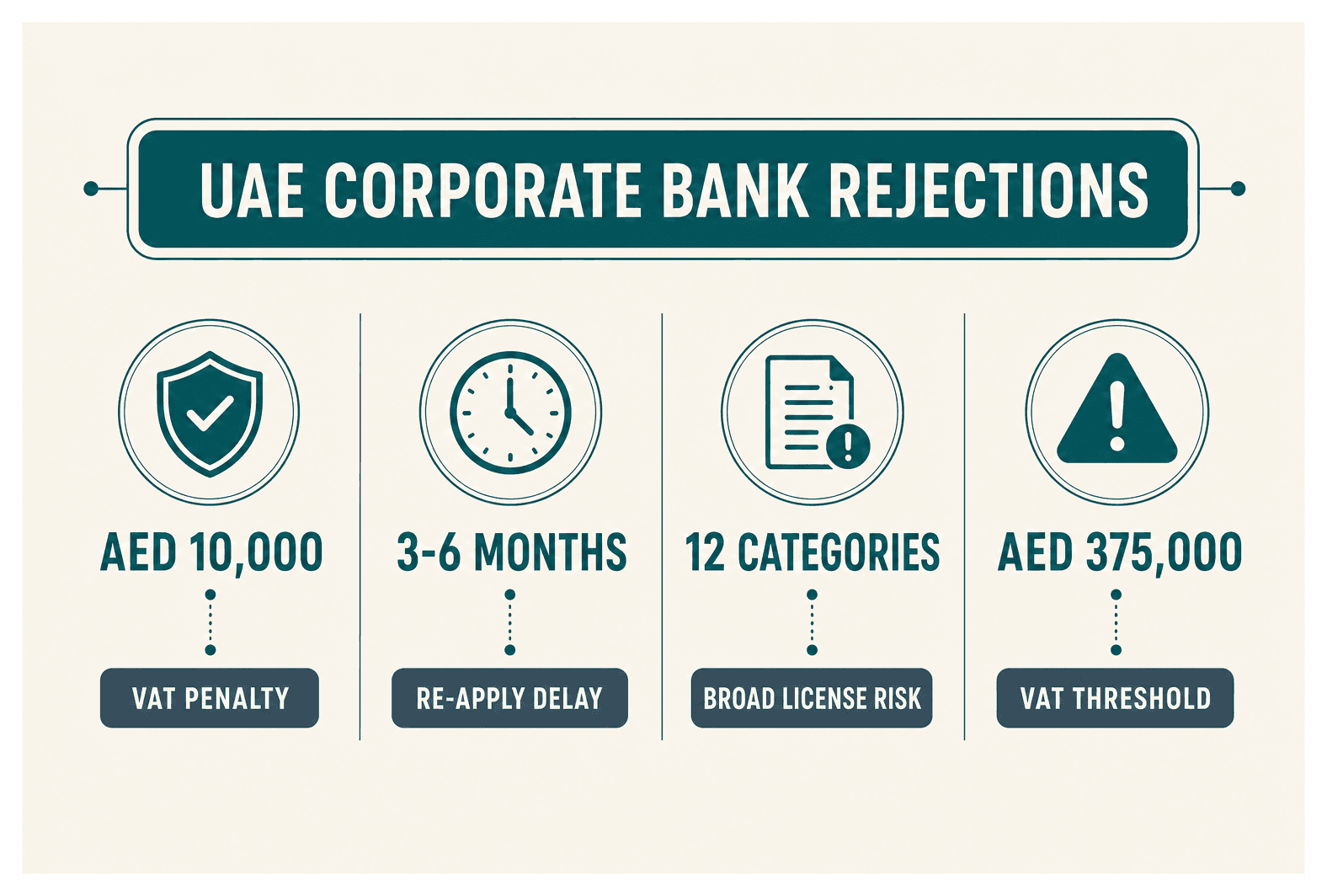
Late VAT registration carries an AED 10,000 penalty from the Federal Tax Authority, and late corporate tax registration carries a separate flat AED 10,000 penalty. The VAT registration threshold is AED 375,000 in annual turnover, so fast-growing startups can hit the deadline before an account is even open.
In 2026, the majority of first-time founders who set up a company in Dubai discover that getting a corporate bank account is harder than getting the license itself. The Central Bank of the UAE tightened Know Your Customer (KYC) and Anti-Money Laundering (AML) standards significantly from 2023 onward. Banks now reject corporate UAE applications at rates that catch new founders off guard. A rejected application delays payroll, client invoicing, and visa salary transfers. A second rejection at a different bank can trigger an informal risk flag that takes three to six months to clear. Late VAT registration alone carries an AED 10,000 penalty (Federal Tax Authority, 2023). Corporate tax late registration carries a separate one-time flat AED 10,000 penalty. The VAT registration threshold sits at AED 375,000 in annual turnover. And at Dubai South Business Hub Free Zone, each activity beyond the first five costs AED 2,000, a figure that matters because overly broad licenses are among the top rejection triggers.
This guide ranks the most common reasons banks reject corporate UAE applications by frequency, gives you the specific fix for each, and tells you what each fix costs, so you arrive at your bank interview with a file that passes.
What Corporate Bank Account Rejection in the UAE Actually Means
UAE banks reject corporate account applications when a company's documents, ownership structure, or business model fail internal KYC and AML checks set by the Central Bank of the UAE. Rejection is not always communicated with a clear reason, and a second failed application at another bank can delay account opening by three to six months.
How UAE Banks Evaluate a New Corporate Application
Banks run a multi-layer review covering document completeness, beneficial ownership verification, business model plausibility, and source-of-funds checks. The Central Bank of the UAE mandates that all licensed banks apply risk-based AML and KYC frameworks. Each bank then sets its own risk appetite on top of that regulatory floor, which is why the same application can be approved at one institution and rejected at another.
A sole founder with no UAE transaction history is automatically placed in a higher-risk tier. That means more documentation is required, not less. Banks do not score applications as a simple pass or fail on a single criterion, multiple weak signals together trigger a rejection. A founder incorporating a general trading company with no named clients and a business plan listing 12 unrelated product categories will score poorly on business model plausibility even if every document is physically present.
Why a Rejection Hurts More Than a Delay
The consequences of banks rejecting corporate UAE applications go beyond a timing inconvenience. Four specific problems follow a rejection:
Banks share data through informal compliance networks and through the Al Etihad Credit Bureau, a rejection flag can follow the company to the next application.
Visa salary transfer requirements mean employees cannot be sponsored until a bank account is active and receiving payroll.
Client contracts requiring UAE-based payment rails stall when there is no active account to receive funds.
A second rejection at a different bank compounds the risk score and narrows remaining options significantly.
A logistics startup that received two rejections in Q1 2025 found that its third application required a notarised letter from the license authority confirming the company was in good standing, a requirement not asked of first-time applicants. That extra step added three weeks to the process.
UAE Corporate Bank Account Rejection: Causes, Fixes, and Costs Ranked by Frequency
# | Rejection Cause | Fix and Cost |
|---|---|---|
1 | Incomplete KYC documents | Prepare full pack before applying. Cost: AED 0 if in order; AED 150–600 per document for foreign attestation |
2 | Vague or overly broad business plan | Narrow to a coherent activity cluster. Cost: AED 2,000 per activity amended at renewal |
3 | Restricted activity without regulator approval | Obtain named regulator approval first. Cost: AED 10,000–50,000+ depending on regulator (UNVERIFIED: confirm before publishing) |
4 | No physical UAE address | Provide tenancy contract or dedicated desk. Cost: AED 5,000–15,000/year (UNVERIFIED: confirm before publishing) |
5 | Undisclosed beneficial ownership | UBO declaration with full ownership chain. Cost: AED 1,500–5,000 in legal fees |
6 | Missing VAT or corporate tax registration | Register with Federal Tax Authority before the bank interview. Cost: AED 0 to register; AED 10,000 each if already late |
7 | Implausible transaction volume projections | Conservative, evidence-backed projections with supporting contracts. Cost: AED 0 |
The Eight Ranked Reasons Banks Reject Corporate UAE Applications
The top reasons banks reject corporate UAE applications, ranked by frequency, are: incomplete KYC documents, a vague or overly broad business plan, missing tax registration, restricted or high-risk business activities, no UAE address or virtual-only office, undisclosed beneficial ownership, low projected transaction volumes, and a mismatch between the license type and stated banking purpose.
Reasons 1 Through 4: The Most Frequent Causes
Incomplete KYC documents (most common). Missing passport copies, proof of address older than three months, or absent Emirates ID for resident shareholders. Fix: prepare a full KYC pack before approaching any bank. Cost: AED 0 if documents are in order; attestation of foreign documents costs AED 150–600 per document (UNVERIFIED: confirm before publishing).
Vague or overly broad business plan. Banks want named target markets, realistic revenue projections, and a coherent flow of money in and out. A plan listing 15 unrelated activities triggers a high-risk flag. Fix: narrow your business activities in Dubai to a focused set. At Dubai South Business Hub Free Zone, the first five activities are included in the license and each additional activity costs AED 2,000. Cost: AED 2,000 per activity removed or restructured at renewal. A fintech founder listing "payment processing" and "investment advisory" on the same license was rejected by two banks before separating the activities into distinct licensed entities.
Restricted or high-risk activity on the license. Crypto, forex, money services, and certain financial activities require separate regulatory approval before a bank will open an account. The license alone is not enough. Fix: obtain the named regulator's approval first. Cost: varies by regulator, often AED 10,000–50,000+ (UNVERIFIED: confirm before publishing).
No physical UAE address or a virtual-only office. Most UAE banks will not open accounts for companies that cannot demonstrate real operational presence. Fix: upgrade from a flexi-desk to a dedicated office, or provide a tenancy contract. Cost: AED 5,000–15,000 per year for a physical desk arrangement (UNVERIFIED: confirm before publishing).
Reasons 5 Through 8: Less Frequent but Still Disqualifying
Undisclosed or complex beneficial ownership. If the ultimate beneficial owner (UBO) cannot be identified through a clean chain of documents, banks reject the file. A holding company with three layers of ownership across three jurisdictions was asked to produce notarised UBO declarations for each layer, a process that took six weeks and cost approximately AED 4,200 in legal and attestation fees. Fix: prepare a UBO declaration with supporting corporate documents for any holding structure. Cost: legal fees AED 1,500–5,000.
Missing VAT or corporate tax registration. Banks increasingly ask for a Tax Registration Number (TRN) or a letter confirming exemption. Late VAT registration carries an AED 10,000 penalty from the Federal Tax Authority; late corporate tax registration carries a separate one-time flat AED 10,000 penalty. Fix: register before the bank interview. Cost: AED 0 to register; AED 10,000 each if already late.
Low or implausible projected transaction volumes. A company projecting AED 500,000 monthly turnover with no named clients and no industry track record raises a red flag. Fix: present conservative, evidence-backed projections and attach any letters of intent or signed contracts. Cost: AED 0.
Mismatch between license type and stated banking purpose. A service license holder claiming they will receive large import/export payments looks inconsistent to a compliance officer. Fix: align your license activities with your actual banking flows before the application. Cost: activity amendment fees apply if changes are needed.
The Document Pack That Stops Banks Rejecting Corporate UAE Applications
A complete UAE corporate bank account document pack includes: a valid trade license, memorandum of association, passport copies and Emirates IDs for all shareholders, proof of physical address, a UBO declaration, a business plan with revenue projections, bank statements for the past six months, and, where applicable, a Tax Registration Number. Getting this pack right before you walk into any bank is the single most reliable way to prevent banks rejecting corporate UAE applications at the first hurdle.
Core Documents Every Bank Requires
Valid trade license, must be active and not within 60 days of expiry at the time of application.
Memorandum of association (MOA) and, for free zone companies, the certificate of incorporation.
Passport copies for all shareholders and directors, clear colour scans with at least six months' remaining validity.
Emirates ID for all UAE-resident shareholders and directors.
Proof of physical UAE address, tenancy contract or utility bill not older than three months.
Dubai South Business Hub Free Zone issues the certificate of incorporation and MOA on the same day the license is issued. Founders can walk into a bank with a complete foundational document set from day one, which removes one of the most common early delays.
Supporting Documents That Differentiate a Strong Application
A concise business plan, two to four pages covering what you sell, who you sell to, how money moves in and out, and realistic first-year projections.
Source-of-funds letter, explains where initial capital comes from: personal savings, a parent company, or an investor.
Letters of intent or signed contracts with named clients, even if early-stage.
Six months of bank statements from the founder's home-country personal or corporate account.
Tax Registration Number (TRN) or a written confirmation from the Federal Tax Authority that the company is below the mandatory VAT registration threshold of AED 375,000.
A management consulting founder who attached a signed retainer agreement worth AED 120,000 to her bank application was approved at her first attempt. The contract resolved the "implausible revenue" flag before the compliance officer raised it, proof that a single strong supporting document can shift the outcome.
What does a bank look for in a UAE corporate account application?
UAE banks look for document completeness, a verifiable beneficial owner, a plausible business model with named clients or contracts, a physical UAE address, and evidence of tax registration. A sole founder with clean ownership and a focused license typically clears KYC faster than a multi-shareholder structure with broad activities.
How a Clean License Structure Reduces the Risk That Banks Reject Corporate UAE Applications
Banks assess the license as the first signal of business legitimacy. A license with a focused set of coherent activities, zero compliance flags, and a clear legal structure reduces KYC risk scores. Free zone licenses with transparent single-founder ownership are faster to verify than multi-layer holding structures, which is one reason banks reject corporate UAE applications less often when the ownership chain is simple.
Why Activity Selection Matters to the Bank, Not Just the Regulator
Banks map your licensed activities to FATF (Financial Action Task Force) risk categories. Trading, financial services, and real estate are inherently higher-risk categories. A license listing 12 activities across unrelated sectors looks like a shell structure to a compliance officer, even if it is perfectly legal under UAE commercial law.
Keeping activities to a coherent cluster, IT consulting and software development, for example, produces a cleaner risk profile. At Dubai South Business Hub Free Zone, the first five activities are included in the license; each additional activity beyond five costs AED 2,000. That pricing structure creates a direct financial incentive to stay focused. If you need broader activities later, add them at renewal rather than front-loading a cluttered license.
An e-commerce founder who listed "general trading, import, export, retail, wholesale, distribution, storage, and logistics" on a single license was asked by two banks to clarify which activity would generate the first AED 500,000 in revenue. The business plan did not answer that question, and both applications were rejected.
Free Zone Ownership Transparency as a Banking Asset
Free zone companies with a single foreign founder and zero nominee shareholders have the simplest possible UBO chain. Banks can verify ownership in minutes rather than requesting additional corporate documents from multiple jurisdictions. It is worth noting that 100% foreign ownership is available in UAE free zones and on the mainland, it is not exclusive to any particular zone type.
Dubai South Business Hub Free Zone requires zero paid-up share capital, which removes one common document request entirely. Banks cannot ask for a blocked capital deposit certificate that does not exist. A sole founder incorporating at Dubai South Business Hub Free Zone from AED 18,350 all-in (license plus one visa) can present a single-page ownership structure to any bank compliance team, no intermediate holding companies, no nominee directors. The bank account opening in UAE process moves faster when the free zone authority can issue a direct confirmation letter to the bank on the same day.
Regulated Activities: What Banks Need Before They Open the Account
For regulated activities, financial services, healthcare, education, and others, UAE banks require both a valid trade license and evidence of approval from the named sector regulator. The license alone does not satisfy compliance. Without the regulatory approval letter, the bank's risk team will reject the application regardless of document completeness. This is one of the less obvious banks reject UAE reasons, and it catches regulated-sector founders repeatedly.
Which Activities Trigger a Dual-Approval Requirement
Financial services: The license authority licenses the activity; the Central Bank of the UAE or the relevant financial regulator approves the specific financial service separately.
Healthcare: Dubai South Business Hub Free Zone licenses the activity; the Dubai Health Authority (DHA) approves the practice or clinic separately. The healthcare license in Dubai page covers the full approval pathway.
Education and training: The license authority licenses the activity; KHDA or the relevant education authority approves the curriculum and premises separately.
ICT and technology with data-handling components: Standard licensing applies, but any activity touching financial data or payments may require CBUAE or TDRA sign-off.
A telemedicine startup that opened a license under a healthcare activity category was rejected by its target bank because it had not yet obtained DHA approval for telehealth services. The bank's compliance team flagged the gap before the founder did, a reminder that the license is only half the picture for regulated sectors.
How to Sequence Regulatory Approvals and Bank Applications
Step 1: Obtain the trade license first. It is the foundation document required before most regulators will accept an application. At Dubai South Business Hub Free Zone, the license is issued in one day, the regulatory approval timeline is the variable, not the license.
Step 2: Submit the sector regulator application immediately after license issuance. Do not wait for full approval before approaching the bank; include the regulator's acknowledgement letter as a placeholder document.
Step 3: Approach the bank once you have the license, the regulator acknowledgement or interim approval, and your full KYC pack assembled.
Step 4: Ask explicitly whether the bank will open a restricted account pending final regulatory approval. Some banks offer this, do not assume it is unavailable without asking.
References
For related guidance, see our page on UAE bank account rejection.
Frequently Asked Questions