Foodstuff Supply Services Business Setup in Dubai: Licensing Guide

Topic Summary
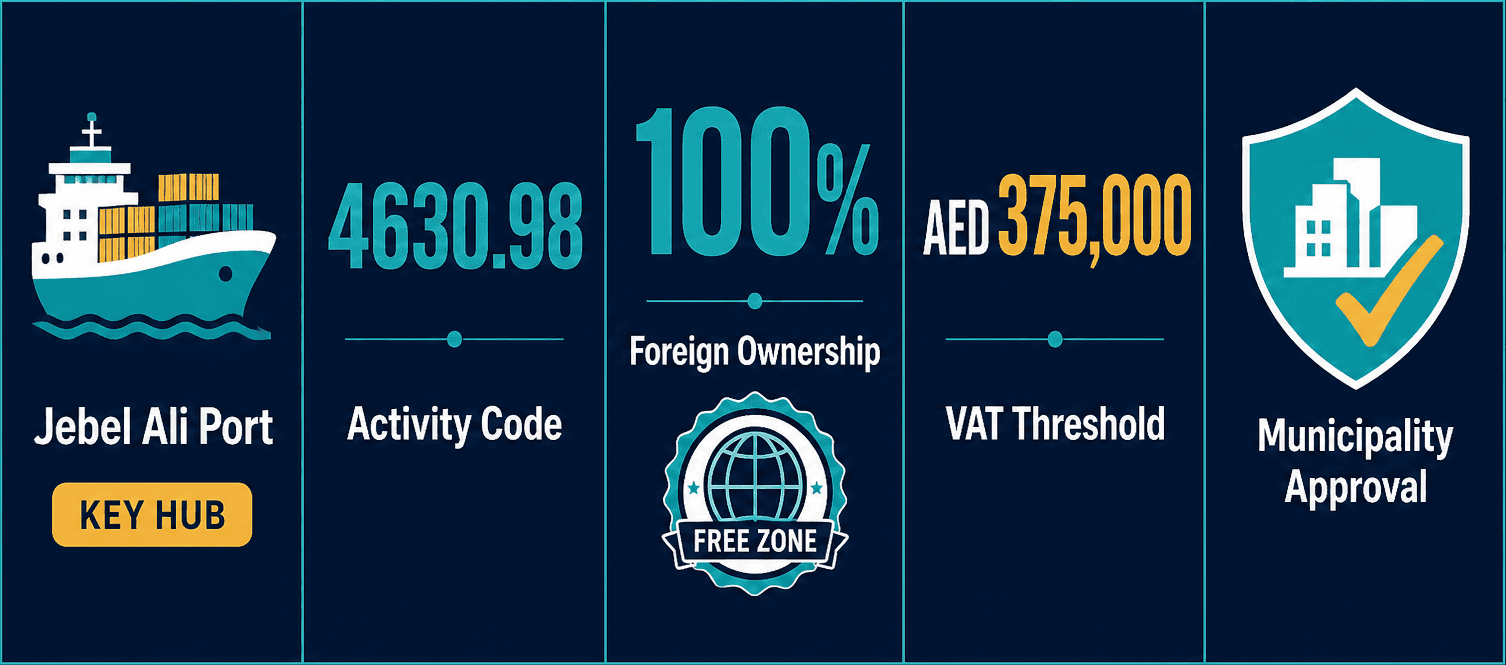
Dubai allows 100% foreign-owned foodstuff supply businesses under activity code 4630.98, covering wholesale food trade.
Dubai's position as a regional trade and logistics hub makes it one of the most strategic locations in the world to establish a foodstuff supply services business. With world-class port infrastructure, a business-friendly regulatory environment, and strong demand from a growing population and hospitality sector, Dubai offers genuine competitive advantages for food traders and wholesalers.
This guide explains what activity code 4630.98 covers, who can operate under it, and the key licensing and setup considerations for launching a foodstuff supply business in Dubai.
📊 Key Facts at a Glance
Activity Code: 4630.98 — Foodstuff Supply Services
Licence Type Required: Commercial Trade Licence
Ownership: 100% foreign ownership available in free zones
External Approval: Dubai Municipality Food Safety Department (where applicable)
VAT: Registration required if annual turnover exceeds AED 375,000
Key Advantage: Access to Al Maktoum International Airport and Jebel Ali Port via Dubai South
What Is Foodstuff Supply Services (Activity Code 4630.98)?
Activity code 4630.98 falls under Dubai's commercial activity classification system and covers the wholesale supply and trade of food products, ingredients, and consumables. Businesses operating under this code act as intermediaries in the food supply chain — sourcing, storing, and distributing food goods to retailers, hospitality operators, institutions, and other businesses.
This activity is distinct from food manufacturing (which involves processing or producing food items) and food retail (which involves selling directly to end consumers). The scope of 4630.98 is specifically focused on the wholesale and supply side of the food trade.
Typical products covered under this activity include:
Dry goods and packaged foods (rice, flour, sugar, cereals)
Canned and preserved foods
Beverages, including juices, water, and soft drinks
Perishable products such as dairy, meat, and fresh produce (subject to additional storage requirements)
Bulk food commodities for commercial use
Food ingredients and additives supplied to the food service industry
You can explore the full list of business activities in Dubai to compare related trade classifications before finalising your application.
Who Can Conduct This Activity?
Foodstuff supply services can be conducted by a range of legal structures, including Limited Liability Companies (LLCs), sole establishments, and free zone companies. Both UAE nationals and foreign investors are eligible to operate under this activity. Importantly, setting up within a free zone allows 100% foreign ownership without the requirement for a local UAE sponsor — a significant advantage for international entrepreneurs and investors entering the Dubai market.
Licensing Requirements and Regulatory Considerations
To legally operate a foodstuff supply services business in Dubai, you will need a commercial trade licence issued by the relevant authority — either the Department of Economy and Tourism (DET) for mainland operations or the applicable free zone authority. The licence must accurately reflect the activity code and description to ensure regulatory compliance. For general guidance on business licensing frameworks in the UAE, refer to the UAE Ministry of Economy.
If your business model includes a trading business licence in Dubai, it is important to ensure the activity description on your licence precisely matches the nature of goods you intend to supply.
Businesses that exceed the UAE's mandatory VAT registration threshold are required to register for VAT. Full details on thresholds, registration procedures, and filing obligations are available through the Federal Tax Authority.
Dubai Municipality External Approval
Dubai Municipality's Food Safety Department may require an external approval for businesses involved in the storage, distribution, or supply of food products. This is a critical step that many new entrants overlook. The approval process typically involves demonstrating that your storage and handling facilities meet applicable food safety standards.
The requirement applies to businesses operating in both mainland and free zone jurisdictions when they physically handle food products within Dubai. Operators are strongly advised to verify current requirements directly with Dubai Municipality before submitting their licence application, as requirements can vary depending on the product category and operational model.
Mainland vs Free Zone Licensing
A mainland licence issued through the DET allows businesses to trade directly across the UAE market without restriction. A free zone licence offers 100% foreign ownership and a streamlined setup process, but local distribution within the UAE mainland may require engagement with a registered mainland agent or distributor. The right choice depends on your target customer base, distribution model, and ownership preferences.
Typical Setup Requirements for Foodstuff Supply Businesses
Regardless of whether you choose a mainland or free zone structure, the following are typically required when setting up a foodstuff supply services business in Dubai:
Registered trade name: Must comply with UAE naming conventions and be approved by the licensing authority. You can check your business name availability before proceeding with your application.
Memorandum of Association (MOA): Or equivalent constitutional document, depending on your legal structure.
Suitable business premises or warehouse: Storage facilities for food products may need to meet specific temperature, hygiene, and safety standards as defined by Dubai Municipality.
Visa eligibility: Linked to your licence type, legal structure, and the size of your office or facility.
Understanding the business setup cost in Dubai early in the planning process helps you budget accurately for licence fees, premises, and ancillary approvals.
Staffing and Visa Considerations
For mainland entities, employee visas are processed through the Ministry of Human Resources and Emiratisation (MOHRE). You can find guidance on labour-related processes through MOHRE's official portal. Visa quotas are typically tied to office space and the licence category. Residency stamping and Emirates ID issuance are handled by the Federal Authority for Identity, Citizenship, Customs and Port Security (ICP). Free zone companies follow their own visa allocation frameworks as defined by the respective free zone authority.
Setting Up in a Free Zone: Dubai South Business Hub as an Option
For foodstuff supply businesses with a logistics-driven operational model, Dubai South Business Hub Free Zone presents a practical and strategically positioned option. Its proximity to Al Maktoum International Airport — one of the world's largest cargo hubs — and the Jebel Ali Port corridor provides direct access to major import and export routes, which is a meaningful advantage for food supply chains dependent on timely freight movement.
The free zone environment supports 100% foreign ownership and offers a streamlined company registration process. Dubai South Business Hub offers flexible licence packages suited to trading activities, including foodstuff supply services. Operators should confirm activity eligibility and any food-related external approval requirements with the free zone authority directly before applying. For further information on navigating setup procedures, including immigration file references, visit Dubai South Business Hub's immigration guide.
Why Location Matters for Foodstuff Supply
Access to major ports and air freight corridors directly reduces import and export lead times — a critical factor when dealing with perishable or time-sensitive food products. Dubai South's strategic positioning supports both regional distribution into Gulf markets and re-export operations into Africa, South Asia, and beyond. Dubai's trade infrastructure is consistently ranked among the most efficient globally, supported by platforms such as Dubai Trade, which facilitates customs clearance and logistics coordination.
Key Considerations Before You Apply
Before submitting your licence application, work through the following checklist to avoid delays or rejections:
Confirm the exact activity code and description with the licensing authority. Minor discrepancies in activity wording can cause compliance issues later.
Identify whether Dubai Municipality food safety approval applies to your specific product range and operational model — this is not automatic and must be verified.
Assess your distribution model to determine whether a mainland or free zone structure better supports your business goals.
Engage a registered business setup consultant to navigate the approvals process efficiently and avoid common procedural errors.
Ensure VAT compliance from day one. Review your registration obligations with the Federal Tax Authority before you begin trading.
Conclusion
Establishing a foodstuff supply services business in Dubai under activity code 4630.98 requires a commercial trade licence, potential Dubai Municipality food safety approval, and a deliberate choice between mainland and free zone structures. For logistics-focused operations, options like Dubai South Business Hub Free Zone offer practical geographic and operational advantages worth evaluating carefully.
With the right structure in place, Dubai's food supply sector offers significant growth potential — supported by strong trade infrastructure, a diverse consumer base, and a well-regulated business environment.
Contact Dubai South Business Hub today to explore licence packages for your foodstuff supply business and receive guidance tailored to your operational needs.
Activity code 4630.98 covers the wholesale supply and trade of food products, ingredients, and consumables. It is distinct from food manufacturing and retail, focusing specifically on the supply chain and distribution of foodstuffs to commercial buyers.
References
UAE Ministry of Economy (moet.gov.ae)
Federal Tax Authority (tax.gov.ae)
MOHRE's official portal (mohre.gov.ae)
Federal Authority for Identity, Citizenship, Customs and Port Security (ICP) (icp.gov.ae)
Dubai Trade (dubaitrade.ae)
Frequently Asked Questions