Sea Freight & Passengers Charters Business Setup in Dubai: Licensing Guide

Topic Summary
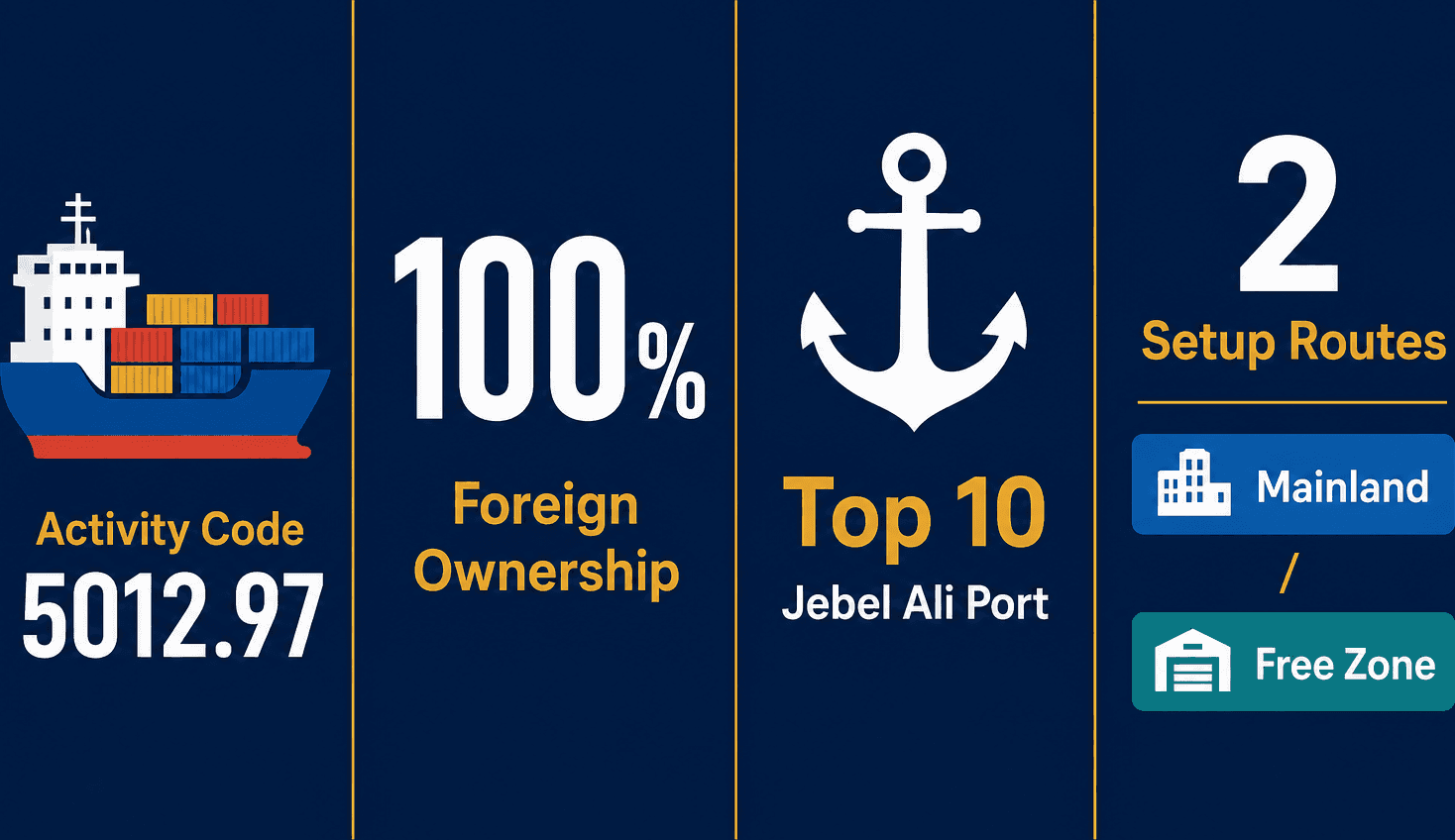
Understanding Activity Code 5012.97
This code covers chartering and operation of sea-going vessels for both cargo and passenger transport, distinct from land-based logistics. It applies to firms managing vessel charters across sea routes for freight or passenger purposes.
Scope of Permitted Operations
Registered businesses can charter or sub-charter vessels, handle maritime freight forwarding, arrange passenger charters for tourism or commercial use, and coordinate route planning and logistics.
Mainland Licensing Route
A mainland license is issued by Dubai's Department of Economy and Tourism, allowing unrestricted trade with local entities and government contracts. It requires alignment with activity code 5012.97 and may involve specific shareholder structures.
Free Zone Licensing Advantages
Free zones such as Dubai South Business Hub allow up to 100% foreign ownership and offer a streamlined setup process for international operators. This route suits businesses focused on regional or international maritime operations.
Key Regulatory Approvals Needed
Operators must secure vessel registration and clearances from the Dubai Maritime Authority, along with port authority approvals and crew certifications. These approvals ensure compliance with maritime safety and operational standards.
Strategic Port Access via Jebel Ali
Businesses benefit from direct access to Jebel Ali Port, one of the world's ten busiest container ports. This provides strong connectivity for both cargo and passenger vessel operations.
Planning Setup Costs Effectively
Entrepreneurs are encouraged to use a dedicated cost calculator to estimate Dubai business setup expenses. This helps in budgeting for licensing, approvals, and operational requirements.
Dubai's strategic position as a global maritime hub makes it one of the most commercially viable locations in the world to establish a sea freight and passenger charters business. Sitting at the crossroads of major international shipping lanes, with world-class port infrastructure and an open trade environment, Dubai offers unmatched advantages for maritime entrepreneurs. This guide covers everything you need to know about activity code 5012.97 — what it permits, who qualifies, licensing pathways, regulatory requirements, and how free zones like Dubai South Business Hub can support your setup.
📊 Sea Freight & Passengers Charters in Dubai — Key Facts
|
What Is Sea Freight & Passengers Charters (Activity Code 5012.97)?
Activity code 5012.97 falls under the UAE's commercial business classification system and covers the chartering and operation of sea-going vessels for both cargo and passenger transport. It is a recognised activity within the maritime and logistics sector, applicable to businesses that arrange, manage, or operate vessel charters across sea routes — whether for freight movement or passenger transportation purposes.
This activity is distinct from general freight forwarding or land-based logistics. It specifically relates to the maritime dimension of cargo and passenger movement, making it relevant to a defined category of operators. You can explore the full list of business activities in Dubai to understand how this code sits within the broader commercial landscape.
What Does This Activity Permit?
Businesses registered under activity code 5012.97 are generally permitted to conduct the following operations:
Chartering and sub-chartering of sea-going vessels for commercial purposes
Freight forwarding and cargo transport via maritime routes
Passenger vessel charter arrangements for commercial, leisure, or tourism purposes
Coordination of vessel scheduling, route planning, and maritime logistics
Typical businesses that register under this activity include international shipping companies, maritime charter operators, cruise and leisure boat operators, and logistics firms with a sea freight component.
Licensing Requirements and Business Setup Options in Dubai
Choosing the right licensing pathway is one of the most important decisions when setting up a sea freight and passenger charters business in Dubai. Entrepreneurs generally have two primary routes: mainland licensing or free zone licensing. Each carries different ownership structures, operational scopes, and regulatory considerations. For guidance on the business setup cost in Dubai, using a dedicated cost calculator can help you plan your budget effectively.
Mainland Licensing Pathway
A mainland commercial license is issued by the Department of Economy and Tourism (DET) in Dubai. Under this structure, businesses can operate directly within the UAE market without restrictions on trading with local entities. According to the UAE Ministry of Economy, commercial activities must align with approved activity codes and comply with applicable federal and emirate-level regulations.
Requires a commercial license issued by DET aligned with activity code 5012.97
Legal structures such as an LLC may require specific shareholder arrangements depending on the activity and applicable laws
Direct engagement with UAE-based clients and government contracts is permitted
Free Zone Licensing Pathway
Free zones in Dubai offer a compelling alternative, particularly for international operators looking to establish a regional base. Key advantages include:
100% foreign ownership permitted without the need for a local partner
Streamlined documentation and a simplified registration process
Access to investor visa packages tied to the commercial license
Dubai South Business Hub Free Zone offers commercial licenses that can cover logistics and maritime-adjacent activities, making it a practical option for operators in the sea freight and charter space. Its location near Jebel Ali and Al Maktoum International Airport adds logistical value for maritime businesses.
Regulatory Approvals and Maritime Authority Requirements
Beyond the standard business license, sea freight and passenger charter operations in Dubai are subject to additional regulatory oversight. The Dubai Maritime Authority (DMA) is the primary body responsible for regulating maritime activities within Dubai's waters, and its approvals are a mandatory consideration before commencing commercial vessel operations.
Businesses should also be aware of federal maritime regulations enforced across UAE territorial waters, which govern vessel safety, crew qualifications, and operational standards. Dubai Trade provides a useful portal for understanding customs, trade, and port-related compliance requirements relevant to sea freight operators.
Key External Approvals to Consider
Dubai Maritime Authority (DMA): Approval required for commercial vessel registration, charter licensing, and operational permits within Dubai waters
Port Authority Clearances: Freight handling at major ports may require clearances from relevant port authorities; DP World manages several key terminals including Jebel Ali Port
Vessel Safety Certifications: All sea-going vessels must meet international safety standards, including SOLAS compliance where applicable
Crew Licensing: Marine crew must hold valid certifications under STCW (Standards of Training, Certification and Watchkeeping) conventions
Insurance Requirements: Passenger charter vessels are typically required to carry comprehensive liability insurance covering passengers and third parties
Typical Setup Requirements and Documentation
Whether you choose a mainland or free zone route, certain documentation and procedural requirements are common across both pathways. Being prepared with the right paperwork can accelerate your registration timeline significantly.
Passport copies of all shareholders and directors
A business plan outlining the nature and scope of maritime operations
No Objection Certificate (NOC) letters where applicable
Proof of registered office address or flexi-desk arrangement
Minimum share capital (varies by legal structure and jurisdiction)
Visa eligibility is linked to your license type and company size. Most free zone licenses, including those at Dubai South Business Hub, come with the option to sponsor investor and employee visas. You can learn more about UAE residency visa options available through free zone company formation.
Choosing the Right Legal Structure
The legal structure of your business will affect ownership, liability, and operational flexibility. Common options include:
Free Zone Company (FZC/FZE): Suitable for international operators; allows 100% foreign ownership but restricts direct onshore trading without a local distributor or agent
Limited Liability Company (LLC): Mainland structure allowing full UAE market access; subject to applicable ownership regulations
Sole Establishment: Available on the mainland for individual operators; owner assumes full liability
Carefully assess your operational scope — particularly whether you intend to trade directly with UAE-based clients or primarily serve international routes — before selecting your jurisdiction.
Why Dubai Is a Strategic Base for Sea Freight & Charter Operations
Dubai's maritime credentials are well established. The emirate's location at the junction of the Arabian Gulf and the Indian Ocean places it on some of the world's most active shipping lanes, connecting Asia, Europe, Africa, and the Americas. According to the Dubai Chamber of Commerce, the UAE's trade ecosystem continues to attract international businesses across sectors, with maritime and logistics remaining core pillars of economic activity.
Additional strategic advantages include:
Access to Jebel Ali Port — one of the world's largest and busiest container terminals
UAE's extensive network of bilateral trade agreements supporting maritime commerce
A growing leisure and tourism sector driving demand for passenger charter services
Transparent regulatory frameworks and investor-friendly government policies
Dubai South Business Hub as a Setup Option
Dubai South Business Hub Free Zone is strategically located near Al Maktoum International Airport and in proximity to Jebel Ali — a combination that makes it particularly relevant for logistics and maritime-oriented businesses. The free zone offers:
Commercial licenses covering freight and charter-related activities
Flexible office and flexi-desk solutions to suit different business sizes
An investor-friendly environment with streamlined onboarding processes
Residency visa packages linked to the commercial license
If you are ready to start your business in Dubai, Dubai South Business Hub provides a practical and well-located foundation for maritime entrepreneurs looking to establish a credible regional presence.
Conclusion
Setting up a sea freight and passenger charters business in Dubai under activity code 5012.97 requires careful selection of the right jurisdiction, compliance with Dubai Maritime Authority regulations, and thorough preparation of documentation. However, the emirate's world-class infrastructure, open trade environment, and strategic geographic position make it a compelling choice for maritime entrepreneurs at every scale. Whether you opt for a mainland commercial license or a free zone structure, understanding the regulatory landscape from the outset will position your business for long-term success.
Speak with a Dubai South Business Hub advisor today to explore licensing options tailored to your sea freight or passenger charter business needs.
References
UAE Ministry of Economy (moet.gov.ae)
Dubai Trade (dubaitrade.ae)
DP World (dpworld.com)
Dubai Chamber of Commerce (dubaichamber.com)
Frequently Asked Questions