How to Get an Other Passenger Road Transport Business License in Dubai

Topic Summary
Starting a passenger road transport business in Dubai under activity code 49221 requires both a trade license and RTA approval.
Dubai's expanding road network and growing population make passenger road transport one of the emirate's most in-demand commercial activities. Whether you are planning shuttle services, charter bus operations, or corporate transfer solutions, understanding the licensing landscape is essential before you invest. This guide explains what activity code 49221 covers, who can operate under it, the licensing steps involved, and how Dubai South Business Hub Free Zone can serve as a practical setup option for transport entrepreneurs.
📊 Key Facts at a Glance — Activity Code 49221
Activity Name: Other Passenger Road Transport
Activity Code: 49221
Primary Regulator: Department of Economy and Tourism (DET) for mainland; relevant free zone authority for free zones
External Approval Required: Road and Transport Authority (RTA)
Common Use Cases: Shuttle services, charter buses, school transport, corporate transfers, tourism transfers
Ownership: Up to 100% foreign ownership available in free zones
VAT Threshold: Applicable per Federal Tax Authority guidelines
What Is 'Other Passenger Road Transport' (Activity Code 49221)?
Activity code 49221 falls under the UAE Standard Industrial Classification for land transport and covers scheduled and non-scheduled passenger transport services that are not classified elsewhere in the transport taxonomy. In practical terms, this includes shuttle services between designated points, charter bus operations, school transport contracts, private group transfers, and tourism-related road transport. It is distinct from taxi and ride-hailing services, which are regulated under separate classifications, and from public bus operations managed directly by government transport authorities.
Businesses targeting corporate shuttle contracts, hotel-to-airport transfers, event transportation, or school bus operations would typically register under this activity code. You can explore the full list of business activities in Dubai to understand how 49221 sits within the broader transport and logistics classification framework.
Who Can Conduct This Activity?
LLC structures on the mainland, where foreign ownership rules have been significantly liberalised for many commercial activities
Free zone entities, which can benefit from up to 100% foreign ownership depending on the zone's charter
Sole establishments, typically available to UAE and GCC nationals on the mainland
Regardless of legal structure or jurisdiction, all operators must meet the Road and Transport Authority's fleet, driver, and operational standards. Choosing between mainland and free zone affects your ownership structure and operational scope — not your obligation to comply with RTA requirements.
Licensing and Regulatory Requirements in Dubai
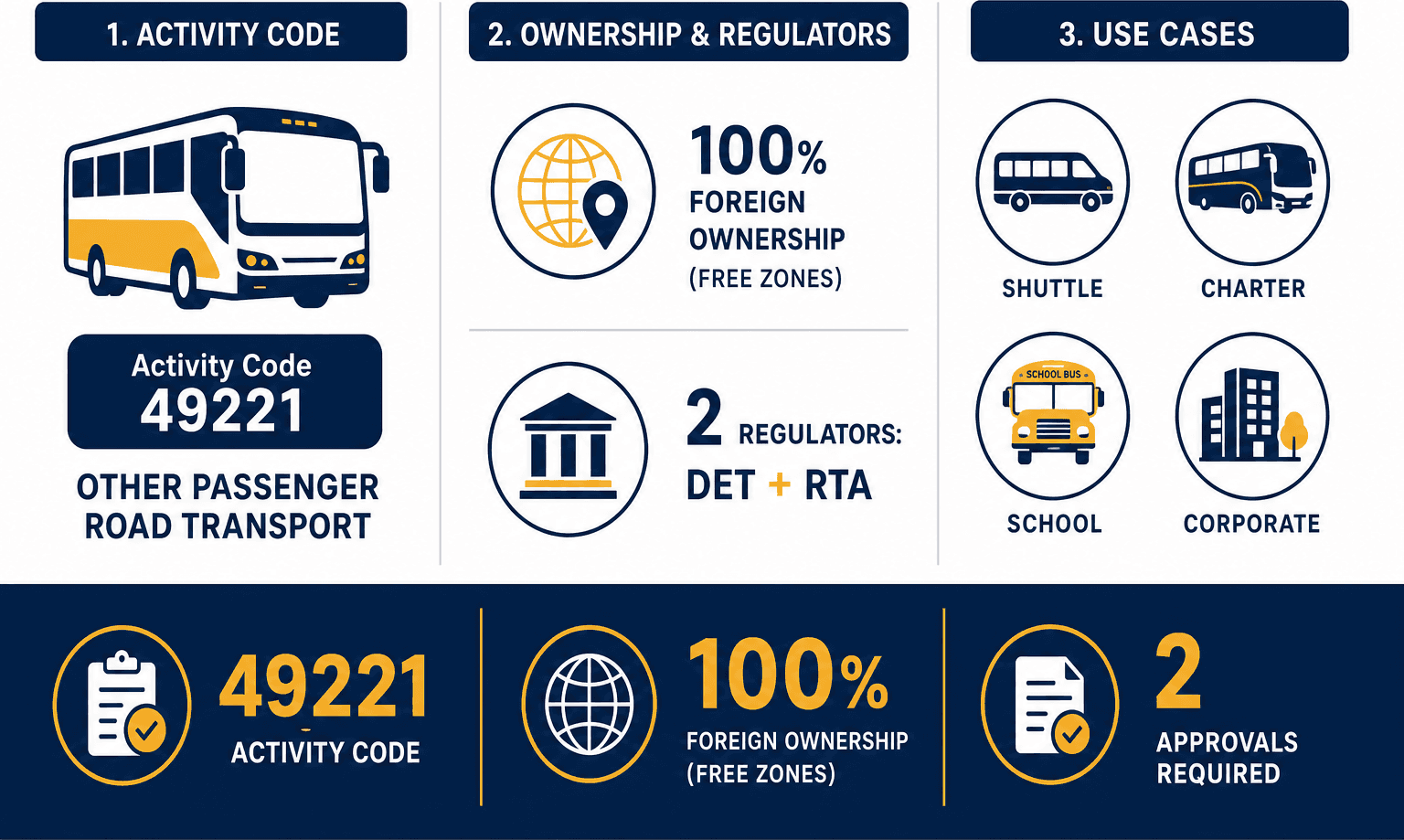
The primary trade license for this activity is issued either by the Department of Economy and Tourism (DET) for mainland companies or by the relevant free zone authority for free zone entities. The trade license confirms your legal right to conduct the business activity but does not, on its own, authorise vehicles to operate on public roads.
Your trade name registration and Memorandum of Association must explicitly reflect the passenger transport activity. Ambiguously worded corporate documents can delay approvals or create compliance issues later. Initial approval from the licensing authority is typically obtained before the MOA is finalised and the full license is issued.
RTA External Approval Considerations
RTA approval is a mandatory external step that runs parallel to — but separate from — the trade license process. The UAE government's official portal outlines the general framework for transport licensing, but operators should engage directly with the RTA for fleet-specific requirements. Key RTA requirements typically include:
Vehicle registration and roadworthiness certification for each unit in the fleet
Route permits or operational area approvals depending on service type
Driver licensing verification and, where applicable, NOC for hired drivers
Vehicle type standards — for example, specifications for school buses differ from charter coaches
Operators should factor RTA processing timelines into their overall business launch plan. Receiving your trade license does not mean you can immediately begin road operations — RTA clearance must be in place first.
Business Setup Options: Mainland vs. Free Zone
A mainland setup under DET allows your company to operate across Dubai and the wider UAE road network without geographic restriction. This is generally the preferred structure for businesses with contracts spanning multiple emirates or those servicing public-facing routes. Mainland companies can engage directly with government tenders and corporate clients across all sectors.
A free zone setup is well-suited to operators whose primary contracts are within or adjacent to a specific economic zone — for example, airport transfers, logistics corridor shuttles, or zone-specific corporate transport. Free zone companies that wish to operate vehicles on public roads outside the zone may require additional mainland permits or RTA approvals, so this distinction is important to clarify during setup planning.
Before choosing a jurisdiction, compare visa quota allocations, minimum office space requirements, and the business setup cost in Dubai across both options to find the structure that fits your operational model.
Why Consider Dubai South Business Hub Free Zone?
Dubai South Business Hub Free Zone is strategically located within the Dubai South economic district, adjacent to Al Maktoum International Airport and in close proximity to major logistics, aviation, and Expo City corridors. For transport businesses targeting airport-adjacent transfers, cargo-linked passenger services, or corporate shuttle contracts within this high-growth zone, the location offers genuine operational relevance. The free zone provides flexible office and flexi-desk options, making it accessible for early-stage transport operators who want a compliant registered address without committing to large physical premises from day one.
Typical Requirements and Key Setup Considerations
While exact requirements depend on your chosen jurisdiction and business structure, the following documents and steps are commonly involved:
Passport copies and current visa status documentation for all shareholders and managers
No-objection certificates (NOCs) where shareholders are employed on existing UAE visas
A signed lease agreement or registered office address confirmation in the chosen jurisdiction
Fleet documentation including vehicle registration, comprehensive insurance, and RTA compliance certificates
Completed application forms for trade name reservation and initial approval
VAT registration may apply once your annual turnover meets or exceeds the threshold set by the Federal Tax Authority. Review the FTA's official guidance to understand when registration becomes mandatory and what transport-related supplies are treated as taxable or exempt.
Workforce and Visa Considerations
Driver employment contracts and visa arrangements must comply with MOHRE standards, including written employment agreements, appropriate job classifications, and wage protection system registration. Visa quotas are allocated based on your license type and the office space category you hold. Flexi-desk arrangements typically carry a lower quota than dedicated office space, so plan your headcount requirements before finalising your office package. You can also explore UAE residency visa packages tied to your company license through Dubai South Business Hub Free Zone.
Steps to Obtain Your Passenger Road Transport License in Dubai
Choose your jurisdiction — Decide between a mainland DET license or a free zone authority license based on your target market and operational scope.
Reserve your trade name — Submit a trade name application and obtain initial approval from the relevant authority. You can check company name availability before applying.
Prepare and attest legal documents — Draft your Memorandum of Association and shareholder agreements; attest where required.
Secure your registered address — Sign a lease or flexi-desk agreement that satisfies the jurisdiction's minimum office requirements.
Submit the full license application — Provide all required documents to the licensing authority for review and issuance.
Obtain RTA external approval — Register your fleet, secure vehicle permits, and confirm driver licensing compliance through the RTA.
Receive your trade license — Proceed with employee visa applications, bank account opening, and VAT registration as applicable.
Conclusion
Getting a passenger road transport license in Dubai under activity code 49221 involves choosing the right jurisdiction, meeting RTA fleet and operational standards, and following a structured, sequential application process. Free zone options such as Dubai South Business Hub Free Zone offer a practical entry point — particularly for operators targeting airport-adjacent or zone-specific transport contracts — while mainland licensing remains the route for businesses seeking unrestricted UAE-wide operations. Planning your regulatory steps carefully, including RTA approvals, workforce compliance, and VAT obligations, will position your business for a smooth and compliant launch.
Contact Dubai South Business Hub Free Zone today to explore how to set up your business in passenger road transport efficiently and compliantly.
Activity code 49221 covers other passenger road transport services not classified elsewhere, including shuttle services, charter buses, school transport, and private group or corporate transfers. It does not include taxi, ride-hailing, or scheduled public bus services, which fall under separate classifications.
References
Department of Economy and Tourism (DET) (moet.gov.ae)
FTA's official guidance (tax.gov.ae)
MOHRE (mohre.gov.ae)
Frequently Asked Questions