Raw Materials Transport by Road Business License in Dubai: Cost and Requirements

Topic Summary
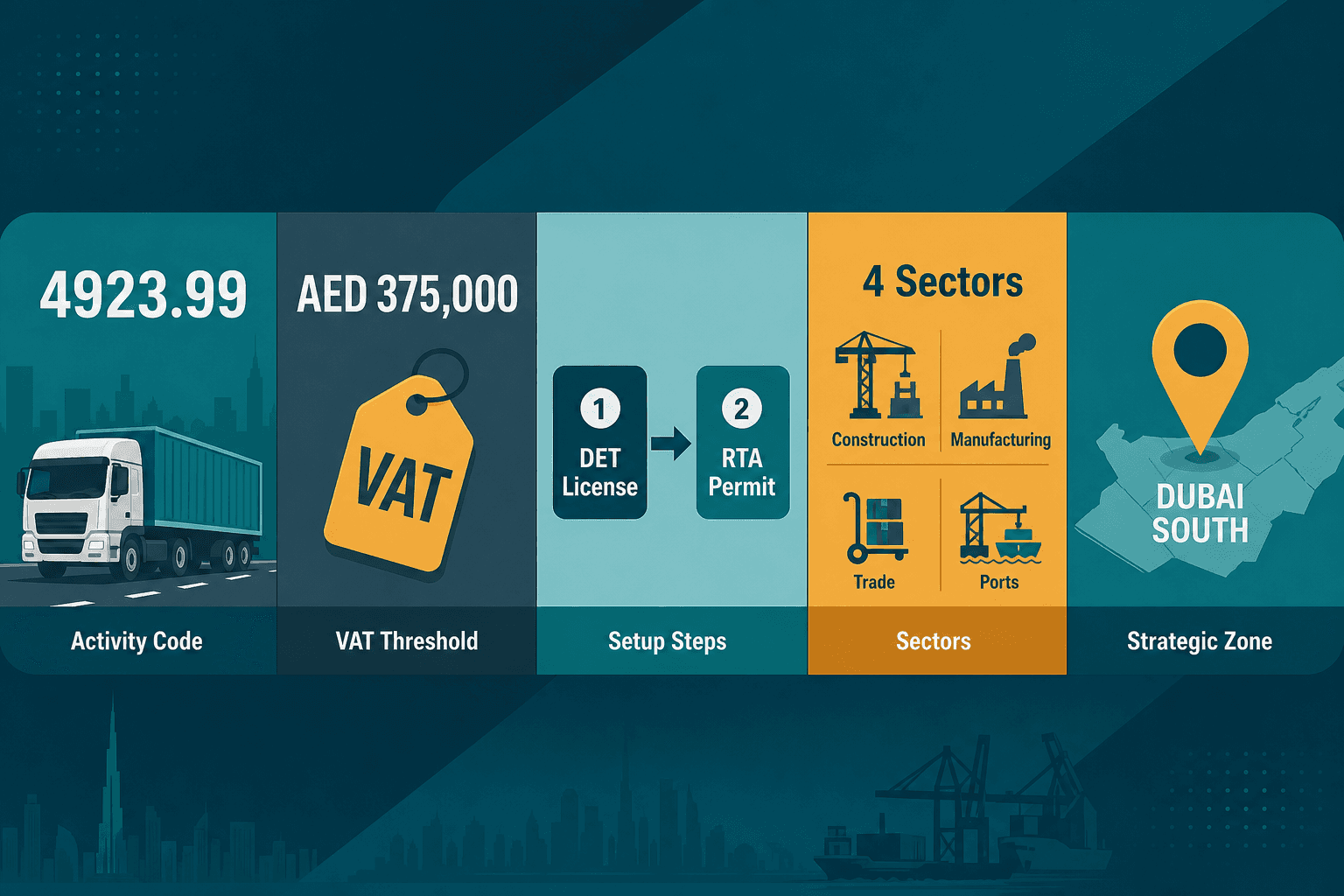
Understand Activity Code 4923.99
This code specifically covers road-based movement of raw and semi-processed materials, distinct from general freight, courier, or hazardous goods transport. It applies to cargo like sand, gravel, cement, steel rods, timber, and bulk agricultural commodities.
Know Who Regulates Your License
Mainland operators must license through the Dubai Department of Economy and Tourism, while free zone businesses go through their respective free zone authority. A business license alone won't authorize road operations without further approvals.
Secure RTA Vehicle Approvals
The Roads and Transport Authority governs commercial vehicle permits, route authorisations, and load limits for freight operators. All fleet vehicles must be registered, drivers properly licensed, and vehicles compliant with roadworthiness and emissions standards.
Confirm the Activity's Scope
This license covers unprocessed and semi-processed material transport but excludes retail delivery, passenger transport, and finished consumer goods. Operators should verify permitted scope with licensing authorities to avoid compliance issues.
Plan for VAT Registration
Businesses crossing AED 375,000 in annual turnover are required to register for VAT. This threshold should be factored into financial planning from the outset.
Consider a Strategic Location
Dubai South is highlighted as an advantageous base due to its proximity to Al Maktoum International Airport and Jebel Ali Port. This location can streamline logistics for construction, manufacturing, and trade-sector clients.
Serve High-Demand Industrial Sectors
This activity plays a key role in supply chains for construction, manufacturing, trade, and port logistics. Reliable raw materials transport supports continuous operations at quarries, warehouses, and processing facilities.
Dubai's position as a regional trade and logistics hub makes road-based raw materials transport a high-demand business activity — but securing the right license under activity code 4923.99 requires navigating specific regulatory and setup considerations. Whether you are moving construction aggregates, industrial inputs, or bulk commodities between suppliers and industrial zones, operating legally in Dubai means understanding both the licensing framework and external approval requirements. This guide covers what the Raw Materials Transport by Road activity entails, who can operate it, licensing requirements, and how to set up compliantly in Dubai.
📊 Key Facts at a Glance
Activity Code: 4923.99 — Raw Materials Transport by Road
Primary Regulator: Dubai Department of Economy and Tourism (DET) for mainland; relevant free zone authority for free zone
External Approval: Roads and Transport Authority (RTA) for commercial vehicle permits
VAT Threshold: AED 375,000 annual turnover triggers mandatory VAT registration
Key Sectors Served: Construction, manufacturing, trade, and port logistics
Strategic Location Option: Dubai South — proximity to Al Maktoum International Airport and Jebel Ali Port
What Is Raw Materials Transport by Road (Activity Code 4923.99)?
Activity code 4923.99 falls under the UAE's freight transport classifications and specifically covers the road-based movement of raw and semi-processed materials. This distinguishes it from general freight haulage, courier services, or the transport of hazardous goods, which each carry their own regulatory classifications. The activity is directly relevant to Dubai's booming construction, manufacturing, and trade sectors, where the continuous movement of unprocessed inputs — from quarries, ports, and warehouses to processing facilities and industrial zones — is essential to daily operations.
Businesses licensed under this activity play a critical role in supply chain continuity. You can explore the full list of business activities in Dubai to understand how this activity code fits within the broader transport and logistics classification framework.
Scope of the Activity
The activity covers the road-based movement of unprocessed or semi-processed materials between suppliers, ports, and industrial zones. Common cargo types include sand, gravel, cement, steel rods, timber, chemical raw inputs, and agricultural commodities in bulk. The activity does not typically include retail delivery, passenger transport, or the movement of finished consumer goods. Operators should confirm the precise scope with the licensing authority to avoid inadvertently conducting activities outside the permitted classification.
Licensing Requirements and Regulatory Approvals
The primary business license for Raw Materials Transport by Road is issued either by the Dubai Department of Economy and Tourism (DET) for mainland operations, or by the relevant free zone authority if the business is established within a free zone. In both cases, the business license alone is not sufficient — operators must also obtain the necessary approvals from the Roads and Transport Authority (RTA) to legally deploy commercial vehicles on Dubai's public road network.
For general regulatory guidance on business licensing in the UAE, the UAE Ministry of Economy provides baseline information on commercial activity classifications and compliance obligations.
RTA and External Approvals
The RTA oversees commercial vehicle permits, load limits, route authorisations, and road usage compliance for all freight operators in Dubai. Before beginning operations, businesses must ensure that:
All fleet vehicles are registered with the RTA as commercial freight vehicles
Drivers hold valid UAE commercial driving licences appropriate for the vehicle class
Vehicles meet UAE roadworthiness and emissions standards, including periodic inspection requirements
Load limits and permitted routes are observed in accordance with RTA regulations
For operators conducting port-linked haulage — moving raw materials to or from Jebel Ali or Al Maktoum — coordination with Dubai Trade may also be required for customs-related clearances and port access permits.
Mainland vs. Free Zone Licensing
A mainland license issued by DET allows unrestricted commercial road operations across Dubai and the wider UAE, making it the most operationally flexible option for businesses serving multiple client sites. A free zone license is suitable for operators primarily focused on zone-to-zone logistics or export-linked transport corridors. However, free zone operators who wish to conduct haulage on public mainland roads may require a local agent arrangement or an additional permit from the relevant mainland authority. Businesses should assess their operational model carefully before selecting a jurisdiction.
Business Setup Considerations for This Activity
When setting up a Raw Materials Transport by Road business in Dubai, the legal structure you choose will influence your operational flexibility, ownership rights, and compliance obligations. Common structures include a Limited Liability Company (LLC) for mainland operations, a sole establishment, or a free zone company. Minimum share capital requirements vary depending on the jurisdiction and legal structure — always verify current requirements directly with the authority you are registering with.
Office or warehouse space requirements will depend on your operational scale. Smaller operators may qualify for a flexi-desk or registered address arrangement, while larger fleet operators will typically need dedicated yard or depot space. You can use the business setup cost calculator to get an indicative figure based on your activity and requirements.
Why Location Matters for Transport Businesses
For raw materials transport operators, physical proximity to key freight infrastructure is a genuine competitive advantage. Dubai South Business Hub Free Zone is a practical option worth considering, given its location adjacent to Al Maktoum International Airport, within reach of Jebel Ali Port, and embedded within Dubai's primary logistics and industrial corridor. This geography supports supply chain-integrated transport operators who need fast, cost-efficient access to major cargo entry points. Free zone setup within this cluster can reduce overheads for startups and growing businesses while maintaining meaningful access to key freight routes.
Typical Costs Involved in Obtaining This License
The cost of obtaining a Raw Materials Transport by Road license in Dubai varies depending on the jurisdiction, legal structure, and scale of operations. Key cost categories to plan for include:
License registration fees: These differ between DET (mainland) and free zone authorities. Always consult the chosen authority directly for current fee schedules, as these are subject to periodic revision.
RTA permits and vehicle registration: Each commercial vehicle in your fleet will require RTA registration, periodic roadworthiness certification, and route-specific permits where applicable.
Commercial vehicle insurance: Mandatory for all freight vehicles operating on UAE public roads; premiums vary by vehicle type, load capacity, and coverage scope.
Visa allocation costs: Employee and investor visas are tied to your company's registered size and office space. Costs include application fees, Emirates ID, and medical screening.
Annual renewal fees: Both the trade license and vehicle-related permits require annual renewal — factor these into your ongoing operational budget.
For UAE residency visa packages linked to your company license, Dubai South Business Hub Free Zone offers structured options that can be explored alongside your business registration.
Key Operational and Compliance Considerations
Beyond the initial licensing, Raw Materials Transport by Road businesses in Dubai must maintain ongoing compliance across several areas. Fleet management is central — operators must keep accurate records of vehicle maintenance, driver licences, and RTA inspection certificates. Any lapse in vehicle compliance can result in fines or suspension of operating permits.
Employment compliance is equally important. All drivers and logistics staff must be contracted in accordance with UAE Labour Law. The Ministry of Human Resources and Emiratisation (MOHRE) governs employment contracts, working hours, and worker protections in the UAE — operators should ensure all staff are properly registered and their rights protected.
VAT obligations apply if your annual turnover exceeds AED 375,000. At that threshold, registration with the Federal Tax Authority becomes mandatory. Businesses should also draft clear contracts with suppliers and clients to define liability, cargo responsibility, and dispute resolution — particularly important when transporting high-value raw materials over long distances.
For broader business support in the UAE, including PRO services and government transaction assistance, Dubai South Business Hub Free Zone provides structured support to help operators stay compliant from day one.
Conclusion
Obtaining a Raw Materials Transport by Road license in Dubai under activity code 4923.99 involves securing the correct business license from the appropriate authority, obtaining RTA approvals for all commercial vehicles, and choosing the right jurisdiction for your operational model — whether mainland or a logistics-focused free zone like Dubai South Business Hub. Each step requires careful planning and accurate, current information from the relevant regulatory bodies.
Speak with a Dubai South Business Hub advisor to explore licensing options tailored to your raw materials transport operation and get accurate, up-to-date cost guidance. You can also check your business name availability as a first step toward formalising your setup.
References
the UAE Ministry of Economy (moet.gov.ae)
Dubai Trade (dubaitrade.ae)
The Ministry of Human Resources and Emiratisation (MOHRE) (mohre.gov.ae)
Frequently Asked Questions