Setting Up a Transport of Freight via Rivers, Canals, Lakes and Other Inland Waterways, Including Inside Harbours and Ports Business in Dubai

Topic Summary
Understanding Activity Code 50221
This code covers commercial freight transport via rivers, canals, lakes, harbours, and ports, distinct from open-sea shipping classifications. In Dubai, it applies to operations along Dubai Creek, the Dubai Water Canal, and harbour freight movements.
Core Business Operations Covered
Licensed operators can conduct cargo barging within harbours, freight movement via man-made canals, port-to-port inland logistics, and creek-based goods transport. These activities support both urban and commercial supply chains across the UAE.
Eligible Legal Structures for Setup
Businesses can register as a mainland LLC, a Free Zone Company, or a Branch of a Foreign Company. Mainland LLCs now generally allow 100% foreign ownership, though transport activities may carry extra conditions.
Required Regulatory Approvals
Operators must secure approval from the Dubai Maritime Authority for vessel registration and safety compliance. Additional coordination through the Dubai Trade Portal and alignment with UAE Federal Transport Authority guidelines may also be necessary.
Demonstrating Operator Credentials
While formal qualifications aren't always mandatory at licensing, the Dubai Maritime Authority may evaluate operator experience during approval. Employing qualified maritime personnel can significantly strengthen a licence application.
Mainland vs Free Zone Decision
Mainland companies can trade directly with government entities and across all emirates but face more regulatory requirements. Free zone setups, such as Dubai South Business Hub, offer streamlined processes suited to logistics operators.
VAT and Tax Compliance
Inland waterway freight transport services are subject to VAT under UAE Federal Tax Authority rules. Operators should factor tax registration and reporting obligations into their business planning.
Dubai's strategic position as a global trade hub, anchored by world-class ports and an expanding network of inland waterways, makes it one of the most compelling locations to establish an inland waterway freight transport business. This guide explains what activity code 50221 covers, who can operate under it, how to obtain the right licence in Dubai, and why Dubai South Business Hub Free Zone is a practical setup option for operators in this sector.
📊 Key Facts: Inland Waterway Freight Transport in Dubai
|
What Is Activity Code 50221 and What Does It Cover?
Activity code 50221 falls under the UAE's standard business classification for inland waterway freight transport. It specifically covers the commercial movement of goods via non-sea water routes and waterside infrastructure — including rivers, canals, lakes, harbours, and ports. This distinguishes it from open-sea or coastal shipping activities, which fall under separate maritime classifications.
In Dubai's context, this activity is directly relevant to operations along Dubai Creek, the Dubai Water Canal, and harbour-side freight movements within and around major port facilities. Operators under this code are engaged in the physical logistics of moving cargo through these inland and port-adjacent waterways, rather than deep-sea or international ocean freight.
Types of Operations Included Under This Activity
Cargo barging and lighter services inside harbours and port terminals
Freight movement via man-made canals and waterways, including the Dubai Water Canal corridor
Port-to-port inland water logistics within UAE jurisdiction, including inter-terminal cargo transfers
Creek-based freight and goods transport supporting urban and commercial supply chains
Who Can Conduct This Business Activity in Dubai?
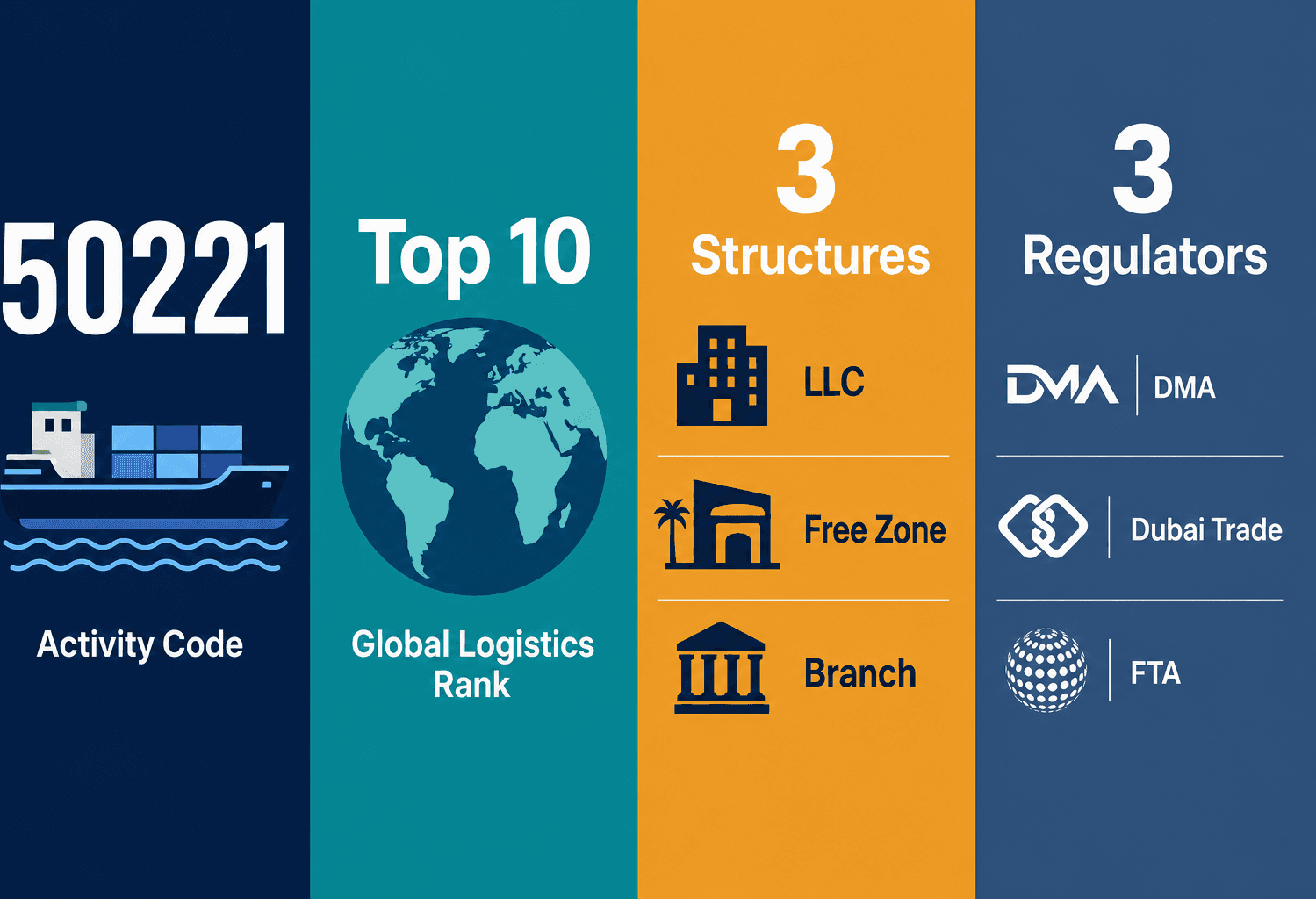
Businesses seeking to operate under activity code 50221 may be established as a Limited Liability Company (LLC) on the mainland, a Free Zone Company, or as a Branch of a Foreign Company. Under the UAE Commercial Companies Law, mainland LLCs now permit 100% foreign ownership across most sectors, though specific transport activities may carry additional conditions.
Operators are typically expected to demonstrate relevant maritime or logistics experience. While the UAE does not always mandate formal qualifications at the licensing stage, the Dubai Maritime Authority — the primary regulatory body for waterway operations — may assess operator credentials as part of its approval process. Engaging qualified maritime personnel strengthens any application considerably.
External Approvals and Regulatory Bodies
Dubai Maritime Authority: Approval from this authority is required for any commercial operation on Dubai's inland waterways and harbour areas. This includes vessel registration, safety compliance, and operational permits.
Dubai Trade Portal: Harbour-side activities and port logistics coordination are managed through Dubai Trade, which serves as the central platform for trade and logistics documentation.
UAE Federal Transport Authority: Depending on the nature of operations, alignment with federal transport guidelines may also be required for cross-emirate or federally regulated waterway routes.
Business Setup and Licensing Considerations in Dubai
Choosing between a mainland and free zone structure is a fundamental decision for inland waterway freight operators. Mainland companies benefit from the ability to operate directly with UAE government entities and across all emirates, but require compliance with additional local regulations. Free zone companies offer streamlined setup, full foreign ownership, and a favourable operating environment — particularly for logistics and trade-oriented businesses.
The applicable licence category for this activity is a commercial transport and logistics licence. Typical documentation required during the application process includes a business plan outlining operations, vessel details and registration documents, operator credentials, and proof of relevant insurance coverage. You can explore the full list of business activities in Dubai to confirm scope and related classifications before applying.
Why Consider Dubai South Business Hub Free Zone?
Dubai South Business Hub Free Zone is positioned within the Dubai South district — a master-planned logistics and aviation city adjacent to Al Maktoum International Airport and in close proximity to the Jebel Ali Port corridor. This geographic advantage makes it a practical choice for businesses involved in freight, logistics, and port-adjacent operations.
Proximity to major logistics and port infrastructure supporting harbour-side freight activities
Streamlined free zone company formation with full foreign ownership
Access to a business ecosystem aligned with trade, transport, and supply chain sectors
Straightforward licence issuance for transport and logistics activity codes
To understand your investment before committing, use the business setup cost calculator to get an indicative figure for your free zone company formation.
Key Requirements and Operational Considerations
Beyond the licence itself, inland waterway freight operators in Dubai must satisfy several operational requirements before commencing activity. Vessel registration and safety compliance under Dubai Maritime Authority regulations are non-negotiable prerequisites. All vessels used in commercial freight operations must meet applicable safety standards and carry valid registration.
Cargo liability insurance is strongly advisable and may be required by port authorities or clients. Staff engaged in waterway operations must hold appropriate visas and work permits in line with MOHRE guidelines, and employers must comply with UAE labour law regarding contracts, wages, and worker welfare.
Opening a corporate bank account is an essential step before commencing operations. You can learn more about bank account opening in Dubai and how taxation applies to your business structure. VAT registration is required once your taxable supplies exceed the mandatory threshold, and freight services carry specific VAT treatment under UAE Federal Tax Authority rules — full guidance is available at tax.gov.ae.
Compliance and Ongoing Obligations
Annual licence renewal: Free zone and mainland licences must be renewed annually with supporting documentation
VAT filing: Quarterly or periodic returns to the UAE Federal Tax Authority as applicable
Emiratisation: Transport businesses above a certain headcount threshold must comply with Emiratisation targets under MOHRE guidelines
Trade documentation: Port and harbour-side activities require accurate trade documentation submitted through the Dubai Trade portal
Dubai's Inland Waterway and Port Ecosystem: Market Context
Dubai consistently ranks among the world's leading logistics hubs, driven by its geographic position at the crossroads of Europe, Asia, and Africa. This status creates sustained demand for all categories of freight transport, including harbour-side and inland waterway operations.
DP World and Jebel Ali Port together form one of the busiest port complexes globally, generating significant demand for lighter services, inter-terminal barging, and harbour freight logistics. As Dubai's urban landscape evolves, the Dubai Water Canal and creek freight corridors are increasingly relevant for last-mile logistics and specialised cargo movement.
Niche opportunities exist for operators focusing on inter-terminal barging, time-sensitive harbour freight, and creek-based cargo services supporting the hospitality, construction, and retail supply chains. Setting up a business in this sector now positions operators to benefit from Dubai's continued investment in port and waterway infrastructure.
Conclusion
Establishing an inland waterway freight transport business in Dubai under activity code 50221 requires the right licence structure, external approvals from the Dubai Maritime Authority, and a clear understanding of operational and compliance obligations — all within one of the world's most active trade corridors. From vessel registration to VAT compliance and staff visa requirements, each step demands careful planning and the right setup partner.
Contact Dubai South Business Hub Free Zone today to explore how to set up your inland waterway freight transport company efficiently and within the correct regulatory framework. Before you begin, check your business name availability to secure your preferred trade name from the outset.
Activity code 50221 covers the commercial transport of freight via inland waterways, including rivers, canals, lakes, harbours, and port areas. It is distinct from open-sea or international maritime freight classifications and applies to harbour-side and waterway logistics within UAE jurisdiction.
References
Dubai Trade (dubaitrade.ae)
MOHRE (mohre.gov.ae)
tax.gov.ae (tax.gov.ae)
DP World (dpworld.com)
Frequently Asked Questions