Workshop Equipment, Machinery & Spare Parts Trading License in Dubai: Cost and Requirements

Topic Summary
What the Trading License Actually Covers
Activity code 4773.4 authorises holders to buy, sell, import, export, and re-export workshop tools, industrial machinery, automotive spare parts, and related consumables. Both wholesale and retail trading are permitted, making it suitable for businesses targeting end-users and regional distribution networks alike.
100% Foreign Ownership Is Fully Permitted
Setting up at Dubai South Business Hub Free Zone allows international entrepreneurs and companies to retain complete ownership of their business without requiring a local partner. This makes it an attractive option for global machinery manufacturers and spare parts importers seeking a regional base.
Setup Can Be Completed in Under a Week
The typical timeline for obtaining this license runs between three and seven working days, making it one of the faster routes to market in the region. Applicants need to submit passport copies, a business plan summary, and a trade name reservation to get started.
Strategic Location Drives Re-Export Potential
Dubai South sits adjacent to Al Maktoum International Airport and the Jebel Ali Port corridor, giving license holders direct access to major air and sea freight routes. The UAE's annual re-export trade exceeds AED 1.5 trillion, with strong demand flowing toward Africa, South Asia, and the broader Middle East.
Costs Depend on Facility and Visa Choices
Core cost components include license registration fees, a facility package such as a flexi-desk or warehouse unit, establishment card fees, and visa costs for shareholders and employees. Fee structures are updated periodically, so requesting a tailored breakdown from the free zone authority is recommended.
A Wide Range of Business Profiles Qualify
The license suits international manufacturers, spare parts importers, industrial equipment traders serving construction and oil and gas sectors, and entrepreneurs targeting Dubai's re-export corridors. Existing workshop operators looking to formalise or expand their trading arm are also well-positioned to apply.
Dubai's industrial and automotive sectors are expanding at a pace that few markets can match. Demand for workshop equipment, heavy machinery, and spare parts continues to rise across the UAE and the wider Gulf region, creating a compelling opportunity for traders looking to establish a foothold in one of the world's most strategically located commercial hubs. If you are considering entering this market, securing a Workshop Equipment, Machinery & Spare Parts Trading License under activity code 4773.4 at Dubai South Business Hub Free Zone is one of the most efficient routes available.
This article covers everything you need to know: what the license covers, who it suits, the costs involved, the steps to set up, and why Dubai remains the preferred destination for this type of trade.
What the License Covers
The Workshop Equipment, Machinery & Spare Parts Trading License (activity code 4773.4) is classified as a Trading License under the Trading category. It authorises the holder to buy, sell, import, export, and re-export a broad range of goods, including:
Workshop tools and equipment such as hydraulic lifts, compressors, and diagnostic machines
Industrial and construction machinery
Automotive and mechanical spare parts
Replacement components for manufacturing and processing equipment
Accessories and consumables used in workshop environments
The license permits wholesale and retail trading activities, making it suitable for businesses targeting both end-users and distribution networks across the region.
Who This License Suits
This license is well-suited to a wide range of business profiles, including:
International machinery manufacturers seeking a regional distribution base
Spare parts importers supplying the UAE's large automotive aftermarket
Industrial equipment traders serving construction, oil and gas, and logistics sectors
Entrepreneurs looking to capitalise on Dubai's re-export trade to Africa, South Asia, and the Middle East
Existing workshop operators wishing to formalise or expand their trading arm
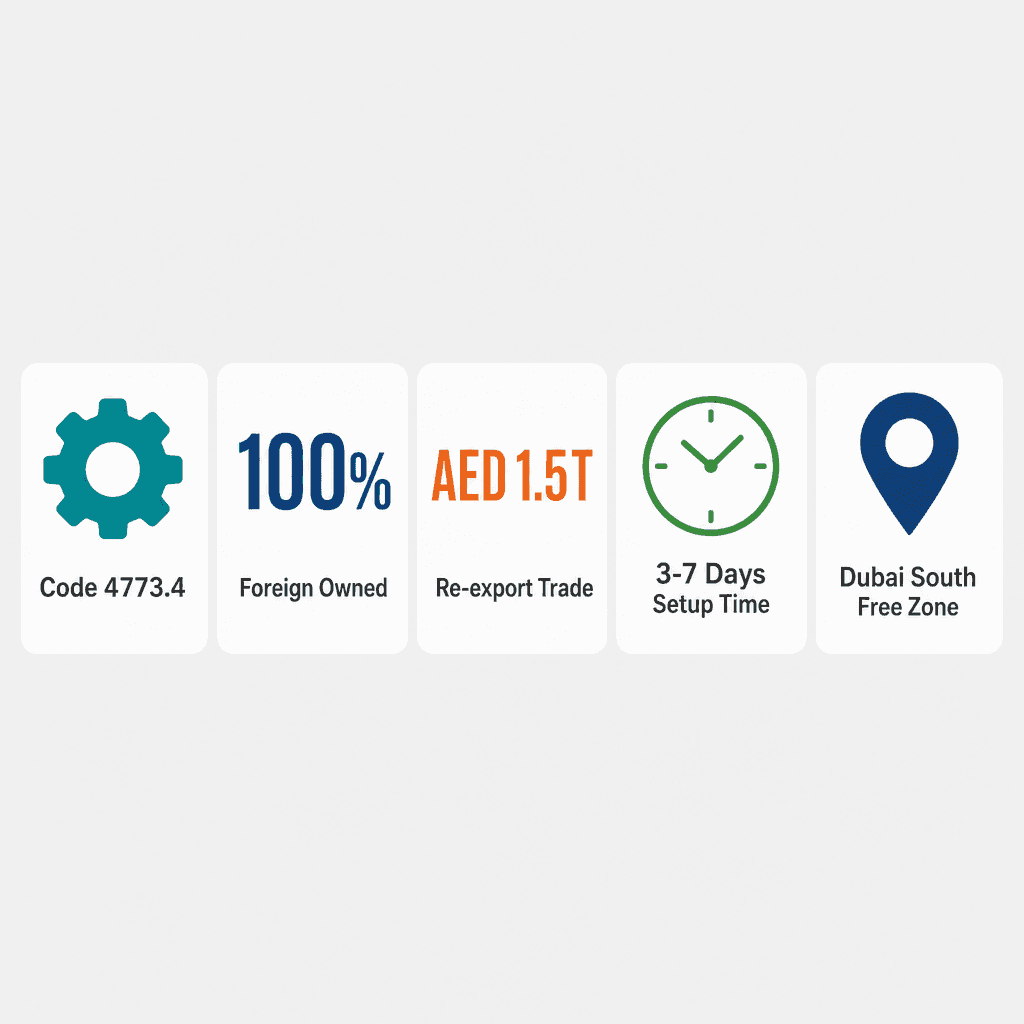
Infographic: Workshop Equipment & Spare Parts Trading in Dubai
Activity Code: 4773.4
License Type: Trading License
Free Zone: Dubai South Business Hub
Foreign Ownership: 100% permitted
UAE re-export trade value: Over AED 1.5 trillion annually
Dubai South proximity: Adjacent to Al Maktoum International Airport and Jebel Ali Port corridor
Typical setup timeline: 3 to 7 working days
Minimum share capital: Subject to free zone authority requirements at time of application
Estimated Costs
The overall cost of obtaining this license at Dubai South Business Hub Free Zone depends on several factors, including the type of office or facility package selected, the number of visa allocations required, and any additional regulatory approvals. Typical cost components include:
License registration and issuance fees
Business hub or flexi-desk facility package
Immigration card and establishment card fees
Visa costs per shareholder and employee
Notarisation and attestation of incorporation documents where applicable
Prospective applicants are encouraged to request a tailored cost breakdown directly from the free zone authority or a registered business setup adviser, as fee structures are updated periodically.
Steps to Set Up
Choose your business activity: Confirm that activity code 4773.4 aligns with your intended trading operations.
Select a company structure: Free zone limited liability company (FZ-LLC) is the standard structure for most applicants.
Reserve your trade name: Submit two to three preferred names for approval by the free zone authority.
Submit your application: Provide passport copies, a business plan summary, and any required declarations.
Choose a facility: Select a flexi-desk, shared office, or warehouse unit depending on your operational needs.
Pay fees and receive your license: Upon approval and payment, the license is typically issued within three to seven working days.
Apply for visas: Process investor and employee visas through the free zone's immigration desk.
Licensing and Compliance Requirements
Operating under this license requires adherence to the regulatory framework set by both the Dubai South Free Zone Authority and the relevant UAE federal bodies. Key compliance considerations include:
Annual license renewal with updated documentation
Compliance with UAE customs regulations for import and re-export activities
Adherence to product safety and quality standards where applicable
Maintaining valid establishment and immigration cards for all visa holders
Filing of financial records in line with free zone accounting requirements
Certain categories of machinery or spare parts may require additional approvals from bodies such as the Emirates Authority for Standardisation and Metrology (ESMA) or the Ministry of Economy, depending on the nature of the goods traded.
Why Dubai Is Well-Positioned for This Trade
Dubai's geographic position at the crossroads of Europe, Asia, and Africa gives it a structural advantage for machinery and spare parts trading. Al Maktoum International Airport, located within the Dubai South ecosystem, is set to become the world's largest cargo airport. Combined with the proximity to Jebel Ali Port, the region's busiest container terminal, businesses licensed at Dubai South benefit from unmatched logistics infrastructure.
The UAE's zero corporate tax rate for qualifying free zone entities, 100% foreign ownership, and absence of import duties on goods re-exported from free zones make the cost model highly attractive. The country's network of over 100 bilateral trade agreements further reduces friction for international traders sourcing from Europe, China, Japan, or the United States.
Dubai's automotive aftermarket alone is valued in the billions, with a large expatriate population and a high vehicle ownership rate sustaining consistent demand for spare parts and workshop services. Industrial growth driven by Expo City, logistics expansion, and infrastructure investment continues to fuel demand for machinery and equipment across the emirate.
Related Activities
Heavy Equipment & Machinery Spare Parts Trading Trading License
Construction Equipment & Machinery Spare Parts Trading Trading License
Agricultural Equipment & Machinery Spare Parts Trading Trading License
Frequently Asked Questions