Tax Treaty Between the UAE and Canada: What It Means for Your Company

Topic Summary
What Is the Tax Treaty UAE Canada Founders Rely On and Why It Matters
The UAE-Canada Double Tax Treaty is a bilateral agreement that decides which country may tax specific income, such as dividends, interest and royalties. It prevents double taxation and sets maximum withholding rates.
Which Taxes the Treaty Reduces or Eliminates
Which Taxes the Treaty Reduces or Eliminates
Corporate Tax Rules That Sit Alongside the Treaty
The treaty works with UAE corporate tax, introduced by Federal Decree-Law No. 47 of 2022 and administered by the Federal Tax Authority (FTA). A free zone company may get 0% on qualifying income, but it must register, file and show substance.
How to Claim Tax Treaty UAE Canada Benefits in a Clear Process
To claim relief, confirm residency, get an FTA tax residency certificate, give it to the Canadian payer, file the CRA forms and keep records. Without the certificate, the payer usually withholds at the full domestic rate.
Residency Proof Needed to Claim Treaty Relief
Claims under the tax treaty UAE Canada setup rest on proof of residence: a visa, Emirates ID, address record and FTA certificate.
Compliance Pitfalls Canadian Founders Should Avoid
The treaty doesn't end Canadian tax residency on its own. Departure tax and ties are separate CRA questions. Picture a founder who moves but keeps a home and spouse in Ontario.
Next Move on the Tax Treaty UAE Canada Path for Your License
Pick business activities that match real services, such as consultancy for a Canadian software consultant. Then cost your license and visas before committing.
The UAE has more than 140 double tax agreements in force (Ministry of Finance, 2026). The tax treaty UAE Canada founders use is one of them. This guide shows Canadian owners of a Dubai South Business Hub company what it covers and how to claim it. It's general information, not tax advice.
What Is the Tax Treaty UAE Canada Founders Rely On and Why It Matters
The UAE-Canada Double Tax Treaty is a bilateral agreement that decides which country may tax specific income, such as dividends, interest and royalties. It prevents double taxation and sets maximum withholding rates.
What the Agreement Covers
From here on, we'll call it the treaty. It applies to residents of either country, covers income taxes and allocates taxing rights. Picture a Canadian founder with a Dubai South Business Hub license, asking if profits brought home get taxed twice. The UAE Canada double tax agreement is the answer to that question. For wider context, see double tax treaties and your UAE company.
Who Qualifies for Treaty Relief
Relief depends on tax residency, not citizenship. A Canadian passport alone qualifies nobody. Someone who has left Canada and lives in the UAE is in a different position from someone who keeps a home, spouse and accounts in Canada. Home-country rules are covered in Dubai company Canadian tax residency.
Which Taxes the Treaty Reduces or Eliminates
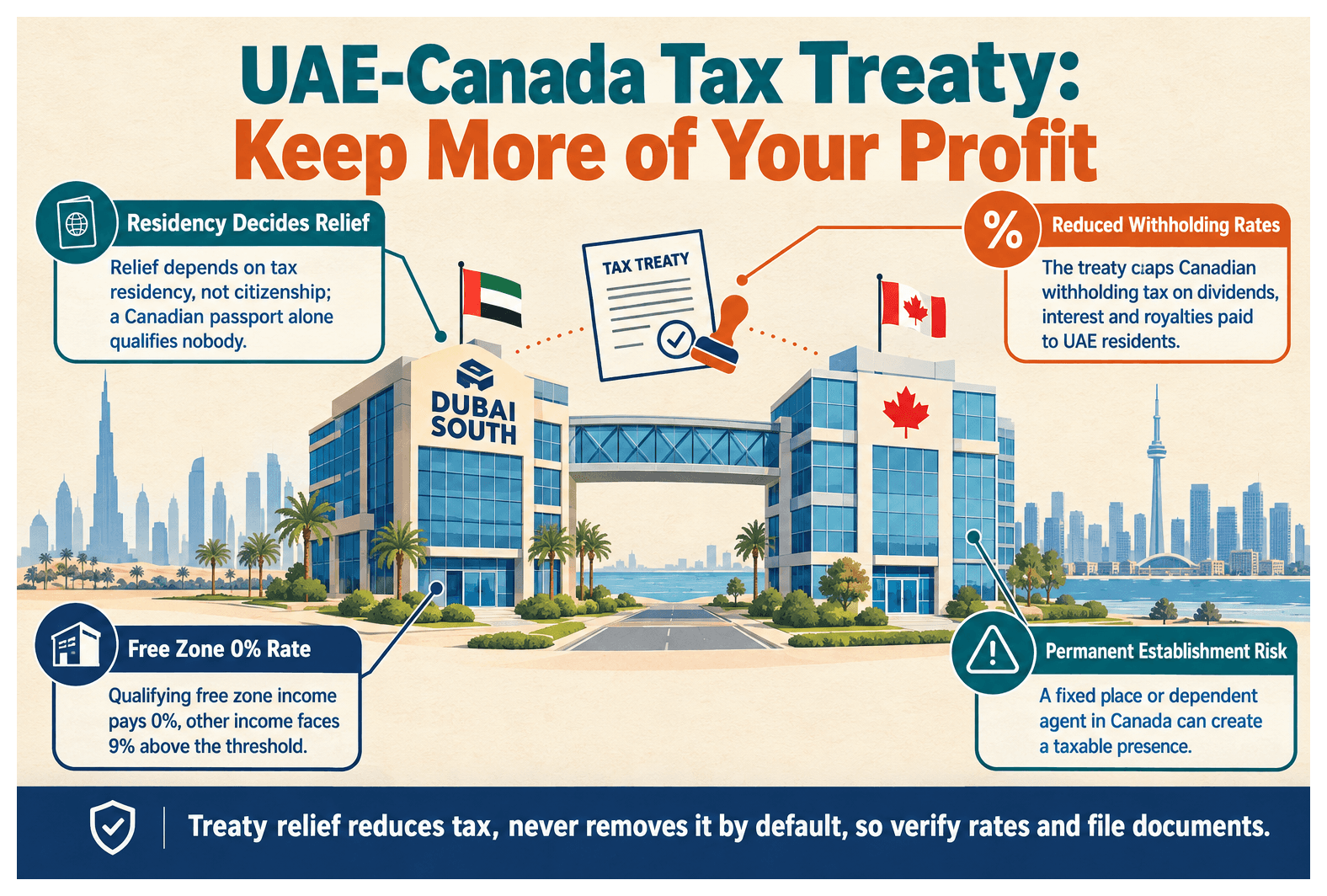
The treaty caps or removes Canadian withholding tax on certain payments to UAE residents, mainly dividends, interest and royalties. It also gives tie-breaker rules for dual residents. It doesn't remove Canadian tax on profits earned through a permanent establishment in Canada. For any Canada company Dubai tax question, that distinction matters most.
Dividends, Interest and Royalties
The treaty sets reduced withholding rates in place of the domestic rate.
Example: a Canadian operating company pays a dividend to its owner's UAE holding company.
The benefit is reduced tax, never zero by default.
Check exact percentages against the treaty text and CRA guidance first.
Treaty Treatment of Common Income Types
Feature | Without Treaty Relief | With Treaty Relief |
|---|---|---|
Dividends | Full domestic non-resident withholding rate | Reduced treaty cap on the payment |
Interest | Domestic rules apply to related-party loans | Capped treaty rate where conditions are met |
Royalties | Full domestic withholding on IP payments | Lower treaty cap for the beneficial owner |
Dual residency | Both countries may claim you as resident | Tie-breaker rules assign one residence |
Documents required | None, but the full rate is withheld | FTA certificate plus CRA non-resident forms |
Verify all rates before filing.
Permanent Establishment and Dual Residency
A fixed place or dependent agent in Canada can create a taxable presence. Tie-breaker rules settle residency when both countries claim you, and the Canada Revenue Agency (CRA) weighs home, family and economic ties. A founder who keeps a Toronto home and runs client work from it is exposed.
Corporate Tax Rules That Sit Alongside the Treaty
The treaty works with UAE corporate tax, introduced by Federal Decree-Law No. 47 of 2022 and administered by the Federal Tax Authority (FTA). A free zone company may get 0% on qualifying income, but it must register, file and show substance.
Free Zone Status and Qualifying Income
Under the corporate tax law, a qualifying free zone person pays 0% on qualifying income. Other income faces the standard 9% rate above the threshold (FTA, 2026). Take a Dubai South Business Hub consultancy invoicing Canadian clients: income type decides the rate. Read about Dubai corporate tax filing services to stay compliant. A dubai free zone Canadian owner still has to file.
How to Claim Tax Treaty UAE Canada Benefits in a Clear Process
To claim relief, confirm residency, get an FTA tax residency certificate, give it to the Canadian payer, file the CRA forms and keep records. Without the certificate, the payer usually withholds at the full domestic rate.
Step 1: Confirm Residency and Beneficial Ownership
Check your days in the UAE, your substance and your ties. Confirm you're the beneficial owner of the income.
Step 2: Obtain a UAE Tax Residency Certificate
Apply through the FTA portal with your license, lease and financial records.
Step 3: Submit Forms to the Canadian Payer and Keep Records
Hand over the certificate and the CRA non-resident forms the payer requests. Keep copies for audit. Setup details are in moving to Dubai from Canada.
Residency Proof Needed to Claim Treaty Relief
Claims under the tax treaty UAE Canada setup rest on proof of residence: a visa, Emirates ID, address record and FTA certificate.
Visa, Emirates ID and Address Evidence
A residence visa issued via the Federal Authority for Identity, Citizenship, Customs and Port Security (ICP) and the General Directorate of Residency and Foreigners Affairs (GDRFA).
A valid Emirates ID.
A lease or address record.
See the investor visa for Canadians.
Documents Canadian Payers Often Request
Expect requests for certified copies, your company license and ownership evidence. One payer might reject an uncertified certificate, so authenticate first.
Compliance Pitfalls Canadian Founders Should Avoid
The treaty doesn't end Canadian tax residency on its own. Departure tax and ties are separate CRA questions. Picture a founder who moves but keeps a home and spouse in Ontario.
Don't skip the residency certificate.
Meet Financial Transactions and Reports Analysis Centre of Canada (FINTRAC) requirements on identity and source of funds.
Align invoices, contracts and bank records.
Next Move on the Tax Treaty UAE Canada Path for Your License
Pick business activities that match real services, such as consultancy for a Canadian software consultant. Then cost your license and visas before committing.
Making the Tax Treaty UAE Canada Work for Your Company
The tax treaty UAE Canada founders use reduces double taxation on specific income, but only with real residency, an FTA certificate and clean records. Use the Business Activities and Cost Calculator to set up or buy a license with Dubai South Business Hub.
References
tax-treaty-between-the-uae-and-canada-what-it-means-for-your-company