Dubai Company Against a German GmbH: Cost, Tax and Reporting Compared

Topic Summary
What Is a Dubai Company Against a German GmbH and Why It Matters
A Dubai company against a German GmbH comparison weighs a DSBH free zone entity's 100% foreign ownership and territorial tax rules against a GmbH's domestic incorporation, German corporate tax, and Finanzamt filing duties. Founders choose based on where they want tax residency and clients.
Ownership and Residency Rules for German Founders
Ownership and Residency Rules for German Founders
Tax Treatment: Dubai Free Zone Against German Corporate Tax
Under Federal Decree-Law No. 47 of 2022, qualifying free zone income can be taxed at 0%, while standard UAE corporate tax sits at 9% above the threshold, overseen by the FTA. German GmbHs face roughly 30% combined corporate and trade tax through the Finanzamt.
Reporting Duties: DSBH Free Zone Versus GmbH Obligations
A DSBH free zone company files annual financial statements and corporate tax returns with the FTA, with lighter audit thresholds than Germany. A GmbH must file with the Finanzamt yearly and consider German exit tax if shareholders relocate assets abroad.
Steps to Set Up Your Dubai Company From Germany
Setting up a DSBH free zone company from Germany involves five steps: choosing a business activity, checking name availability, submitting documents, securing the license, then applying for residency. Most founders complete the process within two to three weeks.
Which Structure Fits German Founders Best
German founders selling mainly within the EU often keep the GmbH, while those targeting GCC, African or Asian markets benefit more from a DSBH free zone company for lower tax exposure and faster residency. Many run both structures in parallel.
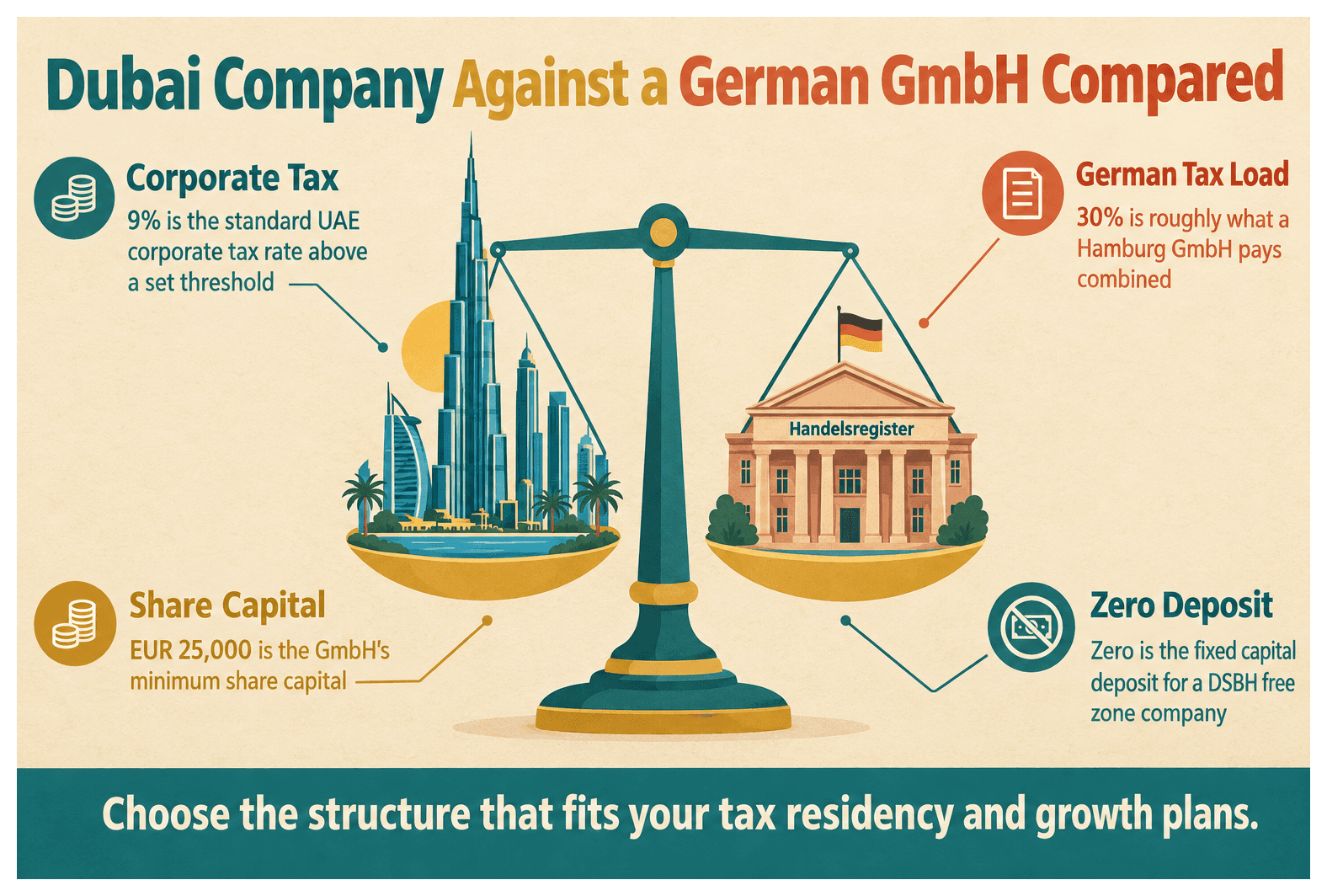
In 2026, over 37,000 German nationals are registered as UAE residents (Statista, 2024), and a growing number are founders comparing a Dubai company against a German GmbH before relocating. A Dubai company against a German GmbH decision often starts with one question: where should profit be taxed? 9% is the standard UAE corporate tax rate above a set threshold. 30% is roughly what a Hamburg GmbH pays combined. EUR 25,000 is the GmbH's minimum share capital. Zero is the fixed capital deposit for a DSBH free zone company. Two to three weeks is a realistic residency timeline. This guide compares ownership, tax exposure and annual reporting, then helps you pick the structure that fits your growth plans.
What Is a Dubai Company Against a German GmbH and Why It Matters
A Dubai company against a German GmbH comparison weighs a DSBH free zone entity's 100% foreign ownership and territorial tax rules against a GmbH's domestic incorporation, German corporate tax, and Finanzamt filing duties. Founders choose based on where they want tax residency and clients.
Core Structural Differences
A GmbH needs EUR 25,000 minimum share capital and a registered German office before the Handelsregister (commercial register) will accept it. A DSBH free zone company skips that fixed deposit entirely and allows full foreign ownership with no local partner required. Incorporation speed tells its own story too: GmbH formation runs through notarization appointments, while a free zone setup can be handled largely online.
Take a Berlin-based software founder who keeps her GmbH dormant for existing EU clients while opening a DSBH entity for new Gulf contracts. That's not unusual. Many German founders run both structures in parallel rather than picking one over the other.
Why German Founders Compare the Two
Market access to GCC and South Asian trade corridors
Lower operating costs for small or solo teams
Simpler license renewal versus GmbH annual bureaucracy
Faster decision-making without a supervisory board requirement
A Munich trading firm expanding into re-export, for instance, found a Dubai free zone license cut its logistics paperwork significantly compared to running everything through its German entity alone.
Ownership and Residency Rules for German Founders
DSBH free zone companies grant 100% foreign ownership under ICP (Federal Authority for Identity, Citizenship, Customs and Port Security) oversight, with the GDRFA (General Directorate of Residency and Foreigners Affairs) handling entry permits and Emirates ID issuance. A GmbH, by contrast, requires German notarization and gives no automatic UAE residency.
Key Facts: DSBH Free Zone Company Versus German GmbH
Feature | DSBH Free Zone Company | German GmbH |
|---|---|---|
Ownership | 100% foreign ownership, no local partner needed | German resident managing director often required in practice |
Minimum capital | No fixed capital deposit | EUR 25,000 share capital before registration |
Corporate tax | 0% on qualifying income, 9% above threshold | Roughly 30% combined corporate and trade tax |
Regulator | FTA (Federal Tax Authority) | Finanzamt (local tax office) |
Residency | Tied to license via GDRFA and Emirates ID | No automatic UAE residency granted |
Annual reporting | Simplified filings tied to license renewal | Full statutory accounts with Finanzamt |
How Free Zone Ownership Works
ICP sets the federal rules on foreign shareholding
No local sponsor needed for a DSBH company
Shareholder can be a person or a German holding entity
Share transfers stay simpler than GmbH notarized transfers
A German engineer who kept full equity in his Dubai consultancy told us he'd assumed he'd need a local partner (he didn't, under current rules).
Residency Visa and Identity Steps
Once your license is issued, GDRFA processes your entry permit and residency stamping. After that, an Emirates ID is issued following medical and biometric checks. Worth flagging: the visa ties directly to your trade license, not a separate standalone route.
In practice, founders typically see their Emirates ID within two to three weeks of license issuance, assuming documents are submitted cleanly the first time.
Is a Dubai free zone company worth it for German founders?
Yes, if you're targeting GCC or Asian markets and want full ownership. It's less compelling if your revenue stays entirely within the EU and VAT registration matters more than residency flexibility.
Tax Treatment: Dubai Free Zone Against German Corporate Tax
Under Federal Decree-Law No. 47 of 2022, qualifying free zone income can be taxed at 0%, while standard UAE corporate tax sits at 9% above the threshold, overseen by the FTA. German GmbHs face roughly 30% combined corporate and trade tax through the Finanzamt.
UAE Corporate Tax Framework
Federal Decree-Law No. 47 of 2022 introduced federal corporate tax across the UAE. The FTA administers filings and determines qualifying free zone status. Qualifying income thresholds decide whether the 0% rate applies or whether the 9% standard rate kicks in.
A DSBH trading company that keeps its qualifying income under the relevant threshold can retain the 0% treatment on that portion of profit, while still filing annually with the FTA.
German Corporate Tax Burden
Corporate tax plus solidarity surcharge plus municipal trade tax
Finanzamt requires annual returns and quarterly advance payments
Dividend withholding adds further cost on distributions
Combined rate often lands near 30% depending on the municipality
A Hamburg GmbH paying close to 30% combined tax on annual profit isn't an outlier. It's closer to the norm once trade tax is factored in.
Reporting Duties: DSBH Free Zone Versus GmbH Obligations
A DSBH free zone company files annual financial statements and corporate tax returns with the FTA, with lighter audit thresholds than Germany. A GmbH must file with the Finanzamt yearly and consider German exit tax if shareholders relocate assets abroad.
Annual Filing in Dubai
Bookkeeping tied to free zone license renewal cycle
FTA corporate tax return due after financial year-end
Simplified audit thresholds for smaller free zone entities
Records kept digitally, reducing paper-based overhead
A one-person consultancy filing its first short-form return often finds the process lighter than expected, compared to what GmbH shareholders describe back home.
German Exit Tax and Finanzamt Rules
The Finanzamt requires continuous annual filing, regardless of where you personally reside. German exit tax can apply when founders move substantial shareholdings offshore, taxing unrealized gains as if shares were sold. Double taxation treaty considerations between the UAE and Germany also matter here (Ministry of Finance, 2024).
Before transferring GmbH shares to a Dubai holding structure, most founders consult a tax advisor first. That step isn't optional, it's the difference between a clean transition and an unexpected exit tax bill.
Steps to Set Up Your Dubai Company From Germany
Setting up a DSBH free zone company from Germany involves five steps: choosing a business activity, checking name availability, submitting documents, securing the license, then applying for residency. Most founders complete the process within two to three weeks.
Step 1: Select Your Business Activity
Match activity to the approved free zone activities list
Activity choice affects license category and cost
Some activities require extra approvals from sector regulators
A German IT consultant typically picks an advisory services activity code, keeping the license scope narrow and cost predictable. Check the business activities list before applying.
Step 2: Run a Name Check
Confirm trade name availability before submitting documents
Avoid restricted or duplicate business names
Reserve the name once confirmed to lock it in
Run this through Name Check early. It takes minutes and saves a rejected application later.
Step 3: Submit Documents and Get Approval
Passport copy and application form required
Initial approval typically issued within days
Additional documents may apply for regulated activities
Step 4: Apply for Residency
GDRFA entry permit followed by medical test and Emirates ID
Residency visa linked to the trade license term
Biometrics appointment usually scheduled within a week
Which Structure Fits German Founders Best
German founders selling mainly within the EU often keep the GmbH, while those targeting GCC, African or Asian markets benefit more from a DSBH free zone company for lower tax exposure and faster residency. Many run both structures in parallel.
When the GmbH Still Makes Sense
If most clients need a German VAT number, keep the GmbH. Existing contracts tied to German jurisdiction also argue for keeping it active. A manufacturer supplying domestic retailers, for example, has little reason to shut down a working GmbH just to chase a Dubai license.
When the Dubai Free Zone Company Wins
Founders relocating personally for lower personal tax exposure tend to favour the free zone route. So do businesses targeting non-EU trade corridors where a UAE-based entity simplifies invoicing and banking. A logistics founder routing Gulf and African trade through a DSBH entity, for instance, cut both tax friction and banking delays compared to running everything through Germany (Dubai Chamber of Commerce, 2024).
Choosing between a Dubai company against a German GmbH comes down to where your clients sit, how much tax exposure you can accept, and how much reporting overhead you want to manage across two jurisdictions. Review the Moving to Dubai from Germany guide for the residency side of this decision.
Run the numbers with the Cost Calculator and confirm your trade name with Name Check before you set up or buy a license.
References
dubai-company-against-a-german-gmbh