How to Invoice UK Clients From Your Dubai Company Legally

Topic Summary
What Is Invoicing UK Clients From a Dubai Company and Why It Matters
To invoice UK clients from a Dubai company means issuing a compliant tax invoice from your licensed free zone entity to a British customer. It shows your legal name, license details, currency, VAT treatment and payment terms.
Step-by-Step Process to Invoice UK Clients From Your Dubai Company
Step-by-Step Process to Invoice UK Clients From Your Dubai Company
VAT Treatment When You Invoice UK Clients From a Dubai Free Zone
Services supplied to a UK client are usually zero-rated exports when the recipient is outside the UAE and the service is used abroad. Goods and place-of-supply exceptions can change the rate, so check each contract.
UK Tax and Compliance Checks Before You Invoice
Before you invoice UK clients from your Dubai company, confirm your UK residency. HMRC can still tax you if you fail the statutory residence test, and the Companies Act 2006 still governs any UK company you keep.
Cross-Border Payment Options and Key Facts for British Clients
British clients can pay by SWIFT, local account details or regulated platforms. SWIFT suits larger invoices; multi-currency accounts cut conversion costs. For a Dubai South Business Hub company, the route depends on size, speed and how your bank treats incoming GBP.
Common Invoicing Mistakes and How to Avoid Them
Common errors when you invoice UK clients from a Dubai company include missing fields, wrong VAT, wrong entity and poor records. Each risks FTA queries or frozen payments.
Next Steps to Invoice UK Clients From Your Dubai Company With Confidence
Secure the right license, register for VAT if needed, build a template, confirm your UK position and open a corporate account. Allow time for license, visa and bank; one founder lost three weeks waiting on the account.
More than 350,000 businesses are VAT-registered in the UAE (Federal Tax Authority, 2025) [1]. Many cross-border founders still lose time to faulty invoices. This guide shows British founders how to invoice UK clients from a Dubai company so each invoice survives the Federal Tax Authority (FTA), HMRC and your bank.
What Is Invoicing UK Clients From a Dubai Company and Why It Matters
To invoice UK clients from a Dubai company means issuing a compliant tax invoice from your licensed free zone entity to a British customer. It shows your legal name, license details, currency, VAT treatment and payment terms.
Who Can Legally Issue the Invoice
Only the licensed company invoices, never you personally, and the license activity must cover the service billed. Picture a London marketing consultant who relocates and bills former clients through a new Dubai South Business Hub company. Keep your ICP (Federal Authority for Identity, Citizenship, Customs and Port Security), GDRFA (General Directorate of Residency and Foreign Affairs) and Emirates ID records current. Banks then see one consistent, active company. Our guide on which Dubai license lets you invoice internationally covers activity matching.
Why Correct Invoicing Protects Your License and Bank Access
Invoices are the audit trail behind revenue, VAT returns and bank checks. One UK payment was held because the invoice carried a trading name missing from the license. Mismatched names trigger compliance queries.
Step-by-Step Process to Invoice UK Clients From Your Dubai Company
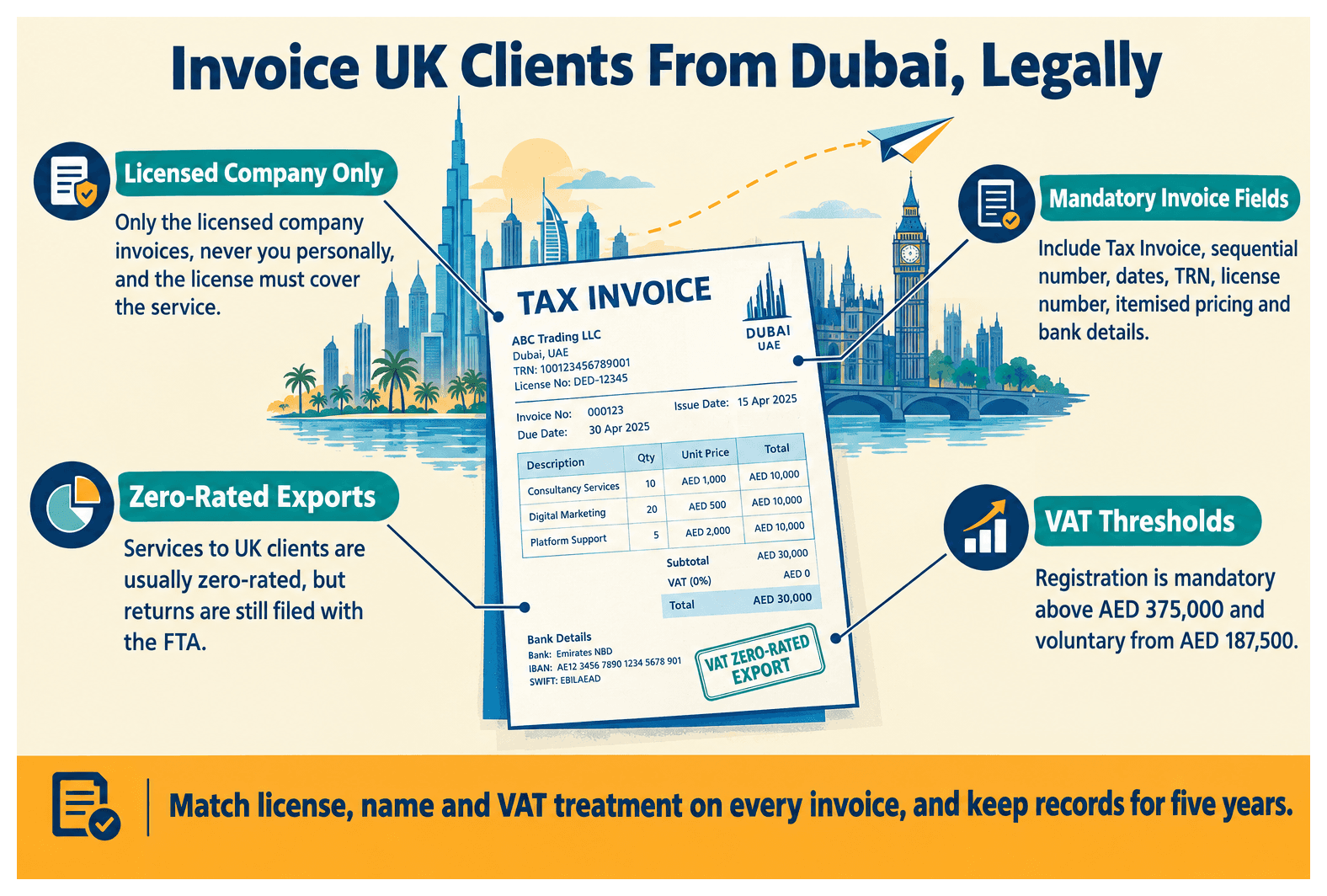
Confirm your license covers the activity, register for VAT if required, issue an invoice with all mandatory fields, choose a currency, state the VAT treatment, collect payment and keep records for five years.
Confirm activity and contract. Match the service to your license. Sign an agreement naming the Dubai entity. A developer, for example, can novate a contract from a UK limited company.
Build the invoice. Include "Tax Invoice", a sequential number, issue and supply dates, supplier and client details, the Tax Registration Number if registered, the license number and free zone, itemised pricing, bank details and terms. Example: consulting, 20 days at GBP 500, zero-rated export.
Choose currency. GBP, USD or AED all work. The dirham is pegged to the dollar at 3.6725. Where VAT applies, show AED at the Central Bank rate on the supply date, and record that rate.
Send, collect, archive. Send a PDF with the invoice number as payment reference. Reconcile monthly. Keep records for five years.
Read more on billing UK clients through a Dubai company.
VAT Treatment When You Invoice UK Clients From a Dubai Free Zone
Services supplied to a UK client are usually zero-rated exports when the recipient is outside the UAE and the service is used abroad. Goods and place-of-supply exceptions can change the rate, so check each contract.
Conditions: client outside the UAE, no UAE benefit, written contract, proof of payment.
Zero-rated businesses still file returns with the FTA.
Registration is mandatory above AED 375,000 and voluntary from AED 187,500.
Physical goods shipped to the UK attract UK import VAT, paid by the importer. Free zone status doesn't remove VAT duties by default, and a service firm assuming otherwise invites penalties. Setups here are never fully tax free. Standard UAE VAT is 5%. See commercial invoice for UAE exports for goods.
UK Tax and Compliance Checks Before You Invoice
Before you invoice UK clients from your Dubai company, confirm your UK residency. HMRC can still tax you if you fail the statutory residence test, and the Companies Act 2006 still governs any UK company you keep.
HMRC Residency and Permanent Establishment Risks
Imagine a founder spending 150 days a year in the UK, running the company from a home office. That pattern can create a UK taxable presence. Read whether Dubai changes your UK tax position.
Payment Options for UK Clients Paying a Dubai Company
Feature | SWIFT Bank Transfer | Multi-Currency Account or Payment Platform |
|---|---|---|
Typical speed | One to three working days | Often same day or next day |
Fee structure | Sender fee plus possible intermediary deductions | Low flat or percentage fee; card links cost more |
Currency conversion cost | Bank margin on GBP to AED | Lower FX margin, or hold GBP unconverted |
Best for invoice size | Larger invoices, such as GBP 8,000 and above | Retainers and small recurring invoices |
Compliance documentation needed | Invoice and contract if the bank queries funds | Extra due diligence at onboarding |
How the UAE-UK Double Tax Treaty Applies
The UAE-UK Double Tax Treaty allocates taxing rights.
Federal Decree-Law No. 47 of 2022 sets 9% corporate tax above AED 375,000.
Qualifying free zone income is treated separately.
A UAE tax residency certificate may be required.
If you keep a UK Ltd, Companies Act filings continue. Don't bill one client from both entities. See running a UK and a Dubai company side by side.
Cross-Border Payment Options and Key Facts for British Clients
British clients can pay by SWIFT, local account details or regulated platforms. SWIFT suits larger invoices; multi-currency accounts cut conversion costs. For a Dubai South Business Hub company, the route depends on size, speed and how your bank treats incoming GBP.
Quote the full IBAN, SWIFT/BIC and invoice number.
Keep contracts ready for source-of-funds questions.
Expect a request after a large first GBP receipt.
More detail: getting paid by international clients.
Common Invoicing Mistakes and How to Avoid Them
Common errors when you invoice UK clients from a Dubai company include missing fields, wrong VAT, wrong entity and poor records. Each risks FTA queries or frozen payments.
Billing outside the licensed activity.
Gaps or duplicates in invoice numbers.
Receiving funds in a personal account.
Charging 0% with no signed contract.
Discarding records before five years.
Next Steps to Invoice UK Clients From Your Dubai Company With Confidence
Secure the right license, register for VAT if needed, build a template, confirm your UK position and open a corporate account. Allow time for license, visa and bank; one founder lost three weeks waiting on the account.
To invoice UK clients from your Dubai company legally, match the invoice to your license, apply correct VAT, choose a sensible currency, confirm your HMRC position and keep clean records.
Follow the next move: use the Business Activities and Cost Calculator to set up or buy a license with Dubai South Business Hub.
References
Frequently Asked Questions