
Topic Summary
What Is the Dubai Free Zone Audit Requirement and Why It Matters
The dubai free zone audit requirement obligates licensed free zone companies to prepare annual audited financial statements, usually to keep Qualifying Free Zone Person status and meet corporate tax obligations under Federal Decree-Law No. 47 of 2022. It applies regardless of revenue or activity size.
Who Must Comply With Dubai Free Zone Audit Requirement Rules
All companies registered in Dubai free zones are required to submit audited financial statements annually. The obligation applies regardless of turnover, trading activity, or whether the company is dormant. Sole proprietorships and branch offices have different deadlines, so confirming your specific entity type with the free zone authority before year-end avoids a late filing.
How Much the Dubai Free Zone Audit Requirement Actually Costs
Audit fees for Dubai free zone companies typically range from AED 3,500 to AED 15,000, depending on transaction volume, industry complexity, and auditor seniority. Multi-activity or high-turnover entities can exceed AED 30,000. Catch-up bookkeeping before a first audit often adds significant cost.
Steps to Stay Compliant With Dubai Free Zone Audit Requirement Deadlines
To meet the dubai free zone audit requirement on time: register for corporate tax, appoint an approved auditor, organize records continuously, schedule the audit before year-end, and file audited statements within 90 days of your financial year closing to avoid penalties.
Common Mistakes With Dubai Free Zone Audit Requirement Compliance
The most common dubai free zone audit requirement mistakes include waiting until the deadline to engage an auditor, mixing personal and business transactions, ignoring ancillary activity classification, and assuming a dormant company is exempt from filing audited financial statements. Dormant companies still often owe nil-activity audits.
Choosing the Right Auditor for Dubai Free Zone Audit Requirement Filings
Select an auditor approved by your specific free zone authority, with experience in your industry and a track record meeting the 90-day filing window. Ask about fixed-fee packages, turnaround time, and whether they handle corporate tax coordination alongside the audit.
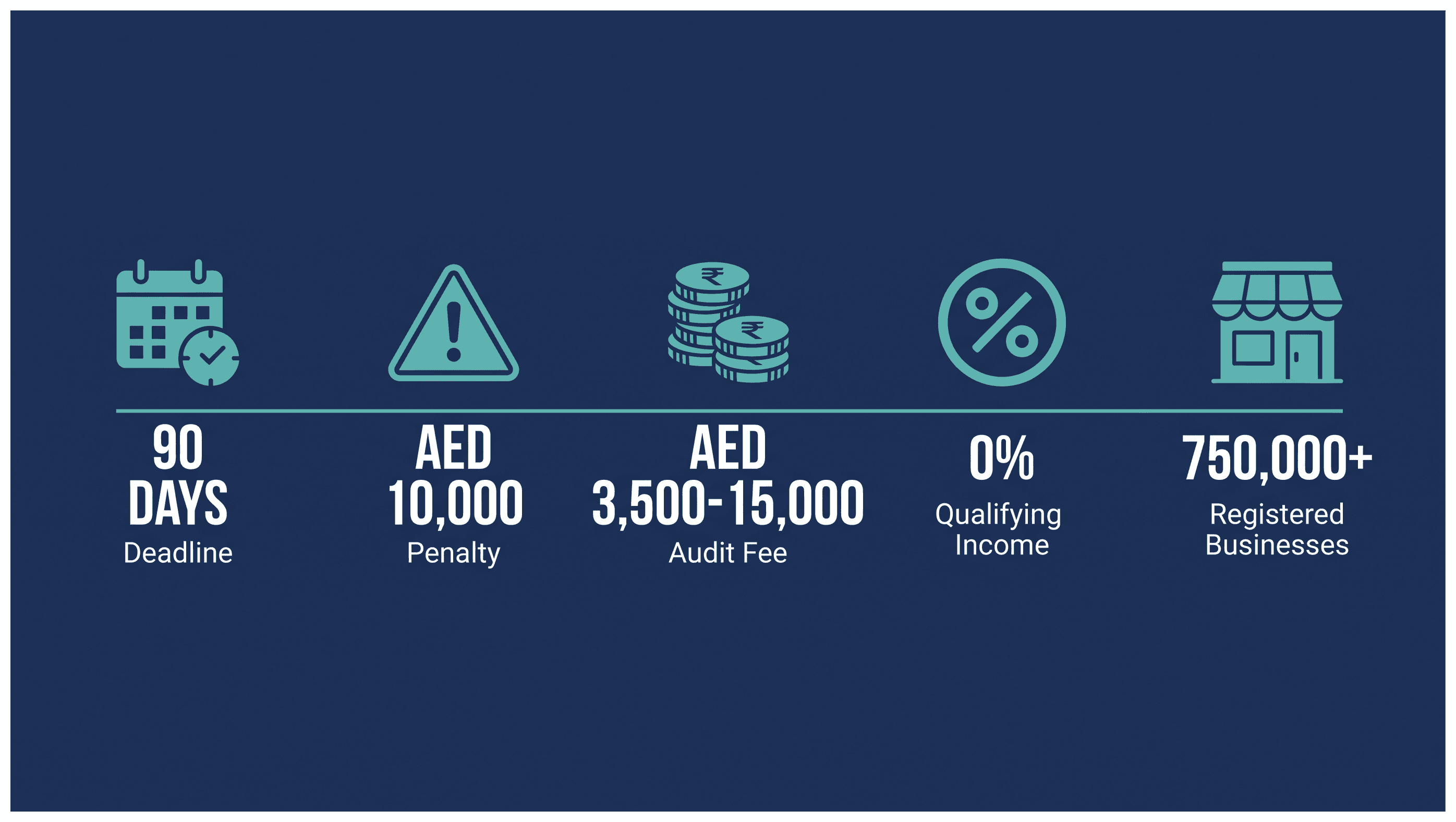
In 2026, more than 40 free zones and over 750,000 registered businesses operate across the UAE, and nearly all of them face the same compliance deadline [1]. 90 days is the window. AED 10,000 is the penalty for missing it. AED 3,500 to AED 15,000 is the typical fee range. Corporate tax has applied since June 2023 [2]. 0% remains available on qualifying income, but only if you meet audit obligations. These numbers define the dubai free zone audit requirement, and this guide walks through what it means, who it hits, and when your clock runs out.
What Is the Dubai Free Zone Audit Requirement and Why It Matters
The dubai free zone audit requirement obligates licensed free zone companies to prepare annual audited financial statements, usually to keep Qualifying Free Zone Person status and meet corporate tax obligations under Federal Decree-Law No. 47 of 2022. It applies regardless of revenue or activity size.
Why Free Zones Enforce Mandatory Audits
Your QFZP status, the thing that gets you 0% tax on qualifying income, depends on proving your books are clean. Auditors verify that. Across 40-plus UAE free zones, license renewal applications increasingly ask for the prior year's audited accounts before approval goes through (Federal Tax Authority, 2026). A trading company we've seen renew annually gets stopped at the gate if it can't produce last year's report. Banks want it too, for credit lines and account reviews.
How It Differs From Mainland Audit Rules
Free zone authorities treat audit submission as a license condition, not a tax-only trigger.
Mainland LLCs answer to UAE Commercial Companies Law thresholds instead.
Some free zones want the report filed directly with them, separate from the Federal Tax Authority.
A missing report can block your renewal outright, not just flag a tax issue.
Free zone mandates tend to be stricter and more consistently enforced than mainland thresholds, since the audit is tied straight to your license renewal. For a deeper look at who exactly needs to appoint one, see who must appoint an auditor and what the fee depends on.
Who Must Comply With Dubai Free Zone Audit Requirement Rules
Every free zone company registered in Dubai, including small single-shareholder entities, must appoint an approved auditor and submit audited financial statements annually. This applies whether or not the company claims QFZP status, and regardless of whether it turned a profit.
Entities Covered Under the Rule
Trading, service, and holding companies all fall within scope.
Dormant companies still owe filings in most jurisdictions.
Branches of foreign companies fall under the same umbrella.
Single-shareholder FZCOs get no exemption just for size.
Dubai Free Zone Audit Cost and Timeline Snapshot
Factor | Typical Range or Rule | What It Means for You |
|---|---|---|
Standard audit fee | AED 3,500 to AED 15,000 | Covers most single-activity entities with clean books |
Complex entities | AED 30,000+ | Multi-activity or high-transaction trading firms |
Filing deadline | Within 90 days of year-end | Calculated from your fiscal year-end date, not calendar year |
Late filing penalty | AED 10,000 fixed | Applied automatically, no grace period |
Auditor selection | From free zone's approved panel | Non-panel auditors can delay renewal approval |
Exceptions and Special Cases
Very small entities sometimes get simplified reporting in limited cases, and natural persons under certain revenue thresholds skip some tax filings entirely (Ministry of Finance, 2026). But your free zone authority can still demand an audit regardless. A consultancy under AED 1 million revenue often still needs audited accounts just to renew its license. Review the full scope in our guide to free zone company registration requirements in Dubai.
How Much the Dubai Free Zone Audit Requirement Actually Costs
Audit fees for Dubai free zone companies typically range from AED 3,500 to AED 15,000, depending on transaction volume, industry complexity, and auditor seniority. Multi-activity or high-turnover entities can exceed AED 30,000. Catch-up bookkeeping before a first audit often adds significant cost.
Factors That Drive the Fee Up or Down
Transaction volume and the number of bank accounts you operate.
Quality of your existing bookkeeping records.
Industry complexity, trading businesses cost more than consultancies.
Whether you need catch-up reconciliation before the auditor even starts.
A trading firm juggling multiple suppliers and shipments pays considerably more than a single-service consultancy with ten invoices a year. See the full breakdown in annual audit cost for a Dubai company.
Budgeting for Your First-Year Audit
Messy books can double your first invoice. Engaging an auditor early cuts reconciliation work dramatically. Fixed-fee packages exist for straightforward single-activity entities, and they're worth asking for upfront rather than accepting hourly billing.
Steps to Stay Compliant With Dubai Free Zone Audit Requirement Deadlines
To meet the dubai free zone audit requirement on time: register for corporate tax, appoint an approved auditor, organize records continuously, schedule the audit before year-end, and file audited statements within 90 days of your financial year closing to avoid penalties.
Step 1: Confirm Your Financial Year-End
Most free zone companies use calendar or custom fiscal years.
Your deadline math starts from this date.
Mismatched dates cause filing confusion later.
A company with a March year-end must file by late June.
Step 2: Appoint an Approved Auditor Early
Choose from your free zone's approved auditor list.
Engage before year-end, never after.
Avoid shortages during peak Q2 audit season.
A founder who locks in an auditor three months ahead skips the rush entirely. More on this in appointing your first auditor mid year.
Step 3: Prepare and Submit Within 90 Days
Gather bank statements, invoices, contracts early.
Submit within 90 days of year-end.
Missing this triggers a fixed AED 10,000 penalty (Federal Tax Authority, 2026).
Is the 90-day audit deadline the same for every free zone company?
Yes. The 90-day window applies broadly under corporate tax rules. Some free zones also set their own internal submission dates tied to license renewal, so always confirm both.
One company we know submitted on day 85, cutting it close but avoiding any fine. Read more in filing your first audited accounts.
Common Mistakes With Dubai Free Zone Audit Requirement Compliance
The most common dubai free zone audit requirement mistakes include waiting until the deadline to engage an auditor, mixing personal and business transactions, ignoring ancillary activity classification, and assuming a dormant company is exempt from filing audited financial statements. Dormant companies still often owe nil-activity audits.
Assuming Dormant Status Means No Filing
Dormant companies still often owe nil-activity audits. License renewal gets blocked without that submission. A shelf company owner we've encountered was genuinely surprised when renewal got rejected over missing audits. Confirm the exact rule with your specific free zone authority, don't assume.
Leaving Bookkeeping Until Year-End
Twelve months of reconciliation in one sitting inflates fees fast.
Missing invoices delay the auditor's sign-off.
Monthly bookkeeping prevents audit-season bottlenecks entirely.
A retailer scrambling for receipts in month 12 ends up paying double the original quote. For setup basics, see setting up accounting from day one in Dubai.
Choosing the Right Auditor for Dubai Free Zone Audit Requirement Filings
Select an auditor approved by your specific free zone authority, with experience in your industry and a track record meeting the 90-day filing window. Ask about fixed-fee packages, turnaround time, and whether they handle corporate tax coordination alongside the audit.
What to Ask Before Signing an Engagement Letter
Confirm approved auditor status with your free zone directly.
Request a fixed quote tied to transaction volume.
Ask about experience with similar activity classes.
A founder comparing three quotes should pick the one with genuine free zone experience, not just the cheapest number. See choosing an approved auditor in the UAE for a full checklist.
Red Flags to Avoid
Unusually low fees paired with vague scope are a warning sign. So is no clear delivery timeline. Worst of all is discovering, mid-engagement, that your auditor isn't on the free zone's approved panel. One company lost weeks sorting that out right before a renewal deadline.
The dubai free zone audit requirement isn't optional paperwork, it's a license-renewal and corporate tax condition that applies to nearly every registered entity, with real penalties for missed deadlines. Start organizing your records now and line up an approved auditor well before your financial year closes.
References
Frequently Asked Questions