Business Setup With One Investor Visa in Dubai: Eligibility, Process and Costs

Topic Summary
Investor Visa Ties Residency to Your Company
Unlike employer-sponsored visas, a Dubai investor visa links your legal right to live in the UAE directly to your trade license. This means your residency belongs to you as a business owner, not to any employer or local sponsor.
Any Nationality Can Qualify Through Free Zones
The UAE imposes no country-of-origin restrictions for free zone investor visas, so founders from any country can apply. Most free zones also require no minimum share capital, making entry accessible for solo founders from day one.
One Package Can Cost as Little as AED 16,350
Dubai South Business Hub Free Zone offers a one investor visa package at AED 16,350, with a trade license issued within a single business day. Budgeting accurately upfront helps founders avoid unexpected costs that can run into thousands of dirhams.
Core Documents Are Straightforward but Mandatory
You will need a passport valid for at least six months beyond your visa duration, recent passport photos, a signed application form, your trade license, proof of health insurance, and a medical fitness certificate. Missing any one of these can delay the entire application process.
Health Insurance Is a Legal Requirement Before Stamping
Dubai law requires proof of valid health insurance before your investor visa can be stamped, not after. Arranging coverage early in the process prevents a common bottleneck that stalls otherwise complete applications.
Overstays and Late Filings Carry Real Financial Penalties
Entry permits are typically valid for 60 days, and overstay fines range from AED 25 to AED 50 per day. Late VAT registration carries a separate AED 10,000 penalty, so tracking compliance deadlines from the moment your license goes live is essential.
Sponsoring Family Requires a Minimum Monthly Salary
To sponsor a spouse under your investor visa, UAE rules require a minimum salary of AED 4,000 per month. Founders planning to relocate their families should factor this threshold into their business and salary planning before applying.
In 2026, the UAE issues hundreds of thousands of investor visas annually, and a growing share go to solo founders who tie their UAE residency directly to a single free zone company. The one investor visa package at Dubai South Business Hub Free Zone costs AED 16,350 and issues a trade license within one business day. The UAE ranked 16th globally in the World Bank's Ease of Doing Business index (World Bank, 2020, still referenced in 2026 policy frameworks). Late VAT registration carries an AED 10,000 penalty (Federal Tax Authority, 2026). Entry permits are valid for typically 60 days from issuance. Overstay fines run AED 25 to AED 50 per day. The minimum salary to sponsor a spouse in the UAE is AED 4,000 per month.
This guide walks you through what a business setup with one investor visa in Dubai actually involves: who qualifies, what the process looks like step by step, what it realistically costs, and which compliance obligations kick in once your license is live. Read it before you apply and you'll avoid the mistakes that cost founders weeks and thousands of dirhams.
What Is an Investor Visa in Dubai and Who Qualifies
An investor visa in Dubai is a UAE residency visa granted to individuals who hold a valid trade license in their name. It links your legal right to live in the UAE directly to your company. Eligibility requires a licensed business, a minimum share capital in some structures, and a clean immigration record. For most free zone setups, there is no minimum capital threshold at all.
How the Investor Visa Differs From Other UAE Visa Types
The investor visa works differently from most UAE visas you may have heard of. Here's what sets it apart:
It's tied to a company license, not an employer or job offer.
It gives you residency as a business owner, not as an employee.
It does not require a local sponsor for free zone structures.
Validity is typically two to three years, renewable.
Free zone investor visas allow 100% foreign ownership with no UAE national partner required.
Take a US-based management consultant who sets up a professional services company at a Dubai free zone. She receives an investor visa in her own name, with no local employer involved. That's the core appeal of a business setup with one investor visa in Dubai: your residency belongs to you, not to whoever hired you.
Who Is Eligible for an Investor Visa Through a Free Zone Company
Eligibility is broader than most people expect. The UAE imposes no country-of-origin restrictions for investor visas through free zones. Here's the checklist:
Any nationality can apply.
You must be the licensed owner or shareholder of the registered company.
Minimum age is typically 18 years.
A clean immigration record is required, no overstay bans or criminal flags.
Medical fitness and health insurance are mandatory before visa stamping.
No minimum capital threshold in most free zones for a standard investor visa.
An American entrepreneur with no prior UAE presence can qualify for an investor visa on day one of company registration, provided the license is active and all documents are in order. Health insurance is a legal requirement in Dubai before visa issuance (u.ae, 2026). You can explore UAE residency visa and investor visa services at Dubai South Business Hub to understand exactly what's included in each package.
Documents and Eligibility Requirements You Must Meet
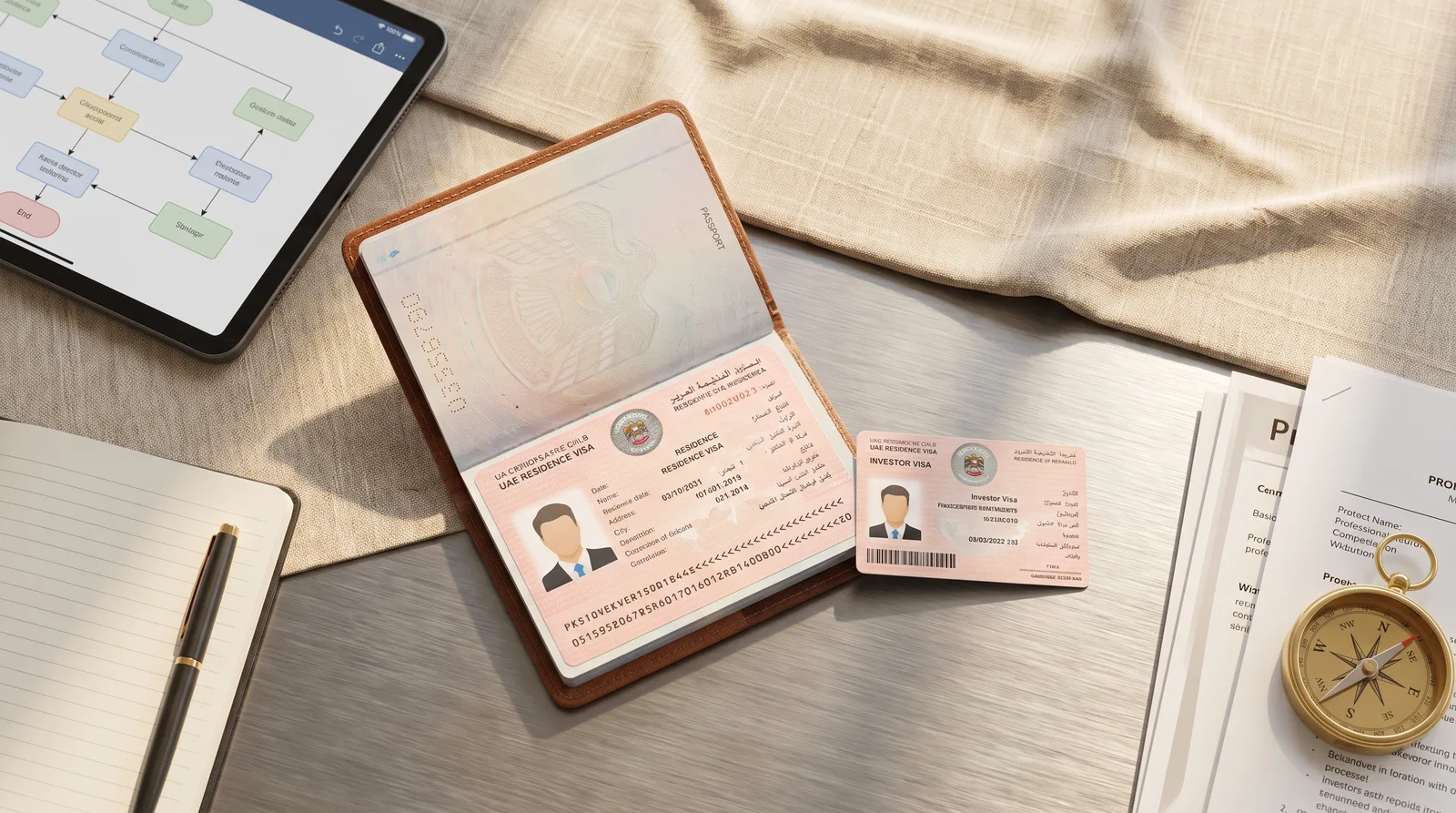
To obtain a business setup with one investor visa in Dubai, you need a valid passport, passport-size photos, a signed application form, your trade license, proof of health insurance, and a medical fitness certificate. Free zone authorities and the ICP (Identity and Citizenship Authority) process these documents together as part of a single application package.
Core Documents Required for Your Application
The document list is straightforward. Get these ready before you start:
Passport valid for at least six months beyond your intended visa duration.
Recent passport-size photographs on a white background.
Completed visa application form, your free zone authority typically submits this on your behalf.
Trade license copy showing you as the licensed owner or shareholder.
Emirates ID application form submitted simultaneously.
Medical fitness certificate from a Ministry of Health-approved centre (mohap.gov.ae, 2026).
Proof of active health insurance.
Dubai South Business Hub Free Zone coordinates the visa application process directly, so founders don't need to visit government offices separately for most steps. Emirates ID is issued by ICP and is required for all UAE residents (icp.gov.ae, 2026).
Additional Requirements for Dependants on One Company License
A single investor visa on one company license does not automatically cover your family. You can sponsor dependants, a spouse, children under 18, and in some cases parents, once your own visa is stamped. Each dependant visa requires separate fees and documentation.
The standard minimum salary to sponsor a spouse in the UAE is AED 4,000 per month, or AED 3,000 plus accommodation. Dependant visa validity typically mirrors the primary investor visa term. Your free zone authority can advise on current income thresholds before you apply. It's worth confirming these figures early if family sponsorship is part of your plan.
Step-by-Step Guide to Business Setup With One Investor Visa in Dubai
Setting up a business with one investor visa in Dubai takes five key steps: choose your business activity and free zone, register your company and get your trade license, submit your visa application through the free zone, complete your medical test and biometrics, then collect your Emirates ID and visa stamp. Here's how each step works in practice.
Step 1: Choose Your Business Activity and Free Zone
Start by defining the exact activity your company will carry out. This determines your license type and flags any sector-specific approvals you'll need before operating. Free zones each maintain an approved activity list, check it before committing.
Dubai South Business Hub Free Zone supports a broad range of business activities in Dubai, including trading, professional services, ICT, and logistics. A US-based e-commerce founder selling goods regionally would select a trading license, a professional services license would not cover physical goods distribution. Get this right at the start. Changing your activity after license issuance typically costs AED 500 to AED 2,000 in amendment fees.
Step 2: Register Your Company and Obtain Your Trade License
Once your activity is confirmed, check company name availability before submitting any documents. Trade names must comply with UAE naming conventions, no offensive terms, no misleading descriptions, no references to political or religious bodies without prior approval.
The incorporation documents include your Memorandum of Association, shareholder details, and selected activities. At Dubai South Business Hub Free Zone, company registration and license issuance can be completed within one business day when all documents are submitted correctly. The trade license is the legal foundation for your investor visa application, nothing moves until it's in hand.
Step 3: Submit Your Visa Application, Medical Test, and Emirates ID
Your free zone authority submits the entry permit application to ICP on your behalf. Once approved, follow these steps in order:
Travel to the UAE, or change your visa status if you're already in-country.
Complete your medical fitness test at an approved health centre.
Submit biometrics at an authorised typing centre for your Emirates ID.
Wait for Emirates ID processing, typically three to seven business days after biometrics.
Collect your visa stamp. Your residency is now active.
An applicant already in Dubai on a visit visa can change their status to investor residency without leaving the country, provided the entry permit is approved before the visit visa expires. ICP manages all residency visa stamping in the UAE (icp.gov.ae, 2026).
Business Setup With One Investor Visa in Dubai: Key Cost Components
Cost Component | What It Covers | Typical Range (AED) |
|---|---|---|
Free zone trade license fee | Company registration, Articles of Association, share register, flexi-desk, lease agreement | Included in package (AED 16,350 for 1 visa package) |
Investor visa application and stamping | ICP entry permit, status change (if applicable), residency visa stamp | Quoted separately by free zone |
Emirates ID fee | Fixed government fee per application, issued by ICP | Government rate (quoted at application) |
Medical fitness test | Mandatory health screening at Ministry of Health-approved centre | AED 200 – AED 300 |
Health insurance (mandatory) | Active coverage required before visa stamping; must remain valid throughout residency | AED 600 – AED 2,500 per year |
Annual license renewal | Keeps your company active; failure to renew can invalidate your residency visa | AED 5,000 – AED 10,000 |
Costs Breakdown for Business Setup With One Investor Visa in Dubai
The total cost of a business setup with one investor visa in Dubai typically ranges from AED 12,000 to AED 25,000 for a free zone package, covering the trade license, investor visa fees, Emirates ID, and medical test. At Dubai South Business Hub Free Zone, the one investor visa package is priced at AED 16,350. Exact figures depend on the free zone, activity type, and visa package selected.
What the License and Visa Fees Cover
The three standard packages at Dubai South Business Hub Free Zone break down as follows:
0 Visa Package: AED 12,500, license, Articles of Association, share register, flexi-desk, lease agreement.
1 Visa Package: AED 16,350, all of the above, plus one visa allocation and establishment card.
2 Visa Package: AED 18,200, all of the above, plus two visa allocations and establishment card.
Outside the package fee, you'll pay separately for: visa processing (entry permit, status change, medical test, Emirates ID), health insurance (AED 600 to AED 2,500 depending on plan), and corporate bank account opening. To model your full business setup cost in Dubai before you apply, use the cost calculator.
Ongoing Annual Costs to Factor Into Your Budget
Setup costs are one-off. Running costs are not. Plan for these from day one:
Annual license renewal: AED 5,000 to AED 10,000 depending on free zone and activity.
Visa renewal: every two to three years, fees similar to initial issuance.
Health insurance: must remain active throughout your residency.
Dependant visas: each renewal adds to annual costs if you sponsor family members.
Workspace fees: confirm whether a flexi-desk or virtual office is included in your package or charged separately.
Is a Dubai free zone investor visa worth it for solo founders?
For most solo founders, yes. A free zone investor visa gives you legal UAE residency, 100% foreign ownership, and a licensed entity from a single package, typically AED 16,350 at Dubai South Business Hub. The alternative, a mainland setup, involves more government touchpoints and often higher total fees for a comparable outcome.
Choosing the Right License for Your Business Setup With One Investor Visa in Dubai
Choosing the right license for a business setup with one investor visa in Dubai depends on your core activity. Trading licenses cover buying and selling goods. Professional licenses cover services and consultancy. General service licenses cover a broad range of operational activities. Your license type must match your declared business activity, mismatches cause delays and amendment costs.
Trading vs. Professional vs. Service Licenses Explained
Trading license: for importing, exporting, distributing, or selling physical goods.
Professional license: for knowledge-based services, consulting, design, IT, education, marketing.
Service license: for operational businesses, logistics support, maintenance, cleaning, facilities management.
A Dubai-based digital marketing consultant needs a professional license in Dubai, not a trading license, even if they occasionally sell software tools as part of their service. Some free zones allow dual activities on a single license, but you'll need to confirm this with your free zone authority before submitting.
How to Match Your Activity to the Right License Category
Before finalising your application, review the free zone's approved activity list. If your activity spans categories, say, selling software and providing IT support, check whether a combined activity is permitted under a single ICT license in Dubai or whether separate entries are required.
Selecting the wrong activity can delay your license issuance or require a costly amendment later. Activity amendments after issuance typically cost AED 500 to AED 2,000 in additional government fees. Dubai South Business Hub Free Zone publishes a searchable activity list, use it before you submit, not after. Regulated activities (healthcare, financial services, education) also require sector authority approval before you can operate, regardless of which license type you hold.
Banking and Tax Obligations After Your Business Setup With One Investor Visa in Dubai
After completing a business setup with one investor visa in Dubai, you must open a corporate bank account and register for corporate tax if your taxable income exceeds AED 375,000 annually. VAT registration is required if your taxable supplies exceed AED 375,000 in any 12-month period. Both registrations carry AED 10,000 penalties for late compliance.
Opening a Corporate Bank Account in the UAE
A corporate bank account is non-negotiable. You can't receive client payments or pay suppliers without one. Banks require your trade license, Emirates ID, passport, and proof of business activity. Some also request a business plan or evidence of incoming transactions.
Free zone companies are eligible for accounts at all major UAE banks.
Account opening timelines vary, budget two to six weeks from application to activation.
Some banks require a minimum average balance; amounts vary by bank and account type.
Some free zones have banking partnerships that can streamline the process.
Apply for your bank account in the UAE as soon as your Emirates ID is issued. Don't wait until you have clients lined up.
Corporate Tax and VAT: What Free Zone Companies Must Know
The UAE introduced a 9% corporate tax on taxable income above AED 375,000 (Federal Tax Authority, 2026). Free zone companies may benefit from a 0% rate on qualifying income, but must meet genuine economic substance and compliance requirements to maintain that status. This is not automatic; consult a qualified tax adviser for your specific structure.
VAT rate: 5%, mandatory registration once taxable supplies exceed AED 375,000 in any 12-month period.
Corporate tax rate: 9% on taxable income above AED 375,000.
Late VAT registration penalty: AED 10,000.
Late corporate tax registration penalty: AED 10,000 (one-time flat fee).
A free zone e-commerce company crossing AED 375,000 in annual sales must register for VAT before that threshold is reached, failure triggers an immediate AED 10,000 penalty whether the oversight was intentional or not. Track your revenue from month one.
What happens if I miss the VAT registration deadline in the UAE?
Missing the VAT registration deadline in the UAE triggers a flat AED 10,000 penalty, applied by the Federal Tax Authority regardless of whether the breach was intentional. Register as soon as your taxable supplies approach AED 375,000 in any rolling 12-month period, do not wait until year-end.
Common Mistakes to Avoid When Setting Up With One Investor Visa in Dubai
The most common mistakes when completing a business setup with one investor visa in Dubai include selecting the wrong business activity, letting your entry permit expire before stamping, skipping health insurance, and missing tax registration deadlines. Each mistake adds cost and delay, sometimes significant penalties that could have been avoided entirely.
Activity and License Errors That Delay Your Visa
Declaring an activity that doesn't match your actual business causes license amendments, which delay visa processing. Choosing a license category outside the free zone's approved list means your application is rejected at the first stage. Not confirming whether your activity requires additional approvals, healthcare, financial services, education, can stall your entire setup.
A fintech startup that selected a generic "business consultancy" activity instead of the correct financial services classification faced a license amendment and a six-week delay before their investor visa could be processed. Regulated activities require sector authority approval before licensing, the free zone license alone is not enough to operate.
Visa Timing and Compliance Mistakes That Cost You
Entry permits are valid for typically 60 days from issuance. Miss the window and the permit lapses.
Overstaying a visit visa while waiting for your investor visa stamp incurs AED 25 to AED 50 per day in fines.
Missing VAT or corporate tax registration deadlines costs AED 10,000 per missed registration.
Not renewing your trade license on time can invalidate your residency visa.
Once your entry permit is approved, book your medical test immediately. Don't treat it as optional admin. Free zone business support services at Dubai South Business Hub can flag these timing issues before they become penalties, a clear advantage over managing a mainland application independently.
References
Frequently Asked Questions