Topic Summary
What Is VAT on Digital Services Sold to UAE Customers by a Foreign Business and Why It Matters
VAT on digital services sold to UAE customers by a foreign business is the 5% UAE VAT due on software, streaming, apps and online platforms supplied by a non-resident to someone in the UAE. Either the supplier registers and charges VAT, or the UAE business self-accounts under the reverse charge.
Place of Supply Rules for Digital Services Sold to UAE Customers
Place of Supply Rules for Digital Services Sold to UAE Customers
How Reverse Charge Applies When UAE Businesses Buy From Foreign Suppliers
When a VAT-registered UAE business buys from a foreign supplier that doesn't charge UAE VAT, it reports 5% output tax under the reverse charge. It usually claims the same amount as input tax in the same return, if the service relates to taxable activity. Our guide to reverse charge VAT in the UAE goes deeper.
Registration Duties for Foreign Digital Suppliers Step by Step
A foreign supplier with UAE B2C sales above AED 375,000 in 12 months must register through the EmaraTax portal. The process covers measuring supplies, applying, charging 5% VAT and filing on time. See the VAT registration threshold rules for detail.
Free Zone Company Obligations When Buying or Reselling Foreign Digital Services
A free zone company must register if taxable supplies and imports exceed AED 375,000, and imported digital services count. Once registered, it self-accounts, files on time and keeps invoices. Read more on a free zone company selling to UAE customers.
Common Mistakes With VAT on Digital Services Sold to UAE Customers by a Foreign Business
The most common mistakes are ignoring reverse charge on subscriptions, treating free zone status as VAT-free, missing AED 375,000, using the wrong exchange rate and weak location evidence. Build a monthly review of foreign invoices.
More than 350,000 businesses are VAT-registered in the UAE (Federal Tax Authority, 2025), yet many foreign software sellers miss the rules. This guide helps free zone owners and finance managers handle VAT on digital services sold to UAE customers by a foreign business, whether you're selling or buying.
What Is VAT on Digital Services Sold to UAE Customers by a Foreign Business and Why It Matters
VAT on digital services sold to UAE customers by a foreign business is the 5% UAE VAT due on software, streaming, apps and online platforms supplied by a non-resident to someone in the UAE. Either the supplier registers and charges VAT, or the UAE business self-accounts under the reverse charge.
Definition and Legal Basis
Digital services are delivered online with minimal human involvement. Federal Decree-Law No. 8 of 2017 and its Executive Regulation tax them at 5% when the place of supply is the UAE. VAT has applied since 1 January 2018, and the seller's foreign status doesn't remove the liability.
Picture a Singapore project management SaaS billing a Dubai South free zone company monthly. That's a taxable supply.
VAT Treatment of Foreign Digital Services by Customer Type
Feature | UAE Business Customer (B2B) | UAE Consumer (B2C) |
|---|---|---|
Who accounts for the VAT | The UAE customer, under reverse charge | The foreign supplier, who charges 5% |
Supplier registration requirement | Generally none | Required above AED 375,000 in 12 months |
Invoice treatment | Issued without UAE VAT, showing the customer's TRN | Tax invoice with supplier TRN and 5% VAT |
VAT201 reporting | Customer reports output and input tax in one return | Supplier files and pays within 28 days of period end |
Evidence to keep | TRN, contract, supplier invoice, workings | Billing address, IP data, payment records |
Why Foreign Sellers and UAE Buyers Both Care
Sellers risk penalties and blocked sales.
Buyers risk unreported reverse charge.
Late registration costs a flat AED 10,000.
Contracts must state VAT treatment clearly.
One free zone consultancy found unreported imported-service VAT during an internal review. It corrected the position before the FTA asked.
Place of Supply Rules for Digital Services Sold to UAE Customers
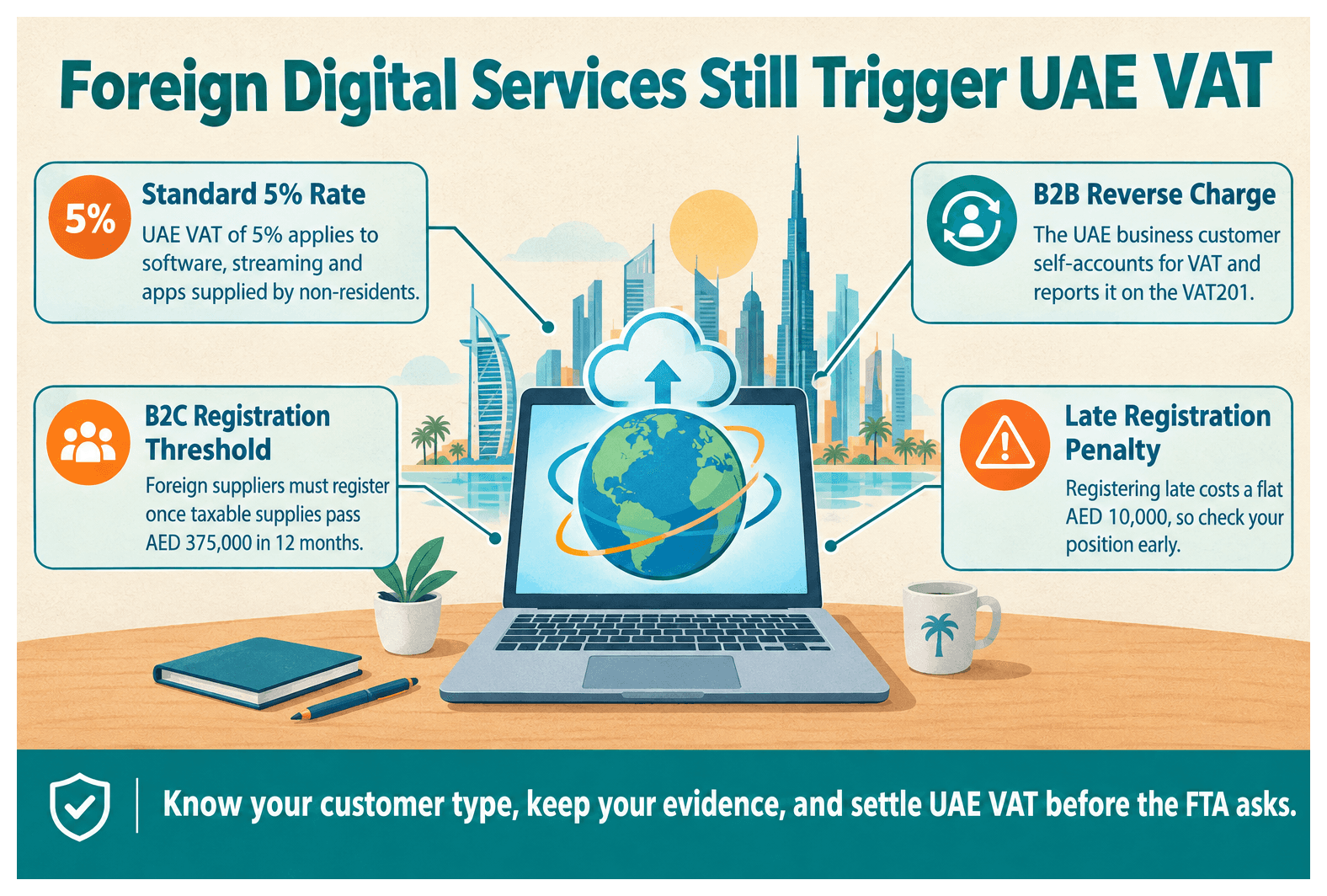
Under UAE VAT law, the place of supply for services generally follows the supplier's location. For B2B services, the recipient's location can apply when the customer is in the UAE and the supplier isn't. That shift triggers VAT on digital services sold to UAE customers by a foreign business.
B2B Supplies to UAE Businesses
A US cloud host invoicing a VAT-registered Dubai South company issues the invoice without UAE VAT. The customer self-accounts and reports it on the VAT201, backed by its Tax Registration Number (TRN) and a valid contract.
B2C Supplies to UAE Consumers
UAE VAT applies where the consumer uses the service in the UAE.
The supplier may need non-resident registration.
Keep billing address and IP evidence.
A European streaming platform charging UAE subscribers must register once its taxable supplies pass AED 375,000 in 12 months.
Free Zone Customers and Designated Zones
A free zone isn't automatically outside the UAE for VAT. Designated Zone treatment mainly covers goods, not services. A free zone firm assuming no VAT applies to imported subscriptions is making a costly assumption. Check the Ministry of Finance Cabinet Decisions for your zone's status.
How Reverse Charge Applies When UAE Businesses Buy From Foreign Suppliers
When a VAT-registered UAE business buys from a foreign supplier that doesn't charge UAE VAT, it reports 5% output tax under the reverse charge. It usually claims the same amount as input tax in the same return, if the service relates to taxable activity. Our guide to reverse charge VAT in the UAE goes deeper.
Reporting the Reverse Charge on VAT201
Declare the value in the reverse charge boxes. The tax point is the invoice or payment date, whichever comes first. Convert using the Central Bank of the UAE rate (AED/USD peg 3.6725).
Example: a USD 2,000 monthly invoice equals AED 7,345. Self-assessed VAT is AED 367.25.
Input Tax Recovery and Partial Exemption
Full recovery applies if you make only taxable supplies.
Exempt supplies restrict recovery.
Keep invoices, contracts and workings for five years.
Registration Duties for Foreign Digital Suppliers Step by Step
A foreign supplier with UAE B2C sales above AED 375,000 in 12 months must register through the EmaraTax portal. The process covers measuring supplies, applying, charging 5% VAT and filing on time. See the VAT registration threshold rules for detail.
Step 1: Measure Your UAE Taxable Supplies
Review 12 months and forecast 30 days.
Registration is mandatory at AED 375,000, voluntary from AED 187,500.
Count only supplies with a UAE place of supply.
Step 2: Prepare Documents and Apply on EmaraTax
Trade license or incorporation certificate.
Passport and ID of the signatory.
Contracts, bank details and turnover evidence.
Register within 30 days of crossing the threshold.
Step 3: Charge VAT, Invoice Correctly and File Returns
Issue tax invoices showing your TRN and 5% VAT. File the VAT201 within 28 days of period end. A quarter ending 31 March means payment by 28 April.
Step 4: Keep Records and Review Compliance
Retain invoices, location evidence and returns for five years. Reassess each quarter. If a SaaS seller under-declares UAE sales, Form VAT 211 (voluntary disclosure) corrects it.
Free Zone Company Obligations When Buying or Reselling Foreign Digital Services
A free zone company must register if taxable supplies and imports exceed AED 375,000, and imported digital services count. Once registered, it self-accounts, files on time and keeps invoices. Read more on a free zone company selling to UAE customers.
Threshold Tracking for Imported Services
Monitor rolling 12-month totals. A free zone agency whose foreign ad-platform and software spend passes AED 375,000 faces the AED 10,000 late registration penalty if it waits. Align accounting software VAT codes early.
Reselling Foreign Digital Services to UAE Clients
A reseller acting as principal charges 5% on its own supply.
Define agent versus principal in the contract.
Corporate tax is 9% above AED 375,000 of taxable income; 0% applies only to qualifying income of Qualifying Free Zone Persons.
A free zone IT firm bundling a foreign license into a managed service for a mainland client is typically the principal. A Dubai South Business Hub Free Zone license with residency visa packages gives you the base to structure that properly.
Common Mistakes With VAT on Digital Services Sold to UAE Customers by a Foreign Business
The most common mistakes are ignoring reverse charge on subscriptions, treating free zone status as VAT-free, missing AED 375,000, using the wrong exchange rate and weak location evidence. Build a monthly review of foreign invoices.
Treating Free Zone Status as an Exemption
A free zone license isn't a VAT exemption, and VAT and corporate tax are separate regimes. One founder skipped registration for that reason and faced the AED 10,000 penalty.
Weak Documentation and Late Filing
Missing invoices block input tax recovery.
Late VAT201 filing triggers penalties.
Set reminders for the 28-day deadline.
VAT on digital services sold to UAE customers by a foreign business comes down to place of supply, registration at AED 375,000 and correct reverse charge reporting. Foreign suppliers charge 5% where required, and UAE buyers self-account. Check your foreign subscriptions and UAE sales against the threshold this month, then speak with Dubai South Business Hub about a free zone license and VAT-ready setup.
References
Frequently Asked Questions