Topic Summary
What Is a Tax Credit Note and When Must You Issue One in the UAE
A tax credit note is a document a VAT-registered supplier issues to reduce the value of a previously invoiced taxable supply. You must issue one when a sale is cancelled, the price falls, goods come back or the invoice overstated the amount. It corrects output VAT and lets your customer adjust input tax.
When Must You Issue a Tax Credit Note Under UAE VAT Rules
When Must You Issue a Tax Credit Note Under UAE VAT Rules
Mandatory Details Every Tax Credit Note Must Carry
A valid note shows the words Tax Credit Note, a unique serial number, issue date, both parties' names, addresses and TRNs (Tax Registration Numbers), the reason, the original invoice reference, the credited value and the VAT adjusted, in AED.
Step-by-Step: A Tax Credit Note and When Must You Issue One
To apply a tax credit note and when must you issue one in practice, confirm the event, find the invoice, calculate the credit, prepare the note, send it within 14 days and record it for your VAT201.
How a Tax Credit Note Adjusts Your VAT201 Return
A tax credit note reduces your output VAT in the period you issue it, and your customer cuts input tax by the same amount. You report it in the VAT201 through EmaraTax.
Records, Penalties and Common Credit Note Mistakes
Keep every tax credit note, linked invoice and evidence for at least five years. Common mistakes are late issue, missing references, wrong VAT and overwritten invoices. Penalties start at AED 10,000.
Final Checklist
Knowing a tax credit note and when must you issue one keeps your VAT accurate: issue within 14 days of a cancellation, return, discount or error, include every field, adjust your VAT201 and keep records five years. Review last quarter's invoices for uncredited adjustments, set a 14-day reminder, and speak to Dubai South Business Hub about free zone company formation, trade licenses and residency visa packages with compliant accounting set-up.
More than 350,000 businesses are VAT-registered in the UAE [1]. VAT is 5% [2], has applied since 1 January 2018 [2], and mandatory registration starts at AED 375,000 of taxable turnover [2]. This guide explains a tax credit note and when must you issue one, so free zone owners and finance managers can correct invoices within 14 days [2] and avoid penalties from AED 10,000 [3].
What Is a Tax Credit Note and When Must You Issue One in the UAE
A tax credit note is a document a VAT-registered supplier issues to reduce the value of a previously invoiced taxable supply. You must issue one when a sale is cancelled, the price falls, goods come back or the invoice overstated the amount. It corrects output VAT and lets your customer adjust input tax.
Legal Definition Under UAE VAT Law
Federal Decree-Law No. 8 of 2017 and its Executive Regulation set the rules, as published by the Federal Tax Authority. Both sides adjust their returns. Say a Dubai South Business Hub Free Zone consultancy invoices AED 20,000 plus 5% VAT, then agrees a AED 2,000 discount. The credit note cuts the taxable value by AED 2,000 and the VAT by AED 100.
Credit Note Triggers and Required Actions
Trigger | Required action |
|---|---|
Cancelled supply | Issue a full credit note within 14 days |
Discount or rebate agreed | Issue a partial credit note for the reduction |
Goods returned | Credit the returned value and its VAT |
Invoice overstated | Credit the excess amount and its VAT |
Service rejected | Credit the rejected portion only |
Credit Note Versus Tax Invoice
An invoice records a supply. A credit note reduces it and must cite the original invoice number. Never overwrite an invoice. One trading company reissued a corrected invoice with no credit note and created a duplicate output VAT record. For invoice basics, see tax invoice requirements in the UAE.
When Must You Issue a Tax Credit Note Under UAE VAT Rules
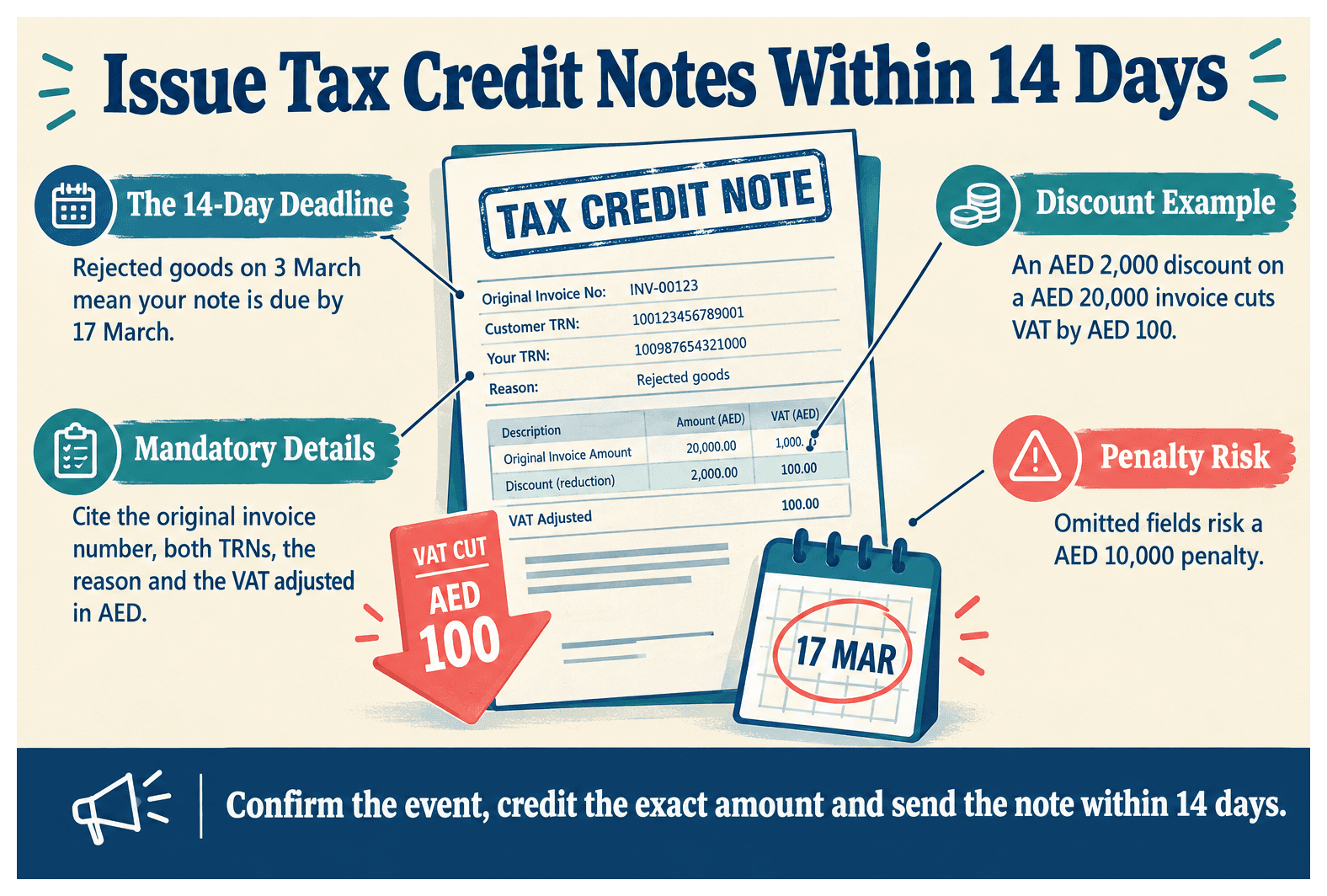
You must issue a tax credit note when a supply is cancelled, its value is reduced, goods or services are returned, the amount was wrong, or the supply is rejected. The FTA expects it within 14 days of the triggering event.
The 14-Day Deadline Explained
The clock runs in calendar days. If a client rejects goods on 3 March, your note is due by 17 March. Late issue muddles the tax period you adjust in. So set a reminder for finance staff the day the event is confirmed.
When You Do Not Need One
Supplies outside VAT scope.
Unregistered suppliers, below the AED 375,000 threshold, cannot issue VAT credit notes.
Bad debt relief follows separate conditions.
Mandatory Details Every Tax Credit Note Must Carry
A valid note shows the words Tax Credit Note, a unique serial number, issue date, both parties' names, addresses and TRNs (Tax Registration Numbers), the reason, the original invoice reference, the credited value and the VAT adjusted, in AED.
Missing invoice references get notes rejected by customers' accounts teams.
Omitted fields risk a AED 10,000 penalty.
For foreign currency, show VAT in AED using the Central Bank of the UAE rate (the dirham is pegged at 3.6725 to the USD). Keep the rate source on file. Also check e-invoicing in the UAE requirements.
Step-by-Step: A Tax Credit Note and When Must You Issue One
To apply a tax credit note and when must you issue one in practice, confirm the event, find the invoice, calculate the credit, prepare the note, send it within 14 days and record it for your VAT201.
Step 1: Confirm the Event and Pull the Original Invoice
Get written confirmation, such as the client email approving a partial refund.
Match it to the invoice number and TRN.
Step 2: Calculate the Credit and VAT
Compute the reduced value at the original rate.
Example: 5% of AED 2,000 equals AED 100.
Step 3: Issue, Send and Record the Note
Use a sequential number and every required field.
Send within 14 days and log it in your system, as covered in setting up accounting from day one in Dubai.
How a Tax Credit Note Adjusts Your VAT201 Return
A tax credit note reduces your output VAT in the period you issue it, and your customer cuts input tax by the same amount. You report it in the VAT201 through EmaraTax.
Reporting Adjustments for Suppliers
Reduce standard-rated sales and output tax, then reconcile notes to your ledger. Returns are due 28 days after period end. A quarterly filer deducts the AED 100 in the quarter of issue. See VAT return filing for Dubai companies.
What Customers Must Do on Receipt
Customers must lower recoverable input tax by the credited VAT and check the note matches the invoice. One buyer ignored a supplier's note and over-claimed input tax, which means under-declared VAT and penalties.
Records, Penalties and Common Credit Note Mistakes
Keep every tax credit note, linked invoice and evidence for at least five years. Common mistakes are late issue, missing references, wrong VAT and overwritten invoices. Penalties start at AED 10,000.
Errors That Trigger FTA Scrutiny
Issuing after 14 days.
Omitting TRNs or the reason.
Hiding cash refunds off the books.
Three notes in one month without references can prompt an audit query.
Free Zone Company Considerations
Free zone status affects corporate tax, not VAT invoicing. A VAT-registered Dubai South Business Hub Free Zone company follows the same credit note rules as a mainland business. Designated zone goods may differ, so confirm on the FTA site. Store records per the tax invoice retention period in the UAE.
Final Checklist
Knowing a tax credit note and when must you issue one keeps your VAT accurate: issue within 14 days of a cancellation, return, discount or error, include every field, adjust your VAT201 and keep records five years. Review last quarter's invoices for uncredited adjustments, set a 14-day reminder, and speak to Dubai South Business Hub about free zone company formation, trade licenses and residency visa packages with compliant accounting set-up.
References
Frequently Asked Questions