
Topic Summary
What Is Import Duty in Dubai and How Do You Calculate It?
Import duty in Dubai is a tax on goods entering the UAE mainland, usually 5% of CIF value. To calculate import duties Dubai importers apply the HS-code rate to CIF value, then add VAT on the combined total.
Which Factors Decide Your Duty Rate?
Which Factors Decide Your Duty Rate?
How Do You Calculate Import Duties in Dubai Step by Step?
Follow five steps: confirm the HS code, work out CIF, apply the rate, add VAT, then submit through Dubai Trade or Mirsal 2 (the Dubai Customs system). Add permit and handling fees separately.
How Does VAT on Imports Add to Your Total Cost?
Import VAT is 5% on CIF plus duty. VAT-registered businesses usually recover it as input tax through their Federal Tax Authority (FTA) return. Import duty and VAT on imports UAE must be calculated in that order.
Which Documents Do You Need to Calculate and Pay Duty?
You need a commercial invoice, bill of lading or airway bill, packing list, certificate of origin and a customs client code. Perishables may need extra permits. Dubai Customs checks these against CIF and HS code, so mismatches slow clearance.
When Can a Free Zone Setup Change Your Duty Position?
Goods stored in a free zone can stay duty-suspended until they enter the mainland, when duty becomes payable. A license doesn't automatically avoid duty. Dubai South Business Hub Free Zone supports trading and storage, but your end market decides timing.
What Mistakes Make You Overpay or Delay Clearance?
Common errors are the wrong HS code, declaring invoice price instead of CIF, forgetting VAT in the budget, and mismatched documents. Each can trigger recalculation, fines or storage charges. To calculate import duties Dubai customs will accept, verify with your clearing agent first.
To calculate import duties Dubai importers multiply the CIF value (cost, insurance and freight) by the duty rate for the product's HS code, usually 5%. Then add 5% VAT on the CIF value plus duty.
Dubai's ports and free zones handle more than 16 million declarations a year (Dubai Trade, 2026), and each one starts with this sum. This guide is for cold chain founders and logistics operators who want to calculate import duties Dubai shipments attract before they commit to a purchase. A UAE customs duty calculator helps, but only if you feed it the right inputs.
What Is Import Duty in Dubai and How Do You Calculate It?
Import duty in Dubai is a tax on goods entering the UAE mainland, usually 5% of CIF value. To calculate import duties Dubai importers apply the HS-code rate to CIF value, then add VAT on the combined total.
What Does the 5% Customs Duty Cover?
Customs duty is simply a tax on goods crossing the border. The 5% customs duty UAE applies to most goods under the GCC Common Customs Law, and Dubai Customs collects it. A cold chain startup importing refrigerated display units pays that rate on the declared CIF value. Fees and requirements may vary, so check the official source before applying.
Why Is CIF Value the Starting Point?
CIF means the cost of goods plus insurance plus freight to the UAE border. Duty applies to this landed value, not the invoice price alone. Goods of AED 100,000, freight of AED 8,000 and insurance of AED 2,000 give a CIF value of AED 110,000. Under-declaring invites penalties.
Which Factors Decide Your Duty Rate?
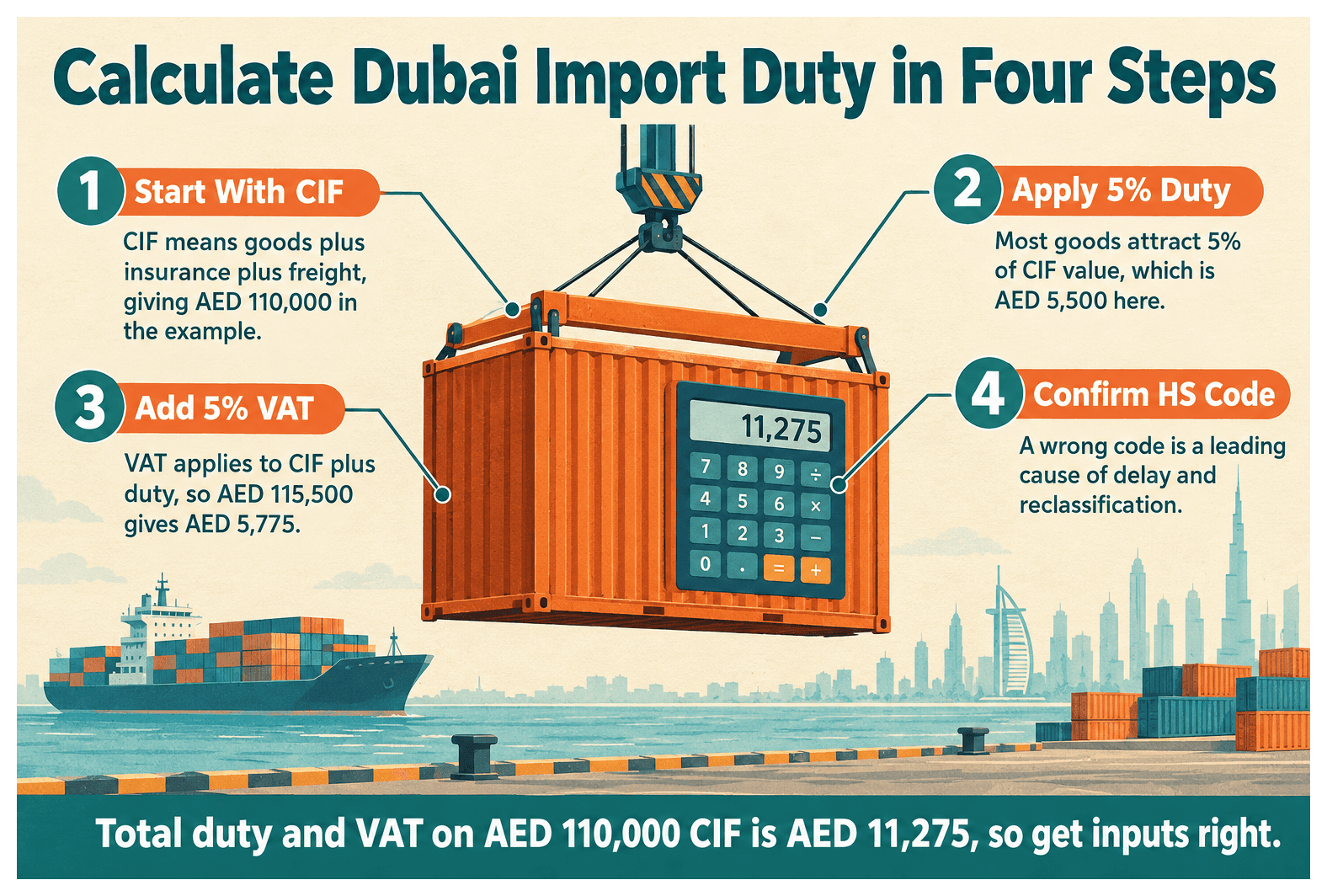
Your rate depends on the HS code, declared CIF value, country of origin and any exemptions. Most goods attract 5%, while alcohol and tobacco carry higher rates. Always confirm against the Dubai customs tariff.
How Does the HS Code Set the Rate?
The HS (Harmonized System) code is a 6-digit international product number, extended nationally. A wrong code is a leading cause of delay and reclassification. Frozen meat, dairy and refrigeration equipment sit under different chapters. Our UAE customs HS code guide shows how to find yours.
Duty and VAT Worked Example for a AED 110,000 CIF Shipment
Cost Component | Amount (AED) |
|---|---|
Goods value, freight and insurance (CIF value) | 110,000 |
Customs duty at 5% of CIF | 5,500 |
VAT base (CIF plus duty) | 115,500 |
VAT at 5% of VAT base | 5,775 |
Total duty and VAT payable | 11,275 |
What Rates Apply to Common Product Types?
Food, equipment and packaging: 5% standard.
Tobacco and alcohol: higher rates.
Some food and medical goods: possibly exempt.
HS code duty rates UAE vary by product, so verify in the official tariff.
Does Country of Origin Matter?
Origin may change treatment under GCC agreements.
A certificate of origin supports your declaration.
Keep it with the shipment file.
How Do You Calculate Import Duties in Dubai Step by Step?
Follow five steps: confirm the HS code, work out CIF, apply the rate, add VAT, then submit through Dubai Trade or Mirsal 2 (the Dubai Customs system). Add permit and handling fees separately.
Step 1: Confirm the HS Code
Search the Dubai customs tariff.
Separate a chiller unit from a spare part.
Ask your clearing agent if unsure.
Step 2: Work Out the CIF Value
Add goods, freight and insurance: AED 110,000.
Convert foreign currency at the customs-accepted rate.
Step 3: Apply the Duty Rate
AED 110,000 x 5% = AED 5,500 duty.
Step 4: Add VAT and Check the Total
VAT base is AED 115,500, VAT is AED 5,775, and total taxes are AED 11,275. Cross-check in Mirsal 2 or a UAE customs duty calculator. For more on landed cost, read import duty calculation in the UAE.
How Does VAT on Imports Add to Your Total Cost?
Import VAT is 5% on CIF plus duty. VAT-registered businesses usually recover it as input tax through their Federal Tax Authority (FTA) return. Import duty and VAT on imports UAE must be calculated in that order.
Why Is VAT Calculated After Duty?
The VAT base includes duty, which is why the example above lands at AED 5,775 rather than AED 5,500. You pay both at clearance, so it hits cash flow before the goods sell.
Can You Reclaim Import VAT?
Yes, if you're VAT-registered. A cold chain importer buying equipment can claim the AED 5,775 in the next return, using the customs declaration as evidence. See reclaiming import VAT and the FTA guidance.
Which Documents Do You Need to Calculate and Pay Duty?
You need a commercial invoice, bill of lading or airway bill, packing list, certificate of origin and a customs client code. Perishables may need extra permits. Dubai Customs checks these against CIF and HS code, so mismatches slow clearance.
Documents Checklist for Duty Assessment
Commercial invoice.
Bill of lading or airway bill.
Packing list.
Certificate of origin.
Customs client code.
For a frozen food consignment, add the relevant permits.
What Is the Customs Client Code?
It's your importer ID with Dubai Customs. Registration is AED 100 and renewal AED 100 a year, though figures may vary. Register before your first shipment; see customs client code costs.
When Can a Free Zone Setup Change Your Duty Position?
Goods stored in a free zone can stay duty-suspended until they enter the mainland, when duty becomes payable. A license doesn't automatically avoid duty. Dubai South Business Hub Free Zone supports trading and storage, but your end market decides timing.
What Happens When Goods Leave the Free Zone?
A cold chain distributor can hold stock and release batches to mainland clients, paying duty on each release. Re-exports may stay suspended. It isn't a way to avoid tax, only to time it.
Does a Free Zone Trading License Avoid Duty?
No. Trade licenses start from a base rate of AED 12,500 (check the official source), with residency visa packages tied to the license. Read whether a free zone license avoids import duty.
What Mistakes Make You Overpay or Delay Clearance?
Common errors are the wrong HS code, declaring invoice price instead of CIF, forgetting VAT in the budget, and mismatched documents. Each can trigger recalculation, fines or storage charges. To calculate import duties Dubai customs will accept, verify with your clearing agent first.
Common Mistake: Declaring Invoice Value Only
Practical tip: An importer leaves out AED 10,000 of freight and insurance. On inspection, duty is reassessed and clearance stalls. Always include both.
How Can You Budget Landed Cost Accurately?
Duty and VAT.
Handling and storage.
Permit fees.
A freight forwarder's quote.
Fees and requirements may vary, so check the official source before applying.
Your Next Step
To calculate import duties Dubai importers confirm the HS code, build the CIF value, apply 5% duty, then add 5% VAT on the total. Run your next shipment through the five steps, then speak with Dubai South Business Hub about a free zone trade license and residency visa package that fits your import plans.
Rules in the UAE change often. Always verify the latest requirements with the official authority before taking action.
References
Frequently Asked Questions