
Topic Summary
What Is IFRS for SMEs and How Does It Work?
IFRS for SMEs is a simplified standard from the International Accounting Standards Board (IASB) for entities without public accountability. It keeps full IFRS principles but trims disclosures and options, so smaller companies produce credible accounts at lower cost.
Which Accounting Standards Do UAE Free Zone Companies Need to Follow?
Which Accounting Standards Do UAE Free Zone Companies Need to Follow?
Can Your UAE Free Zone Company Use IFRS for SMEs?
Yes, a UAE free zone company can generally use IFRS for SMEs if it has no public accountability and its auditor, free zone authority and tax position accept it. Companies seeking Qualifying Free Zone Person (QFZP) status or planning public capital should confirm eligibility first.
How Does IFRS vs IFRS for SMEs Compare?
Full IFRS is the complete global standard with extensive disclosures, while IFRS for SMEs is a shorter document for non-public entities. Both aim at fair, comparable statements. The SME version costs less, but full IFRS has wider acceptance for listing and group reporting.
How Do You Choose and Apply IFRS for SMEs Step by Step?
Confirm you have no public accountability, check free zone and tax requirements, consult your auditor, document the decision, then set up your books. These steps keep small business accounting UAE reporting consistent from first transaction to first audit.
How Does IFRS for SMEs Fit With UAE Corporate Tax?
UAE corporate tax starts from accounting profit under accepted standards, including IFRS for SMEs, then applies adjustments. The FTA administers registration and returns. Align your framework with your tax adviser before filing, and verify current rules.
Do Audited Financial Statements Change the Standard You Choose?
Audited financial statements must follow a recognised framework, and your auditor states which one applied. Companies claiming QFZP status must file audited accounts. IFRS for SMEs is accepted for eligible entities, but confirm early.
IFRS for SMEs is a simplified accounting standard for private companies, and most eligible UAE free zone companies can use it. Confirm acceptance with your auditor, free zone authority and tax adviser first.
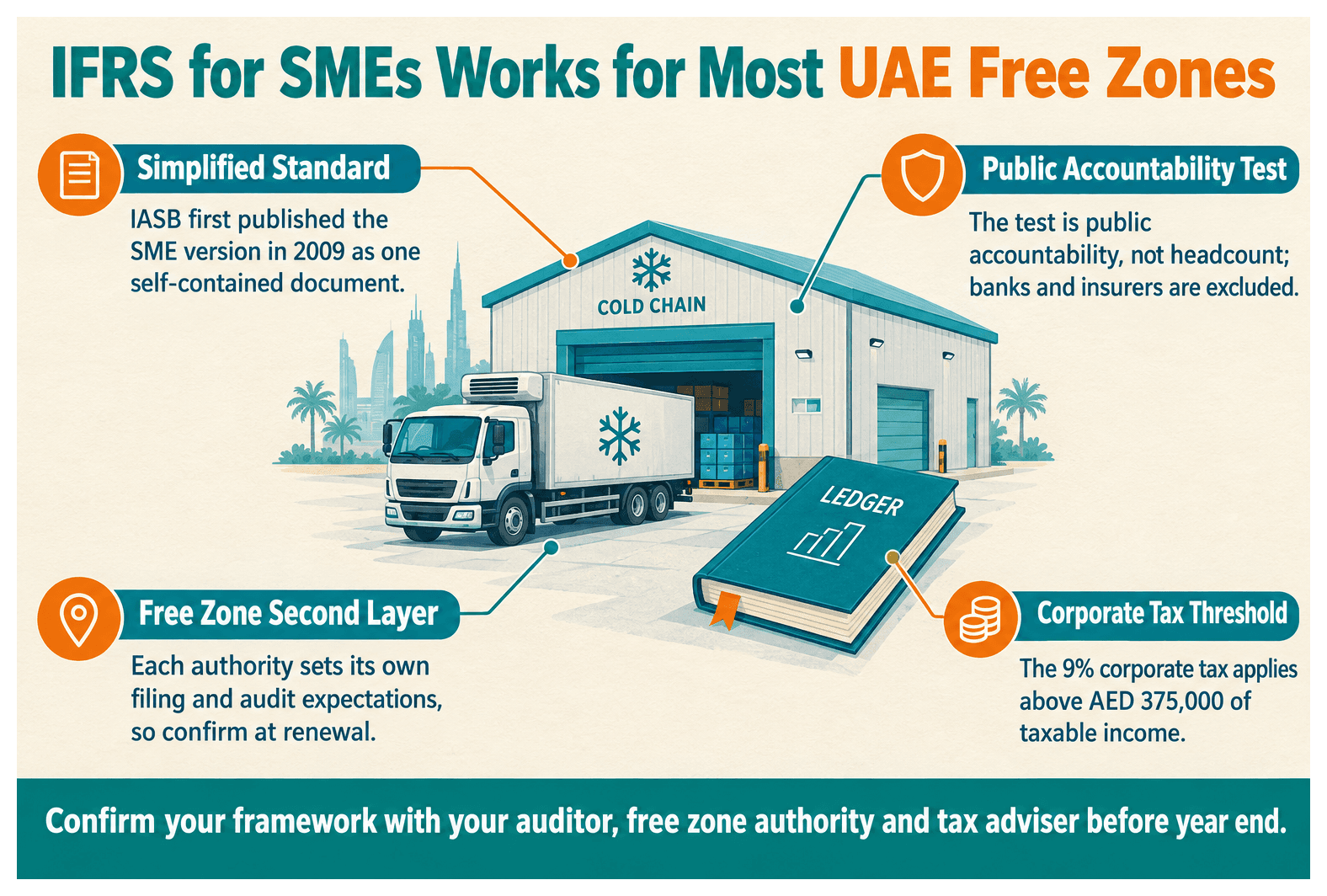
The UAE has more than 40 free zones, and the 9% corporate tax applies above AED 375,000 of taxable income (Federal Tax Authority, 2026). If you're planning a cold chain company, your books need a framework from day one. This guide covers IFRS for SMEs UAE free zone use for founders, logistics operators and investors, so you can decide before your first year closes.
What Is IFRS for SMEs and How Does It Work?
IFRS for SMEs is a simplified standard from the International Accounting Standards Board (IASB) for entities without public accountability. It keeps full IFRS principles but trims disclosures and options, so smaller companies produce credible accounts at lower cost.
Who Issues the Standard and Why It Exists
IFRS means International Financial Reporting Standards, a global rulebook for financial statements. The IASB first published the SME version in 2009 as one self-contained document. Picture a cold chain start-up with one warehouse and a small fleet: it needs lender-ready accounts but has no public investors.
What Counts as an SME
The test is public accountability, not headcount.
Banks and insurers are excluded.
A private logistics company with two investors qualifies.
Local rules may add thresholds, so check the official source.
What Gets Simplified
Fewer disclosure notes.
Simpler goodwill and borrowing cost treatment.
Fewer policy choices, so fewer judgement errors.
Refrigeration equipment depreciation, for example, needs lighter notes. For wider bookkeeping help, see accounting services for small business in the UAE.
Which Accounting Standards Do UAE Free Zone Companies Need to Follow?
UAE free zone companies generally prepare financial statements under IFRS or IFRS for SMEs, depending on size, ownership and the rules of their free zone and auditor. Corporate tax law relies on accepted standards. Fees and requirements may vary, so check the official source before applying.
What IFRS Requirements in the UAE Look Like
Ministry of Finance (MoF) corporate tax rules treat IFRS as the baseline, and IFRS for SMEs is recognised for eligible smaller entities (Ministry of Finance, 2026). Cash basis accounting is limited to small taxpayers under official revenue thresholds, so verify them. A free zone trading company would typically agree full IFRS or IFRS for SMEs with its auditor first.
How Free Zone Rules Add a Second Layer
Each authority sets its own filing and audit expectations.
Confirm Dubai South Business Hub Free Zone requirements at license renewal.
You may need to state your framework when submitting audited accounts.
New to the concept? Read what a free zone actually is in Dubai.
Can Your UAE Free Zone Company Use IFRS for SMEs?
Yes, a UAE free zone company can generally use IFRS for SMEs if it has no public accountability and its auditor, free zone authority and tax position accept it. Companies seeking Qualifying Free Zone Person (QFZP) status or planning public capital should confirm eligibility first.
When IFRS for SMEs Is a Good Fit
Privately held, owner-managed or investor-backed.
No listing plans.
Simple operations, such as a single-facility cold chain operator with bank financing.
IFRS vs IFRS for SMEs: Key Differences
Feature | Full IFRS | IFRS for SMEs |
|---|---|---|
Scope and eligibility | Any entity, required for listed companies | Entities without public accountability |
Document length and complexity | Many separate standards and interpretations | One self-contained, shorter document |
Disclosure requirements | Extensive notes and options | Reduced notes, fewer policy choices |
Typical users | Listed firms, groups with full IFRS parents | Private, owner-managed or investor-backed firms |
Cost and effort to apply | Higher audit and reporting effort | Lower compliance cost |
When Full IFRS Is the Safer Choice
Choose full IFRS if a foreign parent reports under it, a lender requires it in agreements, or you hold complex financial instruments. A logistics group consolidating into a full IFRS parent would avoid a second conversion.
Practical tip: Agree the framework with your auditor before your first books close. Switching later means restating comparatives, which costs more. One company restated its entire first year after changing framework.
Setup order matters, so read setting up accounting from day one.
How Does IFRS vs IFRS for SMEs Compare?
Full IFRS is the complete global standard with extensive disclosures, while IFRS for SMEs is a shorter document for non-public entities. Both aim at fair, comparable statements. The SME version costs less, but full IFRS has wider acceptance for listing and group reporting.
Inventory and Asset Treatment
Frozen stock is valued at the lower of cost and net realisable value.
Cold rooms and reefer trucks sit in property, plant and equipment.
Both need a fixed asset register.
See inventory valuation rules for UAE companies for detail.
How Do You Choose and Apply IFRS for SMEs Step by Step?
Confirm you have no public accountability, check free zone and tax requirements, consult your auditor, document the decision, then set up your books. These steps keep small business accounting UAE reporting consistent from first transaction to first audit.
Confirm eligibility. Check listing plans, group reporting and lender terms.
Check free zone and tax rules. Read Federal Tax Authority (FTA) and MoF guidance.
Agree with your auditor. Hold a kickoff before year end. Use an approved auditor.
Document policies and set up books. Write a policy manual and align your chart of accounts.
Documents checklist:
Trade license
Shareholder agreement
Bank statements and invoices
Fixed asset register
Prior-period accounts, if any
How Does IFRS for SMEs Fit With UAE Corporate Tax?
UAE corporate tax starts from accounting profit under accepted standards, including IFRS for SMEs, then applies adjustments. The FTA administers registration and returns. Align your framework with your tax adviser before filing, and verify current rules.
From Accounting Profit to Taxable Income
The rate is 9% on taxable income above AED 375,000 (Federal Tax Authority, 2026), and it may change. QFZP status offers a favourable regime but isn't "tax free". Operators adjust for non-deductible items. See UAE corporate tax filing for free zone companies.
Small Business Relief
Eligibility is separate from framework choice.
Check revenue limits before your first return.
Do Audited Financial Statements Change the Standard You Choose?
Audited financial statements must follow a recognised framework, and your auditor states which one applied. Companies claiming QFZP status must file audited accounts. IFRS for SMEs is accepted for eligible entities, but confirm early.
What Auditors Look For
Consistent policies.
A clean trial balance.
Stock count sheets and supplier statements.
Filing Obligations
Track license renewal, audit and tax return dates on one calendar. Penalties exist for late filing, so use official figures. Fees and requirements may vary, so check the official source before applying.
What Mistakes Should You Avoid With IFRS for SMEs in a Free Zone?
Common errors include skipping auditor input, switching standards mid-year, weak records, and assuming a license removes reporting duties. Avoiding them protects your IFRS for SMEs UAE free zone audit timeline and lender confidence.
Common mistake: Treating accounting as a year-end task. One cold chain firm rebuilt supplier ledgers weeks before its deadline. Monthly bookkeeping prevents this.
Mixing personal and business expenses.
Unrecorded reefer truck purchases.
No written revenue or inventory policy.
Where Should You Go From Here?
IFRS for SMEs is a simplified IASB standard many eligible free zone companies can use, subject to auditor, authority and tax confirmation. For private, owner-managed businesses it's often the practical choice, while full IFRS suits listed or group entities.
Next step: book a short call with your accountant or auditor this month, then speak to Dubai South Business Hub about free zone company formation and trade license options.
Rules in the UAE change often. Always verify the latest requirements with the official authority before taking action.
References
Frequently Asked Questions