
Topic Summary
What Is a Certificate of Origin and Why Does It Matter for UAE Traders?
A certificate of origin is an official trade document stating the country where goods were manufactured, produced or processed. A recognised UAE chamber of commerce issues and stamps it. Importing customs authorities use it to apply duties, enforce trade rules and test eligibility for preferential treatment.
When Do Certificate of Origin UAE Traders Need One?
When Do Certificate of Origin UAE Traders Need One?
Who Issues a Dubai Certificate of Origin?
The Dubai Chamber of Commerce issues the Dubai certificate of origin for companies registered in its jurisdiction. Other emirates have their own chambers. You apply online, and the chamber stamps the certificate after reviewing your invoice and supporting documents.
How Do You Get a Certificate of Origin in Dubai Step by Step?
To get a certificate of origin in Dubai, register with the chamber, prepare invoice and shipping documents, submit the online application, pay the fee and collect the stamped certificate. Add attestation if required. Timelines and fees may vary, so confirm with the chamber.
Which Certificate of Origin Documents Are Required?
Certificate of origin documents required usually include a commercial invoice, packing list, bill of lading or airway bill, valid trade license and chamber membership details. Preferential claims may need manufacturing proof. Requirements vary by chamber and destination.
How Much Do Certificate of Origin Fees in the UAE Cost and How Long Does It Take?
Certificate of origin fees UAE exporters pay depend on the issuing chamber, certificate type and attestation. Processing is often quick with complete documents, but timelines vary. Fees and requirements may vary, so check the official source before applying.
What Mistakes Should Certificate of Origin UAE Traders Avoid?
Common mistakes include mismatched invoice and certificate details, declaring UAE origin for re-exported goods, applying late and ignoring attestation rules. These cause holds, rejected claims or penalties. Verify every detail with your buyer and the chamber before dispatch.
A certificate of origin is an official document confirming where goods were made. Certificate of origin UAE traders need it when a buyer, bank, letter of credit or importing customs authority asks for proof of origin or a duty preference.
Dubai handles over 14 million TEUs (twenty-foot equivalent container units) a year (DP World, 2025), and every export box depends on its paperwork. This guide is for traders and cold chain operators. You'll learn how the Dubai certificate of origin process works, plus documents, fees, attestation and common mistakes.
What Is a Certificate of Origin and Why Does It Matter for UAE Traders?
A certificate of origin is an official trade document stating the country where goods were manufactured, produced or processed. A recognised UAE chamber of commerce issues and stamps it. Importing customs authorities use it to apply duties, enforce trade rules and test eligibility for preferential treatment.
What a Certificate of Origin Actually Proves
Origin means the country where goods were wholly obtained or last substantially transformed. It isn't the port of shipment. Indian spices shipped through Jebel Ali stay Indian origin unless real transformation happens in the UAE.
The certificate is a statement of fact, not an export permit. Certificate of origin UAE traders still need customs declarations separately.
Non-Preferential vs Preferential Certificates
A non-preferential certificate is general proof for customs and buyers. A preferential certificate of origin UAE exporters use supports reduced or zero duty under agreements such as the Greater Arab Free Trade Area (GAFTA), which covers 22 Arab member states. For fundamentals, see this guide to the certificate of origin in the UAE.
Non-Preferential vs Preferential Certificate of Origin
Feature | Non-Preferential Certificate | Preferential Certificate |
|---|---|---|
Purpose | Proves the country of manufacture to customs and buyers | Proves goods meet a trade agreement's origin rules |
Duty benefit | None, standard duty applies | Reduced or zero duty where the agreement allows |
Typical use | Letters of credit, tenders, general exports | A food exporter claiming GAFTA treatment in an Arab League market |
Extra proof needed | Usually invoice and packing list only | Manufacturing and value-added evidence |
Who may request it | Buyer, bank or importing customs | Importer or exporter claiming the duty preference |
When Do Certificate of Origin UAE Traders Need One?
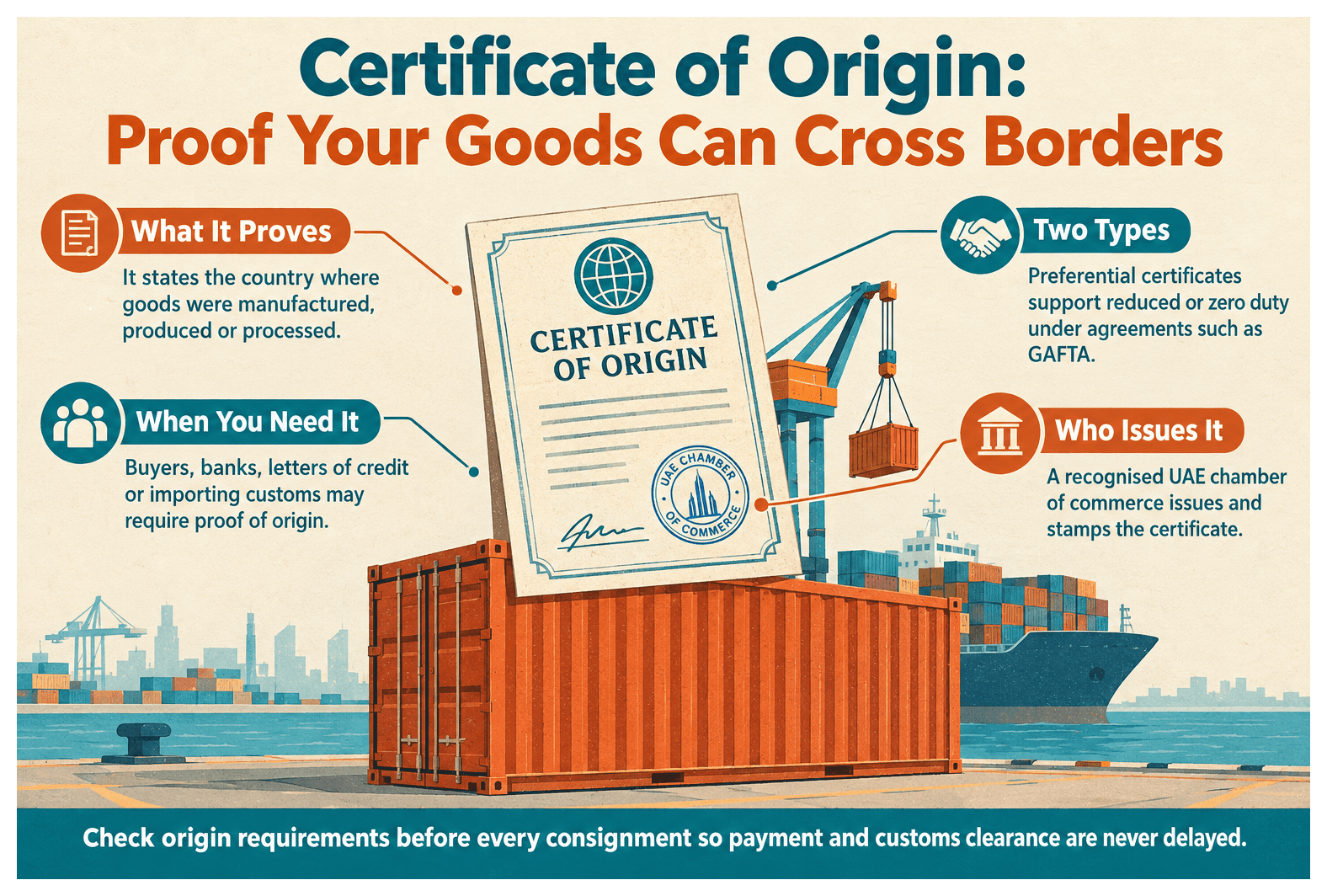
You need one when the importing country, buyer, bank or letter of credit requires proof of origin, or when you want a preferential duty rate. It's also common for food, cold chain, industrial and re-export cargo, so check requirements before every consignment.
Situations Where Buyers and Banks Ask for One
A letter of credit lists the certificate as a required document.
Importing-country customs rules or tenders demand it.
The sales contract specifies origin.
Picture a cold chain operator exporting UAE-processed frozen seafood. The buyer's bank won't release payment without a stamped certificate. That's a certificate of origin for exporters in practice.
Exports, Re-Exports and Transit Cargo
Locally produced goods can carry UAE origin. Foreign-origin goods re-exported from the UAE cannot. Electronics imported from Asia and sent to Africa via Dubai keep their Asian origin, and Dubai Customs and the Federal Customs Authority (FCA) process the declarations. Read more on re-export documentation in the UAE.
When You May Not Need One
A small sample shipment may move on the commercial invoice alone if the buyer accepts it and no duty preference is claimed. Always confirm with the importer and destination customs. Fees and requirements may vary, so check the official source before applying.
Who Issues a Dubai Certificate of Origin?
The Dubai Chamber of Commerce issues the Dubai certificate of origin for companies registered in its jurisdiction. Other emirates have their own chambers. You apply online, and the chamber stamps the certificate after reviewing your invoice and supporting documents.
The Role of Dubai Chamber of Commerce
The Dubai Chamber of Commerce normally requires registration before your first application. A newly licensed Dubai South Business Hub Free Zone trader should register before the first export, not the week of shipment.
What Is Certificate of Origin Attestation in the UAE?
Attestation is extra stamping that confirms a document's authenticity. Certificate of origin attestation UAE exporters arrange often runs through the chamber, then the Ministry of Foreign Affairs (MoFA), and sometimes the destination embassy. Requirements depend on the destination, so verify with your buyer. See documents that need attestation for related rules.
How Do You Get a Certificate of Origin in Dubai Step by Step?
To get a certificate of origin in Dubai, register with the chamber, prepare invoice and shipping documents, submit the online application, pay the fee and collect the stamped certificate. Add attestation if required. Timelines and fees may vary, so confirm with the chamber.
Step 1: Confirm the Destination's Origin Requirements
Ask the buyer or check importing-country rules.
Decide if a GAFTA-based duty preference is claimed.
Choose non-preferential or preferential.
Step 2: Prepare Documents and Submit the Application
Log in to the chamber's e-service.
Upload invoice, packing list and transport document.
Match descriptions exactly, as a cold chain exporter must.
Customs declarations run separately through Dubai Trade and Mirsal 2.
Step 3: Pay, Collect and Attest if Required
Pay the official fee.
Collect the stamped certificate.
Arrange attestation if requested.
Courier the original with the bill of lading set.
Your shipping documents should travel together.
Which Certificate of Origin Documents Are Required?
Certificate of origin documents required usually include a commercial invoice, packing list, bill of lading or airway bill, valid trade license and chamber membership details. Preferential claims may need manufacturing proof. Requirements vary by chamber and destination.
Documents Checklist for Exporters
Valid trade license and chamber membership
Commercial invoice with goods description, HS code and value
Packing list and transport document
Import/export code and authorised signatory details
Our guide to the commercial invoice for UAE exports covers the invoice side.
Extra Proof for Preferential Claims
Expect to show manufacturing details, local value-added evidence or supplier declarations. A processor of packaged food should document UAE value added. The invoice must match the origin declaration, or the claim can be rejected.
How Much Do Certificate of Origin Fees in the UAE Cost and How Long Does It Take?
Certificate of origin fees UAE exporters pay depend on the issuing chamber, certificate type and attestation. Processing is often quick with complete documents, but timelines vary. Fees and requirements may vary, so check the official source before applying.
What Drives the Cost
Chamber fees and membership
Attestation steps
Courier costs
Budget attestation and courier into each shipment's document cost.
What Affects Timing
Complete, consistent documents speed approval. Attestation adds steps. For a perishable cold chain consignment, a late certificate risks spoilage, so plan before the vessel cut-off. For wider trade-logistics benchmarks, see the World Bank.
What Mistakes Should Certificate of Origin UAE Traders Avoid?
Common mistakes include mismatched invoice and certificate details, declaring UAE origin for re-exported goods, applying late and ignoring attestation rules. These cause holds, rejected claims or penalties. Verify every detail with your buyer and the chamber before dispatch.
Practical Tip Box: Match Every Detail
Practical tip: Reconcile invoice, packing list, certificate and letter of credit wording line by line. One bank refused a letter of credit because the goods description differed by a single word. Misdeclared origin can also bring customs penalties and rejected duty claims.
Setting Up Properly From Day One
A valid trade license is the starting point. Dubai South Business Hub Free Zone company formation, free zone trade licenses and residency visa packages tied to your license let you build the export document workflow at setup, not after your first order.
What Should You Do Next?
Certificate of origin UAE traders need depends on destination, buyer and any duty preference. Apply through the Dubai Chamber of Commerce with matching documents, then verify attestation and fees.
Check your next shipment's requirements with your buyer and the chamber. If you're setting up a trading company, speak to Dubai South Business Hub about a free zone trade license and residency visa package.
Rules in the UAE change often. Always verify the latest requirements with the official authority before taking action.
References
Frequently Asked Questions