Topic Summary
No Dining Room Means Massive Cost Savings
Cloud kitchens eliminate the dining space that typically accounts for 40–60% of a traditional restaurant's cost base. With no front-of-house staff, decor, or walk-in fit-out required, your capital goes directly into cooking and operations.
Run Multiple Brands From One Small Kitchen
A single 400 sq ft unit can operate three separate virtual brands simultaneously, each with its own delivery app listing but sharing one cooking team and one trade license. This multiplies revenue streams without multiplying your fixed costs.
Entry Costs Are Surprisingly Accessible
Shared cloud kitchen setups in the UAE can be entered for as little as AED 30,000 total, with trade licenses starting at AED 10,000 per year. Compared to a full restaurant fit-out, the financial barrier to entry is dramatically lower.
UAE Delivery Market Is Projected to Hit USD 2.5 Billion
The UAE food delivery market is forecast to exceed USD 2.5 billion in 2026, with delivery orders already accounting for over 35% of all restaurant revenue in Dubai. That figure more than doubled since 2020, signalling sustained structural demand.
Extreme Heat Keeps Delivery Demand Year-Round
Summer temperatures regularly exceeding 45°C push UAE residents onto delivery apps for months at a time, removing the seasonal dips that affect markets in cooler climates. This makes delivery volume more predictable and bankable for cloud kitchen operators.
Dubai's 190-Nationality User Base Creates Unique Demand Breadth
Delivery platforms in Dubai serve customers from over 190 nationalities, meaning appetite for diverse cuisines is genuinely wide and deep. A single cloud kitchen running an Indian curry brand, a burger concept, and a healthy bowl menu can realistically find audiences for all three.
Platform Commissions Are a Critical Cost to Model
Talabat and Deliveroo charge commission rates of 15–30% of each order value, which directly compresses margins if not factored into pricing from the start. Understanding this cost before launch is one of the structural decisions that determines whether an operation scales or stalls.
In 2026, the UAE's food delivery market is projected to exceed USD 2.5 billion (Statista, 2025). Delivery orders now account for over 35% of all restaurant revenue in Dubai [1], a figure that more than doubled since 2020 [2]. Cloud kitchen UAE setups require no dining room, no front-of-house staff [3]. A single 400 sq ft unit can run three virtual brands simultaneously [4]. Trade license costs start at AED 10,000 per year [5]. Shared kitchen entry costs can be as low as AED 30,000 total [6]. Platform commission rates run 15–30% of order value [7].
Cloud kitchens, professional cooking facilities with no dine-in space, built entirely around delivery, have become one of the fastest-growing business models in the UAE. Low setup costs, no front-of-house overhead and access to millions of delivery app users make this one of the most accessible routes into the food industry in Dubai. This guide walks you through exactly what it takes to launch a cloud kitchen in the UAE: the licenses you legally need, the municipality requirements that trip people up, realistic setup costs in AED, how to get listed on Talabat and Deliveroo, and the structural decisions that determine whether your operation scales or stalls. For more detail, see our guide on foodstuff trading and food business in Dubai.
What Is a Cloud Kitchen and Why the UAE Market Is Ideal for It
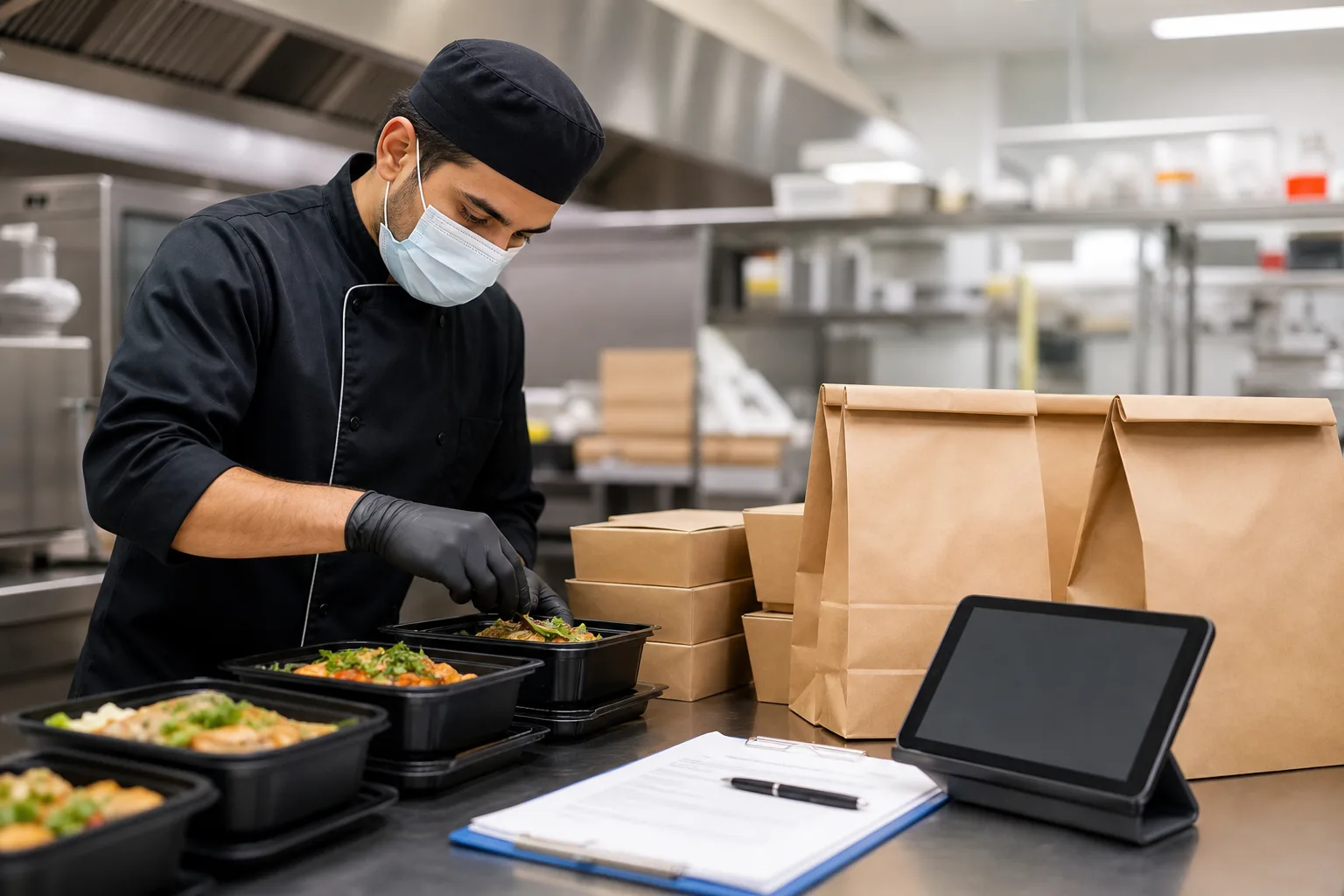
A cloud kitchen, also called a ghost kitchen or dark kitchen, is a professional, licensed cooking facility that prepares food exclusively for delivery orders. There is no dining area, no waitstaff and no walk-in customers. Revenue comes entirely through delivery platforms. The UAE's high delivery demand and relatively low setup costs make it an ideal market for this model.
What Separates a Cloud Kitchen from a Traditional Restaurant
The core difference is overhead structure. A traditional restaurant pays rent on a dining room, invests in decor, hires front-of-house staff and builds for walk-in foot traffic. A cloud kitchen in the UAE does none of that. You pay for a kitchen space, a trade license, and the equipment to cook. That's it.
The terms "ghost kitchen," "dark kitchen" and "cloud kitchen" are used interchangeably in the UAE market, they all describe the same delivery-only model. The practical upside is significant:
No dining space rent (typically 40–60% of a restaurant's cost base)
No front-of-house payroll
No decor or fit-out beyond food safety compliance
One kitchen space can run multiple virtual brands simultaneously
That last point is a genuine profit lever. A single 400 sq ft cloud kitchen in Al Quoz running three virtual brands, an Indian curry concept, a burger brand and a healthy bowl menu, can operate with separate Talabat listings, one shared cooking team and one trade license. Three revenue streams, one cost base.
Why the UAE Is One of the Best Markets to Launch a Cloud Kitchen
Kitopi, founded in Dubai in 2018, scaled to over 200 kitchen locations across multiple countries, starting with the UAE's delivery-hungry urban market. That trajectory reflects genuine structural advantages in this market.
Dubai's delivery platform user base spans over 190 nationalities, creating demand breadth that almost no other city can match. Summer temperatures regularly exceed 45°C, which pushes residents indoors and onto delivery apps for months at a time. And the UAE has one of the highest per-capita food delivery spend rates in the MENA region (Statista, 2025).
High smartphone penetration drives delivery app adoption
Year-round summer heat sustains delivery volumes even outside peak months
Licensing pathway for a cloud kitchen is simpler than a full restaurant setup
If you're considering an F&B business license in Dubai, the cloud kitchen model is one of the most capital-efficient entry points available.
UAE Cloud Kitchen Market at a Glance (2026) | ||
Metric | Figure | Source |
|---|---|---|
UAE food delivery market size (projected) | USD 2.5 billion+ | Statista, 2025 |
Delivery share of Dubai restaurant revenue | 35%+ | Industry estimates, 2025 |
Nationalities on Dubai delivery platforms | 190+ | Platform data, 2025 |
Kitopi kitchen locations (global) | 200+ | Kitopi, 2024 |
Licenses Required to Run a Cloud Kitchen in Dubai
To legally operate a cloud kitchen in Dubai you need three things: a trade license with the correct food activity classification issued by DET or a free zone authority, a Dubai Municipality kitchen approval confirming your premises meet food safety standards, and a food safety (HACCP) certification for your team. Missing any one of these blocks platform onboarding.
The Trade License and Food Activity Classification
A generic trading license won't get you through Talabat's onboarding. You need a trade license that specifically includes a food preparation or catering services activity. The Dubai Department of Economy and Tourism (DET) holds a database of over 2,000 classified activities, the relevant codes for cloud kitchen UAE operations fall under food preparation and catering services categories.
Getting this right upfront matters. An operator who registered a "general trading" license without specifying food preparation was rejected during Talabat's onboarding verification, a two-week delay and an AED 3,000 amendment fee followed. Trade license amendment fines for operating outside licensed scope can reach AED 50,000, so choosing the right business activity for your license is not a box-ticking exercise.
Mainland trade license (DET): AED 10,000–15,000/year
Food preparation activity code: must be explicitly listed on the license
Free zone licenses: must also carry F&B activity classification, not all free zones permit food preparation
Dubai Municipality Kitchen Approval and What Inspectors Check
Dubai Municipality's Food Safety Department must inspect and approve your kitchen premises before you operate. This approval is premises-specific, if you relocate, you need a fresh inspection. Approval fees run AED 2,000–5,000 depending on kitchen size.
A first-time operator in Deira fitted out their kitchen before consulting the Municipality's design guidelines and had to redo their ventilation ducting, adding AED 15,000 to their setup cost. Download the food establishment design guidelines from (Dubai Municipality, 2025) before you sign a lease, not after.
Inspectors check:
Ventilation systems and exhaust capacity
Dedicated handwashing stations (separate from food prep sinks)
Pest control measures and sealed entry points
Cold storage temperatures and cold chain integrity
Waste disposal setup and grease trap installation
Food Safety Certification and HACCP Requirements
Every food handler must hold a valid Food Handler Certificate issued through a Dubai Municipality-approved training provider. HACCP (Hazard Analysis and Critical Control Points) certification is required at the kitchen operations level, not just for individual staff. Training costs run AED 200–500 per person, and certification must be renewed periodically. A lapsed certificate can trigger an inspection failure and platform suspension on the same day.
Cloud Kitchen Dubai License, Three Required Approvals | |||
Approval | Issuing Authority | Approximate Cost | Renewal |
|---|---|---|---|
Trade license (food preparation activity) | DET or free zone authority | AED 10,000–15,000/year | Annual |
Kitchen premises approval | Dubai Municipality Food Safety Dept. | AED 2,000–5,000 | Per premises / periodic |
Food handler + HACCP certification | Municipality-approved providers | AED 200–500 per person | Periodic renewal required |
Mainland vs Free Zone, Which Setup Works for Cloud Kitchens?
Mainland licenses allow you to operate anywhere in Dubai and supply directly to any delivery zone. Free zone licenses offer lower setup costs and 100% foreign ownership but restrict you from operating outside the free zone without additional approvals. For a cloud kitchen UAE operation serving all of Dubai, mainland setup or a free zone that explicitly permits delivery-to-mainland operations is the practical choice.
Mainland Setup, Full Geographic Reach, Higher Base Cost
A mainland license issued by DET gives you unrestricted ability to operate from any Dubai location and deliver across all zones. Under UAE Federal Decree-Law No. 26 of 2020 (the amended Commercial Companies Law), 100% foreign ownership is available on mainland for most business activities including F&B, you no longer need a UAE national shareholder for most food business structures (UAE Ministry of Economy, 2021).
Base license cost: AED 10,000–15,000/year
100% foreign ownership available since 2021 for most F&B activities
Municipality approval and HACCP requirements apply regardless of setup type
Default choice for kitchens in standard industrial or commercial buildings
Free Zone Setup, Lower Entry Cost, Understand the Delivery Restrictions
Free zones like Dubai South Business Hub offer lower license fees, some starting from AED 12,500/year, and streamlined setup processes. That's a meaningful saving for operators minimising initial capital outlay.
The restriction to understand: free zone entities typically can't conduct direct commercial activity on the UAE mainland without a mainland branch or distributor arrangement. However, some free zones explicitly permit cloud kitchen operators to receive delivery orders through platforms from a free zone facility. You must verify this directly with your chosen free zone authority before committing to the structure. Dubai South Business Hub Free Zone specifically supports F&B business licensing suitable for cloud kitchen operations, and some free zones bundle visa allocation and shared kitchen infrastructure into their packages, reducing overhead further.
Finding and Setting Up Your Kitchen Space
Cloud kitchen spaces in Dubai range from shared commissary kitchens with monthly rentals to standalone units in industrial areas. Shared kitchens reduce fit-out costs significantly. Standalone units give you more brand control but require full fit-out to Municipality standards. Budget AED 30,000–80,000 for fit-out of a standalone unit; shared kitchens can be operational from AED 5,000–10,000 per month.
Shared Kitchen vs Standalone Unit, What Makes Financial Sense
A first-time operator launching a single brand in Dubai typically starts in a shared kitchen at around AED 8,000/month, avoiding the AED 50,000+ fit-out cost until they've validated demand. Shared commissary kitchens operated by providers in Al Quoz and Jebel Ali come with Municipality approval already in place, meaning you can be operational within 2–3 weeks of license approval.
Standalone units in industrial zones (Al Quoz, Dubai Industrial City, Jebel Ali) give you full brand control and space to run multiple virtual brands at scale. The trade-off is a 4–8 week Municipality approval timeline and full fit-out responsibility.
Shared kitchen: AED 5,000–10,000/month, fastest route to market
Standalone fit-out: AED 30,000–80,000, full brand control
Standalone Municipality approval: 4–8 weeks from fit-out completion
Lease and Location Considerations That Affect Your License
Your kitchen address must match the address on your trade license exactly. Mismatches create compliance issues during platform verification and Municipality renewals. Before signing any lease, confirm that the building is zoned for food preparation, not all commercial or industrial units carry this classification, and discovering the problem at inspection stage is expensive.
Proximity to delivery hotspots also affects your platform ranking. Talabat and Deliveroo's algorithms factor delivery time into search ranking, a kitchen in central Al Quoz can reach most of Dubai within 30–40 minutes, while a unit in a peripheral industrial area may struggle with consistent delivery scores.
How to Get Listed on Talabat, Deliveroo and Noon Food
To list on Talabat, Deliveroo or Noon Food in Dubai, you need an active trade license with a food activity classification and a valid Dubai Municipality kitchen approval. Platforms verify these documents during onboarding. Commission rates typically range from 15% to 30% of order value. No separate cloud kitchen Dubai license is needed per platform, one license covers all three.
What Each Platform Requires Before They Onboard You
All three platforms require the same core document set:
Valid trade license with food preparation activity listed
Dubai Municipality kitchen approval certificate
Food safety certification (HACCP and food handler certificates)
UAE bank account in the business name
Menu photography and brand assets (budget AED 2,000–5,000)
Onboarding timelines: Talabat typically 1–2 weeks post-document submission; Deliveroo 2–3 weeks; Noon Food 2–4 weeks. Commission rates start at 15–30% and are negotiable at volume. Each platform has a separate partner agreement, read the commission structure carefully before pricing your menu.
Optimising Your Listings to Drive Early Order Volume
Platform algorithms favour restaurants with high acceptance rates, fast prep times and strong early ratings. These metrics matter from day one, not after you've built a review base. Run platform-sponsored promotions in your first 4–6 weeks to build review volume and improve your ranking position.
Operate consistently during peak hours: 12–2pm and 7–10pm in Dubai. The algorithm reads consistent availability as reliability and rewards it with higher placement. Multiple virtual brands on one account require separate menu setups but share the same kitchen approval, no additional compliance cost per brand.
Cost Breakdown, What Does It Actually Cost to Launch a Cloud Kitchen in Dubai?
Launching a cloud kitchen in Dubai costs between AED 80,000 and AED 200,000 all-in for a standalone setup. Shared kitchen models can reduce initial outlay to AED 30,000–50,000. If you're planning how to start a cloud kitchen in Dubai, these are the real numbers to model.
Line-by-Line Cost Breakdown for a Dubai Cloud Kitchen Launch
Trade license (mainland, food preparation activity): AED 10,000–15,000/year
Dubai Municipality kitchen approval: AED 2,000–5,000
Kitchen fit-out (standalone): AED 30,000–80,000
Shared kitchen deposit (if shared route): AED 10,000–20,000
Commercial kitchen equipment (ovens, refrigeration, prep stations): AED 15,000–40,000 if not provided by shared kitchen
Food handler certificates and HACCP training (team of 3): AED 2,000–5,000
Menu photography and brand setup: AED 2,000–5,000
Working capital (3 months): AED 20,000–40,000
Total standalone launch: AED 80,000–200,000. Shared kitchen entry model: AED 30,000–50,000. The shared route makes sense for first-time operators validating a concept before committing to fit-out capital.
Ongoing Monthly Costs to Factor Into Your P&L
Kitchen rent or shared kitchen fee: AED 5,000–15,000/month
Platform commissions: 15–30% of gross revenue (your largest variable cost)
Kitchen staff (1–3 for a single-brand operation): AED 5,000–12,000/month
Ingredient COGS: typically 25–35% of menu price
At 25% platform commission on a AED 50 average order, you net AED 37.50 before COGS and staff. Model this before you set menu prices. Use the Dubai South Business Hub Free Zone cost calculator to run your specific scenario before committing to a structure.
Common Mistakes First-Time Cloud Kitchen Operators Make
The most common mistakes cloud kitchen operators make in Dubai include choosing the wrong business activity code on their trade license, fitting out a kitchen before obtaining Municipality design approval, underestimating platform commission impact on margins, and launching too many virtual brands before validating one. Each of these mistakes has a direct and measurable cost.
Citations
UAE Ministry of Economy and Tourism.. moet.gov.ae. MOET UAE, 2024.
Dubai Economy and Tourism.. dubaidet.gov.ae. DET Dubai, 2024.
UAE Cabinet.. uaecabinet.ae. UAE Cabinet, 2023.
UAE Government Portal.. u.ae. UAE Government, 2024.
Central Bank of the UAE.. centralbank.ae. CBUAE, 2024.
Frequently Asked Questions