Topic Summary
Topic Summary
In 2026, over 25,000 active businesses operate across Dubai South's 145 sq km master-planned city (DSBH, 2025). Al Maktoum International Airport is targeting a 260-million-passenger build-out (Dubai Airports, 2023). Jebe
In 2026, over 25,000 active businesses operate across Dubai South's 145 sq km master-planned city (Dubai South Business Hub, 2025). Al Maktoum International Airport is targeting a 260-million-passenger build-out (Dubai Airports, 2023). Jebel Ali Port processes over 14 million TEUs annually (DP World, 2024). Free zone licenses start from AED 12,500 (Dubai South Business Hub, 2026). An 8-hour flight radius from the zone reaches approximately 4.5 billion people (Dubai South Business Hub, 2025). Those five figures tell you most of what you need to know about why companies in Dubai South keep multiplying.
This article maps the types and sectors of companies in Dubai South, from logistics operators and aerospace businesses to e-commerce merchants and professional services firms, and explains the specific structural advantages that keep drawing them here. Whether you're evaluating a license, a warehouse lease, or a regional headquarters, understanding who is already based in Dubai South tells you a great deal about what the zone delivers.
What Are Companies in Dubai South and Why Does the Ecosystem Matter
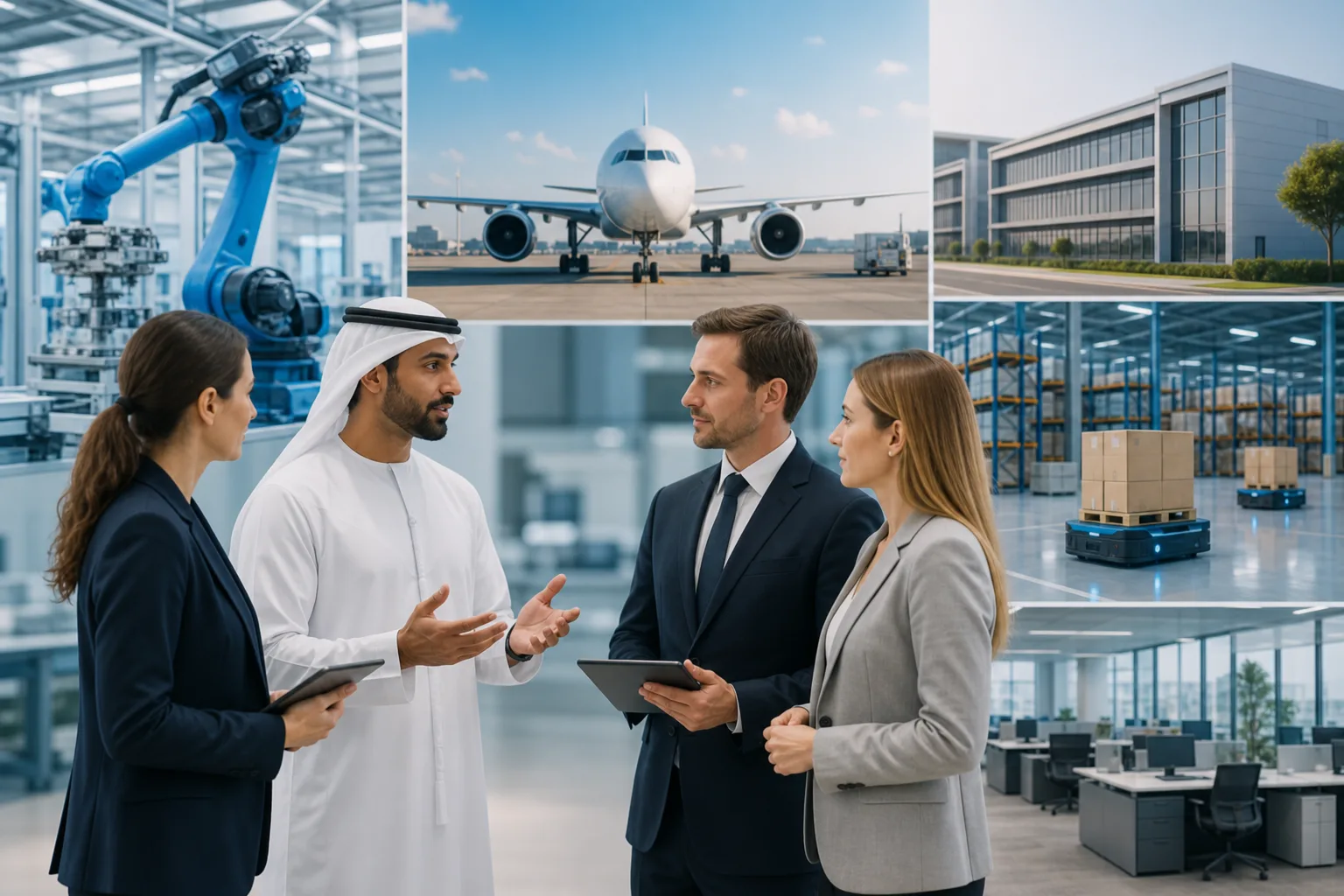
Companies in Dubai South are businesses licensed and operating across the zone's free zone, logistics district, aviation district, and residential and commercial precincts. The ecosystem spans logistics, aerospace, e-commerce, trading, and professional services, all co-located around Al Maktoum International Airport within a single 145 sq km master-planned city.
A Master-Planned City Built Around Economic Activity
Dubai South isn't a single free zone. It's a full urban district with distinct sub-zones, each designed to attract a specific cluster of businesses. The five main districts are the Free Zone, Logistics District, Aviation District, Residential District, and Business Park. That structure creates a self-reinforcing ecosystem rather than a generic industrial estate.
The planning authority, Dubai South (the entity), issues licenses and manages infrastructure across all districts. This unified governance matters: a freight forwarder based in the Logistics District shares the same postcode ecosystem as an e-commerce retailer in the Free Zone and an MRO provider in the Aviation District, all within a 15-minute drive of each other. That kind of proximity isn't accidental; it's engineered.
145 sq km total master-planned area
Over 25,000 active businesses (Dubai South Business Hub, 2025)
Five distinct sub-zones with purpose-built infrastructure
Single licensing authority across all districts
How Dubai South Defines Its Business Community
Businesses in Dubai South range from multinational anchor tenants with regional headquarters to SMEs and early-stage startups holding single-activity licenses. The zone accommodates both free zone entities (with 100% foreign ownership) and mainland-linked operations, a flexibility most standalone free zones can't offer at this scale.
License categories cover trading, services, industrial, and logistics activities. That breadth matters. An SME importing consumer goods from Asia can hold a trading license in the Free Zone, store inventory in a bonded warehouse in the Logistics District, and fulfil UAE orders without ever touching the mainland customs process. Free zone licenses start from AED 12,500 (Dubai South Business Hub, 2026), a genuinely accessible entry point for early-stage businesses.
Logistics and Freight: The Anchor Sector for Firms in Dubai South

Logistics and freight is the dominant sector among firms in Dubai South. The Logistics District offers bonded warehousing, cross-docking, and last-mile facilities directly connected to Al Maktoum International Airport and 15 km from Jebel Ali Port, making it the UAE's most strategically positioned supply chain corridor.
Freight Forwarders, 3PLs, and Warehouse Operators
Third-party logistics (3PL) providers are among the most active Dubai South tenants. Purpose-built bonded warehousing and direct airside access are the primary draws. Freight forwarders benefit from proximity to both Al Maktoum cargo terminals and Jebel Ali Port, Jebel Ali alone handles over 14 million TEUs annually (DP World, 2024), enabling air-sea intermodal operations from a single base.
The Logistics District also supports temperature-controlled and hazardous goods facilities, which means pharmaceutical, food, and chemicals supply chains can operate here without the infrastructure compromises common in older industrial zones. A regional 3PL operator handling e-commerce returns for a Gulf-wide retailer can receive inbound air freight at Al Maktoum, process returns in a bonded facility, and redistribute stock across the GCC, all within one contiguous logistics corridor.
Bonded warehousing with direct airside access
Temperature-controlled and hazardous goods facilities
Cross-docking and last-mile distribution infrastructure
Customs broker services available within the district
Why the Dual-Port Corridor Matters for Supply Chain Businesses
No other location in the UAE places a business within 15 km of both a major deep-water port and an international cargo airport. That dual-port position lets businesses switch between air and sea freight dynamically, routing by cost when lead times allow, routing by speed when they don't. It's a structural advantage that compounds over time as cargo volumes grow.
Road connectivity reinforces the picture. Sheikh Mohammed Bin Zayed Road and Emirates Road link the district to Dubai, Abu Dhabi, and the Northern Emirates within 45 to 60 minutes. Combined with the 8-hour flight radius covering approximately 4.5 billion people (Dubai South Business Hub, 2025), Dubai South's logistics firms aren't just serving the UAE, they're serving a significant share of global trade.
Aviation and Aerospace Firms in Dubai South
Aviation and aerospace businesses in Dubai South operate from the Aviation District, which sits adjacent to Al Maktoum International Airport. Tenants include MRO providers, aircraft parts suppliers, ground handling operators, aviation training organisations, and aerospace component manufacturers attracted by direct airside access and GCAA-aligned regulatory infrastructure.
MRO, Ground Handling, and Aircraft Parts Suppliers
Maintenance, repair, and overhaul (MRO) operators are among the most capital-intensive businesses in Dubai South's Aviation District. They need large hangars, airside permits, and proximity to active flight operations, all of which the district provides. An MRO provider based here can service wide-body freighters arriving from Europe or Asia, turn them around within regulatory maintenance windows, and return them to service without the aircraft leaving the airport precinct.
Aircraft component and parts suppliers locate here to serve both MRO operators and airlines transiting Al Maktoum, which is targeted at 260 million passengers at full build-out (Dubai Airports, 2023). Ground handling companies, providing fuelling, cargo loading, and passenger services, are operationally embedded in the airport's daily functioning, making the Aviation District a genuine operational necessity rather than just a business address.
Dubai South Districts: Which Business Type Fits Where
District | Best-Suited Business Type | Key Infrastructure Advantage |
|---|---|---|
Free Zone | Trading, e-commerce, services, light manufacturing | 100% foreign ownership; licenses from AED 12,500; bonded warehouse access |
Logistics District | 3PLs, freight forwarders, warehouse operators, customs brokers | Direct airside access; 15 km from Jebel Ali Port; temperature-controlled and hazmat facilities |
Aviation District | MRO providers, aerospace suppliers, ground handlers, aviation training | Adjacent to Al Maktoum Airport; hangar allocations; GCAA-aligned regulatory framework |
Business Park | Professional services, consulting, technology, financial services | Grade-A office space; flexi-desk options; proximity to 25,000+ zone businesses as a client base |
Residential & Commercial | Retail, hospitality, and community-facing businesses | Growing residential population; proximity to Expo City Dubai; footfall from zone workforce |
Aviation Training and Aerospace Manufacturing
Aviation training organisations offering type-rating, cabin crew, and ground operations programmes have established facilities in the district. The demand is structural: as Al Maktoum expands, the workforce requirements for qualified aviation personnel grow with it.
Aerospace component manufacturers, particularly those working in composite materials and precision engineering, benefit from industrial land allocations and direct proximity to their MRO and airline customers. The district's growth trajectory is tied directly to Al Maktoum's expansion timeline, which means businesses investing here now are building into a rising demand curve rather than a static one.
Type-rating and cabin crew training facilities on-site
Industrial land for composite and precision engineering manufacturers
GCAA regulatory alignment reduces compliance friction
5 Key Sectors That Define Companies in Dubai South
The five defining sectors among companies in Dubai South are: logistics and freight, aviation and aerospace, e-commerce and retail fulfilment, general trading and import/export, and professional and business services. Together these sectors reflect the zone's dual identity as both a global cargo hub and a full-service business district.
The Sector Breakdown: From E-Commerce to Professional Services
Here's how the sector landscape breaks down across the zone's 25,000+ active businesses (Dubai South Business Hub, 2025):
Logistics and freight: The largest cohort by license volume. Covers 3PLs, freight forwarders, customs brokers, and warehousing operators anchored by the dual-port corridor.
Aviation and aerospace: MRO providers, parts suppliers, ground handlers, and training organisations. Directly tied to Al Maktoum Airport operations.
E-commerce and retail fulfilment: Online retailers, marketplace sellers, and direct-to-consumer brands using the Logistics District as a GCC fulfilment base. The UAE e-commerce market is projected to exceed USD 9 billion by 2026 (Statista, 2025), a significant share of that activity routes through this corridor.
General trading and import/export: Commodities traders, FMCG distributors, and re-export businesses using the zone's bonded status and dual-port access to move goods efficiently across the region.
Professional and business services: Consulting firms, legal and compliance advisers, financial services providers, and tech companies that co-locate here to serve the surrounding business ecosystem.
SMEs and Startups as a Growing Cohort
SMEs and early-stage businesses aren't a secondary consideration in Dubai South, they represent a large proportion of active license holders. Licenses from AED 12,500 (Dubai South Business Hub, 2026) and flexible flexi-desk arrangements make the zone genuinely accessible for founders who don't need a full office on day one.
The presence of anchor sector tenants creates real B2B demand that SMEs can serve directly. A logistics tech startup, for instance, can win contracts from established 3PLs operating in the same district, no cold outreach required. That kind of proximity-driven pipeline is something you don't get in a generic office park.
Is Dubai South right for a business that doesn't operate in logistics or aviation?
Yes. Professional services, technology, and trading businesses regularly license in Dubai South's Free Zone or Business Park without any direct connection to logistics or aviation. The 25,000+ co-located businesses create a dense client base, and the 100% foreign ownership and competitive license costs apply across all activity types, not just supply chain sectors.
Why Businesses in Dubai South Choose to Locate Here
Businesses in Dubai South choose the zone for its combination of airport-adjacent logistics infrastructure, 100% foreign ownership, competitive license costs, and access to a 4.5-billion-person flight radius. The integrated master-plan eliminates the need to split operations across multiple locations, a material cost and efficiency advantage for supply chain-intensive businesses.
Infrastructure, Ownership, and Cost Advantages
100% foreign ownership on free zone licenses removes the need for a local sponsor, a structural advantage mainland licensing can't match.
Licenses from AED 12,500 (Dubai South Business Hub, 2026) set a lower entry barrier than most comparable Dubai free zones.
Purpose-built warehousing, cold storage, and industrial land are available at scale, businesses don't need to engineer workarounds for non-standard requirements.
Zero corporate tax on qualifying free zone income, subject to UAE Corporate Tax Law conditions (Federal Decree-Law No. 47 of 2022, as amended).
Single authority governance across all districts simplifies license applications, renewals, and compliance.
Market Access and the Network Effect
An 8-hour flight radius covering approximately 4.5 billion people (Dubai South Business Hub, 2025) makes Dubai South one of the most connected trade addresses available. But the network effect inside the zone is just as compelling. Co-location with 25,000+ businesses means procurement, partnerships, and customer acquisition can happen within the zone itself.
A professional services firm advising on trade compliance can base itself in Dubai South's Business Park, serve logistics and aviation clients within the zone, and pitch to inbound international businesses as they establish UAE operations, all from a single address. Proximity to Expo City Dubai adds a further layer of international brand visibility that's hard to replicate elsewhere in the emirate.
5 billion people within an 8-hour flight radius. Dubai South: Business Ecosystem at a Glance 25K+ Active Businesses Dubai South Business Hub, 2025 145 sq km Master-Planned Area Dubai South Business Hub, 2025 AED 12,500 Min. License Cost Dubai South Business Hub, 2026 4.5B People within 8-hr flight radius Dubai South Business Hub, 2025
Dubai South Business Ecosystem at a Glance
Dubai South's business ecosystem spans five core sectors across a 145 sq km master-planned city, hosting over 25,000 active businesses adjacent to Al Maktoum International Airport and 15 km from Jebel Ali Port, making it one of the most strategically positioned commercial zones in the UAE.
Key Data Points for Dubai South Tenants
The numbers below give prospective Dubai South tenants a quick reference for evaluating the zone's scale and connectivity before committing to a district or license type.
Dubai South Business Ecosystem: Key Stats
Visualise the scale, sector mix, and connectivity advantages of Dubai South for prospective businesses and investors.
25,000+ active businesses operating across Dubai South (Dubai South Business Hub, 2025)
145 sq km total master-planned city area
5 anchor sectors: logistics, aviation/aerospace, e-commerce, trading, professional services
AED 12,500, minimum free zone license entry cost (Dubai South Business Hub, 2026)
15 km from Jebel Ali Port (14 million+ TEUs annually, DP World, 2024)
8-hour flight radius covering approximately 4.5 billion people (Dubai South Business Hub, 2025)
Suggested alt text: Infographic showing Dubai South's business ecosystem: 25,000+ companies across 5 sectors, 145 sq km zone, AED 12,500 license cost, 15 km from Jebel Ali Port, and a 4.5-billion-person flight radius.
How to Position Your Business Among the Companies in Dubai South
To position your business among companies in Dubai South, identify which district aligns with your activity, Free Zone for trading and services, Logistics District for warehousing and freight, Aviation District for aerospace. Then match your license category to your primary activity and assess infrastructure requirements before applying through the Dubai South authority.
Choosing the Right District for Your Activity
Free Zone: Best for trading, e-commerce, services, and light manufacturing. You get a UAE address, 100% foreign ownership, and bonded warehouse access without needing physical industrial space.
Logistics District: Suited to businesses with warehousing, freight, customs, or distribution requirements. Direct cargo infrastructure integration is the defining draw here.
Aviation District: Relevant only for businesses with a direct operational or supply relationship with the aviation or aerospace sector. Airside permits and hangar access are specific to this district.
Business Park: The right choice for professional services, consulting, and tech firms that need quality office space rather than industrial facilities.
Residential and Commercial precincts: Appropriate for retail, hospitality, and community-facing businesses serving the zone's growing resident and workforce population.
Build Your Business Case Around the Ecosystem
Who is based in Dubai South already? That's the commercial question to ask first. The existing 25,000+ businesses are potential customers, suppliers, and partners, not just neighbours. A regional trading company relocating from a mainland address to Dubai South's Free Zone gains 100% ownership, bonded warehouse access, and immediate proximity to those 25,000 potential B2B counterparties, while cutting effective logistics costs by eliminating cross-emirate freight runs.
Frame your location decision around proximity to your key counterparties, not just license cost. The zone's expansion trajectory matters too: businesses entering now establish a footprint before Al Maktoum reaches its 260-million-passenger build-out capacity. That's a positioning advantage that compounds as the airport grows and the surrounding ecosystem densifies.
What's the fastest way to start a business in Dubai South?
Apply directly through the Dubai South Business Hub (Dubai South Business Hub) portal at dsbh.ae. Select your district and license category, submit your trade name reservation and shareholder documents, and pay the license fee from AED 12,500. The authority's business development team can match your activity to the correct district before you commit to an application.
The companies in Dubai South ecosystem is defined by five anchor sectors, logistics, aviation, e-commerce, trading,
Useful Resources
Frequently Asked Questions
What are companies in Dubai South?
Companies in Dubai South are businesses operating within a 145 sq km master-planned city built around Al Maktoum International Airport and Jebel Ali Port, home to over 25,000 active firms. The zone attracts logistics, aviation, e-commerce, and manufacturing businesses. Visit the Dubai South Business Hub website to explore the active business ecosystem.