
Topic Summary
What Is a Conformity Certificate for Imported Products in the UAE?
A conformity certificate is an official document confirming that an imported product meets UAE technical regulations for safety, quality and performance. Issued under the national scheme overseen by MoIAT, it lets regulated goods clear customs and be sold legally. Think of the conformity certificate for imported products in the UAE as your cargo's passport.
Which Imported Products Need a Conformity Certificate in the UAE?
Which Imported Products Need a Conformity Certificate in the UAE?
How Do You Get a Conformity Certificate Step by Step?
Confirm your product is regulated, register with the scheme, submit technical documents, arrange testing or use recognised reports, then use the certificate for clearance through Dubai Customs. This is how to get a conformity certificate in Dubai. Fees and requirements may vary, so check the official source before applying.
What Documents Do You Need for a COC Certificate in the UAE?
You typically need your trade license, importer registration, technical data, recognised laboratory test reports, commercial invoice and packing list. Confirm the exact list with MoIAT, because a certificate of conformity for imports UAE varies by category.
How Long Does It Take and What Does a Conformity Certificate Cost?
Timelines and costs depend on category, risk level, testing needs and document quality. Don't budget from generic figures. Fees and requirements may vary, so check the official source before applying, and allow extra time for laboratory testing of new products.
How Do Customs and Port Checks Affect Your Shipment?
Customs officers check that regulated goods carry a valid certificate before release. Mismatched or missing certificates can mean holds, re-export orders or fines. Get the certificate before the cargo ships, because import compliance for UAE products is checked at declaration.
What Mistakes and Penalties Should You Avoid?
Common mistakes include trusting a supplier's foreign certificate, using the wrong HS code, ordering before certification, and mismatched models. Consequences include holds, rejection, re-export and storage costs. Penalty amounts vary, so verify current rules with the authority. Your conformity certificate imported products UAE plan should address each risk.
confirm whether your product is regulated, then apply for the conformity certificate for imported products in the UAE through the Emirates Conformity Assessment Scheme (ECAS), run by the Ministry of Industry and Advanced Technology (MoIAT). You'll submit test reports and import documents.
UAE ports handle over 14 million TEUs a year (DP World, 2025), and regulated cargo without a valid ECAS conformity certificate can sit at the border while storage charges build. This guide is for cold chain founders and importers. You'll learn the process, documents, costs and mistakes.
What Is a Conformity Certificate for Imported Products in the UAE?
A conformity certificate is an official document confirming that an imported product meets UAE technical regulations for safety, quality and performance. Issued under the national scheme overseen by MoIAT, it lets regulated goods clear customs and be sold legally. Think of the conformity certificate for imported products in the UAE as your cargo's passport.
What the Certificate Proves
A technical regulation is simply a legal rule a product must meet before sale. The COC certificate UAE buyers ask about is proof you've met it. A cold chain operator importing refrigeration units and electrical controllers needs that proof for every item before release.
Who Issues and Oversees It
MoIAT oversees ECAS. The Emirates Authority for Standardization and Metrology (ESMA) previously handled this work, which is why many traders still search for an "ESMA conformity certificate." In practice, you're dealing with MoIAT and ECAS today.
Which Imported Products Need a Conformity Certificate in the UAE?
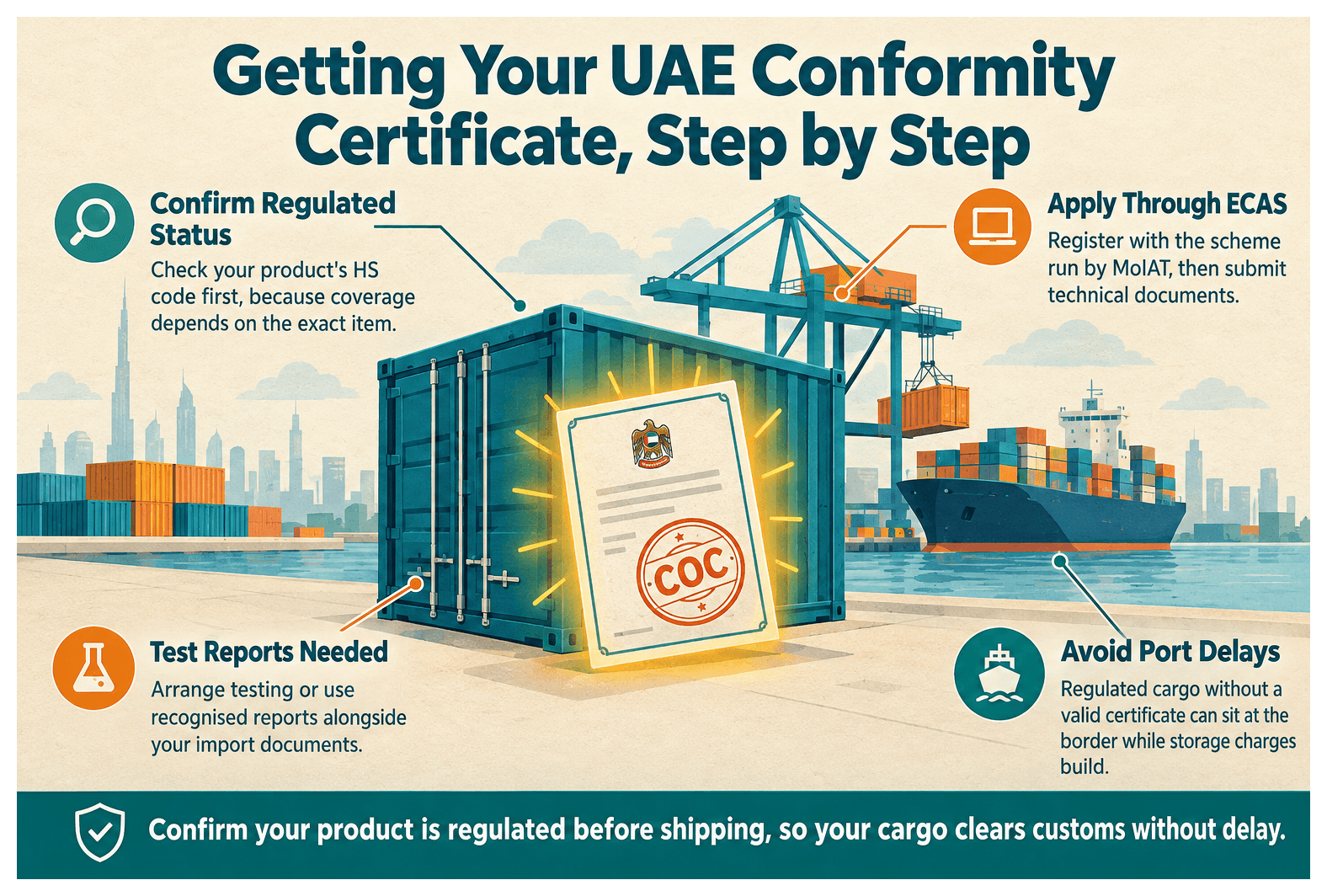
Products covered by UAE technical regulations need a certificate: typically electrical goods, low-voltage equipment, toys, tyres, building materials and some chemicals. Food and health items follow separate routes. Coverage depends on the exact product, so check the HS code (the international tariff code) first. See which products need a conformity certificate in the UAE.
Regulated Product Categories at a Glance
Electrical and electronic equipment
Refrigeration units and chillers
Control panels and temperature loggers
Toys and tyres
Building materials
Lists change, so verify each item. A logistics start-up importing reefer control panels and warehouse chillers should check every line separately.
Products Handled by Other Authorities
Dubai Municipality handles food and packaging, and health regulators handle health products. Insulated food packaging may need separate approval even if your cooling unit holds a certificate. Start with your UAE customs HS code.
How Do You Get a Conformity Certificate Step by Step?
Confirm your product is regulated, register with the scheme, submit technical documents, arrange testing or use recognised reports, then use the certificate for clearance through Dubai Customs. This is how to get a conformity certificate in Dubai. Fees and requirements may vary, so check the official source before applying.
Step 1: Confirm the Product Is Regulated
Check the HS code against technical regulation coverage.
Ask your supplier for existing test reports.
Step 2: Prepare Your Trade License and Customs Setup
Hold an active trade license and a customs client code. A Dubai South Business Hub free zone license can support import activity.
Step 3: Apply Through ECAS and Submit Documents
Submit product details, test reports and supplier documents.
Choose the route that matches your product's risk category.
Step 4: Receive the Certificate and Use It at Customs
Quote the certificate number in your declaration on Dubai Trade.
Keep copies for inspections and audits.
What Documents Do You Need for a COC Certificate in the UAE?
You typically need your trade license, importer registration, technical data, recognised laboratory test reports, commercial invoice and packing list. Confirm the exact list with MoIAT, because a certificate of conformity for imports UAE varies by category.
Documents Checklist
Trade license and customs code
Technical file and test reports
Commercial invoice and shipping documents
Labelling samples
Certificate of origin, where relevant
Practical Tip: Align Names and Models Across Every Document
Practical tip: product names, model numbers and HS codes must match on the invoice, test report and application. One typo in a model number can delay release.
How Long Does It Take and What Does a Conformity Certificate Cost?
Timelines and costs depend on category, risk level, testing needs and document quality. Don't budget from generic figures. Fees and requirements may vary, so check the official source before applying, and allow extra time for laboratory testing of new products.
What Drives the Timeline
Complete, consistent documents
Whether testing is needed
Product risk category
Comparison of Conformity Routes for Imported Products
Feature | Product-Specific Conformity Certificate | Recognised Test Report or Other Authority Approval |
|---|---|---|
Typical use case | Regulated electrical or refrigeration goods | Products with existing recognised lab evidence |
Who applies | Importer or authorised agent via ECAS | Importer, supported by supplier or laboratory |
Documents needed | Technical file, test reports, invoice | Laboratory report or approval letter, invoice |
Customs treatment | Certificate number quoted in declaration | Accepted only where the authority allows it |
Key risk to watch | Model or HS code mismatch | Report not recognised for your product |
What Drives the Cost
Certification fees
Laboratory testing
Consultant or clearing agent fees
Storage or demurrage if delayed
Budget for the delay risk too. Our guide on product registration costs helps.
How Do Customs and Port Checks Affect Your Shipment?
Customs officers check that regulated goods carry a valid certificate before release. Mismatched or missing certificates can mean holds, re-export orders or fines. Get the certificate before the cargo ships, because import compliance for UAE products is checked at declaration.
What Happens at Declaration
Mirsal 2 is Dubai Customs' electronic declaration system. Your certificate reference, HS code and invoice details must agree. Imagine a shipment of cold room panels held at port because the declared HS code differed from the certificate. Dubai Customs and the Federal Customs Authority both apply these checks.
What Mistakes and Penalties Should You Avoid?
Common mistakes include trusting a supplier's foreign certificate, using the wrong HS code, ordering before certification, and mismatched models. Consequences include holds, rejection, re-export and storage costs. Penalty amounts vary, so verify current rules with the authority. Your conformity certificate imported products UAE plan should address each risk.
Common Mistake Box
Ordering 500 units before confirming certification status
Relying on CE marking alone
Skipping the HS code check
Penalties and Consequences
Expect holds, rejection, re-export, storage and demurrage (charges for keeping a container beyond free time). I won't quote fine amounts, since they change.
What Should You Do Next to Secure Your Conformity Certificate?
List your products with HS codes, check which are regulated, confirm your license and customs setup, then apply before any large order. If you need a license to import, Dubai South Business Hub can set up a free zone company with residency visa packages tied to it.
Your Practical Next Step
Build a product-by-product compliance sheet this week.
Summary of the Process
Getting a conformity certificate for imported products in the UAE means confirming regulation, applying under ECAS with accurate documents, and keeping certificate, HS code and invoice aligned. Rules in the UAE change often. Always verify the latest requirements with the official authority before taking action.
References
Frequently Asked Questions