
Topic Summary
Draft a Deadlock Clause Before Incorporation
Most free zone companies receive a standard Articles of Association at formation that contains no deadlock clause, leaving shareholders with no automatic resolution mechanism. Requesting amendments before incorporation is far simpler than trying to pass a shareholder resolution during an active dispute.
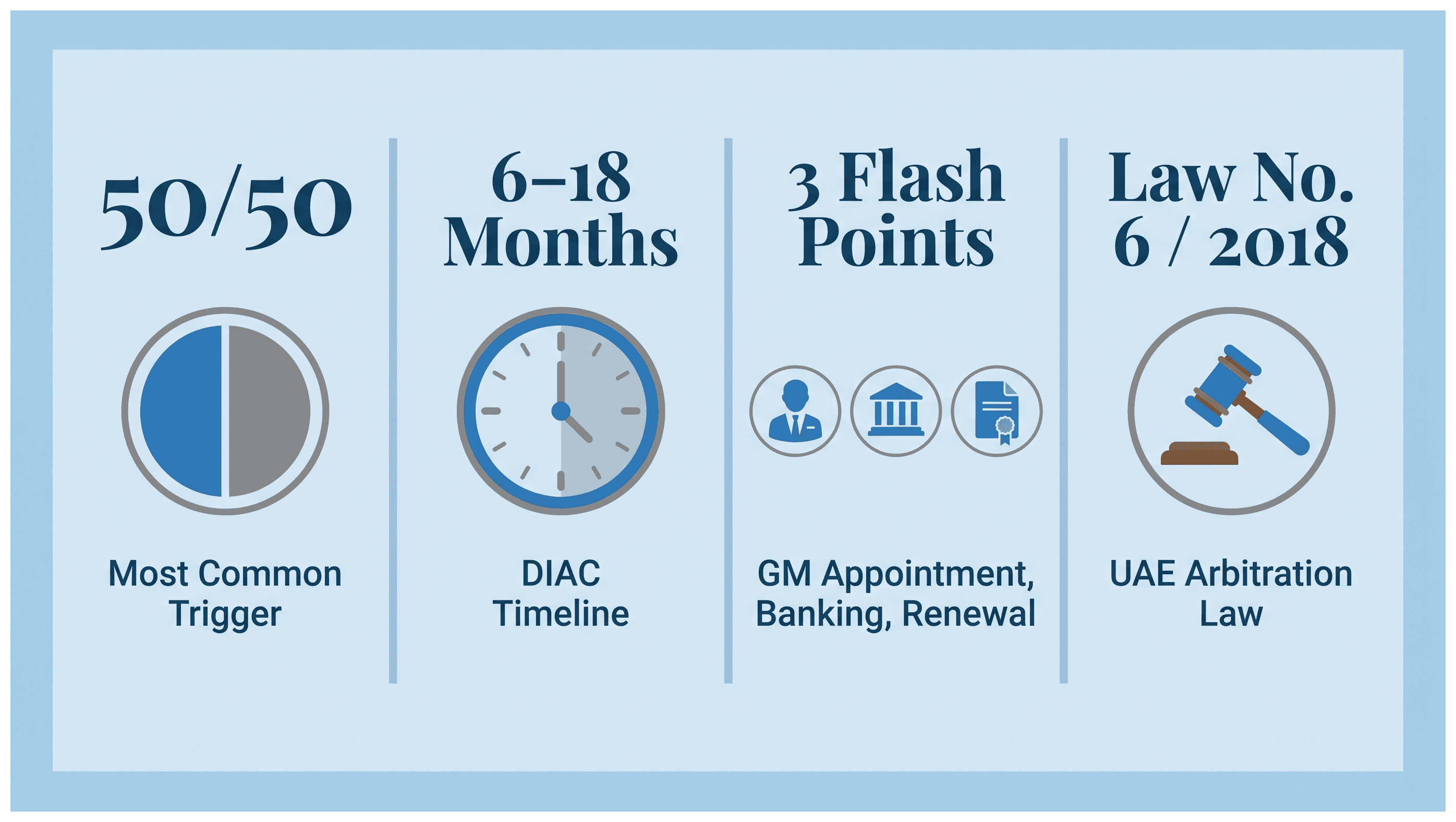
50/50 Splits Are the Most Common Trigger
An equal ownership structure means neither shareholder can out-vote the other on contested resolutions, creating a structural paralysis rather than a personal conflict. Three-shareholder structures can face the same outcome when one party abstains and removes the required quorum.
License Renewals and Banking Are Top Flash Points
The three highest-frequency deadlock triggers in Dubai SME free zone companies are license renewals, banking mandates, and general manager appointments. A missed renewal deadline can block operations entirely, as the underlying dispute prevents the procedural steps needed to keep the company compliant.
Know Your Four Core Resolution Mechanisms
Deadlock resolution options move from least to most formal: a casting vote held by a named chairperson, a shotgun or buy-sell clause, an agreed share valuation and buyout, and finally binding arbitration. Each mechanism must be pre-agreed in the Articles of Association or a shareholders agreement to be enforceable.
DIAC Arbitration Is the Primary Formal Venue
The Dubai International Arbitration Centre governs binding resolution under UAE Federal Arbitration Law No. 6 of 2018, with proceedings typically concluding in 6 to 18 months. A written arbitration agreement naming the seat and appointing institution must already exist before this route becomes available.
Amending Governing Documents Mid-Dispute Is Risky
Changing the Articles of Association after a deadlock has started requires a shareholder resolution, which the deadlock itself may block. Shareholders should review and update their AoA proactively, while both parties can still agree on the terms.
A deadlock between shareholders in Dubai is one of the most disruptive governance events a free zone company can face. UAE Federal Arbitration Law No. 6 of 2018 governs binding resolution, yet the majority of free zone companies receive a standard Articles of Association at formation that contains no deadlock clause at all (UAE Cabinet, 2018). DIAC proceedings typically conclude in 6 to 18 months. License renewals, banking mandates, and general manager appointments are the three highest-frequency deadlock flash points in SME free zone structures. A 50/50 ownership split is the single most common trigger. The Dubai International Arbitration Centre (DIAC) is the primary institutional venue for resolving these disputes when contractual mechanisms are exhausted.
This guide covers what a shareholder deadlock is under UAE company law, the requirements you need in place before one occurs, the costs involved in resolving it, and a step-by-step process for moving through each resolution mechanism, from a casting vote to binding arbitration. It is written for existing Dubai free zone company owners and finance managers who want to understand their options clearly. For more detail, see our guide on shareholder removal process in Dubai. For more detail, see our guide on shareholder agreement and deadlock prevention in the UAE.
What Is a Deadlock Between Shareholders in a Dubai Company
A deadlock between shareholders in a Dubai company occurs when two or more shareholders hold equal voting rights and cannot reach a majority decision on a material matter. Without a pre-agreed resolution mechanism in the Articles of Association (AoA), the company can be legally paralysed until the dispute is resolved through mediation, arbitration, or a court order.
How a Deadlock Forms in Practice
Equal 50/50 ownership is the most common trigger. Neither shareholder can out-vote the other on resolutions requiring a simple or special majority, so any contested decision stalls. It's a structural problem, not a personal one, and it happens faster than most founders expect.
Deadlocks also arise in three-shareholder structures when one party abstains, removing the quorum required to pass a resolution. The mechanism is different, but the outcome is the same: nothing moves.
The highest-frequency flash points in practice are:
Appointment or removal of a general manager
Approval of the annual budget
Signing authority on bank accounts
Admission of a new shareholder
License renewal decisions
Here's a real scenario: two co-founders of a Dubai South free zone trading company, each holding 50% of shares, cannot agree on renewing the company's flexi-desk lease. Neither has a casting vote. The company misses the renewal deadline, and the license renewal is blocked. The dispute wasn't about the lease, it was the symptom of a deeper governance gap.
Why the Articles of Association Are the First Line of Defence
UAE free zone companies are governed by their own AoA. If the AoA is silent on deadlock, no statutory default mechanism fills the gap automatically. That's the critical point most founders miss at formation stage.
A well-drafted AoA should include:
Casting vote provisions for the chairperson or a named party
Buyout triggers and the conditions that activate them
A valuation methodology for share pricing
Escalation timelines and notice requirements
Many off-the-shelf AoA templates issued at incorporation don't include these clauses. Shareholders should review and request amendments before a dispute arises, because amending the AoA after a deadlock has started requires a shareholder resolution, which may itself be blocked by the very deadlock you're trying to resolve (UAE Ministry of Economy, 2024).
Requirements for Resolving a Deadlock Between Shareholders in Dubai
To resolve a deadlock between shareholders in Dubai you need a valid AoA that defines the resolution pathway, a shareholders agreement or separate deadlock clause, identification of the mechanism that applies (casting vote, shotgun clause, valuation, or arbitration), and, where arbitration is used, a written arbitration agreement naming the seat and appointing institution.
Documentary Requirements Before You Begin
Before you take any formal step, pull together these documents. Missing or unsigned agreements are the single most common reason deadlock clauses are unenforceable when you need them most.
Certified copy of the current AoA, confirm whether a deadlock clause exists and which mechanism it triggers
Shareholders agreement or side letter, if one was executed at formation, it typically governs over the AoA in free zone structures
Share register, confirming current ownership percentages and any pledges or encumbrances on shares (mandatory under UAE free zone company law)
Board or shareholder meeting minutes, showing the specific resolution that failed; this is the formal record of the deadlock event
Prior written correspondence, any emails or letters between shareholders on the disputed matter, establishing the negotiation history
A share register showing two shareholders each at 50% with no share pledges confirms a clean 50/50 deadlock with no third-party complication, the clearest starting point for any resolution pathway.
Deadlock Resolution Mechanisms: Comparison of Cost, Speed, and Control
Mechanism | Typical Cost | Typical Timeline | Best Suited For |
|---|---|---|---|
Casting Vote | Zero external cost | Hours from tied vote | One founder is the operating lead; the other is primarily an investor |
Shotgun Clause | Legal drafting cost only; share transfer filing fee applies | 30-day acceptance window from trigger | Equal founders with straightforward asset base; clean 50/50 split |
Independent Valuation | UNVERIFIED: <figure> to UNVERIFIED: <figure> AED valuer fee. Confirm before publishing. | 4 to 12 weeks depending on complexity | Companies with complex assets or minority shareholder protections |
DIAC Arbitration | Filing fee as % of claim value; sole arbitrator is lower cost | 6 to 18 months | All contractual mechanisms exhausted; court-enforceable outcome needed |
Court Winding-Up Order | Highest cost; full litigation fees apply | 18 months or more | Last resort only; company purpose has become unachievable |
Each mechanism carries different regulatory requirements:
Casting vote: No regulatory filing required. Governed entirely by the AoA; confirm the chairperson is still an active director.
Shotgun clause: No filing at trigger stage, but the resulting share transfer requires the free zone authority to update the share register and issue a new share certificate.
Independent valuation: Parties must agree on a qualified valuer, typically a licensed business valuation firm or a Big Four firm in UAE practice.
Arbitration: Requires a written arbitration agreement; UAE Federal Arbitration Law (Federal Law No. 6 of 2018) governs the process; DIAC is the primary institutional venue (UAE Cabinet, 2018).
Court winding-up petition: A last resort available under UAE company law when all other mechanisms fail and the deadlock makes the company's purpose unachievable.
Deadlock Resolution Mechanisms Every Dubai Shareholder Should Know
The four main deadlock resolution mechanisms for Dubai companies are: a casting vote granted to the chairperson or a named shareholder; a shotgun clause where one party names a price and the other must buy or sell at that price; an independent valuation followed by a structured buyout; and binding arbitration under UAE Federal Arbitration Law. Each suits a different risk profile.
Casting Vote: The Fastest Built-In Solution
A casting vote gives one named party, typically the chairperson of the board, a second, tie-breaking vote when a resolution is deadlocked. It's the fastest and lowest-cost mechanism available: no external parties, no fees, no regulatory filing.
The limitation is real, though. The party holding the casting vote effectively controls the company on contested matters. The other shareholder has to accept that imbalance at the drafting stage, which is why it works best where one founder is the acknowledged operating lead and the other is primarily a capital investor.
Consider this: a Dubai South free zone company's AoA grants the chairperson a casting vote on tied resolutions. When the two shareholders deadlock on the annual budget, the chairperson casts the deciding vote and the budget passes the same day. Zero external cost. Resolution within hours.
Shotgun Clause and Independent Valuation
A shotgun clause (also called a buy-sell clause) works like this: Shareholder A names a price per share. Shareholder B must either buy A's shares at that price or sell their own shares to A at the same price, within a defined acceptance window, typically 30 days from trigger.
The strategic dynamic is powerful. Name too low, and the other party buys you out cheaply. Name too high, and you must buy them out at that inflated figure. This creates a strong incentive to price fairly.
In practice: Shareholder A in a 50/50 Dubai free zone company triggers the shotgun clause and names AED 500,000 per 50% stake. Shareholder B, who believes the company is worth more, chooses to buy A out at AED 500,000 rather than accept that price for their own shares. Clean exit. No arbitration needed.
Independent valuation is the alternative for companies where strategic pricing games are a concern. Both parties appoint a neutral valuer who determines fair market value; the buyout price is fixed by that determination. It's slower than a shotgun clause but removes the gaming element entirely, better suited to companies with complex asset bases or meaningful minority shareholder protections.
Arbitration as the Final Binding Step
When all other mechanisms fail, binding arbitration under UAE Federal Law No. 6 of 2018 provides a court-enforceable outcome. DIAC proceedings typically conclude in 6 to 18 months, significantly faster than UAE court litigation for commercial disputes of comparable complexity.
Arbitration awards are enforceable in UAE courts without re-litigating the merits. And here's something worth flagging: parties can request interim relief from UAE courts even while arbitration is ongoing, for example, an injunction preventing one shareholder from making unilateral company decisions during the proceedings.
Two equal shareholders in a Dubai free zone consulting firm couldn't agree on a GM appointment. They referred the matter to a sole DIAC arbitrator. The arbitrator issued a binding award within eight months naming the GM, ending the operational paralysis. Sole arbitrator proceedings are materially less expensive than a three-member tribunal, worth specifying in the arbitration clause at formation.
Step-by-Step Process for Resolving a Deadlock Between Shareholders in Dubai
Resolving a deadlock between shareholders in Dubai follows a structured escalation: document the failed resolution, review the AoA and shareholders agreement, attempt negotiated settlement, activate the contractual mechanism (casting vote, shotgun clause, or valuation), and if unresolved, refer to DIAC arbitration or apply to the court for a winding-up order as a last resort. This is your deadlock between Dubai guide in practice.
Steps 1 to 4: Document, Review, Negotiate, Activate
Document the deadlock. Record the failed resolution in a formal board or shareholder meeting minute, noting the vote count, the matter in dispute, and the date. These minutes are required evidence for any subsequent arbitration or court proceeding, don't skip this step.
Review the AoA and any shareholders agreement. Identify which mechanism applies and whether it has been properly triggered according to the notice requirements. A shareholders agreement executed at formation typically governs over the standard AoA.
Attempt a structured negotiation period. A 14-to-30-day window is standard practice. Many deadlocks resolve at this stage once both parties understand the cost and disruption of escalation. A 30-day negotiation window with a neutral mediator can resolve the dispute before the shotgun clause is formally triggered, saving legal fees and protecting the business relationship.
Activate the contractual mechanism. Serve formal written notice under whichever clause applies, casting vote exercise, shotgun trigger, or valuation appointment request, in strict compliance with the AoA's notice provisions. Procedural errors here can invalidate the trigger.
Steps 5 to 7: Valuation, Transfer, or Arbitration
Appoint a valuer if required. Jointly appoint a qualified independent valuer within the timeframe specified in the AoA. If the AoA is silent, agree in writing on the valuer and their mandate before either party acts unilaterally.
Execute the share transfer. Once a buyout price is agreed or determined, instruct the free zone authority to update the share register, issue a new share certificate, and amend the trade license if the departing shareholder was also a director or general manager. After a shotgun clause buyout at Dubai South, the acquiring shareholder files to update the share register and remove the departing party as a signatory, completing the clean transfer. You'll also need to update bank account signatories in the UAE as a separate step.
File for DIAC arbitration or apply for winding-up. If no resolution is reached through contractual mechanisms, file for DIAC arbitration under Federal Law No. 6 of 2018. A compulsory winding-up order is a last resort only, it applies where the
References
Frequently Asked Questions