
Topic Summary
What Are Dubai Customs Clearance Documents and Why Do They Matter?
Dubai Customs clearance documents prove what you're importing, who owns it, where it came from and what it's worth. Dubai Customs uses them to assess duty and release cargo. They are the documents required for customs clearance UAE wide.
What Do You Need Before You Can Import Goods?
What Do You Need Before You Can Import Goods?
Which Dubai Customs Clearance Documents Are Mandatory for Every Import?
Every import needs a commercial invoice, a bill of lading (sea) or airway bill (air), a packing list and a customs declaration. Many shipments also need a certificate of origin and a delivery order. Values, quantities and descriptions must agree.
How Do You Clear Goods Through Dubai Customs Step by Step?
Confirm your license and client code, gather documents, file the declaration, pay duty, get the delivery order and collect. The customs clearance process Dubai importers follow runs through Mirsal 2 declarations , handling 17 million+ a year.
How Does the Customs Declaration Work in Dubai?
A customs declaration Dubai importers file is an electronic statement of goods, value, origin, HS code and duty. Dubai Customs checks it against your papers. Errors can trigger inspection or penalties.
Which Extra Permits Do Regulated and Cold Chain Goods Need?
Food usually involves Dubai Municipality, regulated products may need Ministry of Industry and Advanced Technology (MoIAT) conformity approval, and pharmaceuticals involve the Ministry of Health and Prevention . Requirements vary, so check the official source.
What Mistakes Delay Dubai Customs Clearance and How Do You Avoid Them?
Common mistakes: mismatched invoice and packing list details, wrong HS codes, missing permits, an inactive client code and undervalued goods. Cross-check every one of your Dubai Customs clearance documents before shipment.
Dubai Customs clearance documents are the commercial invoice, bill of lading or airway bill, packing list, customs declaration and any permits your goods need. With a valid customs client code, they let you release cargo.
Dubai Customs handles over 22 million declarations a year (Dubai Chamber of Commerce, 2025), so a mismatched page gets noticed. This guide gives cold chain founders and logistics operators a practical customs clearance checklist UAE importers can follow. Fees and requirements may vary, so check the official source before applying.
What Are Dubai Customs Clearance Documents and Why Do They Matter?
Dubai Customs clearance documents prove what you're importing, who owns it, where it came from and what it's worth. Dubai Customs uses them to assess duty and release cargo. They are the documents required for customs clearance UAE wide.
What Does Dubai Customs Check on Every Shipment?
Officers verify the importer's identity, goods description, HS code (the Harmonized System code, a global number that classifies your product), value and origin. Every document must match the others exactly.
Picture a chilled food shipment held because the invoice said "frozen items" while the packing list said "chilled poultry". Small wording gap, real delay.
Why Do Missing Documents Cause Costly Delays?
Storage and demurrage (carrier charges for holding a container too long) build up while cargo waits. Perishables suffer most. A cold chain start-up's pharmaceutical consignment can sit idle for a missing permit while temperature risk grows. Read more on shipping documents for UAE traders.
What Do You Need Before You Can Import Goods?
You need a valid trade license with the right activity, a customs client code (an importer registration number issued by Dubai Customs) and a Dubai Trade portal account. Without these, no declaration can be filed. A Dubai South Business Hub Free Zone license can support this setup.
Which Trade License Activity Covers Your Goods?
Your license activity must match what you import. A logistics operator, for example, should add food storage before bringing in chilled stock. See which license you need to import goods into Dubai.
Dubai Customs Clearance Documents Checklist
Document | Purpose |
|---|---|
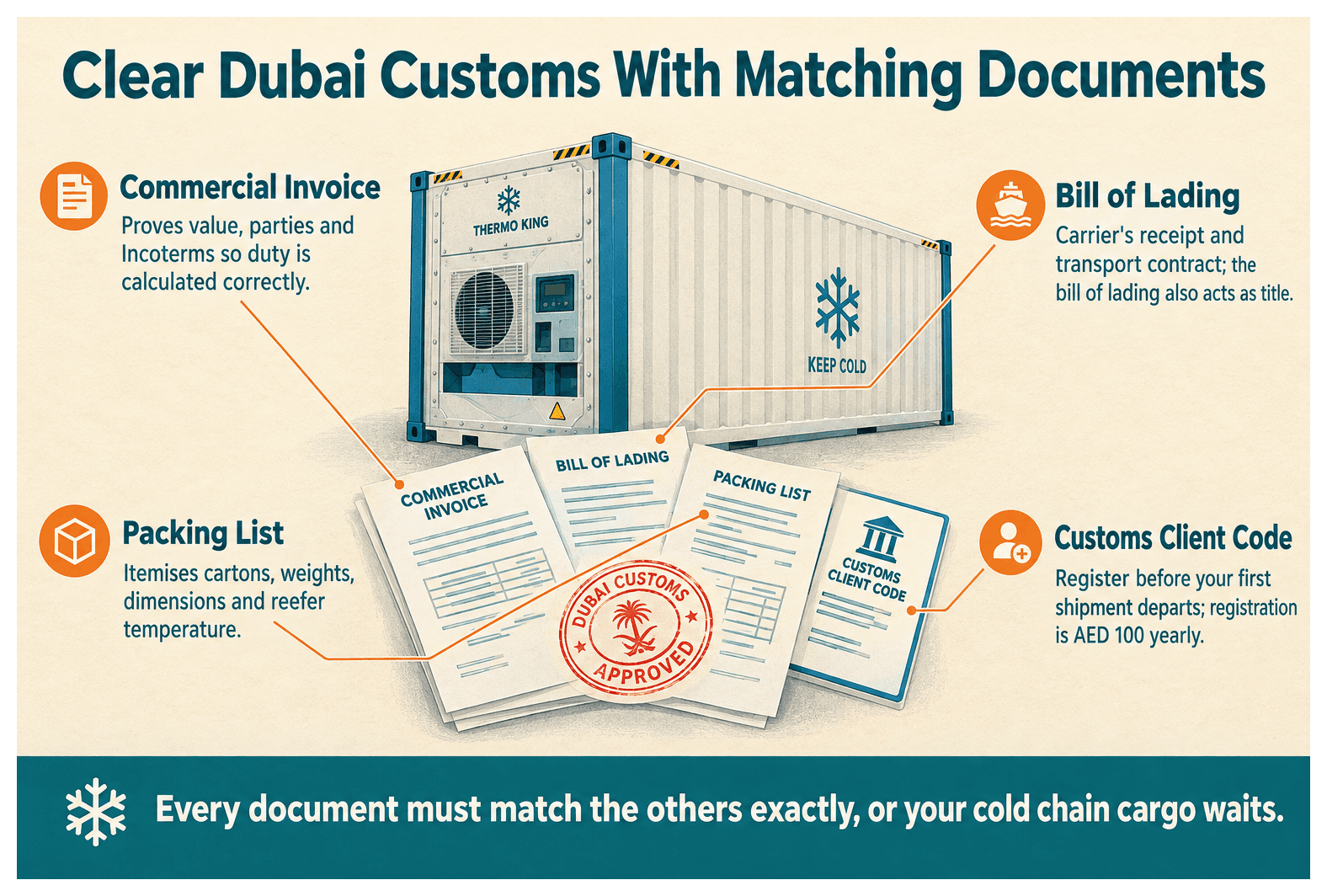
Commercial invoice | Proves value, parties and Incoterms so duty is calculated correctly |
Bill of lading or airway bill | Carrier's receipt and transport contract; the bill of lading also acts as title |
Packing list | Itemises cartons, weights, dimensions and reefer temperature |
Customs declaration | Electronic statement of goods, HS code, value and duty payable |
Certificate of origin and permits | Supports duty treatment and satisfies sector regulators |
How Do You Get a Customs Client Code and Portal Access?
Register the code before your first shipment departs. Registration is AED 100 with AED 100 yearly renewal, but verify before applying. See what a customs client code costs. Typical import documents Dubai asks for:
Trade license
Passport copies
Emirates ID
Tenancy or lease details
Which Dubai Customs Clearance Documents Are Mandatory for Every Import?
Every import needs a commercial invoice, a bill of lading (sea) or airway bill (air), a packing list and a customs declaration. Many shipments also need a certificate of origin and a delivery order. Values, quantities and descriptions must agree.
What Must a Commercial Invoice Include?
Seller and buyer details
Goods description and quantity
Unit price and currency
Incoterms (standard trade terms that split cost and risk between buyer and seller)
A commercial invoice customs UAE officers trust shows CIF value (cost, insurance and freight), so duty uses the right base.
How Do the Bill of Lading and Packing List Differ?
The bill of lading proves carriage and ownership.
The packing list details cartons, weights and set-point temperature.
Packing list requirements UAE officers apply: quantities must match the invoice.
When Do You Need a Certificate of Origin and Delivery Order?
A certificate of origin supports duty treatment. The shipping line or agent issues the delivery order once port charges are settled. Check the official source for current requirements.
How Do You Clear Goods Through Dubai Customs Step by Step?
Confirm your license and client code, gather documents, file the declaration, pay duty, get the delivery order and collect. The customs clearance process Dubai importers follow runs through Mirsal 2 declarations, handling 17 million+ a year.
Prepare your checklist. Cross-check names, values, HS codes and weights. A pre-shipment review once caught a mismatched consignee name.
Submit and pay. File via Mirsal 2, the electronic declaration system, directly or through an agent. Customs may inspect or request more papers.
Release and collect. Obtain the gate pass, then move chilled cargo straight to a temperature-controlled warehouse.
How Does the Customs Declaration Work in Dubai?
A customs declaration Dubai importers file is an electronic statement of goods, value, origin, HS code and duty. Dubai Customs checks it against your papers. Errors can trigger inspection or penalties.
Importer code and HS code
Value, origin and quantity
Transport details
A wrong HS code on a refrigeration unit means a correction and lost days. First-timers often use a freight forwarder for their first three shipments, then self-file for control.
Which Extra Permits Do Regulated and Cold Chain Goods Need?
Food usually involves Dubai Municipality, regulated products may need Ministry of Industry and Advanced Technology (MoIAT) conformity approval, and pharmaceuticals involve the Ministry of Health and Prevention. Requirements vary, so check the official source.
Health certificates and halal certification where relevant
Dubai Municipality food import approval
Temperature records and shelf-life labelling
A chilled dairy importer should secure approval before shipping. A refrigeration equipment buyer should check MoIAT conformity before purchase, as product compliance affects clearance.
What Mistakes Delay Dubai Customs Clearance and How Do You Avoid Them?
Common mistakes: mismatched invoice and packing list details, wrong HS codes, missing permits, an inactive client code and undervalued goods. Cross-check every one of your Dubai Customs clearance documents before shipment.
Practical tip: send draft documents to your agent before the vessel sails. A draft bill of lading corrected at origin costs minutes; fixing it after arrival costs storage.
Penalties can include storage, demurrage, amendment fees and fines. A delayed reefer container racks up port charges quickly. Amounts vary, so confirm with DP World and Dubai Customs.
What Should Cold Chain Entrepreneurs Do Next?
Confirm your license activity, register your customs client code, set up portal access, assemble your Dubai Customs clearance documents checklist and talk to a clearing agent. A Dubai South Business Hub Free Zone license is a sound starting point.
The license comes with residency visa packages. Corporate tax and VAT still apply, so plan for both. Follow the guide on starting an import business in Dubai.
Accurate, consistent Dubai Customs clearance documents keep cargo moving. Build your checklist today, confirm your client code, and contact Dubai South Business Hub to set up a company ready to import.
Rules in the UAE change often. Always verify the latest requirements with the official authority before taking action.
References
Frequently Asked Questions