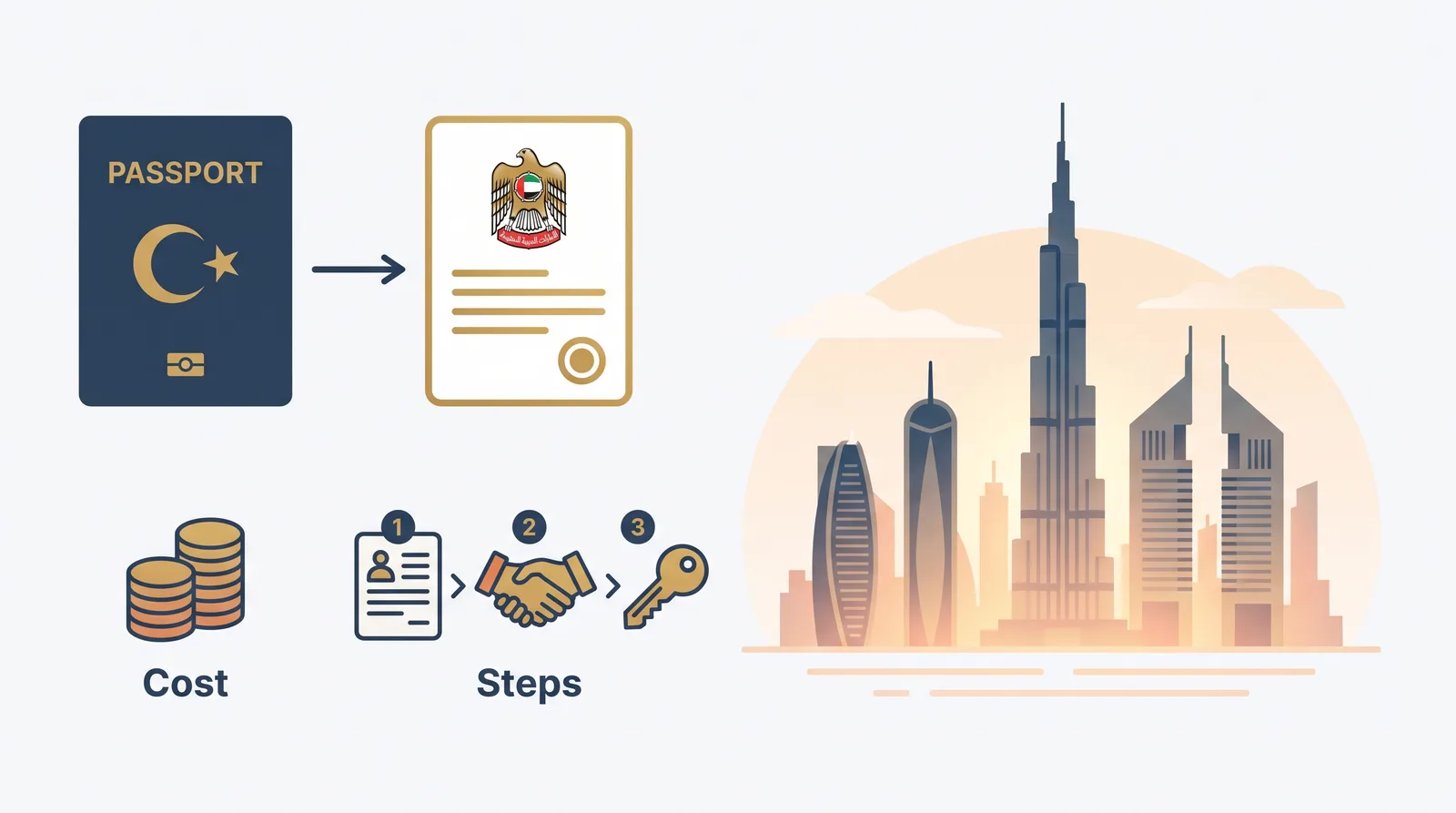
Topic Summary
What Doing Company Paperwork in Dubai Actually Involves
Doing company paperwork in Dubai means gathering founder documents, registering a trade name, obtaining a license, opening an ICP establishment file, and, if visas are needed, processing entry permits, medical tests, Emirates ID, and visa stamping. Each step involves a separate g
Doing Company Dubai Requirements: What You Must Have Ready
To complete company registration in Dubai you need a valid passport copy for each shareholder, a passport-size photograph, proof of residential address, a trade name reservation, and a completed application form. Regulated activities require additional approvals from the named se
Step-by-Step Process for Doing Company Paperwork in Dubai
The company paperwork process in Dubai runs in six stages: trade name reservation, license application and document submission, license issuance, ICP establishment file creation, visa allocation activation (if applicable), and visa processing for each applicant. Each stage involv
Cost Comparison: DIY vs. PRO Service for Doing Company Paperwork in Dubai
DIY company paperwork in Dubai eliminates the PRO service fee but adds time cost, rejection risk, and potential amendment fees. For founders without prior UAE formation experience, the PRO route often saves money once you account for corrections.
Time, Error Risk, and When Each Option Makes Sense
Error risk, not difficulty, is the main variable separating DIY from a PRO service. The portals are accessible. The forms are in English. The issue is that a small error at any stage restarts that stage, and the stages are sequential.
Banking, Tax Registration, and Post-License Paperwork
After the license is issued, founders must open a corporate bank account, register for VAT if turnover exceeds AED 375,000, and register for corporate tax. Each is a separate process with its own portal and deadline.
Fewer than one in three first-time founders who attempt to handle their own company formation in Dubai complete the process without at least one rejected submission or missed document, and that single error can add two to three weeks to a launch timeline that most business plans treat as day one. Doing company paperwork in Dubai spans multiple government portals, each with its own document standards, submission windows, and rejection triggers. Miss one, and the clock resets.
This guide sets out what doing company paperwork in Dubai actually involves, what the requirements are, what each path costs, and how to decide honestly whether to handle it yourself or hand it to a PRO service, so you can make that call before you start, not halfway through.
What Doing Company Paperwork in Dubai Actually Involves
Doing company paperwork in Dubai means gathering founder documents, registering a trade name, obtaining a license, opening an ICP establishment file, and, if visas are needed, processing entry permits, medical tests, Emirates ID, and visa stamping. Each step involves a separate government portal or authority with its own requirements and processing time (u.ae, 2025).
The Two Paths: Self-Filing vs. PRO Service
Self-filing means you interact directly with each authority, the free zone authority, the Identity and Citizenship Authority (ICP), and the Ministry of Human Resources and Emiratisation (MOHRE), using their portals and submitting documents yourself. There's no intermediary catching errors before they reach the reviewer.
A PRO (Public Relations Officer) service assigns a dedicated officer who knows each portal's current requirements, submission windows, and common rejection triggers. The choice isn't really about difficulty. It's about whether your time and risk tolerance match the process.
Here's a concrete illustration of where self-filing goes wrong: a founder submitting a trade name with an Arabic transliteration error receives a rejection notice, not a correction. The name check restarts from scratch, with a fresh fee and a fresh queue position. Trade name registration is also a distinct step from license issuance, it must be completed first, and the ICP establishment file must be active before any visa application can be submitted.
Who Actually Handles the Paperwork in Each Model
In the DIY model, you're the applicant of record on every form. Any mismatch between documents, passport name vs. application name, for instance, causes an automatic rejection. A founder whose passport shows "Mohammed Al Rashidi" but whose tenancy contract uses "M. Rashidi" will fail the ICP file verification step. A PRO catches exactly this kind of discrepancy before submission.
In the PRO model, a licensed officer handles submissions, tracks status, and liaises with authorities on your behalf. You supply documents and sign approvals. At Dubai South Business Hub Free Zone, PRO handling is bundled into formation packages rather than charged as a separate line item. The license is issued in 1 day once documents are complete, meaning the time risk sits in preparation, not in authority processing. Visa processing steps (entry permit, status change, medical, Emirates ID, stamping) are always quoted separately from the license fee.
Doing Company Dubai Requirements: What You Must Have Ready
To complete company registration in Dubai you need a valid passport copy for each shareholder, a passport-size photograph, proof of residential address, a trade name reservation, and a completed application form. Regulated activities require additional approvals from the named sector regulator before the license is issued (moet.gov.ae, 2025).
Core Documents Every Founder Needs
Passport copy (colour scan, minimum 300 dpi, valid for at least six months). Expired or low-resolution scans are the single most common rejection reason. A founder submitting a scan at 72 dpi (screen resolution) instead of 300 dpi (print resolution) typically receives a document quality rejection within 24 hours.
Passport-size photograph (white background, taken within the last six months). Off-white or grey backgrounds are rejected on upload by most free zone portals.
Proof of residential address (utility bill, bank statement, or official letter, no older than three months). The document must show your name and address as they appear on your passport.
Completed application form. Each free zone authority has its own version; details must match the passport exactly, including middle names and date of birth format.
All documents in a language other than Arabic or English must be legally translated and attested before submission. Corporate shareholders, rather than individuals, must also supply entity documents: a certificate of incorporation, memorandum of association, and a board resolution authorising the investment.
Additional Requirements for Regulated Activities
Activities in healthcare, education, financial services, and ICT require pre-approval from the named sector regulator before the license can be issued. The free zone licenses the activity; the regulator approves it. Both steps are mandatory, and neither waives the other.
A practical example: a founder licensing a medical consultancy at Dubai South Business Hub Free Zone receives the free zone license first, then applies separately to the Dubai Health Authority (DHA) for the activity-specific permit before seeing any patients. Financial services activities require approval from the Central Bank of the UAE (CBUAE) or the Dubai Financial Services Authority (DFSA), depending on scope. You can browse the full list of business activities to check which category your chosen activity falls under.
Worth flagging: missing a post-license registration deadline carries real cost. VAT late registration carries an AED 10,000 penalty; corporate tax late registration carries the same. These are not warnings, they're fixed penalties under UAE tax law.
Step-by-Step Process for Doing Company Paperwork in Dubai
The company paperwork process in Dubai runs in six stages: trade name reservation, license application and document submission, license issuance, ICP establishment file creation, visa allocation activation (if applicable), and visa processing for each applicant. Each stage involves a separate portal or authority and must be completed in sequence.
Step 1: Reserve Your Trade Name
Search name availability before submitting, duplicate or restricted names are rejected automatically.
The name must not include references to governments, religions, or protected organisations.
Both the Arabic and English versions must be submitted and must be consistent transliterations of each other.
Reservation is valid for a limited window; missing the deadline requires a fresh application and fee.
Use the company name check tool to confirm availability before paying the reservation fee. It takes two minutes and saves a resubmission queue.
Step 2: Submit the License Application
Upload all core documents in the correct format and resolution.
Select your business activities carefully, adding activities after issuance requires a license amendment and an additional fee.
Pay the license fee and receive the license. At Dubai South Business Hub Free Zone, issuance takes 1 day once documents are accepted.
Package pricing at Dubai South Business Hub Free Zone (2026, standard prices):
0 Visa Package: AED 12,500, includes license, Articles of Association, share register, flexi-desk space, and lease agreement.
1 Visa Package: AED 16,350, adds one visa allocation and establishment card.
2 Visa Package: AED 18,200, adds two visa allocations and establishment card.
DIY vs. PRO Service: Honest Comparison for Company Paperwork in Dubai
Feature | DIY (Self-Filing) | PRO Service |
|---|---|---|
Government fees | Identical to PRO route, no self-filing discount | Identical to DIY route, PRO fee is separate from government fees |
Service fee | None, but time cost and potential amendment fees apply | Bundled into DSBH packages; standalone market rate varies |
Time to complete | Longer, learning portals, correcting rejections, tracking status adds days or weeks | Faster, officer knows current requirements and submission windows |
Error risk | Higher, one document mismatch restarts the affected stage | Lower, PRO reviews documents before submission and catches mismatches |
Best for | Single founder, simple activity, UAE-based, prior formation experience | Overseas founders, corporate shareholders, regulated activities, complex structures |
Step 3: Open the ICP Establishment File and Process Visas
The ICP establishment file must be created before any visa application can be submitted, without it, the ICP portal returns a company-not-found error.
The establishment card (included in the 1 and 2 Visa Packages) is a prerequisite for every visa the company files.
Visa processing, entry permit, status change, medical, Emirates ID, stamping, is always quoted separately from the package fee.
A founder on the 1 Visa Package activates one investor visa allocation. The ICP file typically takes 3 to 5 working days to open after license issuance. Visa processing costs are quoted at the time of application. For a full breakdown of what residency processing involves, see the UAE residency visa services page.
Cost Comparison: DIY vs. PRO Service for Doing Company Paperwork in Dubai
DIY company paperwork in Dubai eliminates the PRO service fee but adds time cost, rejection risk, and potential amendment fees. For founders without prior UAE formation experience, the PRO route often saves money once you account for corrections.
What DIY Actually Costs in Time and Money
Government fees are identical whether you file yourself or through a PRO, there's no discount for self-filing. What DIY adds is the time cost of learning each portal, correcting rejected submissions, and tracking status across multiple authorities.
A single document rejection can delay the ICP file by one to two weeks, pushing the visa application back by the same margin. The license itself is issued in 1 day at Dubai South Business Hub Free Zone, the time risk sits in document preparation, not authority processing. VAT and corporate tax late registration each carry an AED 10,000 penalty, missing these deadlines is one of the most common DIY oversights, particularly for founders who focus on the license stage and defer the post-license obligations.
What a PRO Service Covers and Where It Adds Value
A PRO service covers document review, submission, status tracking, and liaison with authorities. It doesn't cover government fees, those are paid directly regardless of which route you take.
Value is highest for founders who aren't based in the UAE during formation, who have complex shareholding structures, or who are licensing regulated activities. A founder based outside the UAE who needs to notarise and attest documents from their home country benefits most from a PRO who knows exactly which attestation chain each authority accepts, and that chain differs by country of origin. At Dubai South Business Hub Free Zone, PRO handling is built into the formation packages rather than billed separately. Use the business setup cost calculator to model your full formation cost before committing.
Time, Error Risk, and When Each Option Makes Sense
Error risk, not difficulty, is the main variable separating DIY from a PRO service. The portals are accessible. The forms are in English. The issue is that a small error at any stage restarts that stage, and the stages are sequential.
When DIY Is a Reasonable Choice
Single founder, simple activity, no regulated approvals required.
You're UAE-based and can attend in-person steps if needed.
You've completed a UAE formation before and know each portal.
The time investment is budgeted into your pre-launch schedule.
A solo consultant taking out a professional services license with a straightforward passport and a clean trade name is the textbook DIY candidate. License issuance at Dubai South Business Hub Free Zone takes 1 day once documents are accepted; the ICP establishment file typically follows in 3 to 5 working days.
When a PRO Service Pays for Itself
Multiple shareholders with documents from different countries, each country has a different attestation chain, and getting it wrong means the document is rejected at the authority level.
Founder is overseas and can't attend in-person steps, some verification steps require physical presence or notarised power of attorney.
Activity requires dual approval from a sector regulator, coordination errors between the free zone and the regulator are costly to unwind.
Founder's time has a high opportunity cost, if two weeks of portal management costs more than the PRO fee in lost revenue, the maths is straightforward.
A two-founder company where one partner holds a non-GCC passport and the other holds a corporate shareholder entity from Hong Kong will face document complexity that a PRO resolves in hours rather than days. Worth flagging: the establishment card is required before any visa application, missing this link is the most common PRO-avoidable error in the entire process.
Is doing company paperwork in Dubai difficult for first-time founders?
It's not technically difficult, but it's unforgiving. Each portal has specific document standards, and a mismatch, even a name abbreviation, triggers a rejection that resets that stage. First-time founders without prior UAE formation experience typically encounter at least one rejected submission, which adds one to three weeks to the timeline.
Banking, Tax Registration, and Post-License Paperwork
After the license is issued, founders must open a corporate bank account, register for VAT if turnover exceeds AED 375,000, and register for corporate tax. Each is a separate process with its own portal and deadline.
Corporate Bank Account Opening
UAE banks require a valid trade license, passport copies for all shareholders, proof of address, and often a business plan or evidence of expected transactions. Free zone companies can bank with any UAE-licensed bank, they're not restricted to
References
Frequently Asked Questions