
Topic Summary
What Is Restructuring a Dubai Company After a Dispute and Why It Matters
To restructure a Dubai company after a dispute means changing who owns, controls or funds the business through a buyout, share transfer, shareholder removal or share split. The change is documented in amended constitutional papers and takes legal effect only once the free zone authority approves and reissues the license.
Which Restructuring Route Fits Your Shareholder Dispute in the UAE
Which Restructuring Route Fits Your Shareholder Dispute in the UAE
Step-by-Step Guide to Restructure a Dubai Company After a Dispute
Freeze risky actions, review the shareholder agreement, agree the route, value the business, sign the transfer or settlement, amend the constitutional documents, and file with the free zone authority. Once approved, update the license, bank mandates, visas and tax records. Skipping a step usually causes a filing rejection.
Documents, Fees and Timelines for Restructuring in Dubai (AED)
Expect a share transfer agreement, amended MOA or AOA, shareholder resolutions, passport and Emirates ID copies, and the current license. Amendment fees are quoted in AED and change over time, so confirm the current figure and its date before filing. Straightforward filings usually clear in several working days.
Tax, Visa and Compliance Impact of Restructuring a Dubai Company
Ownership changes can affect corporate tax registration details, residency visas tied to the license, bank mandates and economic substance records. Notify the Federal Tax Authority of material changes, review visa sponsorship for exiting partners, and update banks promptly. Never assume the business is tax free; position depends on activity and income.
Preventing a Repeat Shareholder Dispute in the UAE
Prevent repeat disputes with a written shareholder agreement covering exit mechanics, valuation formulas, deadlock resolution, vesting and contribution duties. Add a buy-sell clause so departures follow a pre-agreed path instead of a fight. Review the document whenever ownership, capital or roles change.
Common Mistakes and What Should You Do Next to Restructure a Dubai Company After a Dispute
The costliest mistakes are informal side deals, filing incomplete documents, ignoring visas and bank mandates, and skipping valuation. Next, collect your paperwork, pick a route, agree terms in writing, and file the amendment with the free zone authority. Get specialist support before you sign anything binding.
To restructure a Dubai company after a dispute, you agree an exit or control model (buyout, share transfer, removal or split), document it in amended constitutional papers, and have the free zone authority approve it. Until that approval is issued, the old ownership remains legally in force.
More than three in five new UAE registrations involve two or more founders (Dubai Chamber, 2026) [1]. That means plenty of businesses carry built-in dispute risk. This guide is for founders, directors and their advisers who need to restructure a Dubai company after a dispute, and it shows the routes, steps, documents and compliance updates in order.
What Is Restructuring a Dubai Company After a Dispute and Why It Matters
To restructure a Dubai company after a dispute means changing who owns, controls or funds the business through a buyout, share transfer, shareholder removal or share split. The change is documented in amended constitutional papers and takes legal effect only once the free zone authority approves and reissues the license.
What Restructuring Covers in Practice
Ownership: share transfer, buyout, removal or split.
Governance: manager or director replacement, signatory and bank mandate updates.
Capital and liability: capital adjustment and debt allocation.
Picture two 50/50 founders of a trading company who stop agreeing on strategy. One buys out the other at an agreed valuation, and the license is reissued in a single-owner name. Activity classification follows what the business does (UN ISIC Rev.4), so changing partners doesn't change the activity code unless the activity itself changes.
Why Shareholder Disputes in the UAE Escalate
Over 60% of early-stage UAE ventures had no documented exit mechanism at their first dispute (Magnitt, 2024) [2]. Add a partner who stops funding while the other keeps paying license renewals and visa costs, and a claim builds quickly. For the next-level read, see deadlock between shareholders in a Dubai company.
What Stays Frozen Until Approval Is Issued
The old shareholding stays valid until the authority approves the amendment.
Bank signatories and visas stay tied to the existing license record.
Informal side agreements carry no regulatory weight.
A signed private share sale that's never filed leaves the seller listed on the license and liable.
Which Restructuring Route Fits Your Shareholder Dispute in the UAE
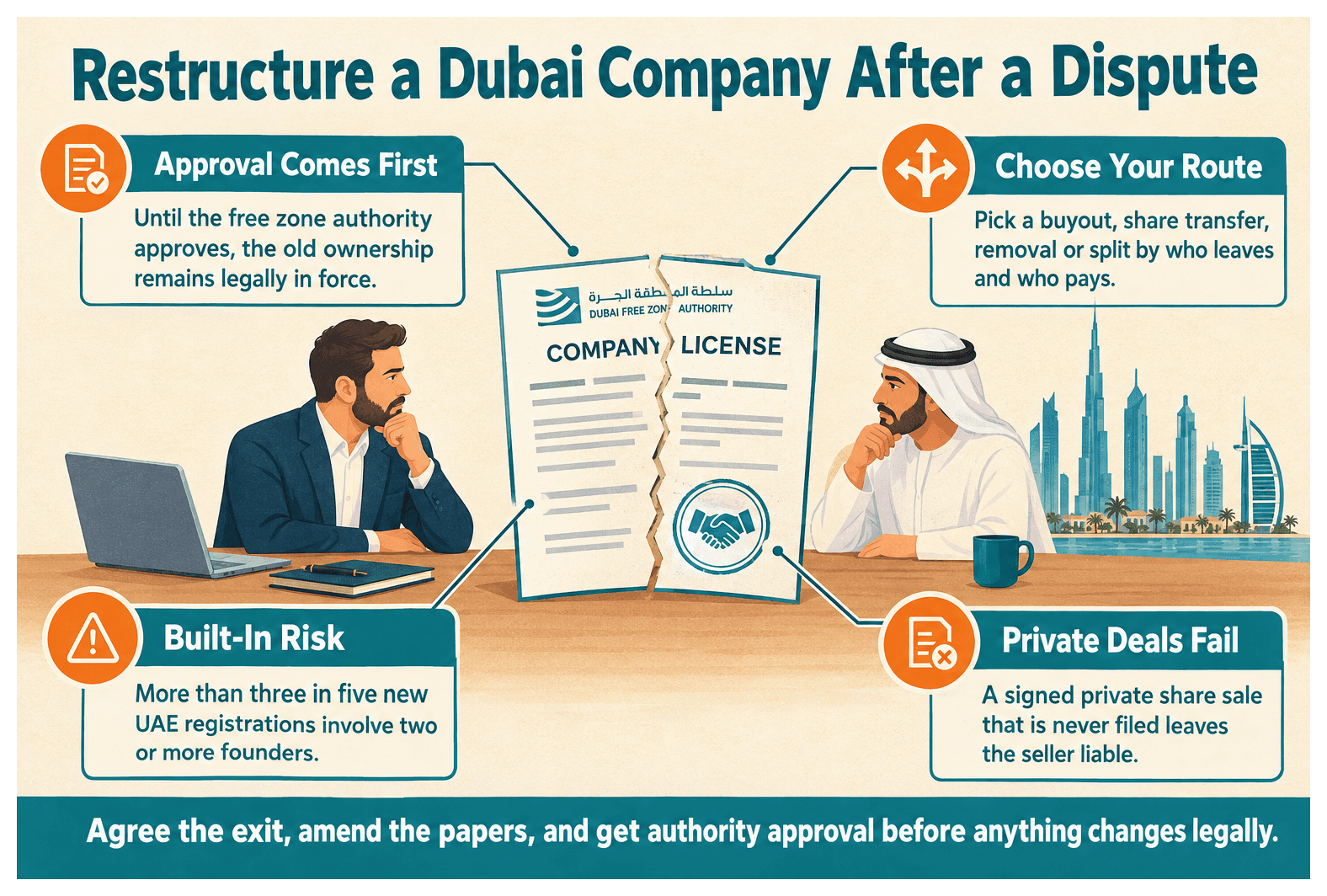
The right route depends on whether someone wants out. A buyout or share transfer suits a clean exit, shareholder removal suits a non-contributing partner, a share split rebalances control, and a freeze protects assets while talks continue. Choose by who leaves, who pays and how much control each party keeps. At Dubai South Business Hub Free Zone, each route runs through the same amendment filing.
Buyout and Share Transfer After a Dispute
One partner buys the other's shares at an agreed value, using net asset value, an earnings multiple or a negotiated figure. A share transfer after dispute needs a signed share transfer agreement and authority approval. Illustrative example only, not a quote: a consultancy with AED 400,000 net assets sees a 40% stake bought for AED 160,000. Read more on buying out your partner in a Dubai company.
Removing a Shareholder or Freezing Shares
Removal needs consent, a court or arbitral order, or a contractual trigger.
A freeze blocks transfer or pledge while the dispute is live.
The amendment file is document-heavy.
One example: a partner who vanished abroad is removed after an arbitral award is filed with the authority. See how to freeze shares for the mechanics.
Splitting Shares or Winding Down Instead
Rebalancing percentages triggers an Articles of Association amendment. A 50/50 firm might move to 70/30 with a casting-vote clause to end deadlocks. If trust is gone and the business can't sustain itself, liquidation is the more honest route (insolvency and restructuring options in the UAE).
Step-by-Step Guide to Restructure a Dubai Company After a Dispute
Freeze risky actions, review the shareholder agreement, agree the route, value the business, sign the transfer or settlement, amend the constitutional documents, and file with the free zone authority. Once approved, update the license, bank mandates, visas and tax records. Skipping a step usually causes a filing rejection.
Step 1: Stabilise the Company and Review the Paperwork
Freeze share transfers, pledges and large payments. A director might pause new contracts above AED 50,000 until both parties sign off.
Read the shareholder agreement for exit, deadlock and dispute resolution clauses.
Gather the license, MOA/AOA (Memorandum and Articles of Association) and share certificates.
Step 2: Agree the Route, Valuation and Settlement Terms
Try mediation first, then arbitration if needed.
Appoint an independent valuer where figures are contested (how to value your Dubai company).
Record the payment schedule, liabilities and release clauses.
Restructuring Routes Compared (AED, Fee Dates Stated)
Feature | Buyout or Share Transfer | Shareholder Removal |
|---|---|---|
What changes | Shares move from seller to buyer by agreement | Shares are cancelled or reassigned by order or contractual trigger |
Indicative AED cost (with date quoted) | Amendment fee plus legal drafting and valuation; no figure quoted here, confirm the current AED fee on the filing date | Same fee categories plus dispute or arbitration costs; confirm the current AED fee on the filing date |
Typical timeline | Several working days once both parties have signed | Longer, as the order or award must come first |
Key documents | Share transfer agreement, amended MOA/AOA, resolutions, IDs | Court or arbitral order, amended MOA/AOA, resolutions |
Best suited when | Both sides agree on a clean exit and price | A partner is absent or won't cooperate |
Step 3: File the Amendment With the Free Zone Authority
Submit the share transfer agreement, amended MOA/AOA, board and shareholder resolutions, and IDs.
Pay amendment fees, then await approval and the reissued license.
Update bank signatories, visas and tax registration.
Fewer than 40% of free zone companies attempting capital restructuring avoid a filing rejection (capital restructuring in a UAE free zone company). A typical cause: the amended MOA still listed the exiting partner as manager. Ask the Dubai South Business Hub team to check completeness before filing, and see transferring shares in a Dubai free zone company.
Documents, Fees and Timelines for Restructuring in Dubai (AED)
Expect a share transfer agreement, amended MOA or AOA, shareholder resolutions, passport and Emirates ID copies, and the current license. Amendment fees are quoted in AED and change over time, so confirm the current figure and its date before filing. Straightforward filings usually clear in several working days.
Document Checklist for the Amendment File
Signed share transfer or settlement agreement.
Amended MOA/AOA and resolutions.
Valid IDs, current license, share certificates.
Court or arbitral order if removal is forced.
One founder lost weeks because a partner's passport copy had expired.
Realistic Timelines and Delays to Plan For
The biggest delay is usually a missing counterparty signature, followed by authority review and resubmission cycles. If the split leads to a rebrand, run the new name through the name check before filing. Budget with the cost calculator, and see what adding a shareholder costs for fee categories. I haven't quoted a government fee here because none is verified for this article date.
Tax, Visa and Compliance Impact of Restructuring a Dubai Company
Ownership changes can affect corporate tax registration details, residency visas tied to the license, bank mandates and economic substance records. Notify the Federal Tax Authority of material changes, review visa sponsorship for exiting partners, and update banks promptly. Never assume the business is tax free; position depends on activity and income.
Corporate Tax and Registration Updates
Update your profile with the Federal Tax Authority after ownership or manager changes. Qualifying free zone status depends on activity and income, not simply the license. Keep the settlement paperwork for audit support.
Residency Visas and Employees
Visas tied to the license may need cancellation, transfer or reissue.
Settle the exiting shareholder's visa handling in writing.
Staff contracts remain with the company (MOHRE).
Bank Accounts and Contracts
Replace signatories and update KYC.
Review change-of-control clauses.
Notify key suppliers and clients.
One bank froze an account until a new resolution naming signatories arrived.
Preventing a Repeat Shareholder Dispute in the UAE
Prevent repeat disputes with a written shareholder agreement covering exit mechanics, valuation formulas, deadlock resolution, vesting and contribution duties. Add a buy-sell clause so departures follow a pre-agreed path instead of a fight. Review the document whenever ownership, capital or roles change.
Key Clauses to Put in Writing
Exit and valuation, such as a set earnings multiple reviewed annually.
Deadlock resolution and casting votes.
Non-compete and confidentiality.
More than 40% of UAE startup disputes reaching arbitration trace to a missing or weak shareholder agreement (shareholder agreement in the UAE).
Buy-Sell Agreements and Contribution Rules
A buy-sell can trigger when a partner misses capital calls for 90 days, with payment terms agreed upfront. That protects your stake if a partner stops contributing; see how to protect your stake.
Common Mistakes and What Should You Do Next to Restructure a Dubai Company After a Dispute
The costliest mistakes are informal side deals, filing incomplete documents, ignoring visas and bank mandates, and skipping valuation. Next, collect your paperwork, pick a route, agree terms in writing, and file the amendment with the free zone authority. Get specialist support before you sign anything binding.
Mistakes That Trigger Rejections and Disputes
Unfiled private agreements.
Mismatched names or percentages across documents.
No release of liabilities for the exiting party.
An exiting partner stayed liable for a lease because the release clause was missing.
Your Next Move With Dubai South Business Hub
To restructure a Dubai company after a dispute, choose the route that fits who is leaving, document it fully, secure free zone approval, then update tax, visa and bank records. Clean paperwork matters more than speed. Bring a signed settlement and you'll get a document checklist before filing. Use the cost calculator to budget, then contact Dubai South Business Hub to confirm documents and current AED fees.
References
Frequently Asked Questions


