
Topic Summary
What Is UAE Corporate Tax for Energy Companies and Why It Matters
UAE corporate tax for energy companies is a federal tax of 9% on taxable profit above AED 375,000. Profit up to that threshold is taxed at 0%. Qualifying free zone energy firms can access 0% on qualifying income if they meet every Qualifying Free Zone Person (QFZP) condition.
Oil, Gas and Renewables Supply Treatment Under UAE Corporate Tax for Energy Companies
Oil, Gas and Renewables Supply Treatment Under UAE Corporate Tax for Energy Companies
Free Zone Corporate Tax 2026 and the De Minimis Rule for Energy Operators
Free zone corporate tax 2026 gives Qualifying Free Zone Persons 0% on qualifying income and 9% on the rest. The de minimis rule caps non-qualifying revenue at the lower of 5% of total revenue or AED 5 million. Exceeding it removes the 0% status.
Mainland Versus Free Zone Tax Position for Energy Operators
Mainland energy companies pay 9% above AED 375,000 on all profit. Dubai South Business Hub free zone companies can reach 0% on qualifying income if they pass every condition. Client mix and structure decide the better position.
Step-by-Step Registration and Filing for a UAE Energy Company
Register on the Federal Tax Authority EmaraTax portal, keep audited records, calculate taxable income and file within nine months of year end. Free zone companies must register even at 0%. Registration is required for all UAE-incorporated companies.
How Much Does It Cost and How Long Does It Take
FTA registration costs AED 0, while professional filing and audit support are the main costs. Registration takes days; annual filing takes several weeks depending on record quality.
Common Mistakes and What to Do Next for UAE Corporate Tax for Energy Companies
Common mistakes include missing registration, breaching the de minimis rule, ignoring transfer pricing, mixing income types and skipping audited accounts. Fix them by registering early, segmenting revenue and engaging an adviser before year end.
UAE corporate tax for energy companies is 9% on taxable income above AED 375,000, with 0% below it. Qualifying free zone entities can reach 0% on qualifying income, but only if they meet every condition, including the de minimis rule.
More than 350,000 businesses are registered with the Federal Tax Authority (Federal Tax Authority, 2026) [1]. The regime applies to financial years starting on or after 1 June 2023 [2]. A late registration costs AED 10,000 [1]. This guide is for owners and finance leads who need to know what they owe, when, and how to structure it.
What Is UAE Corporate Tax for Energy Companies and Why It Matters
UAE corporate tax for energy companies is a federal tax of 9% on taxable profit above AED 375,000. Profit up to that threshold is taxed at 0%. Qualifying free zone energy firms can access 0% on qualifying income if they meet every Qualifying Free Zone Person (QFZP) condition.
The 9% Rate and the AED 375,000 Threshold Explained
Tax is charged on accounting profit, adjusted for specific rules, not on turnover. Take a solar equipment trader with AED 1.2 million taxable profit. It pays 9% on AED 825,000, which is AED 74,250. For a full walkthrough, see our UAE corporate tax guide.
Who Counts as an Energy Company Under ISIC Classification
The UN's ISIC Rev.4 (published 2008, 21 sections from A to U) is a useful lens (UN Statistics Division, 2008).
Section B covers mining and quarrying, including crude petroleum and natural gas extraction.
Section D covers electricity, gas and steam supply.
Classification follows principal activity, not sales channel.
Ancillary work, like internal accounting, is absorbed into the main activity.
A firm selling solar power and running its own accounts is classed by power supply only.
Why Energy Operators Face Closer Scrutiny
Energy contracts are large, and related-party dealings are common. A trading arm selling fuel to an affiliated group company must price at arm's length. Expect transfer pricing questions early.
Oil, Gas and Renewables Supply Treatment Under UAE Corporate Tax for Energy Companies
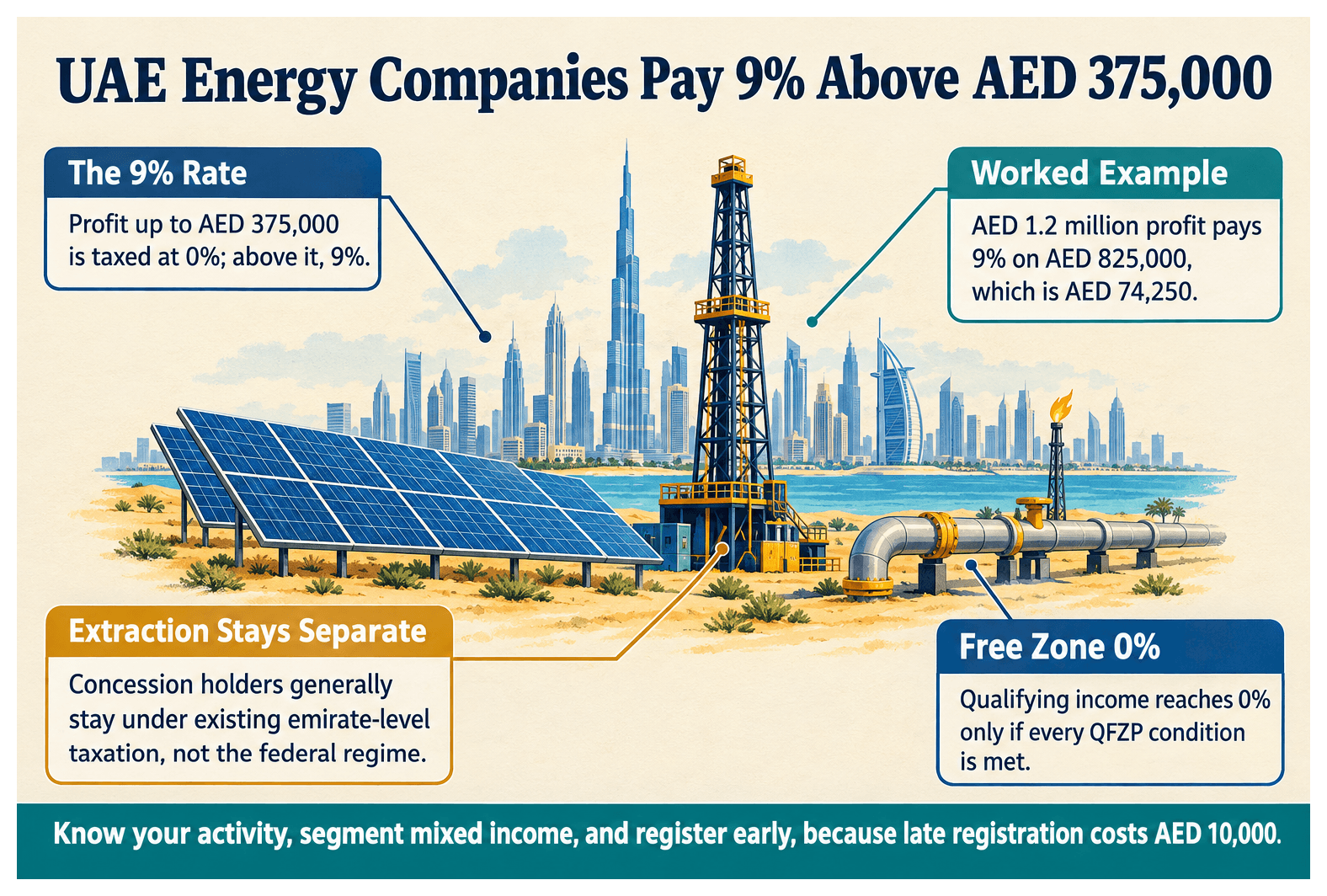
Oil and gas supply is taxed at 9% under federal corporate tax, but upstream extraction businesses are generally taxed under emirate-level regimes. Renewables suppliers follow the standard 9% rate, with 0% possible only where free zone conditions are met. That is the core of energy company tax UAE rules.
Oil and Gas Extraction Versus Downstream Trading
Extraction businesses holding concessions stay under existing emirate-level taxation. Downstream trading, distribution and services fall under the federal regime. A Dubai fuel distributor with no extraction rights pays 9% above AED 375,000. Confirm your status with the FTA and the relevant emirate authority, and segment income clearly if you run mixed operations.
Renewables and Clean Energy Supply
Solar, wind and storage equipment suppliers pay the standard rate.
Power sales to the grid are taxable income.
Engineering consultancy revenue is taxable too.
Tax is on adjusted net profit, not revenue.
A solar EPC contractor invoicing AED 5 million calculates tax on net profit after costs. See the energy projects engineering consultancy license.
Deductible Costs and Related-Party Rules
Fuel, maintenance and equipment depreciation are generally deductible. Depreciation on a storage facility, for example, reduces taxable profit. Interest deduction limits apply, and connected-party deals need transfer pricing documentation. Keep records for seven years (Ministry of Finance, 2026).
Free Zone Corporate Tax 2026 and the De Minimis Rule for Energy Operators
Free zone corporate tax 2026 gives Qualifying Free Zone Persons 0% on qualifying income and 9% on the rest. The de minimis rule caps non-qualifying revenue at the lower of 5% of total revenue or AED 5 million. Exceeding it removes the 0% status.
The De Minimis Rule in Plain Terms
An energy firm with AED 40 million revenue has a cap of AED 2 million, since 5% is lower than AED 5 million. Breach it and you lose QFZP status for that year and the following four years. Here's the thing: one large mainland contract can trigger it.
Mainland Versus Free Zone Corporate Tax Position for Energy Companies
Feature | Mainland Energy Company | Dubai South Free Zone (Qualifying Free Zone Person) |
|---|---|---|
Corporate tax rate | 9% on taxable income above the threshold | 0% on qualifying income, 9% on the rest |
AED 375,000 threshold treatment | 0% on the first AED 375,000 of taxable profit | Not the main benefit; QFZP status drives the result |
Treatment of mainland client income | Taxed as ordinary income at 9% | Generally non-qualifying; taxed at 9% and counted toward de minimis |
De minimis rule and audit requirement | No de minimis test; audit depends on license and size | Non-qualifying revenue capped at lower of 5% or AED 5 million; audited accounts required |
Registration with the Federal Tax Authority | Mandatory on EmaraTax | Mandatory even at 0% |
Qualifying Activities and Qualifying Income
Not every energy activity qualifies.
Trading of qualifying commodities may qualify.
Mainland sales can taint income.
All four QFZP conditions must be met.
A free zone company selling to mainland clients may face 9% on that revenue. Read the qualifying activities guide and our note on free zone companies with mainland clients.
Substance and Audited Accounts Requirements
You need adequate staff, premises and UAE-based decision-making, plus audited financial statements and transfer pricing compliance. A renewable trading company with a flexi-desk and no staff would fail the substance test. And no, the position is never fully tax free.
Mainland Versus Free Zone Tax Position for Energy Operators
Mainland energy companies pay 9% above AED 375,000 on all profit. Dubai South Business Hub free zone companies can reach 0% on qualifying income if they pass every condition. Client mix and structure decide the better position.
Choosing a Structure Around Your Client Mix
Mostly mainland clients call for a different analysis than mostly overseas buyers. A renewable components exporter selling mainly abroad may suit QFZP status. Dubai South Business Hub offers free zone licenses with residency visa packages tied to the license. Check availability first with the company name check, and compare tax benefits for Dubai free zone companies.
Step-by-Step Registration and Filing for a UAE Energy Company
Register on the Federal Tax Authority EmaraTax portal, keep audited records, calculate taxable income and file within nine months of year end. Free zone companies must register even at 0%. Registration is required for all UAE-incorporated companies.
Step 1: Register on EmaraTax
Prepare your trade license, owner Emirates ID and financial year details.
Registration fee is AED 0 (FTA, 2026).
Late registration costs AED 10,000.
See registering after company formation.
Step 2: Classify Income and Keep Records
Separate qualifying and non-qualifying income.
Tag income by client location.
Keep ledgers, contracts and transfer pricing files for seven years.
Step 3: Calculate Tax and Submit the Return
Adjust accounting profit for non-deductible items.
Apply 9% above AED 375,000.
A 31 December year-end company files and pays by 30 September.
Our guide on how to file a return covers the portal screens.
How Much Does It Cost and How Long Does It Take
FTA registration costs AED 0, while professional filing and audit support are the main costs. Registration takes days; annual filing takes several weeks depending on record quality.
Fee Table With Dates and AED Figures
Item | Amount (as of January 2026) |
|---|---|
FTA registration | AED 0 |
Late registration penalty | AED 10,000 |
Audit and filing support | Varies by company scale |
More detail sits in our registration cost guide.
Estimating Setup Costs With the Calculator
A two-visa energy consultancy needs a free zone license plus residency visa packages. Use the cost calculator for a quote.
Common Mistakes and What to Do Next for UAE Corporate Tax for Energy Companies
Common mistakes include missing registration, breaching the de minimis rule, ignoring transfer pricing, mixing income types and skipping audited accounts. Fix them by registering early, segmenting revenue and engaging an adviser before year end.
Five Errors That Trigger Penalties
Late registration: AED 10,000.
Breaching the 5% or AED 5 million cap.
Weak substance.
Poor records.
No transfer pricing file.
A gas services firm can lose QFZP status for five years after one large mainland contract.
Next Steps for Your Energy Business
UAE corporate tax for energy companies comes down to the 9% rate above AED 375,000, careful classification of oil, gas and renewables income, and strict discipline on the de minimis rule and substance. Free zone status reduces tax on qualifying income but is not a blanket exemption. Check your name, estimate costs, then contact Dubai South Business Hub to structure your free zone energy company. Refresh your figures each January.
References
Frequently Asked Questions


