
Topic Summary
Trade License Is Mandatory from Day One
Every e-commerce fulfilment operation in Dubai must hold a valid trade license before accepting client inventory or processing a single order. A free zone license from Dubai South Business Hub Free Zone covers fulfilment and logistics activities and can be issued in just one business day.
DSBH Packages Start at AED 12,500
The zero-visa package costs AED 12,500 and includes the license, Articles of Association, share register, flexi-desk space. One-visa and two-visa packages are available at AED 16,350 and AED 18,200 respectively, with visa processing fees quoted separately.
VAT Registration Triggers at AED 375,000 Turnover
Once annual taxable turnover reaches AED 375,000, VAT registration with the Federal Tax Authority becomes compulsory. Missing this threshold carries a one-time AED 10,000 penalty, making early revenue tracking essential.
Free Zone Goods Are Duty-Suspended, Not Exempt
Goods held inside a Dubai free zone are duty-suspended for as long as they remain within the zone, which can be a significant cost advantage. Standard UAE import duty rates apply the moment those goods move onto the mainland.
Warehouse Space Must Be Leased Independently
DSBH Free Zone does not include bonded warehousing within its license packages, so operators must source compliant warehouse space separately. Leasing near Al Maktoum International Airport is recommended to streamline inbound and outbound logistics.
Visa Allocations Are Capped at Two Per License
DSBH Free Zone permits a maximum of two investor visa allocations per trade license, which limits how many founders or key personnel can be sponsored under a single entity. Medical and Emirates ID costs are always priced separately from the package fee.
Fulfilment Operators Handle the Full Order Lifecycle
A licensed Dubai fulfilment business typically manages inbound receiving, SKU-level storage, pick-and-pack processing, outbound shipping, and returns reconciliation on behalf of merchant clients. This allows online retailers to scale without maintaining their own warehouse staff or lease agreements.
In 2026, UAE e-commerce revenue is projected to surpass USD 9 billion, with Dubai accounting for the largest share of regional fulfilment activity (Statista, 2025). Demand for third-party storage, pick-and-pack, and last-mile delivery has accelerated sharply as cross-border volumes grow. Yet many founders still launch without understanding what a properly licensed e-commerce fulfilment business in Dubai actually requires. Late VAT registration alone carries a AED 10,000 penalty. Operating without a trade license risks fines and closure. This guide covers the regulatory requirements, realistic costs, and a clear step-by-step process for setting up a licensed e-commerce fulfilment business in Dubai, so you can move from decision to trading without costly delays.
Before the first section, here's a quick summary of what you need to know:
A Trade License Is Mandatory from Day One. Every e-commerce fulfilment operation in Dubai must hold a valid trade license before accepting client inventory or processing orders. A free zone license from Dubai South Business Hub (DSBH) Free Zone covers fulfilment and logistics activities and is issued in one business day.
DSBH Packages Start at AED 12,500. The zero-visa package costs AED 12,500 and includes the license, Articles of Association, share register, flexi-desk space. The one-visa package is AED 16,350 and the two-visa package is AED 18,200. Visa processing fees are quoted separately.
VAT Registration Triggers at AED 375,000. Once your annual taxable turnover reaches AED 375,000, VAT registration with the Federal Tax Authority becomes compulsory. Late registration carries a one-time AED 10,000 penalty.
Free Zone Goods Are Duty-Suspended, Not Exempt. Goods held inside a free zone are duty-suspended for as long as they remain within the zone. Import duty at standard UAE rates applies the moment goods move into the UAE mainland.
Warehouse Space Is Sourced Separately. DSBH Free Zone does not provide bonded warehousing as part of its license packages. Operators must lease compliant warehouse space independently, ideally near Al Maktoum International Airport.
Maximum Two Investor Visa Allocations per License. DSBH Free Zone issues up to six visa allocations, with published packages offering 0, 1 or 2 per license. Visa processing, including medical and Emirates ID, is always priced separately from the package fee.
What Is an E-commerce Fulfilment Business in Dubai
An e-commerce fulfilment business in Dubai is a licensed operation that receives, stores, picks, packs, and dispatches goods on behalf of online retailers. It sits between the merchant and the end customer, managing physical inventory and last-mile logistics. In Dubai, it requires a valid trade license and compliance with UAE customs regulations.
Core Activities a Fulfilment Operator Covers
UAE e-commerce revenue is projected above USD 9 billion in 2026 (Statista, 2025), and the volume of parcels flowing through Dubai's logistics corridors reflects that growth. A licensed e-commerce fulfilment business in Dubai typically handles all of the following:
Inbound receiving and quality checking of client inventory on arrival
Storage in leased warehouse space with SKU-level tracking systems
Pick-and-pack processing triggered by marketplace or direct-to-consumer orders
Outbound shipping coordination with carriers for last-mile delivery
Returns management and inventory reconciliation for merchant clients
A Dubai-based fashion brand selling on Noon and its own website, for example, outsources all post-order fulfilment to a licensed third-party operator. That operator picks, packs, and ships within 24 hours of order confirmation, without the brand needing its own warehouse staff or lease.
How ISIC Classifies Fulfilment Activities
Under the UN International Standard Industrial Classification of All Economic Activities (ISIC Revision 4), warehousing and storage falls under Division 52, Section H (Transportation and Storage). Class 5210 covers general warehousing and storage, which is where most e-commerce fulfilment business in Dubai operations sit (UN Statistics Division, 2008, still accurate as of 2026).
E-commerce is not a separate ISIC category. A fulfilment centre generating 80% of its revenue from storage and dispatch is classified under warehousing regardless of whether orders originate from an online marketplace or a physical store. The principal activity is determined by the top-down value-added method: whichever function generates the most value added defines the classification. That matters for your license activity list, which must reflect what you actually do.
Licensing Requirements for an E-commerce Fulfilment Business in Dubai
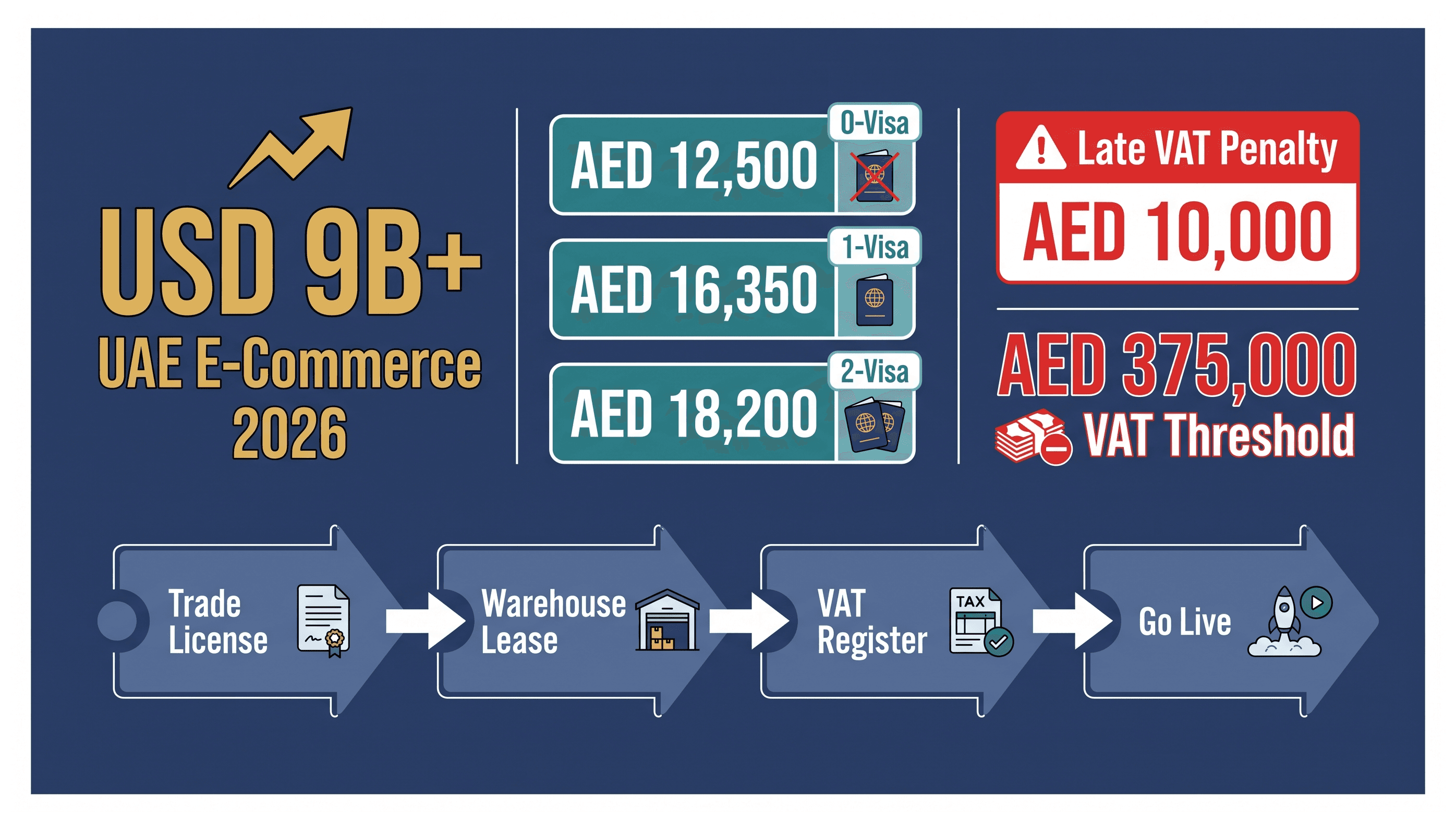
An e-commerce fulfilment business in Dubai requires a trade license covering warehousing and logistics activities, a registered business address, a compliant warehouse lease, and VAT registration once turnover exceeds AED 375,000. Free zone operators at DSBH also need an establishment card to sponsor employees and must source warehouse space independently.
Trade License and Business Activity Scope
You can't accept a single client pallet before your trade license is in place. The license must specifically list the activities you intend to perform, including warehousing, logistics, and fulfilment services. Adding activities later requires a formal amendment, so it's worth reviewing the list of business activities in Dubai before you apply to confirm you've captured everything upfront.
DSBH Free Zone issues the license in one business day once documents are approved
The license must list all intended activities; amendments are required for any additions
Regulated goods require dual approval: the DSBH license covers the activity, and the named sector regulator approves the specific product category separately
An operator planning to fulfil health supplement orders, for instance, must hold both the DSBH free zone trade license for warehousing and a separate product approval from the UAE Ministry of Health and Prevention before storing or dispatching those goods.
Warehouse Space and Physical Infrastructure
DSBH Free Zone does not provide bonded warehousing as part of the license package. You'll need to lease warehouse space independently from a commercial landlord or logistics park, and that lease agreement forms part of your license application documentation.
Proximity to Al Maktoum International Airport gives operators a practical advantage for cross-border and air freight fulfilment (Dubai Airports, 2025)
Racking, warehouse management software (WMS), and carrier integrations are the operator's own responsibility
A startup operator might secure a 500 sq m unit in a logistics park near the airport, sign the lease, and submit the agreement as part of the DSBH application
Worth flagging: free zone goods are duty-suspended, not duty-exempt. Import duty applies the moment goods cross into the UAE mainland, so build that into your client pricing models from the start.
VAT, Corporate Tax, and Customs Obligations
An operator generating AED 500,000 in annual service fees must register for VAT, charge 5% on taxable services, and file quarterly returns with the Federal Tax Authority (tax.gov.ae).
VAT registration is compulsory once taxable turnover reaches AED 375,000; late registration penalty is AED 10,000
Corporate tax registration is required for all UAE businesses; late registration carries a one-time flat penalty of AED 10,000
Corporate tax at 0% on qualifying income is available only if the business meets all four Qualifying Free Zone Person (QFZP) conditions:
It must be a free zone entity
It must derive qualifying income
It must not elect to be subject to the standard regime
It must meet the de minimis and substance requirements
Fulfilment operators handling mainland deliveries must account for customs duty in client pricing models; consult Dubai Trade for current import duty guidance
DSBH Free Zone License Package Comparison for E-commerce Fulfilment
Package | Price | Inclusions |
|---|---|---|
Zero-Visa Package | AED 12,500 | License, Articles of Association, share register, flexi-desk space, lease agreement |
One-Visa Package | AED 16,350 | All above, plus one investor or partner visa allocation and establishment card |
Two-Visa Package | AED 18,200 | All above, plus two visa allocations and establishment card (maximum available) |
Visa Processing | Quoted separately | Entry permit, status change, medical examination, Emirates ID, all packages |
License Issuance Timeline | 1 business day | Applies to all three packages once documents are approved |
Cost of Setting Up an E-commerce Fulfilment Business in Dubai
A DSBH Free Zone license for an e-commerce fulfilment business in Dubai starts at AED 12,500 for the zero-visa package. The one-visa package is AED 16,350 and the two-visa package is AED 18,200. All packages include the license, Articles of Association, share register, flexi-desk space. Visa processing is priced separately.
DSBH Free Zone Package Pricing
A two-partner fulfilment startup would select the two-visa package at AED 18,200 to cover both founders' investor visa allocations, then budget separately for visa processing fees for each partner. Here's how the packages break down:
AED 12,500 zero-visa package: license, Articles of Association, share register, flexi-desk space, and lease agreement. Best for operators who already have UAE residency or don't need a visa through the company.
AED 16,350 one-visa package: all of the above, plus one investor or partner visa allocation and establishment card.
AED 18,200 two-visa package: all of the above, plus two visa allocations and establishment card. This is the maximum available per license.
Visa processing costs (entry permit, status change, medical, Emirates ID) are always quoted separately from the package fee for all three options.
Use the business setup cost in Dubai calculator to model your full investment before committing, factoring in visa processing alongside the package fee.
Additional Operational Costs to Budget For
A founder budgeting for a small fulfilment operation should treat the DSBH license fee, warehouse lease deposit, WMS setup, and VAT accounting as four distinct cost lines from the outset. The license fee is fixed; the rest vary.
Warehouse lease: cost varies by unit size, location, and landlord; obtain independent quotes from logistics parks near Al Maktoum International Airport
WMS (warehouse management software) subscription: varies by platform and order volume
Carrier and last-mile delivery accounts: negotiated directly with logistics providers
VAT compliance and accounting: an ongoing monthly or quarterly cost depending on filing frequency
Late VAT registration penalty: AED 10,000 if you miss the AED 375,000 threshold
Late corporate tax registration: AED 10,000 one-time flat penalty (tax.gov.ae)
Note: average annual warehouse operating cost per sq m in the Dubai South logistics zone is UNVERIFIED. Confirm before publishing.
How to Set Up an E-commerce Fulfilment Business in Dubai: Step-by-Step
To set up an e-commerce fulfilment business in Dubai, confirm your business activities, choose your license package, prepare your documents, submit your application to DSBH Free Zone, receive your license in one day, secure warehouse space, open a corporate bank account, and register for VAT once you approach the AED 375,000 threshold. This e-commerce fulfilment dubai guide walks through each stage.
Step 1: Define Your Business Activities and Structure
Identify the exact fulfilment activities you'll offer: storage, pick-and-pack, returns handling, value-added services
Decide on your share structure and number of shareholders before applying
Check your proposed company name availability using the trade name availability search before submitting
Confirm whether any goods you intend to handle are regulated and identify the relevant approving authority
A founder planning to fulfil electronics orders, for instance, confirms the activity codes for warehousing and logistics services, checks name availability, and notes that certain electronic devices may require Telecommunications and Digital Government Regulatory Authority (TDRA) approval for import, in addition to the DSBH license.
Step 2: Choose Your Package and Prepare Documents
Select the zero-, one-, or two-visa package based on your residency needs
Gather required documents: passport copies for all shareholders, proposed trade name, business activity list, and warehouse lease agreement
DSBH provides the Articles of Association as part of all three packages
Prepare share register details for each shareholder
A solo founder with no need for a UAE residency visa selects the AED 12,500 zero-visa package and prepares a passport copy, trade name, and activity list for submission. Straightforward. The visa allocation (one or two) is included only in the AED 16,350 and AED 18,200 packages.
Step 3: Submit, Receive License, and Activate Operations
Submit your application and documents to DSBH Free Zone; the license is issued in one business day once approved
Obtain your establishment card if your package includes a visa allocation
Initiate investor visa UAE processing separately: entry permit, status change, medical examination, Emirates ID
Open a corporate bank account once the license is issued; banks require the license, Articles of Association, and shareholder documents. See guidance on how to open a bank account in the UAE
Register for VAT with the Federal Tax Authority before your taxable turnover reaches AED 375,000 (tax.gov.ae)
After receiving the license on day one, a founder immediately submits bank account opening documents to a UAE bank and initiates visa processing, targeting full operational readiness within four to six weeks.
References
Frequently Asked Questions