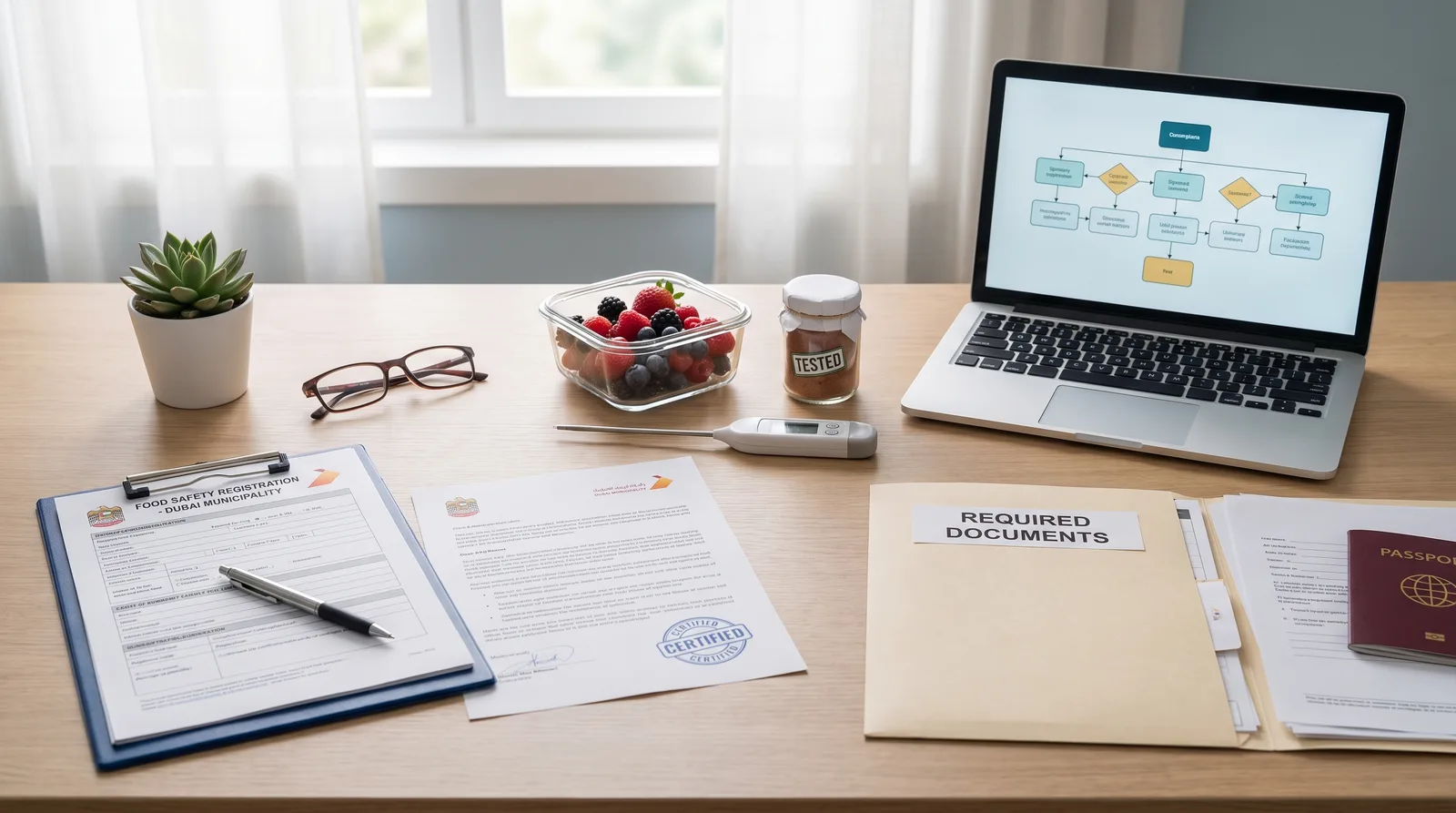
Topic Summary
What Food Safety Registration in Dubai Means and Who Needs It
Food safety registration in Dubai is a mandatory approval issued by Dubai Municipality's Food Safety Department that authorises a food business to prepare, handle, store, or sell food to the public. It applies to restaurants, cafes, food manufacturers, caterers, and any business
Food Safety Dubai Requirements: Documents and Eligibility
To complete food safety registration in Dubai you need a valid trade license, a tenancy contract or NOC for the premises, an approved fit-out layout, food handler medical certificates, and a HACCP-based food safety management plan. Dubai Municipality reviews all documents before
How Your Free Zone License Fits into Food Safety Registration
A Dubai free zone trade license covers company formation and authorises the food activity on paper. Dubai Municipality's Food Safety Department then approves the physical operation through a separate application. Both approvals must be in place before you serve, handle, or distri
Step-by-Step Guide to Food Safety Registration in Dubai
Food safety registration in Dubai follows six ordered steps: secure your free zone trade license, register on the Dubai Municipality Food Safety portal, submit premises documents and fit-out plans, pass the technical review, complete the physical inspection, and collect your Food
Costs Involved in Food Safety Registration in Dubai
Food safety registration costs in Dubai cover the Municipality application fee, any fit-out works needed to meet standards, HACCP plan preparation, food handler medical testing, and annual renewal fees. The Municipality fee varies by establishment type and size. Free zone license
Keeping Your Food Safety Registration Valid After Launch
Once issued, a Dubai Municipality food safety registration must be renewed annually and the premises must pass periodic inspections. Maintaining valid medical certificates for all food handlers, keeping HACCP records updated, and reporting any significant menu or premises changes
Every food business operating in Dubai clears two distinct approval gates before serving a single customer. The first is a trade license. The second is a food safety registration certificate from Dubai Municipality's Food Safety Department, issued under Law No. 8 of 2019 (u.ae, 2024). Skip that second gate and your fit-out spend, your stock order, and your opening date sit idle. Food safety registration dubai is a condition of opening, not a formality you sort out afterwards.
This guide walks first-time founders through the exact food safety dubai requirements, the realistic costs involved, and a plain-language step-by-step process covering both the free zone license and the Dubai Municipality approval you need to operate legally.
What Food Safety Registration in Dubai Means and Who Needs It
Food safety registration in Dubai is a mandatory approval issued by Dubai Municipality's Food Safety Department that authorises a food business to prepare, handle, store, or sell food to the public. It applies to restaurants, cafes, food manufacturers, caterers, and any business where food contact occurs, and it runs alongside your trade license.
The Regulator Behind the Approval
Dubai Municipality's Food Safety Department is the named authority that inspects and approves all food-related premises across Dubai. It operates under the Food Safety Law (Law No. 8 of 2019), which consolidated all prior food-related regulations into a single legislative framework (u.ae, 2024).
That approval is entirely separate from any free zone or mainland trade license. A cloud kitchen operator who secures a free zone trade license but skips the Dubai Municipality food safety inspection cannot legally accept a single delivery order. The license and the approval are two distinct gates, and both must be open before you trade.
Business Types That Must Register
The food safety dubai requirements apply broadly. If your business activities involve food at any point in the chain, registration is mandatory. That includes:
Restaurants, cafes, and quick-service outlets (dine-in or takeaway)
Food manufacturers and packagers supplying retail or wholesale markets
Catering companies, food delivery kitchens, and meal-prep services
Supermarkets, grocery stores, and food importers or distributors
Any free zone company whose operations involve food handling, processing, or distribution
Online food businesses are classified by the nature of the food activity, not the sales channel. A founder setting up a specialty coffee roastery under a free zone license still needs Dubai Municipality food safety approval before roasting, packaging, or selling a single bag. Coverage extends to both B2C and B2B supply chains.
Food Safety Dubai Requirements: Documents and Eligibility
To complete food safety registration in Dubai you need a valid trade license, a tenancy contract or NOC for the premises, an approved fit-out layout, food handler medical certificates, and a HACCP-based food safety management plan. Dubai Municipality reviews all documents before scheduling a physical premises inspection.
Free Zone License vs. Dubai Municipality Food Safety Approval: What Each Covers
Feature | Free Zone Trade License | Dubai Municipality Food Safety Certificate |
|---|---|---|
Issuing authority | Dubai South Business Hub Free Zone | Dubai Municipality Food Safety Department |
What it approves | Legal entity formation and permitted business activities | Physical premises and operational food safety standards |
Issuance timeline | Issued in 1 day | Varies by submission completeness and inspection scheduling |
Cost | Packages from AED 12,500 | Fee based on establishment category (UNVERIFIED: . Confirm before publishing.) |
Renewal frequency | Annual renewal with the free zone | Annual renewal, align with license renewal date to avoid gaps |
Sequence | Required first, becomes a supporting document for the Municipality application | Required before serving, handling, or distributing food commercially |
Core Documents the Municipality Requires
The food safety dubai requirements checklist is specific. Missing a single item triggers a rejection and resets your timeline. You'll need:
Valid trade license showing a food-related activity (must be issued before the Municipality application opens)
Tenancy contract, Ejari-registered for mainland premises, or a lease agreement plus NOC for free zone premises
Approved architectural drawings showing kitchen layout, ventilation, drainage, and designated food zones
HACCP (Hazard Analysis and Critical Control Points) Food Safety Management Plan documenting hazards, critical control points, and corrective actions
Medical fitness certificates for all food handlers, issued by a DHA-accredited centre and renewed annually
A cafe founder who submits drawings without ventilation specifications will receive a technical rejection and must resubmit revised plans, adding two to three weeks to the timeline. Getting the drawings right before submission is the single most effective way to protect your launch date.
Premises and Fit-Out Standards
The physical space must meet specific construction standards before an inspector arrives. Key requirements include:
Non-porous, washable, food-grade surfaces (ceramic tiles or stainless steel are standard)
Separate storage zones for raw and ready-to-eat foods, with cold storage at 4°C or below for chilled items and -18°C or below for frozen goods (u.ae, 2024)
Covered waste bins and a designated disposal route shown on the fit-out plan
Dedicated hand-washing stations, not shared with food preparation sinks, positioned at entry points to food handling areas
A commissary kitchen that installs shared prep-and-wash sinks typically fails the initial inspection and must retrofit dedicated hand-wash units before re-inspection is booked. Dubai Municipality publishes fit-out guidelines on its portal, reviewing these before engaging a fit-out contractor saves significant time and rework costs.
How Your Free Zone License Fits into Food Safety Registration
A Dubai free zone trade license covers company formation and authorises the food activity on paper. Dubai Municipality's Food Safety Department then approves the physical operation through a separate application. Both approvals must be in place before you serve, handle, or distribute food commercially. Neither replaces the other.
What the Free Zone License Covers
The free zone license establishes your legal entity, lists your permitted business activities, and satisfies the Companies Registry requirement. At Dubai South Business Hub Free Zone, the license is issued in one day and includes the Articles of Association, share register, flexi-desk space, and lease agreement.
Pricing is straightforward. The 0 Visa Package is AED 12,500. The 1 Visa Package is AED 16,350 and adds a visa allocation (the investor or partner visa) plus an establishment card. The 2 Visa Package is AED 18,200 and adds two visa allocations and the establishment card. Visa processing, entry permit, status change, medical, Emirates ID, and visa stamping, is quoted separately for all packages.
A founder setting up a company for a meal-prep delivery brand receives the free zone license on day one, then moves immediately into the Municipality application with that license as a supporting document. The license is the first gate. The Municipality food safety approval is the second gate.
Why the Municipality Approval Is Separate
Dubai Municipality has jurisdiction over public health and food safety standards across all of Dubai, regardless of whether the business is free zone or mainland. Dubai South Business Hub licenses the activity; Dubai Municipality approves the safe operation of that activity at the premises level.
Think of it this way: the free zone license is your driving license, it proves you're authorised. The Municipality food safety certificate is the roadworthiness certificate on the vehicle, it proves the premises are safe to operate. Both must be current. Non-compliance can result in immediate closure orders and financial penalties, so aligning renewal dates for both documents is worth planning from the start (moet.gov.ae, 2024).
Is the food safety certificate required for free zone companies?
Yes. Dubai Municipality's jurisdiction covers all food-related premises in Dubai, including those operated by free zone companies. A free zone trade license authorises the business activity on paper, but the Municipality certificate is required before any food handling, preparation, or distribution begins at the physical premises.
Step-by-Step Guide to Food Safety Registration in Dubai
Food safety registration in Dubai follows six ordered steps: secure your free zone trade license, register on the Dubai Municipality Food Safety portal, submit premises documents and fit-out plans, pass the technical review, complete the physical inspection, and collect your Food Safety Registration certificate. Each step must clear before the next opens.
The Six Registration Steps
Step 1: Obtain your free zone trade license with a food-related activity listed. This is the foundational document for all subsequent applications.
Step 2: Create a business account on the Dubai Municipality Food Safety portal (food.dm.gov.ae) and select the correct establishment category. Portal registration is mandatory, walk-in applications are not accepted.
Step 3: Upload all required documents: trade license, tenancy contract or NOC, approved fit-out drawings, HACCP plan, and food handler medical certificates.
Step 4: Pay the application fee. Dubai Municipality charges based on establishment type and size (UNVERIFIED:
. Confirm before publishing.).
Step 5: Await the technical review. The Municipality team checks document completeness and fit-out plan compliance before scheduling an inspection. Inspection results are graded; a score below the passing threshold triggers a re-inspection cycle.
Step 6: Pass the physical inspection and collect your Food Safety Registration certificate.
A restaurant group opening a second Dubai outlet can pre-submit fit-out drawings through the portal before the physical space is complete, reducing the gap between fit-out sign-off and inspection booking. That kind of parallel processing is worth building into your project timeline from day one.
Build Your HACCP Plan Before You Apply
HACCP (Hazard Analysis and Critical Control Points) is not a form you fill in, it is a written food safety management system tailored to your specific menu, processes, and premises. It must identify every hazard (biological, chemical, physical) at each stage of food handling and set critical control points with measurable limits. Corrective actions, monitoring procedures, and record-keeping requirements must all be documented, and staff must be trained on them.
The Municipality reviewer will reject a generic template. A catering company serving corporate events needs a HACCP plan that covers off-site transport temperature controls, not just kitchen preparation, a detail generic templates routinely miss. Hiring a certified food safety consultant to build the plan is common for first-time founders; confirm current consultant fees locally before budgeting. HACCP is mandated under Dubai Food Safety Law No. 8 of 2019, and staff training records tied to the plan are checked during inspection (u.ae, 2024).
Costs Involved in Food Safety Registration in Dubai
Food safety registration costs in Dubai cover the Municipality application fee, any fit-out works needed to meet standards, HACCP plan preparation, food handler medical testing, and annual renewal fees. The Municipality fee varies by establishment type and size. Free zone license costs start at AED 12,500 and are a separate line item.
Municipality Fees and Recurring Costs
The food safety dubai requirements carry real costs beyond the license itself. Key fee categories include:
Registration fee based on establishment category, small cafe, restaurant, manufacturer, and distributor each sit in different fee bands (UNVERIFIED:
. Confirm before publishing.)
Annual renewal fee, comparable to the initial registration, due before the license renewal date
Re-inspection fees if the first physical inspection results in a fail
Food handler medical certificates at approximately AED 120 to AED 250 per person at DHA-accredited centres, renewed yearly (UNVERIFIED:
. Confirm before publishing.)
A ten-person kitchen team renewing medical certificates annually adds roughly AED 1,200 to AED 2,500 to the yearly compliance budget. That figure is worth including in your operating cost model from day one. Penalties for operating without a valid Food Safety certificate can exceed AED 10,000 (UNVERIFIED:
. Confirm before publishing.), so lapsed renewals carry real financial risk.
Free Zone License Costs Alongside Municipality Fees
The free zone trade license is a distinct cost from the Municipality registration fee, both are required and neither covers the other. At Dubai South Business Hub Free Zone, the packages are: 0 Visa Package at AED 12,500, 1 Visa Package at AED 16,350, and 2 Visa Package at AED 18,200. Every package includes the license, Articles of Association, share register, flexi-desk space, and lease agreement. The 1 and 2 Visa packages add the visa allocation and establishment card.
A solo founder launching a food consultancy under the 1 Visa Package at AED 16,350 would then budget separately for the Municipality application fee and HACCP plan preparation on top of that figure. Use a business setup cost calculator to model your total first-year outlay including both the license and anticipated Municipality costs. Visa processing, entry permit, status change, medical, Emirates ID, and stamping, is always an additional line item quoted separately.
Keeping Your Food Safety Registration Valid After Launch
Once issued, a Dubai Municipality food safety registration must be renewed annually and the premises must pass periodic inspections. Maintaining valid medical certificates for all food handlers, keeping HACCP records updated, and reporting any significant menu or premises changes to the Municipality are the core ongoing obligations for food businesses.
Annual Renewal and Inspection Cycles
The Food Safety certificate renews on the same cycle as the trade license. Aligning both renewal dates avoids the risk of operating with a lapsed certificate while the other document is still current.
Unannounced inspections are a standard feature of the Dubai Municipality food safety system, separate from the scheduled renewal inspection. Premises must be inspection-ready at all times, not just in the weeks before a renewal. Inspection scores are published and publicly accessible through the Municipality's Smart Dubai platforms, a high score builds credibility with customers and reduces enforcement risk.
Any change to the menu, kitchen layout, or food handling processes that alters your HACCP plan must be reported to the Municipality before implementation. A restaurant that expands its menu to include raw fish preparations (sushi, ceviche) must update its HACCP plan and notify the Municipality before serving those items.
References
Frequently Asked Questions