Working for a Foreign Employer While Living in Dubai: Freelance Permit or Company?

Topic Summary
What Does It Mean to Work for Foreign Company While Living in Dubai?
To work for foreign company while living in Dubai, you need residency plus a contract structure. There are three routes: a remote work visa where you stay an employee, a contractor arrangement, or your own free zone company that invoices the employer. Each differs in tax, risk, cost and family sponsorship.
Which Remote Work Visa Dubai Route Keeps You on Payroll?
Which Remote Work Visa Dubai Route Keeps You on Payroll?
Can You Be a Contractor for a Foreign Employer Without a Company?
Being a contractor for foreign employer UAE means you invoice as a self-employed supplier instead of drawing a salary. It adds flexibility but shifts benefits and compliance onto you. It also raises misclassification risk if the arrangement looks like employment.
Why Invoice Your Employer Through Your Own Free Zone Company?
Invoicing through your own free zone company separates you from your employer's payroll. It gives you a UAE legal entity, a trade license and a residency basis. Dubai South Business Hub licenses start from AED 12,500 with flexi-desk, up to 5 activity groups, same-day license for eligible applicants and instant IBAN (T&Cs apply).
How Does Each Route Affect Your Employer's PE and Payroll Risk?
A foreign employer whose employee works from Dubai may face PE, payroll registration and social security questions. A contractor or company structure usually reduces payroll exposure but still needs genuine independence. Employers should take tax advice, because outcomes depend on contract terms and home-country law.
How Do You Choose and Set Up Your Route in 5 Steps?
Choose in five steps: confirm your employer's position, check tax residency, compare costs, pick the structure, then apply for residency. This order avoids rework, because employer consent and tax position decide which structure is viable.
How Do Tax, Cost and Family Sponsorship Compare?
Tax residency, cost and family sponsorship vary by route. Employees keep home payroll but may face home-country tax ties. Company owners pay license and compliance costs but gain a UAE entity and visa sponsorship. Check ICP and your home tax authority, because thresholds change.
What Does It Mean to Work for Foreign Company While Living in Dubai?
Which Remote Work Visa Dubai Route Keeps You on Payroll?
Can You Be a Contractor for a Foreign Employer Without a Company?
Why Invoice Your Employer Through Your Own Free Zone Company?
How Does Each Route Affect Your Employer's PE and Payroll Risk?
How Do You Choose and Set Up Your Route in 5 Steps?
How Do Tax, Cost and Family Sponsorship Compare?
What Is the Best Way to Work for Foreign Company While Living in Dubai?
To work for foreign company while living in Dubai, you need a UAE residency basis and a clear contract structure. UAE corporate tax is 9% above AED 375,000 of profit (Ministry of Finance, 2023) [1]. Dubai South Business Hub licenses start from AED 12,500 (T&Cs apply). This guide is for remote employees choosing between three routes and shows what each means for risk, tax, cost and family.
What Does It Mean to Work for Foreign Company While Living in Dubai?
To work for foreign company while living in Dubai, you need residency plus a contract structure. There are three routes: a remote work visa where you stay an employee, a contractor arrangement, or your own free zone company that invoices the employer. Each differs in tax, risk, cost and family sponsorship.
Why Residency and Work Authorisation Are Separate Questions
Residency lets you live in the UAE. Your contract decides who you work for and how you're paid. A foreign employer without a UAE entity can't normally sponsor a UAE employment visa, so the two questions need separate answers. Confirm current rules with ICP and MoHRE before committing.
Picture a London-based software engineer who moves to Dubai and keeps her UK employer. Her residency route and contract route are decided separately. Many applicants handle the license side online, since over 70% of new free zone applications are processed that way. This is the core of residency for remote employees UAE.
The Three Routes at a Glance
Route 1: remote work visa, you stay an employee.
Route 2: contractor for foreign employer UAE, you become a self-employed supplier.
Route 3: your own free zone company invoices the employer.
Which Remote Work Visa Dubai Route Keeps You on Payroll?
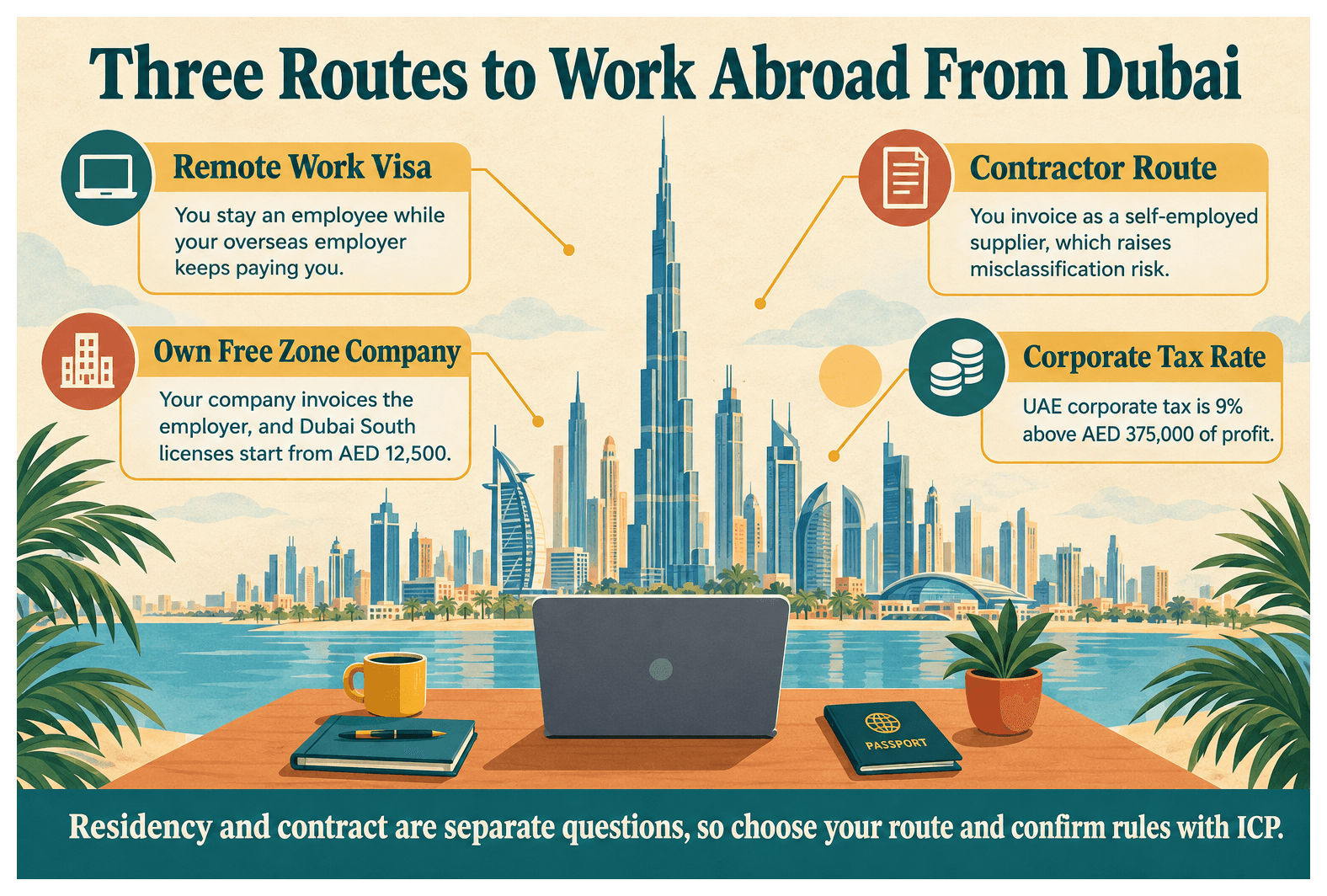
The remote work visa Dubai route lets you live in the UAE while your overseas employer keeps paying you as an employee. It suits people who want no contract change. The trade-off is that your employer carries payroll, tax and permanent establishment (PE) questions in your new location.
How the Employee-Stay Model Works
Contract and payroll stay with the foreign employer. Check eligibility and proof-of-employment requirements on official ICP channels, and don't rely on income thresholds quoted in forums. Our guide on the remote work and UAE work visa question covers the difference in depth.
Take a marketing manager employed by a German firm. She relocates and keeps her salary and benefits.
Who Benefits Most and Where It Falls Short
Best if you want zero contract change.
Weak if you want other clients.
Needs written employer consent.
Can You Be a Contractor for a Foreign Employer Without a Company?
Being a contractor for foreign employer UAE means you invoice as a self-employed supplier instead of drawing a salary. It adds flexibility but shifts benefits and compliance onto you. It also raises misclassification risk if the arrangement looks like employment.
What Changes When You Move From Employee to Contractor
You lose employer-paid leave and pension.
You handle your own invoicing.
Your rate must cover lost benefits.
A product designer leaving a salaried US role should re-price a monthly retainer for exactly this reason.
Misclassification Risk for the Employer
Fixed hours, exclusivity and employer-controlled tools can make a contractor look like an employee. A full-time, single-client contractor on an indefinite agreement is the classic case. Employers should review local and home-country rules, and our note on contractor versus employee differences explains the tests.
Why Many Contractors End Up Needing a Licensed Entity
Finance teams and banks often prefer invoices from a licensed company with a tax registration number. When you weigh freelance permit vs company Dubai, that invoicing expectation often decides it.
Why Invoice Your Employer Through Your Own Free Zone Company?
Invoicing through your own free zone company separates you from your employer's payroll. It gives you a UAE legal entity, a trade license and a residency basis. Dubai South Business Hub licenses start from AED 12,500 with flexi-desk, up to 5 activity groups, same-day license for eligible applicants and instant IBAN (T&Cs apply).
What a Dubai South Business Hub License Includes
Flexi-desk and up to 5 activity groups.
Instant IBAN for client payments.
Residency visa packages tied to the license.
This isn't "tax free". Corporate tax rules still apply, and the Federal Tax Authority sets registration duties.
Invoicing Overseas Clients Legally
Invoices need correct entity details, currency and, where required, a tax registration number. A founder billing a UK employer should read our guide on how to invoice UK clients legally.
Setting Up Without Flying In
Many applicants form the company online before relocating. See setting up a Dubai company while living abroad, and check conditions in holding a Dubai license while employed elsewhere.
How Does Each Route Affect Your Employer's PE and Payroll Risk?
A foreign employer whose employee works from Dubai may face PE, payroll registration and social security questions. A contractor or company structure usually reduces payroll exposure but still needs genuine independence. Employers should take tax advice, because outcomes depend on contract terms and home-country law.
PE Risk When You Stay an Employee
A sales director in Dubai who negotiates and signs deals for a European employer can create PE exposure. Employers should assess payroll and social security duties early. This isn't legal advice, so get professional input.
How Contractor and Company Structures Reduce Exposure
Independent supplier status limits payroll duties.
Substance and independence still matter.
Use a written services agreement with scope, fees and no exclusivity.
Decision Table: Remote Work Visa vs Contractor vs Own Free Zone Company
Feature | Stay an Employee (Remote Work Visa) | Own Free Zone Company (Invoice Employer) |
|---|---|---|
Employer PE and payroll risk | Highest: employer must assess payroll and PE for a Dubai-based employee. | Lower: supplier relationship, if the services agreement shows real independence. |
Tax residency considerations | Personal position depends on home-country exit rules; no company tax filing. | Company faces 9% corporate tax above AED 375,000 profit; home-country ties still checked. |
Cost and setup | No license cost; individual application and proof requirements. | License from AED 12,500 plus visa and accounting costs. |
Family sponsorship | Depends on residency category; verify with ICP. | Company-linked residency visa packages; verify conditions with ICP. |
Flexibility for other clients | Limited; employer policy usually restricts side work. | High: up to 5 activity groups and multiple clients. |
What Employers Should Ask Before Approving the Move
Does policy and insurance cover the new country?
Has tax and data protection been reviewed?
Is a services agreement needed?
HR teams can use managing remote employees from a UAE company as a starting checklist.
How Do You Choose and Set Up Your Route in 5 Steps?
Choose in five steps: confirm your employer's position, check tax residency, compare costs, pick the structure, then apply for residency. This order avoids rework, because employer consent and tax position decide which structure is viable.
Step 1: Confirm your employer's position and get approval in writing.
Step 2: Check tax residency. A UK national should review the statutory residence test.
Step 3: Compare costs with the Dubai South cost calculator, including license, visa, Emirates ID, medical and insurance.
Step 4: Select the structure, sign the services agreement and form the company if invoicing.
Step 5: Apply for residency through ICP channels.
How Do Tax, Cost and Family Sponsorship Compare?
Tax residency, cost and family sponsorship vary by route. Employees keep home payroll but may face home-country tax ties. Company owners pay license and compliance costs but gain a UAE entity and visa sponsorship. Check ICP and your home tax authority, because thresholds change.
Is Residency for Remote Employees UAE Enough to Stop Home Taxes?
Not always. A US citizen stays taxable on worldwide income despite UAE residency. Companies also pay 9% corporate tax above AED 375,000 (Ministry of Finance, 2023). Take adviser input before you move.
Cost and Family Sponsorship
Remote visa: individual costs and proof requirements.
Company: license from AED 12,500 plus visas.
Sponsoring a spouse and two children depends on category; verify with ICP.
The profiles are simple. Single-employer employees fit the remote visa. Single-client contractors need clean contracts. Multi-client consultants fit a company.
What Is the Best Way to Work for Foreign Company While Living in Dubai?
The best way to work for foreign company while living in Dubai depends on your employer and goals. Stay an employee for simplicity, or use your own free zone company for flexibility, multiple clients and sponsorship. Confirm rules with ICP and MoHRE.
One employer, no change: remote work visa.
Growing client base: company route.
Mixed: start as a contractor, then upgrade.
Ready to price it? Use the Dubai South cost calculator or contact the Dubai South Business Hub team to start your license and residency application.
References
Frequently Asked Questions