
Topic Summary
What Is a Free Trade Zone and Why Does It Matter?
A free trade zone is a designated UAE area where companies get 100% foreign ownership, simplified setup and favourable customs and tax treatment. For traders, that means easier import and export, no local sponsor and warehousing close to ports and airports.
What Are the Main Free Trade Zone Benefits Dubai Traders Get?
What Are the Main Free Trade Zone Benefits Dubai Traders Get?
How Do Free Zone Tax Benefits Work for Traders?
Free zone tax benefits in the UAE depend on qualifying status. A Qualifying Free Zone Person may access 0% corporate tax on qualifying income, while other income is taxed at 9%. VAT and substance rules still apply, so free zone companies are not tax-free.
Free Zone vs Mainland Dubai: Which Is Better for Traders?
A free zone suits import, export, re-export and regional distribution. Mainland suits direct sales to UAE consumers and businesses. Your sales channel should decide.
How Do You Set Up a Free Zone Trading Company Step by Step?
Choose your activities, pick a license package, submit shareholder documents, pay fees, receive your license, then apply for visas and open a bank account. Fees and requirements may vary, so check the official source before applying.
How Do Free Zone Traders Handle Customs and Movement of Goods?
Register with customs, get an import-export code and declare goods through Dubai Customs systems such as Mirsal 2. Goods moving between a free zone and mainland generally need customs documents and duty treatment. Confirm procedures with Dubai Customs first.
Which Setup Delivers the Free Trade Zone Benefits Dubai Traders Want?
It depends on your product, storage needs and sales channel. Dubai South Business Hub Free Zone suits importers, exporters and re-exporters wanting trading licenses, airport access and warehousing.
In 2026, the UAE has more than 40 active free zones licensing businesses from over 100 countries (UAE Government Portal, 2024). The free trade zone benefits Dubai traders use most are 100% foreign ownership, simple licensing and warehousing near ports and airports. This guide is for entrepreneurs, logistics operators and investors planning a trading or cold chain business. Fees and requirements may vary, so check the official source before applying.
What Is a Free Trade Zone and Why Does It Matter?
A free trade zone is a designated UAE area where companies get 100% foreign ownership, simplified setup and favourable customs and tax treatment. For traders, that means easier import and export, no local sponsor and warehousing close to ports and airports.
How a Free Zone Is Defined and Regulated
Think of a free zone as a legally separate commercial area with its own licensing authority. Each zone issues licenses under federal UAE law. Picture an electronics importer: instead of hunting for a UAE national sponsor, they license directly in the zone. Read more on what a free zone actually is in Dubai.
Why Traders Gravitate Toward Free Zones
Digital setup is quick, and logistics sit nearby. UAE non-oil trade exceeds AED 2.2 trillion a year (Dubai Trade, 2024). A re-export business storing stock near Al Maktoum International Airport shortens every handover. That is the core of the benefits of free zones in Dubai.
What Are the Main Free Trade Zone Benefits Dubai Traders Get?
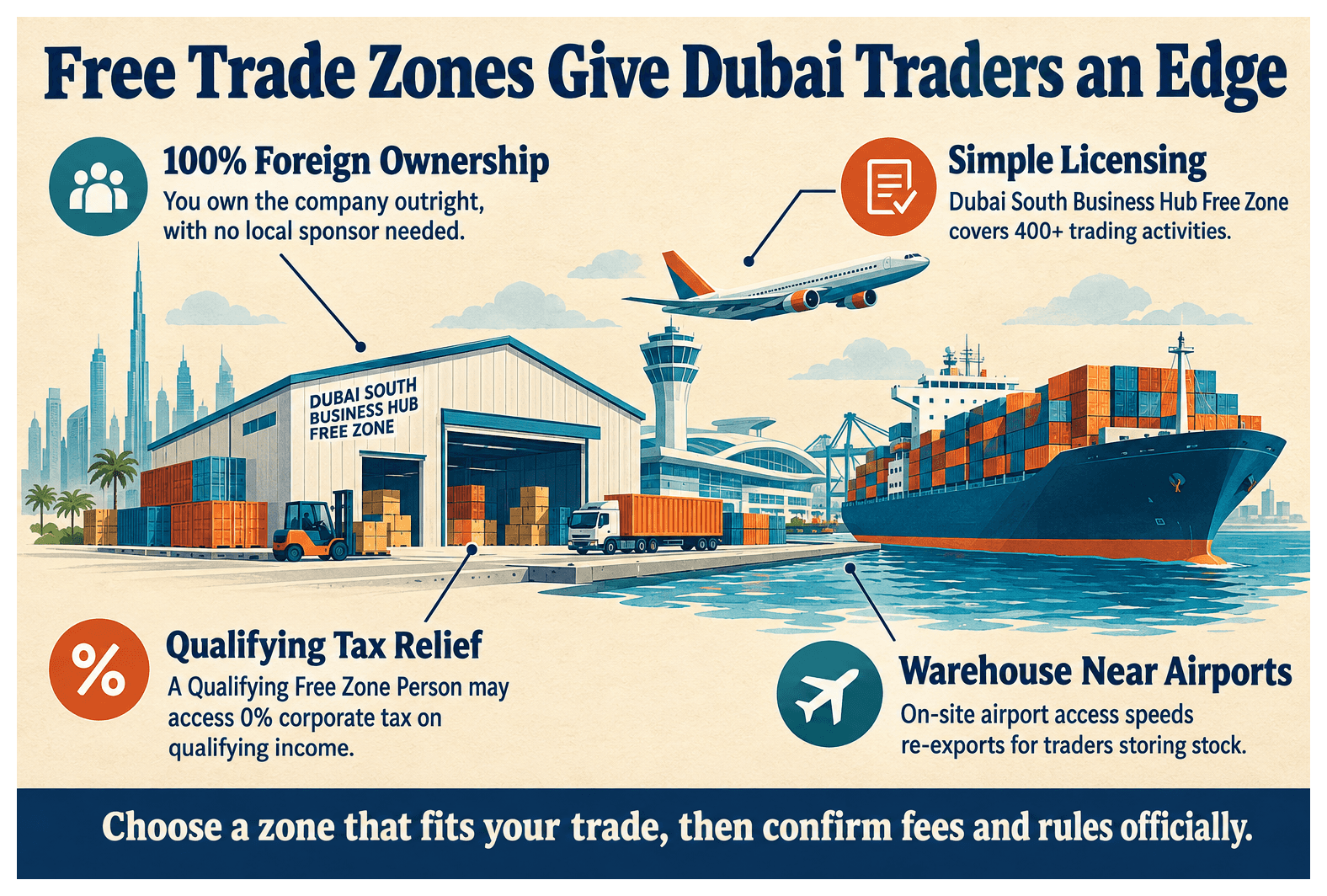
The main free trade zone benefits Dubai traders get are 100% foreign ownership, simplified licensing, qualifying corporate tax relief, flexible warehousing and easier international market access. Together they cut setup friction, so you can scale without a local partner, subject to each zone's rules.
100% Foreign Ownership and Full Profit Control
You own the company outright.
Foreign ownership is a baseline right in every zone.
Profit repatriation is straightforward, subject to compliance.
An overseas investor can hold 100% of a trading company. See free zone company foreign ownership in Dubai.
Simplified Licensing and Visa Options
Dubai South Business Hub Free Zone covers 400+ trading activities.
Residency visa packages attach to your license.
Base licensing starts from AED 12,500 (confirm the current rate).
Logistics and Warehousing Advantages
On-site airport access speeds re-exports.
Over 40% of new 2026 registrations need space beyond a flexi-desk.
A warehouse can replace an office entirely.
An FMCG trader storing stock for GCC distribution is a typical case.
How Do Free Zone Tax Benefits Work for Traders?
Free zone tax benefits in the UAE depend on qualifying status. A Qualifying Free Zone Person may access 0% corporate tax on qualifying income, while other income is taxed at 9%. VAT and substance rules still apply, so free zone companies are not tax-free.
Corporate Tax and Qualifying Free Zone Person Status
A Qualifying Free Zone Person is a free zone company meeting set conditions, including real presence in the zone. The standard rate is 9% (Ministry of Finance, 2023). Picture a trader with export income plus mainland sales: the two may be taxed differently. Confirm your activity qualifies, and see whether a free zone trader pays corporate tax on profits.
Free Zone vs Mainland Dubai for Traders
Feature | Free Zone | Mainland |
|---|---|---|
Foreign ownership | 100% as standard, no sponsor | Also widely available, depends on activity |
Local market access | Indirect, via distributor or dual license | Direct sales to UAE customers |
Setup speed and process | Digital, single-authority process | More approvals, often more steps |
Corporate tax treatment | 0% on qualifying income, 9% on the rest | 9% standard rate |
Warehousing and logistics | On-site units near airport and ports | Leased from separate landlords |
VAT, Registration and Compliance With the FTA
The Federal Tax Authority (FTA) handles VAT and tax registration.
VAT is 5% (confirm with the FTA).
Designated zones may have special goods treatment.
Keep records. File on time.
A trading company registers for VAT once it crosses the threshold. Read tax benefits for Dubai free zone companies.
Free Zone vs Mainland Dubai: Which Is Better for Traders?
A free zone suits import, export, re-export and regional distribution. Mainland suits direct sales to UAE consumers and businesses. Your sales channel should decide.
Side-by-Side Comparison
The table above covers the differences. Over 40,000 new licenses are expected across Dubai in 2026 (Dubai Chamber, 2025). Rules vary, so verify with the licensing authority. A distributor selling to UAE retailers may lean mainland. Our guide on free zone vs mainland for a trading company goes further.
How to Sell Into the UAE Market From a Free Zone
You can appoint a mainland distributor or add a dual license. Mainland sales trigger customs and VAT steps. Choose by activity, location and cost.
How Do You Set Up a Free Zone Trading Company Step by Step?
Choose your activities, pick a license package, submit shareholder documents, pay fees, receive your license, then apply for visas and open a bank account. Fees and requirements may vary, so check the official source before applying.
Step-by-Step Setup Process
Define your trade activities and import-export scope.
Choose a license and space: flexi-desk, office or warehouse.
Submit your application and documents.
Pay fees and receive the trade license.
Apply for residency visas and open a corporate bank account.
Base licensing starts from AED 12,500. See how to get a trading license in a Dubai free zone.
Documents Checklist
Shareholder and manager passport copies
Passport photos and proof of address
Business plan or activity details
Extra approvals for regulated goods, such as food
Practical Tip: Common Setup Mistakes
Picking too few activities, forcing a later amendment.
Ignoring warehouse needs until after licensing.
Skipping a tax and VAT plan.
How Do Free Zone Traders Handle Customs and Movement of Goods?
Register with customs, get an import-export code and declare goods through Dubai Customs systems such as Mirsal 2. Goods moving between a free zone and mainland generally need customs documents and duty treatment. Confirm procedures with Dubai Customs first.
Customs Registration and Declarations
Mirsal 2 is Dubai Customs' online declaration system. You use your importer code to declare each container. Our guide on setting up a trading, importing and exporting business in Dubai covers the basics.
Moving Goods Between Free Zone and Mainland
Shipping stock to a mainland retailer raises duty and VAT questions. Regulated goods need product compliance approvals. Keep every document for audit.
Which Setup Delivers the Free Trade Zone Benefits Dubai Traders Want?
It depends on your product, storage needs and sales channel. Dubai South Business Hub Free Zone suits importers, exporters and re-exporters wanting trading licenses, airport access and warehousing.
Matching Activities and Space to Your Model
Choose a flexi-desk, office or warehouse.
Check coverage across 400+ activities.
Plan visa quota against team size.
A small importer can start with a flexi-desk, then add warehouse space.
Why Dubai South Business Hub Free Zone
You get on-site Al Maktoum Airport access, digital setup and 100% foreign ownership. China holds about 14% of global merchandise exports (World Bank, 2024), so a Chinese exporter can base a trading entity with warehousing here.
Summary and Next Step
The free trade zone benefits Dubai traders can access include full ownership, simpler licensing, qualifying tax relief and strong logistics. FTA, Dubai Customs and Ministry of Finance rules still apply. List your products, target markets and storage needs, then speak to Dubai South Business Hub Free Zone about the right trading license and visa package.
Rules in the UAE change often. Always verify the latest requirements with the official authority before taking action.
References
Frequently Asked Questions