
Topic Summary
What Is the Right Choice in the Free Zone vs Mainland LLC 2026 Decision?
A free zone company suits businesses serving international clients or trading from within a zone. A mainland LLC suits businesses that sell directly across the UAE market. The right choice depends on who your customers are, not on price alone.
Who Are Your Customers and Do You Need Mainland Trading Rights?
Who Are Your Customers and Do You Need Mainland Trading Rights?
How Does Corporate Tax and QFZP Status Affect Your Structure?
A free zone company may qualify for a favourable corporate tax rate only if it meets Qualifying Free Zone Person (QFZP) conditions and earns qualifying income. Mainland LLCs fall under the standard regime. Neither route is tax free, so confirm your position with the Federal Tax Authority as of 2026.
How Do Visas, Office Space and Costs Compare Between the Two?
Free zone companies typically bundle a license with a residency visa package and flexible office options. Mainland LLCs usually require leased premises and follow different visa allocation rules. Compare total first-year cost, not just the license fee, and confirm figures with each authority as of 2026.
Can You Convert Later and What Does the Conversion Path Look Like?
A free zone license can't be converted in place. Founders typically set up a new mainland LLC and close or keep the free zone entity. Planning early avoids duplicated costs, so confirm current procedures with the relevant authorities as of 2026.
What Steps Should You Follow to Decide Between Free Zone and Mainland?
Decide in five steps: define customers, check trading needs, model tax and QFZP effects, compare visas, office and total cost, then confirm the license and conversion path with the authorities. This order keeps the decision tied to how you earn revenue.
Which Mistakes Should Founders Avoid When Choosing a Structure?
Common mistakes include choosing on license price alone, ignoring where customers are, assuming a free zone is tax free, overlooking visa and office needs, and forgetting that conversion means a new setup. Test each factor against your real revenue plan.
What Is the Right Choice in the Free Zone vs Mainland LLC 2026 Decision?
A free zone company suits businesses serving international clients or trading from within a zone. A mainland LLC suits businesses that sell directly across the UAE market. The right choice depends on who your customers are, not on price alone.
Direct Answer for Founders in a Hurry
Dubai has more than 30 free zones next to its mainland system (u.ae, 2026), so the free zone vs mainland LLC 2026 question comes up for nearly every founder. Picture a consultant billing overseas clients and a retailer selling to Dubai shoppers. The first fits a free zone. The second usually needs the mainland. Rules apply as of 2026, so confirm details with the licensing authority before you commit.
At-a-Glance Summary of the Two Structures
Take a two-founder services startup weighing both routes. A free zone company usually serves overseas and zone-based customers, offers a residency visa package tied to its license, and can run from a flexible office. It may qualify for a favourable corporate tax rate if it meets Qualifying Free Zone Person conditions. A mainland LLC trades directly with UAE customers, normally needs leased premises, and falls under the standard tax regime. Conversion is a new setup, not an in-place change. For a wider view, read our free zone vs mainland Dubai full comparison.
How an LLC in Dubai Is Structured
A mainland LLC is a limited liability company licensed by Dubai's Department of Economic Development (DET). Picture a trading LLC with a local shop or warehouse. A free zone company is licensed by the zone authority instead, and the free zone side here is Dubai South Business Hub Free Zone. Our LLC structure and trade license guide covers the mechanics.
Who Are Your Customers and Do You Need Mainland Trading Rights?
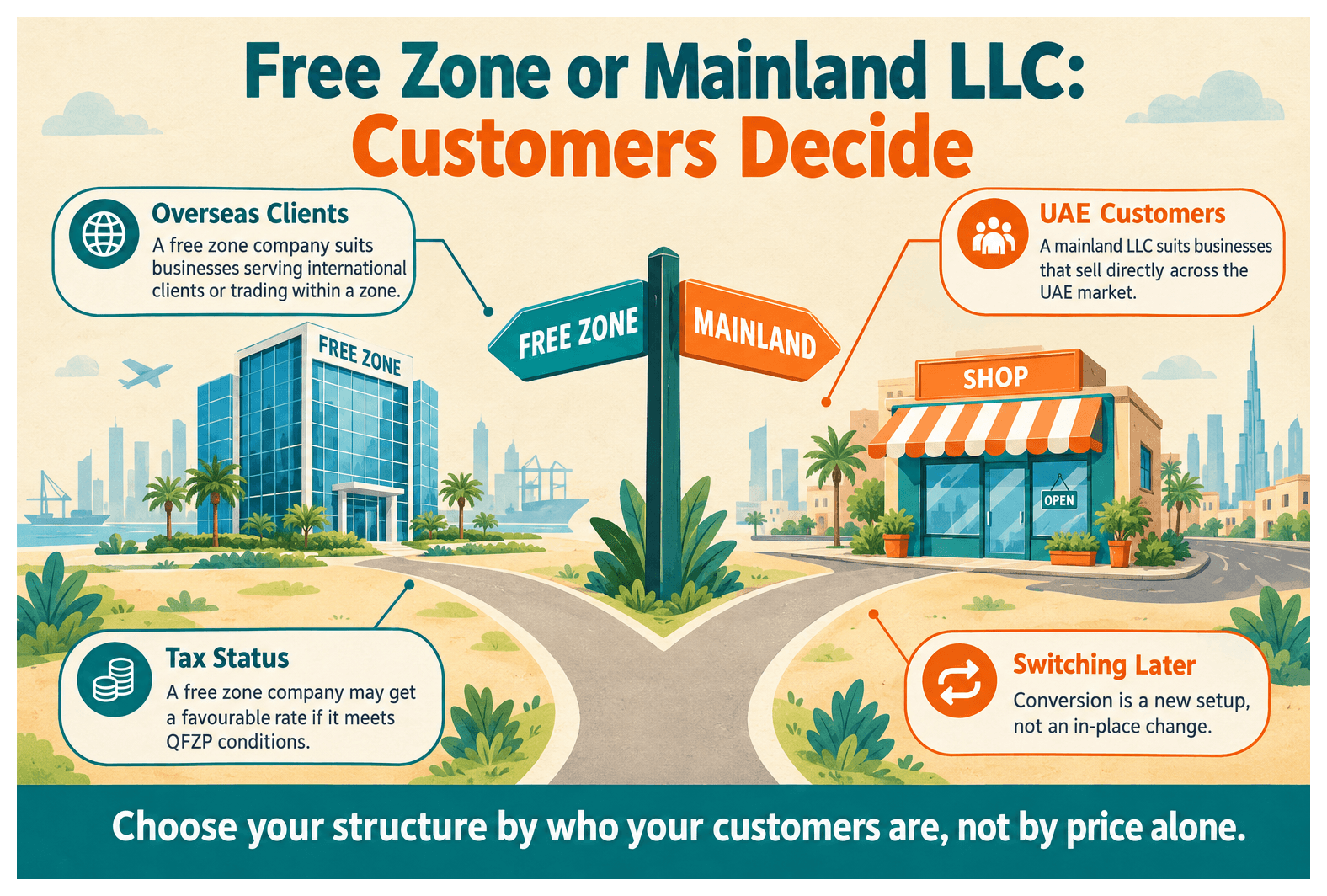
If most revenue comes from UAE customers, government buyers or retail footfall, a mainland LLC usually fits better. If your clients are overseas or inside free zones, a free zone company often works. Confirm current trading permissions with the licensing authority, as rules apply as of 2026.
Mapping Customers to Structure
Sort your customers into five groups: overseas, other free zones, UAE businesses, UAE consumers and government. The first two point toward a free zone. The last three point toward the mainland. Compare an e-commerce brand shipping across the UAE with an advisory firm serving GCC and international clients. Their needs differ, and so should their structures.
Mainland Trading Needs and Contracts
Direct local sales, tenders and retail premises are mainland strengths. A restaurant supplier needing a customer-facing location is the classic case. Free zone companies may need a distributor or additional licensing to sell locally, so check with the authority first. Our guide on when to choose an LLC over a free zone company goes deeper.
Matching Your Activity to a License
Your activity decides which license types are open to you. A trading company should check its activity code before applying. Browse the approved business activities list to see where yours sits.
How Does Corporate Tax and QFZP Status Affect Your Structure?
A free zone company may qualify for a favourable corporate tax rate only if it meets Qualifying Free Zone Person (QFZP) conditions and earns qualifying income. Mainland LLCs fall under the standard regime. Neither route is tax free, so confirm your position with the Federal Tax Authority as of 2026.
Qualifying Free Zone Person Basics
Under Federal Decree-Law No. 47 of 2022, the standard corporate tax rate is 9%. A QFZP can pay 0% on qualifying income, but only while it meets the conditions. Consider a free zone company with mixed qualifying and non-qualifying income: the two streams are taxed differently. Our QFZP and qualifying income explainer unpacks this, and the Federal Tax Authority holds the official guidance.
Free Zone Company vs Mainland LLC: 2026 Decision Comparison
Feature | Free Zone Company | Mainland LLC |
|---|---|---|
Typical customers | Overseas clients and businesses inside free zones | UAE businesses, consumers and government buyers |
Trading across the UAE market | Local sales may need a distributor or extra licensing | Direct trading across the UAE market, subject to activity |
Corporate tax position (QFZP) | Favourable rate on qualifying income only, if conditions are met | Standard 9% regime applies |
Visas and office | Residency visa package tied to the license, flexible office options | Leased premises, with visa quota tied to the lease and activity |
Cost logic and conversion path | Bundled license and visa; moving to the mainland means a new setup | Separate lease, license and visa costs; broad local reach from day one |
What Happens If You Sell on the Mainland
Mainland-sourced revenue can affect qualifying income treatment. Imagine a free zone trader who adds local retail sales mid-year. Part of that income may fall outside the favourable rate. Model your revenue mix before choosing, and confirm the treatment with the Federal Tax Authority.
Balanced View of Tax Pros and Cons
Tax is one factor among customers, visas and cost. One founder picked a free zone purely for tax, then needed mainland trading within a year and paid for a second setup. Read our Dubai free zone company pros and cons for the full free zone vs mainland pros and cons picture.
How Do Visas, Office Space and Costs Compare Between the Two?
Free zone companies typically bundle a license with a residency visa package and flexible office options. Mainland LLCs usually require leased premises and follow different visa allocation rules. Compare total first-year cost, not just the license fee, and confirm figures with each authority as of 2026.
Visas and Office Requirements
A sole founder needing one residency visa can get it through a package tied to a free zone license. On the mainland, premises and visa quota are tied to the lease and the licensed activity. Count your visas and desks before comparing anything else.
Cost Logic Beyond the License Fee
Cost has layers: license, visa, office, renewals and approvals. At Dubai South Business Hub Free Zone, a sole founder pays from AED 18,350 all-in for year one, with the license from AED 12,500 and one visa. That is the best company setup option Dubai 2026 founders can price quickly. Our post on the cost beyond the license covers the detail, and the cost calculator gives your own estimate.
Can You Convert Later and What Does the Conversion Path Look Like?
A free zone license can't be converted in place. Founders typically set up a new mainland LLC and close or keep the free zone entity. Planning early avoids duplicated costs, so confirm current procedures with the relevant authorities as of 2026.
Why Conversion Is Really a New Setup
Take a free zone trader who later needs local retail premises. The mainland license is a separate application with its own approvals. Our guide on how to convert a free zone company to a mainland LLC walks through it.
Planning the Path Before You Start
Choose the structure that fits the next 12 to 24 months. Keep records clean to ease a later move. Some founders keep a free zone entity for international clients and add a mainland LLC for local sales. That can work well when needs genuinely differ.
What Steps Should You Follow to Decide Between Free Zone and Mainland?
Decide in five steps: define customers, check trading needs, model tax and QFZP effects, compare visas, office and total cost, then confirm the license and conversion path with the authorities. This order keeps the decision tied to how you earn revenue.
Step 1: Define Your Customers and Revenue Mix. Estimate your overseas versus local share. As an illustration only, a founder projecting 70% overseas and 30% local revenue leans free zone, but the 30% needs a plan.
Step 2: Check Trading Rights and Tax Position. Confirm mainland trading needs with the licensing authority, and check QFZP implications with the Federal Tax Authority. Start by matching your activity to the approved list.
Step 3: Compare Visas, Office and Total Cost. A two-visa team should count visas and desks first, then use the cost calculator for a first-year estimate.
Step 4: Choose, Apply and Plan the Next Move. Apply through Dubai South Business Hub Free Zone or the mainland route, and note the conversion path. For more, see our guide to starting a business in the UAE at DSBH.
Which Mistakes Should Founders Avoid When Choosing a Structure?
Common mistakes include choosing on license price alone, ignoring where customers are, assuming a free zone is tax free, overlooking visa and office needs, and forgetting that conversion means a new setup. Test each factor against your real revenue plan.
Choosing on Price Alone
The license fee is only one part of total cost. A founder who compares headline fees can be surprised by add-on costs later. Check the full first-year figure instead.
Ignoring Tax and Trading Limits
Never assume a free zone is tax free. Check trading permissions before signing, especially if local sales are likely down the line.
Conclusion
The free zone vs mainland LLC 2026 decision comes down to customers, trading rights, corporate tax and QFZP effects, visas, office, cost logic and a later conversion path. Confirm current rules with the Federal Tax Authority and the licensing authorities. Use the cost calculator to estimate your first-year setup, then speak with the Dubai South Business Hub team about a free zone license and residency visa package.
References
Frequently Asked Questions


