Topic Summary
Classify Goods Before Any Permit Application
The UAE adopts the UN Globally Harmonized System across nine hazard classes, and your goods' UN number, proper shipping name, and packing group must be confirmed from Section 14 of the Safety Data Sheet first. Misclassification is a prosecutable criminal offence under UAE Federal Law No. 24 of 1999.
Five Separate Authorities Each Require Their Own Permit
MOCCAE, Dubai Civil Defence, the Federal Transport Authority, Dubai Customs, and DP World or Dubai Airports each control a distinct compliance gate. No single permit satisfies all five, and you must complete them in sequence before operations can legally begin.
Storage Facilities Must Pass DCD Inspection
Facilities must comply with NFPA 30, NFPA 400, and NFPA 13 as adopted by Dubai Civil Defence, and secondary containment must hold 110% of the largest single container volume. A Certificate of Compliance is issued only after a pre-operational inspection is successfully passed.
Road Transport Demands Permits, Certified Drivers, and Placards
Vehicles must carry FTA permits, ADR-equivalent driver certification, and a TREM card in every cab, with UN hazard placards displayed on all four sides. Certain routes and time windows are restricted for high-risk classes, so check with the FTA before routing through tunnels or densely populated zones.
VAT and Corporate Tax Late Registration Each Carry AED 10,000 Penalties
VAT registration becomes mandatory once taxable supplies exceed AED 375,000, and missing the deadline triggers a flat AED 10,000 penalty from the Federal Tax Authority. A separate flat AED 10,000 one-time penalty applies for late corporate tax registration as well.
A DSBH Free Zone License Can Be Issued in One Day
Trading licenses start at AED 12,500 for a zero-visa package and are issued within one business day, with options rising to AED 16,350 for one visa and AED 18,200 for two visas. The license is only the first step, as sector regulator approvals from DCD, MOCCAE, and the FTA must still follow separately.
In 2026, the UAE processes over 14 million TEUs of containerised cargo annually through its ports, a significant share of which includes chemicals, flammable liquids, and other regulated substances that fall under the hazardous goods handling UAE compliance framework (u.ae, 2024). Nine distinct UN hazard classes apply. Misclassification is a prosecutable offence under UAE Federal Law No. 24 of 1999. Traders face an AED 10,000 penalty for late VAT registration alone. DSBH Free Zone issues a trading license in one business day. Five separate regulatory authorities each require their own permit before you can legally store, move, or declare a single dangerous goods shipment.
This guide covers the classification rules, permits, storage standards, transport obligations, and step-by-step setup process that Dubai trading and logistics companies need to handle hazardous goods lawfully in the UAE, with the responsible authority named at every stage.
What Is Hazardous Goods Handling in the UAE and Why Classification Comes First
Hazardous goods handling in the UAE is the regulated process of classifying, storing, transporting, and declaring substances that pose a risk to health, safety, or the environment. The UAE adopts the UN Globally Harmonized System of nine hazard classes and requires trader compliance at every point in the supply chain.
Classification is the foundation. Every other permit, declaration, and approval depends on getting the hazard class right at the start. The Ministry of Climate Change and Environment (MOCCAE) oversees chemical classification at the federal level, and the consequences of getting it wrong are serious: misclassification is a prosecutable offence under UAE Federal Law No. 24 of 1999 on the Protection and Development of the Environment (still accurate as of 2026).
UAE Hazardous Goods Compliance: Authority, Permit, and Trigger
Regulatory Authority | Permit Required | When It Triggers |
|---|---|---|
MOCCAE | Chemicals Registration System approval | Required before importing any regulated chemical into the UAE |
Dubai Civil Defence | Hazardous Materials Storage Permit and Certificate of Compliance | Required before storing any dangerous goods on site |
Federal Transport Authority | Dangerous Goods Road Transport Permit | Required before moving goods between emirates by road |
Dubai Customs / Federal Customs Authority | Required for every import or export shipment, submitted via dubaitrade.ae | |
DP World / Dubai Airports | IMDG Dangerous Goods Manifest (sea) / IATA DGR Declaration (air) | Required for every sea or air freight consignment before arrival |
The Nine UN Hazard Classes Recognised in the UAE
The UAE applies the GHS and ADR/IMDG frameworks, so the same nine-class system applies whether your goods move by road, sea, or air. The nine classes are:
Class 1: Explosives
Class 2: Gases (compressed, liquefied, dissolved)
Class 3: Flammable liquids
Class 4: Flammable solids, self-reactive substances, pyrophoric materials
Class 5: Oxidising substances and organic peroxides
Class 6: Toxic and infectious substances
Class 7: Radioactive materials
Class 8: Corrosives
Class 9: Miscellaneous dangerous goods
Take a practical example. A Dubai trader importing acetone (Class 3, flammable liquid) must label containers with the correct GHS flame pictogram, provide a Safety Data Sheet in both Arabic and English, and declare UN number 1090 on all shipping and customs documents before the goods clear port. None of those steps are optional.
How to Determine Your Goods' Hazard Class
Start with the Safety Data Sheet (SDS) provided by the manufacturer. Section 14 of the SDS contains the transport hazard classification, including the UN number, proper shipping name, and packing group. Cross-reference that against the UN Model Regulations dangerous goods list to confirm the details before you proceed.
For substances not listed in the UN Model Regulations, a certified laboratory test or classification study by an accredited body is required. Don't proceed to permitting without a confirmed class. MOCCAE can be consulted for borderline or novel substances. A logistics company receiving a new industrial cleaning agent from a European supplier, for instance, checks Section 14 of the SDS, identifies Class 8 (corrosive), packing group II, and UN number 1760, then lodges the customs declaration via (dubaitrade.ae) only after that confirmation is in hand.
Permits and Approvals Required for Hazardous Goods UAE Traders
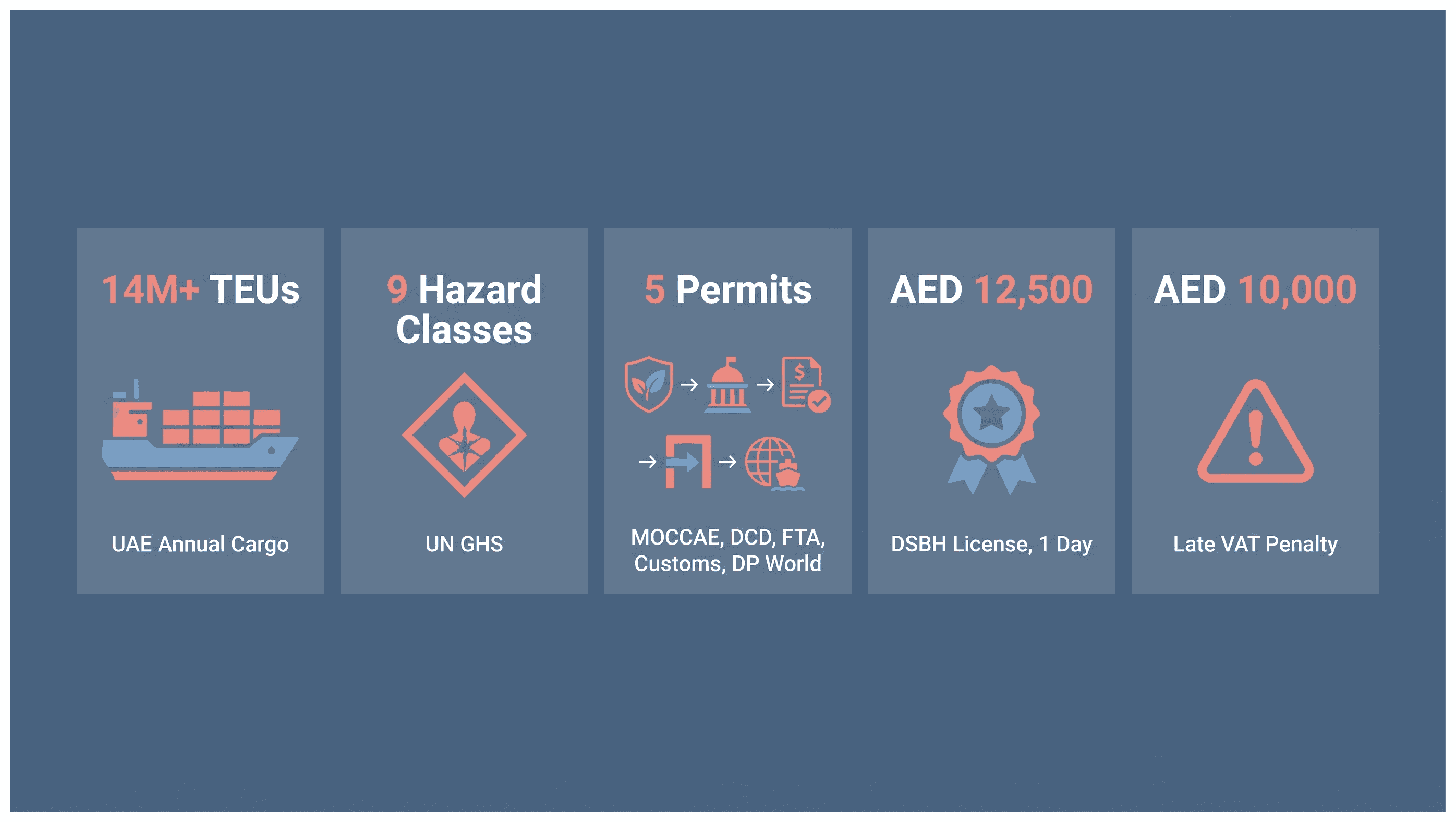
UAE traders handling hazardous goods need a valid trade license, a Dubai Civil Defence No Objection Certificate for storage, a Federal Transport Authority permit for road movement, and a customs declaration through Dubai Trade for each shipment. Each permit is issued by a separate authority and must be in place before operations begin.
Trade License: The Starting Point for Any Hazardous Goods Business
A trade license listing the specific hazardous goods activity is mandatory before any other regulatory approval can be obtained. The activity description must match the goods being handled precisely. A general trading license in Dubai does not automatically cover regulated hazardous substances.
DSBH Free Zone issues a trading license in one business day. The license covers the commercial activity, but the sector regulator approvals are separate and must follow. A Dubai South-based chemical distributor, for example, obtains its DSBH Free Zone trading license on day one, then applies separately to MOCCAE and Dubai Civil Defence for the substance-specific approvals before the first container arrives.
Sector-Specific Permits by Regulating Authority
Once your license is in hand, you need approvals from each relevant authority:
Dubai Civil Defence (DCD): Issues the Hazardous Materials Storage Permit and Certificate of Compliance. Mandatory before a single unit of stock is placed in a warehouse.
Federal Transport Authority (FTA-Roads): Issues the dangerous goods road transport permit for vehicles carrying hazardous substances between emirates. Drivers must hold an ADR-equivalent certificate.
MOCCAE: Regulates import and trade of chemicals under the Chemicals Registration System. Traders must register each substance before it enters the country.
Dubai Customs / Federal Customs Authority: Requires a Dangerous Goods Declaration (DGD) for every shipment, submitted through dubaitrade.ae, with the UN number, proper shipping name, and quantity declared.
DP World: Applies IMDG Code requirements for all sea freight. A Dangerous Goods Manifest must accompany every container.
Worth flagging specifically: DP World Jebel Ali requires all Class 1 (explosives) shipments to be pre-notified 48 hours before vessel arrival with a completed IMDG Dangerous Goods Declaration and port authority clearance (DP World, 2024).
Storage Rules and Facility Approvals for Hazardous Goods in the UAE
Hazardous goods storage facilities in the UAE must comply with NFPA codes as adopted by Dubai Civil Defence, pass a pre-operational inspection, and hold a valid Certificate of Compliance. Incompatible substances must be physically segregated, and quantities above defined thresholds trigger additional reporting obligations to Dubai Civil Defence.
Dubai Civil Defence Storage Standards You Must Meet
Before a DCD inspector sets foot in your facility, you need the following in place:
Compliance with NFPA 30 (flammable and combustible liquids storage)
Compliance with NFPA 400 (hazardous materials code)
Compliance with NFPA 13 (sprinkler systems) as adopted by Dubai Civil Defence
Secondary containment (bunding) sized to hold 110% of the largest single container volume
Explosion-proof lighting in flammable goods storage areas
Ventilation systems meeting DCD specifications
Signage in Arabic and English at all entry points
Emergency response equipment (fire extinguishers, spill kits, PPE) on site
The Certificate of Compliance is issued only after the pre-operational inspection passes. A logistics operator setting up a flammable liquids store in Dubai must install a bunded containment area sized to 110% of the largest container, fit explosion-proof lighting, and display NFPA diamond placards at all entry points before the DCD engineer arrives. There are no shortcuts here.
Segregation Rules for Incompatible Hazardous Substances
The IMDG Code segregation table and Dubai Civil Defence guidance define which classes cannot be stored in the same bay or building. Class 1 (explosives) must be stored in a dedicated licensed magazine, physically separated from all other goods. This is a hard rule, not a recommendation.
Oxidising agents (Class 5.1) and flammable liquids (Class 3) must be stored in separate, ventilated compartments with a defined physical barrier between them. Storage records must be maintained and available for inspection at any time. Digital records are accepted, but they must be current and accessible on-site.
Step-by-Step Guide to Hazardous Goods Handling UAE Compliance
To comply with hazardous goods handling UAE rules, traders must: classify goods using the UN GHS system, register substances with MOCCAE, obtain a trade license, secure a Dubai Civil Defence storage permit, apply for a Federal Transport Authority road permit, and submit a Dangerous Goods Declaration for each customs entry.
Step 1: Classify Your Goods and Prepare Documentation
Obtain the Safety Data Sheet from your supplier. Confirm the UN class, UN number, proper shipping name, and packing group from Section 14.
Prepare Safety Data Sheets in both Arabic and English. Arabic is mandatory for goods sold or stored within the UAE.
If the substance requires MOCCAE registration, complete the Chemicals Registration System application before importing.
Engage a certified dangerous goods trainer or consultant to review your classification if there is any ambiguity. Do not proceed to permitting on an unconfirmed class.
Step 2: Obtain Your Trade License and Sector Approvals
Apply to DSBH Free Zone for a trading license covering your hazardous goods activity. The license is issued in one business day.
Submit the Dubai Civil Defence Hazardous Materials Storage Permit application with your warehouse layout, NFPA compliance documents, and SDS for each substance.
Apply to the Federal Transport Authority for the dangerous goods road transport permit if goods will move between emirates by road.
Register each chemical with MOCCAE through the Chemicals Registration System portal before the first import.
Step 3: Declare Goods at Customs and Maintain Ongoing Compliance
Submit a Dangerous Goods Declaration through dubaitrade.ae for every shipment. Include the UN number, hazard class, quantity, and packing group.
For sea freight, ensure the shipper provides a completed IMDG Dangerous Goods Manifest to DP World before the vessel arrives.
Maintain a current inventory of all hazardous substances on site. Make it available to Dubai Civil Defence inspectors on request.
Renew the DCD Certificate of Compliance and FTA transport permit annually. Set calendar reminders at the 90-day mark before expiry.
One compliance note that catches traders off guard: VAT registration is mandatory once your taxable supplies exceed AED 375,000. Late registration carries a flat AED 10,000 penalty from the Federal Tax Authority (tax.gov.ae, 2024). Don't wait until your first shipment clears to check whether you've crossed that threshold.
What documents do I need for a Dangerous Goods Declaration in the UAE?
You need the Safety Data Sheet, the UN number, the proper shipping name, the hazard class, the packing group, and the quantity per package. All documents must be submitted through dubaitrade.ae. Arabic-language SDS is required for goods stored or sold within the UAE.
Transport Rules for Hazardous Goods UAE Traders Must Follow
Hazardous goods transported by road in the UAE must travel in vehicles holding a Federal Transport Authority dangerous goods permit. Drivers must carry ADR-equivalent certification, goods must be placarded with the correct UN hazard labels, and a transport emergency document must accompany every load
References
Frequently Asked Questions