Topic Summary
The Three Holding Structures Dubai Founders Actually Use
The three holding structures Dubai founders use most are: a free zone holding company owning one or more free zone subsidiaries, a free zone holding company owning a mainland operating subsidiary, and a pure holding entity that owns shares in companies across multiple jurisdictio
Holding Structures Dubai Cost at Dubai South Business Hub Free Zone
Holding Structures Dubai Cost at Dubai South Business Hub Free Zone
How to Choose the Right Structure for Your Situation
Choose your holding structure based on where your operating subsidiaries trade and what assets the holding entity will own. A free zone-to-free zone stack suits IP and investment holding. A free zone-to-mainland stack suits founders who need UAE domestic market access. A pure hol
Step-by-Step Guide to Setting Up Holding Structures in Dubai
To set up holding structures in Dubai: choose your structure configuration, select your business activities, reserve your trade name, submit incorporation documents to the free zone, receive your license (issued in one business day on a complete file), open a corporate bank accou
Common Uses of Holding Structures in Dubai
Holding structures in Dubai are used to consolidate ownership of multiple operating companies under one entity, protect intellectual property from trading risk, receive dividends from subsidiaries in a tax-efficient layer, facilitate investment into UAE and overseas assets, and s
Tax Considerations for Holding Structures in Dubai
A UAE free zone holding company may qualify for a 0% corporate tax rate on qualifying income if it meets all four Qualifying Free Zone Person (QFZP) conditions: adequate substance in the UAE, qualifying income, no election to be subject to the standard tax rate, and compliance wi
In 2026, founders incorporating holding structures in Dubai can have a free zone license issued in one business day, with one-off setup packages starting at AED 12,500 at Dubai South Business Hub Free Zone. The UAE imposes no statutory cap on the number of subsidiaries a single holding entity may own. That makes the structure highly scalable from the moment the license is issued. Corporate tax late registration carries a one-time flat AED 10,000 penalty per entity (Federal Tax Authority, 2026). The VAT registration threshold sits at AED 375,000 in taxable supplies. Free zone holding entities may qualify for a 0% corporate tax rate on qualifying income, subject to four conditions set by the Federal Tax Authority.
If you're still deciding whether a holding company is right for you, the holding company in Dubai guide covers the fundamentals. This article focuses entirely on structure choice, what each configuration costs, and the practical uses that drive founders to choose one setup over another.
The Three Holding Structures Dubai Founders Actually Use
The three holding structures Dubai founders use most are: a free zone holding company owning one or more free zone subsidiaries, a free zone holding company owning a mainland operating subsidiary, and a pure holding entity that owns shares in companies across multiple jurisdictions without trading directly itself. Each configuration serves a different asset type and trading geography.
Free Zone Holding Company With Free Zone Subsidiaries
A single free zone holding entity sits above two or more free zone operating companies. Dividends flow up to the holding company without a withholding tax layer in the UAE, and ownership is 100% foreign-owned at every tier, no local sponsor required at any level of the structure.
A founder with a logistics trading company and a separateICT license in Dubai can place both under one free zone holding entity at Dubai South Business Hub Free Zone. That consolidates ownership into a single cap table and simplifies any future sale of one subsidiary without disturbing the other. The license is issued in one business day on a complete file.
Free Zone Holding Company With a Mainland Operating Subsidiary
Here the holding entity sits in the free zone while the trading or service subsidiary is incorporated on the UAE mainland under DET or an equivalent authority. The mainland subsidiary can access the UAE domestic market without restriction. The free zone holding layer retains its status separately. Both entities carry independent corporate tax filing obligations, the mainland subsidiary files its own return, and the free zone holding entity files its own.
A retail brand, for example, uses a Dubai South Business Hub Free Zone holding company to own its intellectual property and a mainland subsidiary to run its physical stores. Brand assets stay protected at the holding tier; the mainland entity handles day-to-day trading.
Pure Holding Entity With No Direct Trading Activity
The holding company itself holds shares, collects dividends, and may provide intra-group loans. It does not sell goods or services to third parties. The activity scope on the license is typically "holding of shares and other equity instruments", confirm the exact wording with the free zone before filing, because getting it wrong requires a paid amendment.
Because the entity has no direct revenue, its corporate tax position depends entirely on whether dividends and capital gains qualify as exempt income under the UAE Corporate Tax Law. A family with property investments in three countries, for instance, uses a Dubai South Business Hub Free Zone pure holding entity as the central ownership vehicle, with each country's assets held through local subsidiaries underneath it. Qualifying dividends and capital gains may be exempt from UAE corporate tax, subject to conditions set by the Federal Tax Authority (tax.gov.ae, 2026). Check the full list of eligible business activities at Dubai South Business Hub Free Zone before selecting your activity scope.
Holding Structures Dubai Cost at Dubai South Business Hub Free Zone
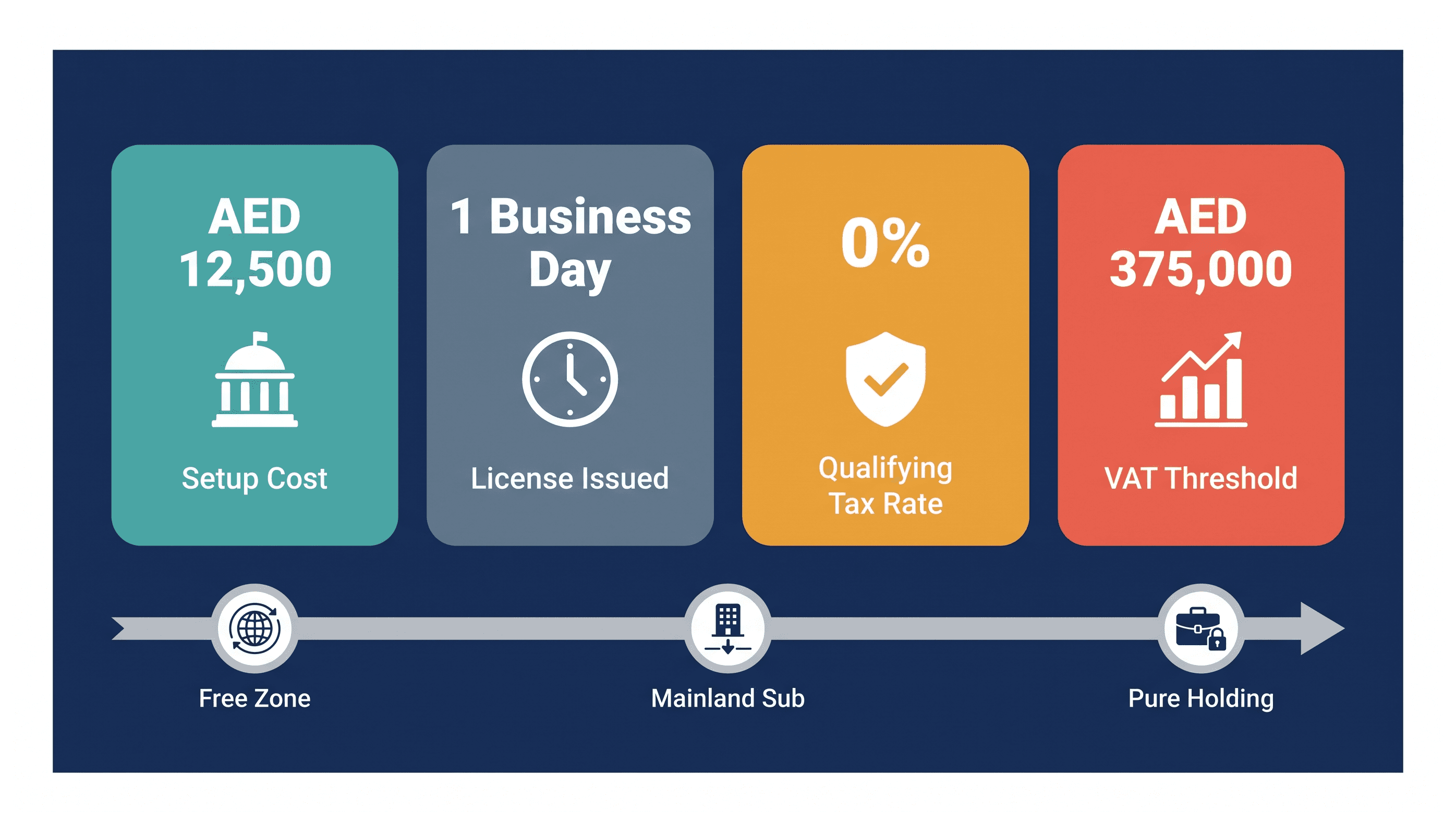
At Dubai South Business Hub Free Zone, a holding company license starts at AED 12,500 (0 Visa Package). The 1 Visa Package is AED 16,350 and the 2 Visa Package is AED 18,200. These are one-off setup costs. Annual renewal and visa processing fees are charged separately and are not included in any package price.
One-Off Setup Costs: What Each Package Includes
Every package includes the license, Articles of Association, share register, flexi-desk space, and a lease agreement. The 1 and 2 Visa packages add the visa allocation (investor or partner visa) and the establishment card. The maximum visa allocations available at Dubai South Business Hub Free Zone is two.
Holding Structures Dubai Cost Breakdown: One-Off vs. Recurring
Item | One-Off Costs | Recurring / Separate Costs |
|---|---|---|
0 Visa Package | AED 12,500, includes license, Articles of Association, share register, flexi-desk space, lease agreement | Not applicable, no visa allocation in this package |
1 Visa Package | AED 16,350, includes everything in 0 Visa Package plus 1 visa allocation (investor or partner visa) and establishment card | Visa processing costs (entry permit, status change, medical, Emirates ID, stamping) quoted separately per visa holder |
2 Visa Package | AED 18,200, includes everything in 1 Visa Package plus a second visa allocation and establishment card; maximum 2 visa allocations available | Visa processing costs quoted separately for each visa holder |
Annual License Renewal | Not applicable, renewal is a recurring cost | Billed each year; not included in the one-off package price |
Corporate Tax Registration | Not included in any package | Mandatory for every UAE entity; late registration penalty AED 10,000 one-time flat per entity (tax.gov.ae, 2026) |
VAT Registration | Not included in any package | Mandatory above AED 375,000 in taxable supplies; late registration penalty AED 10,000 (tax.gov.ae, 2026) |
A sole founder setting up a pure holding entity with no employees would choose the 0 Visa Package at AED 12,500 and add a visa allocation later if residency becomes a requirement. Use the business setup cost in Dubai calculator to build your exact package cost before submitting documents.
What Is Not Included in the Package Price
The following costs sit outside every package and should be budgeted separately:
Visa processing, entry permit, status change, medical examination, Emirates ID, and stamping, quoted separately per visa holder
Annual license renewal fees, a recurring cost billed each year
Corporate tax registration with the Federal Tax Authority, mandatory; late registration carries a AED 10,000 one-time flat penalty per entity (tax.gov.ae, 2026)
VAT registration, mandatory once taxable supplies exceed AED 375,000; late registration carries a separate AED 10,000 penalty
Bank account opening fees, vary by bank; see the guide to open a Dubai bank account for a step-by-step overview
A founder who misses the corporate tax registration deadline for both the holding company and its subsidiary faces two separate one-time AED 10,000 penalties, AED 20,000 in entirely avoidable costs. If you're setting up a holding company with two subsidiaries in the same week, that's three separate registration deadlines to track from day one.
How to Choose the Right Structure for Your Situation
Choose your holding structure based on where your operating subsidiaries trade and what assets the holding entity will own. A free zone-to-free zone stack suits IP and investment holding. A free zone-to-mainland stack suits founders who need UAE domestic market access. A pure holding entity suits cross-border investment portfolios.
Matching Structure to Your Asset Type
IP, shares, and financial instruments sit most efficiently under a free zone holding entity because qualifying income may benefit from the corporate tax exemption framework. Physical goods distribution and retail, though, require a mainland operating subsidiary under the holding layer, free zone entities cannot sell directly into the UAE domestic market without going through a mainland entity or a registered importer.
A founder holding a software platform (IP asset) in a free zone company and distributing it to UAE government clients through a mainland subsidiary uses the free zone-to-mainland stack. The IP stays protected in the free zone while the mainland entity handles contracts. Real estate held for investment is classified differently from real estate brokerage, check the real estate license in Dubai page and the financial services license in Dubai page for activity-specific guidance before choosing your structure.
Substance Requirements You Must Plan for From Day One
A holding entity must have genuine economic substance at the free zone level to maintain its classification. That means adequate physical presence, management decisions taken in the UAE, and qualified staff or directors on record. Flexi-desk space, included in all three DSBH packages, satisfies the physical presence element for a holding entity with no employees.
If the holding company has a board, the majority of board meetings should be held in the UAE and minuted accordingly. Substance is not a one-time checkbox. A holding company whose directors hold all meetings outside the UAE risks failing the substance test at renewal. Scheduling at least two UAE-based board meetings per year and keeping minutes on file addresses this directly. The UAE Economic Substance Regulations framework is published by the Ministry of Finance (mof.gov.ae, 2026).
Is a free zone holding company right for a founder with only one operating subsidiary?
Yes, in most cases. Even with a single subsidiary, a free zone holding entity separates asset ownership from trading risk, simplifies future equity transactions, and positions the structure to add subsidiaries without restructuring. The one-off cost at AED 12,500 is the same whether you own one subsidiary or five.
Step-by-Step Guide to Setting Up Holding Structures in Dubai
To set up holding structures in Dubai: choose your structure configuration, select your business activities, reserve your trade name, submit incorporation documents to the free zone, receive your license (issued in one business day on a complete file), open a corporate bank account, then register for corporate tax with the Federal Tax Authority.
Step 1: Confirm Your Structure and Activity Scope
Decide which of the three configurations fits your asset type and trading geography before approaching the free zone. Identify the correct activity description for a holding entity, typically "holding of shares and other equity instruments", and confirm it covers your intended use. Activity scope determines what the holding entity can legally do; getting it wrong requires a paid amendment to correct.
Check name availability early. The trade name must reflect the holding nature of the entity and comply with UAE naming rules. Check your trade name availability before submitting any documents to avoid delays at the filing stage.
Step 2: Submit Documents and Receive Your License
Required documents typically include passport copies for all shareholders, a completed application form, and the chosen package payment. Articles of Association and the share register are prepared by the free zone and included in every package, you don't source these separately.
The license is issued in one business day on a complete file. Incomplete files extend the timeline. A founder who submits a complete file at 9 a.m. can expect the license by end of the following business day, the most common delay is a missing certified passport copy. Once the license is issued, the establishment card (included in the 1 and 2 Visa packages) enables visa processing to begin.
Step 3: Register for Corporate Tax and Open a Bank Account
Every UAE entity must register for corporate tax with the Federal Tax Authority within the prescribed deadline from the date of incorporation. Don't wait until the first tax period ends. Late registration carries a one-time flat AED 10,000 penalty per entity, so if you're setting up a holding company and a subsidiary simultaneously, you have two separate registration deadlines to track (tax.gov.ae, 2026).
Bank account opening for a holding company typically takes four to eight weeks. Banks conduct enhanced due diligence on entities with no direct revenue, so budget more time than you would for a trading company. The banking and taxation page covers the UAE bank account opening process for free zone entities step by step.
Common Uses of Holding Structures in Dubai
Holding structures in Dubai are used to consolidate ownership of multiple operating companies under one entity, protect intellectual property from trading risk, receive dividends from subsidiaries in a tax-efficient layer, facilitate investment into UAE and overseas assets, and simplify succession planning by centralising equity in one vehicle.
Consolidating Ownership Across Multiple Operating Companies
Founders with two or more operating companies in different sectors use a holding entity to centralise equity, simplify governance, and present a single ownership structure to banks and investors. A holding entity also makes it easier to sell one subsidiary without disturbing the others, the buyer acquires shares in the subsidiary, not shares in the holding company itself. Intra-group dividends flowing from subsidiary to holding company may qualify as exempt income under UAE Corporate Tax Law, subject to conditions confirmed by the Federal Tax Authority (mof.gov.ae, 2026).
A founder with an ICT company and a services company incorporates both under a single Dubai South Business Hub Free Zone holding entity. When a strategic buyer approaches for the ICT business, only the ICT subsidiary changes hands, the services company is entirely unaffected. Ownership is 100% foreign-owned at all tiers in a free zone stack, with no local sponsor required.
Protecting Intellectual Property and Brand Assets
Placing trademarks, patents, software, and brand IP in the holding company separates those assets from the trading risk of operating subsidiaries. The holding company licenses the IP to the operating subsidiaries on commercial terms, this is a standard intra-group arrangement, but it must be documented with a formal licensing agreement at arm's length. Ring-fencing is structural, not automatic; the legal documentation is what makes it enforceable.
A food and beverage brand holds its recipe formulations and trademark in the free zone holding entity and licenses them to its UAE mainland operating company. A creditor claim against the restaurant chain cannot reach the IP held at the holding tier. For any regulated IP-related activities, Dubai South Business Hub Free Zone licenses the activity and the relevant UAE regulator approves it separately.
Tax Considerations for Holding Structures in Dubai
A UAE free zone holding company may qualify for a 0% corporate tax rate on qualifying income if it meets all four Qualifying Free Zone Person (QFZP) conditions: adequate substance in the UAE, qualifying income, no election to be subject to the standard tax rate, and compliance with transfer pricing rules. All four conditions must be satisfied, not just one or two.
The Four QFZP Conditions You Must Satisfy
Condition 1, Adequate substance:
References
Frequently Asked Questions