
Topic Summary
What Are MOHRE Fines and Why Every Dubai Employer Must Know Them
MOHRE fines are administrative penalties issued by the UAE Ministry of Human Resources and Emiratisation against private-sector employers who breach Federal Decree-Law No. 33 of 2021. Penalties cover wage delays, missing contracts, illegal recruitment, and Emiratisation shortfall
Core Employer Duties That Trigger MOHRE Fines in Dubai
Core Employer Duties That Trigger MOHRE Fines in Dubai
MOHRE Fines by Breach: Violations and Costs
MOHRE fines in Dubai are set per breach type and per worker. Amounts range from AED 1,000 for minor record failures to AED 50,000 for illegal recruitment or serious contract violations. The list below covers the main violation categories with the penalty amount sourced from MOHRE
Cost Breakdown: One-Off vs Recurring MOHRE Fines
MOHRE fines in Dubai split into one-off penalties triggered by a single event and recurring penalties that accumulate per period or per unfilled position. Understanding which category a fine falls into helps employers budget for remediation and prioritise which compliance gaps to
How MOHRE Inspects Companies and Issues Fines
MOHRE labour inspectors visit company premises announced or unannounced, review payroll records, contracts, WPS compliance, and work permit validity. A violation notice is issued on the spot or within a set period. Employers can challenge fines through MOHRE's administrative grie
Records Every Dubai Employer Must Keep to Avoid MOHRE Fines
Dubai employers must maintain signed employment contracts registered with MOHRE, monthly WPS payroll records, annual leave schedules, sick leave logs, work permit copies, and end-of-service calculation records. Failure to produce any of these during an inspection is itself a fine
In 2026, MOHRE administrative penalties against private-sector employers reach AED 50,000 per worker for a single unpermitted hire (MOHRE, 2026). The Emiratisation shortfall penalty sits at AED 96,000 per unfilled position per year (NAFIS/MOHRE, 2026). A missing employment contract costs AED 10,000 per worker (MOHRE, 2026). Obstructing an inspector adds a flat AED 20,000 (MOHRE, 2026). Fine ranges span AED 1,000 to AED 50,000 per breach, and all penalties stack per worker in a single visit. If you run a company in Dubai, one unannounced inspection can generate six-figure liability before you've left the room.
This article sets out the specific MOHRE fines an employer in Dubai can face, the duties that trigger them, what each breach costs, which records you must keep, and how to stay compliant before an inspector arrives.
What Are MOHRE Fines and Why Every Dubai Employer Must Know Them
MOHRE fines are administrative penalties issued by the UAE Ministry of Human Resources and Emiratisation against private-sector employers who breach Federal Decree-Law No. 33 of 2021. Penalties cover wage delays, missing contracts, illegal recruitment, and Emiratisation shortfalls, with amounts ranging from AED 1,000 to AED 50,000 per violation.
The Legal Basis for MOHRE Penalties
Federal Decree-Law No. 33 of 2021 on the Regulation of Labour Relations is the primary statute governing private-sector employment in the UAE. Cabinet resolutions issued under it set the specific fine amounts for each category of breach.
MOHRE has broad enforcement powers: it can inspect premises, issue fines, suspend work permit quotas, and refer serious cases directly to the public prosecutor. Critically, penalties are assessed per violation, per worker. A logistics company in Dubai with 40 staff found to have no written contracts for 12 workers faces 12 separate AED 10,000 fines, totalling AED 120,000 from a single visit. That's not a worst-case scenario, it's a straightforward application of the rules.
Who Is Subject to MOHRE Jurisdiction
All private-sector employers on the UAE mainland fall under MOHRE jurisdiction. Free zone companies whose workers hold MOHRE-issued work permits are also fully within scope, even if the company itself is registered in a free zone. MOHRE does not govern employment relationships in the DIFC or ADGM, which operate under separate regulatory frameworks.
Domestic workers are covered by a separate Cabinet Resolution, though MOHRE still administers the related penalties. A free zone company that sponsors staff on MOHRE work permits rather than free zone authority permits is fully subject to MOHRE administrative penalties, the free zone registration offers no protection from this exposure. You can check permit status and compliance flags regularly through the MOHRE portal.
Core Employer Duties That Trigger MOHRE Fines in Dubai
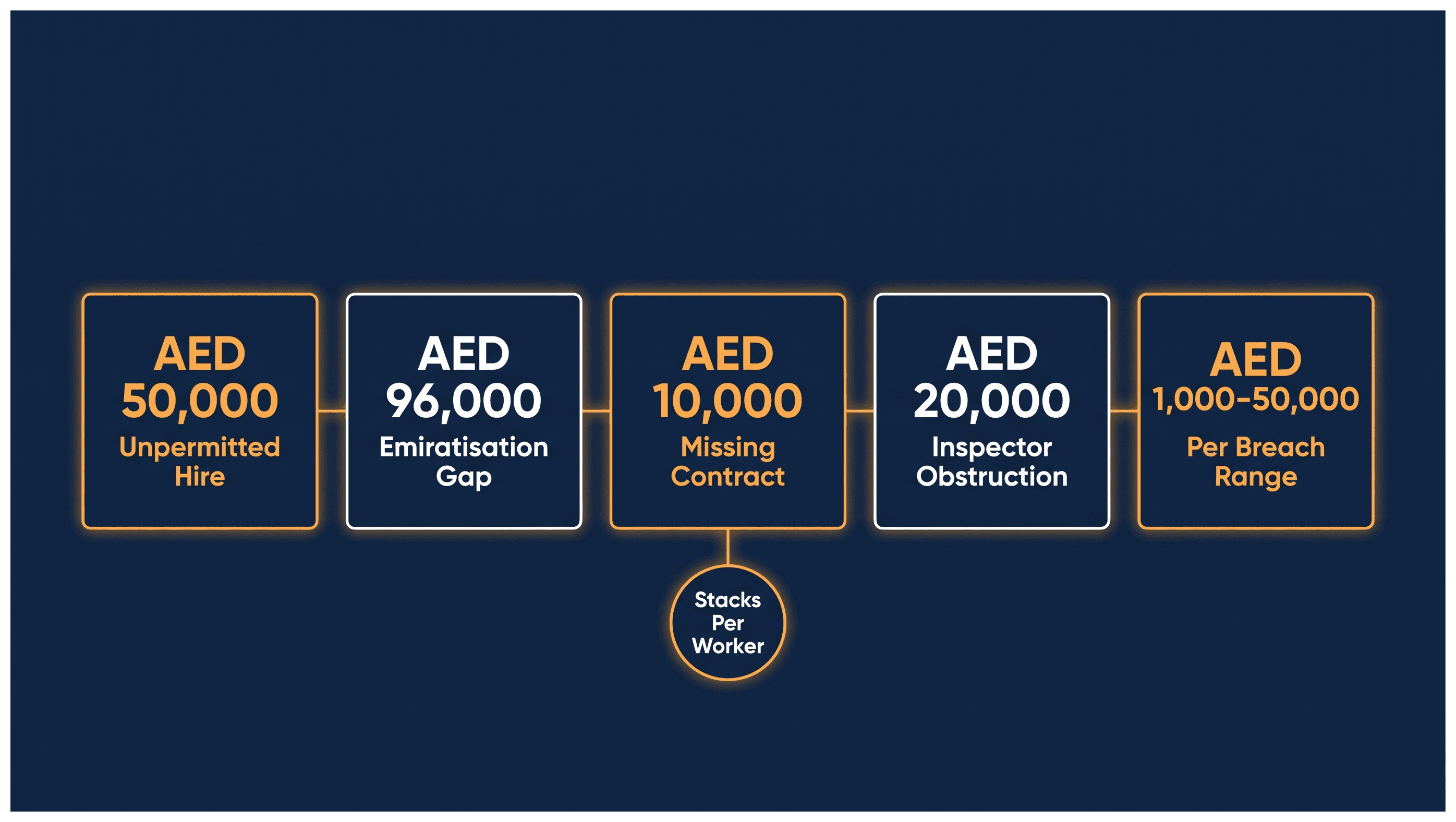
Dubai employers trigger MOHRE fines by failing to provide written employment contracts, delaying wages beyond the WPS deadline, recruiting without proper permits, denying annual or sick leave, and missing Emiratisation targets. Each failure is treated as a separate breach with its own penalty amount under Federal Decree-Law No. 33 of 2021.
Wage and WPS Obligations
Wages must be paid through the Wage Protection System (WPS) by the last working day of each month for monthly-paid staff. A delay of more than 10 days triggers a first-level penalty. Exceeding 30 days escalates the penalty and blocks new work permit applications until arrears are cleared (MOHRE, 2026).
A retail employer in Dubai who processes payroll 15 days late for 20 staff is automatically flagged by WPS and faces permit quota suspension pending payment. Paying below the agreed contract wage is also a separate, independently fineable breach, it doesn't matter that the worker was paid something.
Employment Contract and Record-Keeping Requirements
Every worker must have a written employment contract in Arabic or bilingual format, registered with MOHRE before or on the first day of work. The contract must specify:
Job title and role description
Basic salary and allowances
Working hours and rest days
Annual leave entitlement
Notice period
Employers must also retain contracts, payroll records, and leave schedules for the minimum statutory retention period. If an inspector requests payroll records going back two years and the employer can't produce them digitally or physically, that gap generates a separate fine, independent of any other breach found on the same visit.
Recruitment, Permit and Visa Duties
Hiring a worker without a valid MOHRE work permit is a primary breach. Employing someone in a role that doesn't match their permit category is also penalised separately. Both are treated as distinct violations even if they involve the same worker.
Charging recruitment fees to the worker, directly or indirectly, is prohibited and triggers a fine of AED 20,000 per worker (MOHRE, 2026). A company that deducts "visa fees" from an employee's first salary is in direct breach of this prohibition, regardless of whether the deduction was disclosed in the offer letter. The disclosure doesn't make it lawful.
MOHRE Fines by Breach: Violations and Costs
MOHRE fines in Dubai are set per breach type and per worker. Amounts range from AED 1,000 for minor record failures to AED 50,000 for illegal recruitment or serious contract violations. The list below covers the main violation categories with the penalty amount sourced from MOHRE's published schedule.
Penalty Schedule by Violation Type
No written employment contract: AED 10,000 per worker (MOHRE, 2026)
Wage delay beyond 10 days via WPS: permit quota suspension, exact per-worker fine amount UNVERIFIED: <figure>. Confirm before publishing.
Employing a worker without a valid work permit: AED 50,000 per worker (MOHRE, 2026)
Employing a worker in a role not matching permit category: AED 10,000 per worker (MOHRE, 2026)
Charging recruitment fees to the worker: AED 20,000 per worker (MOHRE, 2026)
Denying statutory leave entitlement: AED 1,000 per worker (MOHRE, 2026)
Emiratisation quota shortfall: AED 96,000 per unfilled position per year (NAFIS/MOHRE, 2026)
Obstructing a MOHRE inspector: AED 20,000 per event (MOHRE, 2026)
A 60-person company that misses its Emiratisation quota by two positions for a full year faces AED 192,000 in Emiratisation penalties alone, separate from any other labour breaches found in the same period. That's a recurring liability, not a one-time cost.
MOHRE Fines: One-Off vs Recurring Cost Breakdown
Violation | One-Off Fines | Recurring Fines |
|---|---|---|
Work permit | No valid work permit: AED 50,000 per worker, triggered once per worker identified (MOHRE, 2026) | Emiratisation quota shortfall: AED 96,000 per unfilled position per year, recurs annually until quota is met (NAFIS/MOHRE, 2026) |
Employment contract | No written contract: AED 10,000 per worker, triggered at point of inspection (MOHRE, 2026) | WPS non-compliance: permit quota suspension per month wages remain unpaid, financial cost compounds through lost hiring capacity |
Recruitment fees | Charging fees to worker: AED 20,000 per worker, triggered once per proven incident (MOHRE, 2026) | Unresolved breach after MOHRE notice: escalating penalties on each subsequent inspection until rectified |
Inspector obstruction | Obstructing MOHRE inspector: AED 20,000 per event (MOHRE, 2026) | N/A, triggered per inspection event only |
Leave denial | Denying statutory leave: AED 1,000 per worker (MOHRE, 2026) | N/A, assessed per worker at point of inspection |
Wage delay / Record-keeping | Wage delay fine amount: UNVERIFIED, confirm before publishing | Record-keeping fine amount: UNVERIFIED, confirm before publishing |
What the Fine Schedule Does Not Cover
Criminal prosecution for serious labour exploitation or forced labour is entirely separate from administrative fines and is handled by the public prosecutor. MOHRE administrative fines and criminal referrals can run in parallel, one doesn't cancel the other.
Civil compensation claims by workers through MOHRE's conciliation process or the labour courts are also additional to any administrative fine. A worker who wins a wage claim through the MOHRE conciliation process receives back-pay from the employer; the employer still pays the MOHRE administrative fine separately. The two are not offset against each other. Sector-specific regulatory fines from the DHA (for healthcare staff) or DET (for regulated activities) sit entirely outside the MOHRE penalty schedule and are issued independently by those bodies.
Cost Breakdown: One-Off vs Recurring MOHRE Fines
MOHRE fines in Dubai split into one-off penalties triggered by a single event and recurring penalties that accumulate per period or per unfilled position. Understanding which category a fine falls into helps employers budget for remediation and prioritise which compliance gaps to close first.
One-Off Fines
No valid work permit: AED 50,000 per worker, triggered once per worker identified (MOHRE, 2026)
No written contract: AED 10,000 per worker, triggered at the point of inspection (MOHRE, 2026)
Charging recruitment fees: AED 20,000 per worker, triggered once per proven incident (MOHRE, 2026)
Obstructing a MOHRE inspector: AED 20,000, triggered per inspection event (MOHRE, 2026)
An employer found with three workers on no contract and one worker on no permit at the same inspection faces AED 30,000 plus AED 50,000: AED 80,000 in one-off fines from a single visit. Each fine is per worker, not per company, so headcount amplifies exposure directly.
Recurring Fines
Emiratisation quota shortfall: AED 96,000 per unfilled position per year, recurs annually until the quota is met (NAFIS/MOHRE, 2026)
WPS non-compliance: permit quota suspension continues each month wages remain unpaid, the financial cost compounds through lost hiring capacity and business disruption
Unresolved breaches: any violation that continues after a MOHRE notice can attract escalating penalties on each subsequent inspection
A company that misses its Emiratisation quota for three consecutive years accumulates AED 288,000 per unfilled position across that period. That's the cost of inaction, and it grows linearly with every year the gap remains open.
How MOHRE Inspects Companies and Issues Fines
MOHRE labour inspectors visit company premises announced or unannounced, review payroll records, contracts, WPS compliance, and work permit validity. A violation notice is issued on the spot or within a set period. Employers can challenge fines through MOHRE's administrative grievance process before escalation to court.
The Inspection Process Step by Step
Step 1: The inspector arrives, announced or unannounced, presents credentials, and requests access. Refusing or delaying access is itself a fineable offence: AED 20,000 per event (MOHRE, 2026).
Step 2: The inspector reviews work permits for every worker on site, WPS payment records, signed employment contracts, leave records, and any posted labour law notices. All of these are checked against MOHRE's digital records in real time.
Step 3: A violation notice is issued on the spot or within a defined administrative window. The notice states the specific breach, the fine amount, and the payment or rectification deadline.
Step 4: The employer pays through the MOHRE portal or files an administrative grievance within the deadline stated on the notice. An unannounced inspection at a Dubai trading company that finds two workers without permit documents results in a notice for AED 100,000 (2 x AED 50,000) before the inspector leaves the premises.
Challenging a MOHRE Fine
Employers can file an administrative grievance with MOHRE within the deadline shown on the violation notice. Missing that deadline forfeits the right to challenge, so act immediately. The grievance is reviewed by a MOHRE committee, which may reduce or uphold the penalty.
If the grievance fails, the employer can escalate to the UAE labour courts. Legal representation is advisable at that stage. Worth flagging: paying a fine does not preclude a parallel worker complaint through MOHRE's conciliation service. The two processes run independently.
What does MOHRE check during an unannounced inspection?
During an unannounced inspection, MOHRE inspectors check work permits for all workers on site, WPS payroll records, signed and registered employment contracts, annual and sick leave logs, and posted labour law notices. Any gap in these records can generate a separate fine, independent of other breaches found in the same visit.
Records Every Dubai Employer Must Keep to Avoid MOHRE Fines
Dubai employers must maintain signed employment contracts registered with MOHRE, monthly WPS payroll records, annual leave schedules, sick leave logs, work permit copies, and end-of-service calculation records. Failure to produce any of these during an inspection is itself a fineable breach under Federal
References
Frequently Asked Questions