Topic Summary
What Is How Does the UAE Participation Exemption Work and Why It Matters
The UAE participation exemption removes qualifying dividends, profit distributions and gains on the sale of shares from a company's taxable income. It applies when a UAE taxpayer holds a qualifying stake for a minimum period, so the same profit isn't taxed twice within a group.
Conditions a Shareholding Must Meet to Qualify
Conditions a Shareholding Must Meet to Qualify
Participation Exemption Versus Other UAE Tax Reliefs
The dividend and capital gains exemption in the UAE works on shareholding income and is claimed in the return. Free zone qualifying income status and small business relief have separate conditions. Test each one on its own terms.
Numbered Checklist to Claim the Exemption
Here's how does the UAE participation exemption work in practice: confirm ownership and holding period, test the subsidiary's tax rate, review its assets, document evidence, then claim it in the return on EmaraTax before the deadline.
Using a Dubai South Free Zone Company as a Holding Vehicle
A Dubai South Business Hub free zone company can hold shares in other businesses and may use the participation exemption holding company Dubai structure for dividends and gains. Outcomes depend on your license activities and the free zone conditions.
Common Mistakes and Compliance Duties
Common errors include selling before 12 months, ignoring the subject-to-tax test, assuming the exemption is automatic and keeping weak records. A qualifying shareholding under UAE corporate tax still needs registration, annual filing and evidence.
Participation Exemption Summary Table for Quick Review
The exemption turns on five tests: stake size, holding period, subsidiary tax rate, asset profile and documentation. Meet all five and qualifying income drops out. Fail one and the 9% rate may apply.
The UAE taxes profit above AED 375,000 at 9% for financial years starting on or after 1 June 2023 (Ministry of Finance, 2023) [1]. Yet a stake of 5% or AED 4 million, held for 12 months, can take dividends and share gains out of that base [2]. Returns are due within 9 months of year end [2]. This guide shows founders how does the UAE participation exemption work, and how to claim it.
What Is How Does the UAE Participation Exemption Work and Why It Matters
The UAE participation exemption removes qualifying dividends, profit distributions and gains on the sale of shares from a company's taxable income. It applies when a UAE taxpayer holds a qualifying stake for a minimum period, so the same profit isn't taxed twice within a group.
The Core Idea Behind the Exemption
Profit already taxed in a subsidiary shouldn't be taxed again when it reaches the parent. The rule sits in Federal Decree-Law No. 47 of 2022 and is detailed in Cabinet Decision No. 116 of 2023 (UAE Cabinet, 2023) [3].
Picture a Dubai South company with a trading subsidiary abroad. Its annual dividend would normally add to the 9% base. Under the exemption, it doesn't. For a wider view, see our guide to corporate tax exemptions in the UAE.
What Income and Gains It Covers
Dividends and other profit distributions.
Capital gains on qualifying shares.
Foreign exchange gains and losses on the stake.
Not interest income.
Losses on the participation generally aren't deductible. A founder who sells a 30% overseas stake after two years can exclude the gain.
Conditions a Shareholding Must Meet to Qualify
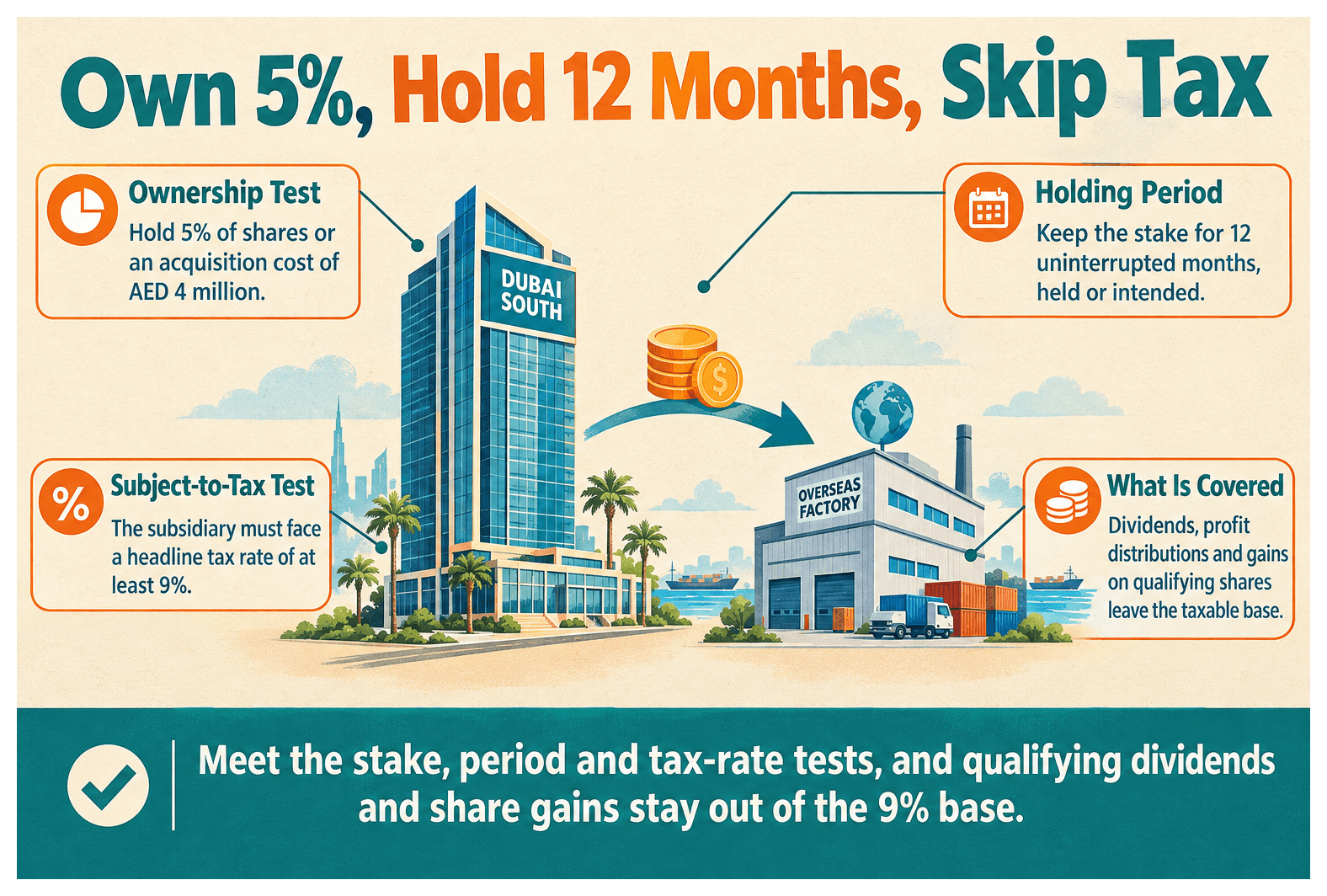
To qualify, you must hold at least 5% of the shares or an acquisition cost of AED 4 million, keep the stake for 12 months, and the subsidiary must face a headline tax rate of at least 9%. It also must not mainly hold ineligible assets.
Ownership Threshold and Holding Period
5% ownership, or AED 4 million cost.
12 uninterrupted months, held or intended.
Right to 5% of profits and liquidation proceeds.
A 4% stake bought for AED 5 million still passes through the cost test.
The Subject-to-Tax Test
The headline rate matters, not the effective rate after reliefs. A subsidiary in a zero-tax jurisdiction fails, so the dividend may stay taxable here. Treaty context helps, and our note on double tax treaties and your UAE company covers it.
Asset and Income Restrictions
The subsidiary's assets or income shouldn't consist mainly of ineligible investments. Deductions matter too. If it deducts a payment as interest to you, the matching dividend may stay taxable. Keep proof for each distribution date.
Participation Exemption Versus Other UAE Tax Reliefs
The dividend and capital gains exemption in the UAE works on shareholding income and is claimed in the return. Free zone qualifying income status and small business relief have separate conditions. Test each one on its own terms.
Free Zone Qualifying Income Compared
The free zone regime looks at income type and activity: 0% on qualifying income, 9% on non-qualifying income above AED 375,000. The exemption looks at the shareholding. A Dubai South company with consulting revenue and an overseas dividend treats each stream differently. See qualifying activities for UAE free zone corporate tax.
Where Withholding Tax Fits In
The UAE charges 0% withholding tax on domestic payments and outbound dividends. Inbound dividends may carry foreign withholding, which a treaty can reduce. Read more on withholding tax in the UAE.
Numbered Checklist to Claim the Exemption
Here's how does the UAE participation exemption work in practice: confirm ownership and holding period, test the subsidiary's tax rate, review its assets, document evidence, then claim it in the return on EmaraTax before the deadline.
Step 1: Confirm Ownership and Holding Period
Pull the share register and purchase agreement.
Check the 5% or AED 4 million test.
Count 12 months from acquisition.
Step 2: Test the Subsidiary's Tax Status
Request a tax residency certificate.
Obtain financial statements.
Confirm the 9% headline rate.
Step 3: Document and File the Return
Reconcile the dividend or gain to your accounts.
Attach a one-page memo of each condition.
File through EmaraTax within 9 months (Federal Tax Authority, 2026).
Using a Dubai South Free Zone Company as a Holding Vehicle
A Dubai South Business Hub free zone company can hold shares in other businesses and may use the participation exemption holding company Dubai structure for dividends and gains. Outcomes depend on your license activities and the free zone conditions.
Why Founders Choose a Holding Layer
One entity owns all operating businesses.
Future sales and restructuring get simpler.
Residency visa packages tie to the license.
Say an entrepreneur places two regional trading subsidiaries under one Dubai South entity. Our guide to corporate tax for UAE holding companies goes deeper.
Group Structure Considerations
A tax group needs 95% ownership and can sit alongside the exemption in suitable cases. Substance matters: keep board minutes and bank records in the UAE to evidence real management (Dubai Chamber guidance applies to licensing context).
Common Mistakes and Compliance Duties
Common errors include selling before 12 months, ignoring the subject-to-tax test, assuming the exemption is automatic and keeping weak records. A qualifying shareholding under UAE corporate tax still needs registration, annual filing and evidence.
Errors That Cost Money
Selling after 8 months turns the gain taxable at 9%.
Assuming low-tax subsidiaries qualify.
Mixing exempt and taxable income in accounts.
Filing late: AED 500 monthly in the first year.
Record-Keeping and Filing
Keep share agreements, financial statements and residency evidence for 7 years. Organise one file per subsidiary with a yearly checklist. For large or cross-border holdings, get a professional review.
Participation Exemption Summary Table for Quick Review
The exemption turns on five tests: stake size, holding period, subsidiary tax rate, asset profile and documentation. Meet all five and qualifying income drops out. Fail one and the 9% rate may apply.
Quick Reference for Founders
Run this table against each investment before year end. Stake size and tax rate need outside evidence.
Participation Exemption Conditions at a Glance
Feature | Condition | Requirement |
|---|---|---|
Ownership threshold: 5% or AED 4 million acquisition cost | Stake size or cost test | Share register and purchase agreement |
Holding period: 12 months uninterrupted | Held or intended to be held | Acquisition date before any sale |
Subsidiary tax rate: headline rate of at least 9% | Subject-to-tax test | Tax residency certificate |
Asset profile: not mainly ineligible investments | Asset and income review | Subsidiary financial statements |
Evidence: records filed with the corporate tax return | Claim in the return | Memo and records kept 7 years |
When to Get Professional Advice
Seek advice for cross-border structures, mixed-income subsidiaries and large disposals. A planned AED 20 million share sale deserves review before signing.
Your Next Step
Understanding how does the UAE participation exemption work comes down to five tests: stake size, holding period, subsidiary tax rate, asset profile and evidence. Meet them and qualifying dividends and gains leave your taxable base. Miss one and 9% may apply.
Speak with the Dubai South Business Hub team about a free zone company, trade license and residency visa package that fits your holding plans.
References
Frequently Asked Questions