
Topic Summary
UAE Withholding Tax Rate Is Currently Zero
The statutory withholding tax rate on UAE-sourced income paid to non-residents is 0% under Federal Decree-Law No. 47 of 2022. This means most cross-border payments carry no actual deduction, but the compliance framework still applies in full.
Dividends, Interest, and Royalties Are In Scope
Article 45 of the corporate tax law identifies dividends, interest, and royalties as the primary categories subject to withholding tax assessment. Any payment in these categories made to a non-resident without a UAE permanent establishment must be formally evaluated, even at a 0% rate.
A Zero Rate Does Not Mean Zero Obligations
Skipping the payment assessment entirely is where compliance risk actually sits, not the payment itself. Misclassifying an in-scope payment as outside scope creates a documentation gap that can surface during a Federal Tax Authority audit even when no tax was owed.
Late Registration Carries a Flat AED 10,000 Penalty
Businesses that fail to register for corporate tax on time face a one-time flat penalty of AED 10,000, regardless of whether any tax is actually due. This penalty applies even to companies whose effective tax liability is zero.
Keep a Payment Log for Every Cross-Border Transfer
A written payment log recording the nature, recipient, and treaty position of every cross-border payment is the lowest-risk compliance approach. This documentation must be retained for seven years under Federal Tax Authority standards.
Over 130 Double Taxation Agreements Affect Your Position
The UAE maintains more than 130 active double taxation agreements, which can influence how specific payments are classified and assessed under Article 45. Identifying the relevant treaty position should be part of every cross-border payment review.
Arm's-Length Evidence Is Required for Related-Party Fees
Management fees or similar payments routed to an overseas holding company must be supported by written evidence that the fee is priced at arm's length and properly assessed under Article 45. This applies even when the resulting withholding tax charge is zero.
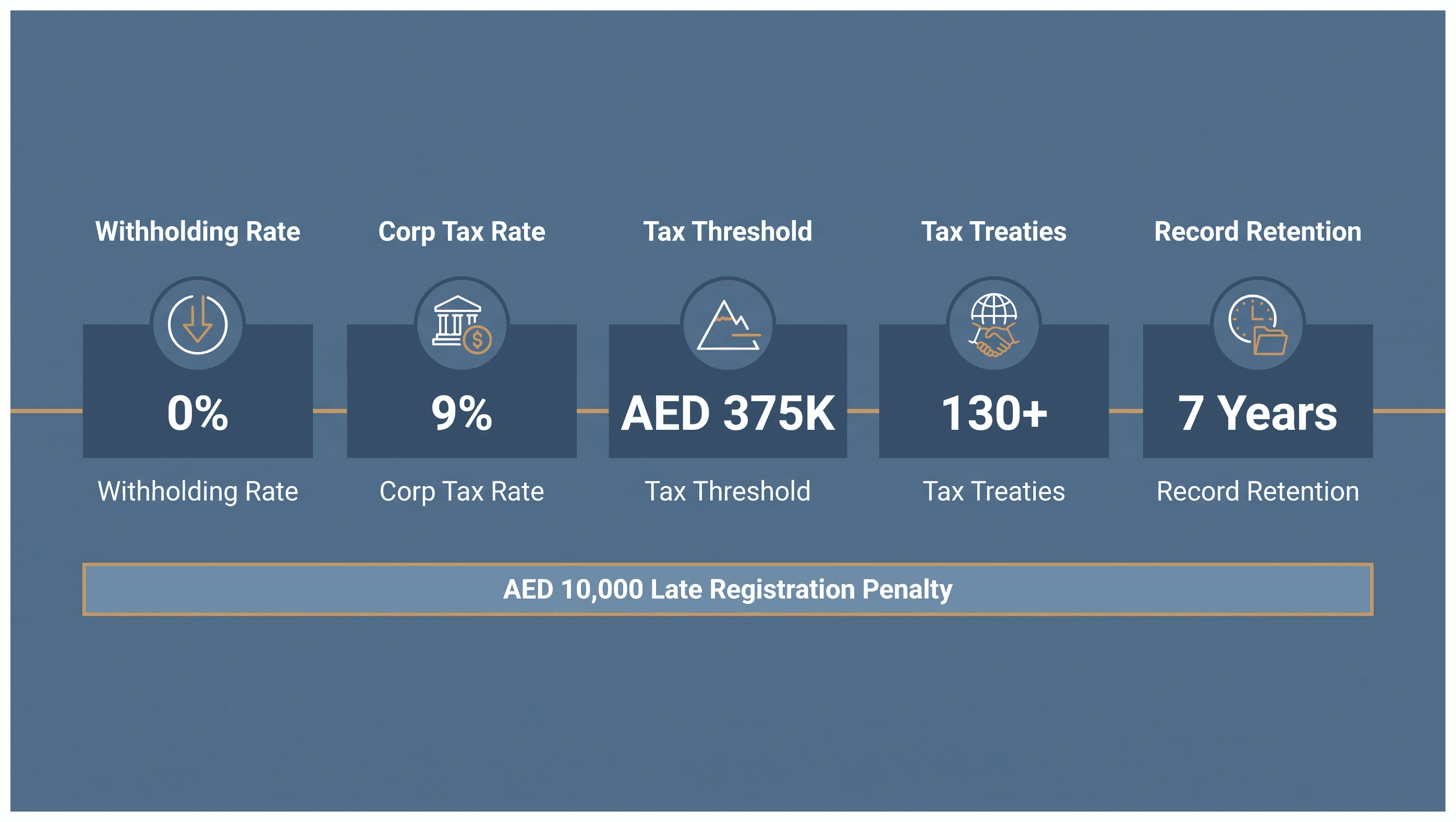
In 2026, the UAE's corporate tax regime has now completed its first full annual cycle since Federal Decree-Law No. 47 of 2022 took effect. The statutory withholding tax rate on UAE-sourced income paid to non-residents is currently 0% (Ministry of Finance, 2022). The standard corporate tax rate is 9% on taxable income above AED 375,000. The qualifying free zone person rate is 0%, subject to four specific conditions. Late corporate tax registration carries a one-time flat penalty of AED 10,000. The UAE maintains more than 130 active double taxation agreements (UAE Cabinet, 2024). Document retention under Federal Tax Authority standards runs seven years. Yet withholding tax in the UAE remains one of the most misread provisions among first-time founders.
This guide explains what withholding tax in the UAE actually covers, which payments fall inside the rules, what your compliance deadlines are, and how to document everything correctly so you can set up a company in Dubai with confidence.
What Is Withholding Tax in the UAE and Why It Matters
Withholding tax in the UAE is a mechanism under Federal Decree-Law No. 47 of 2022 that requires a UAE payer to deduct tax at source on specified categories of income paid to non-residents. The current statutory rate is 0%, meaning most payments carry no deduction obligation, but the compliance framework still applies.
The Definition Under UAE Corporate Tax Law
Withholding tax is defined in Article 45 of Federal Decree-Law No. 47 of 2022 as a tax collected at source by a UAE resident payer on behalf of the Federal Tax Authority. It applies to UAE-sourced income paid to non-resident persons who do not have a permanent establishment in the UAE. Categories in scope include dividends, interest, royalties, and other similar payments as the Minister of Finance may prescribe.
The current rate is 0%. That makes the mechanism largely administrative right now, but the legal obligation to identify in-scope payments remains fully active. A Dubai-registered technology consultancy paying a software license royalty to a parent company in Germany must assess whether that royalty is UAE-sourced income under Article 45 before concluding no withholding applies. Skipping the assessment, not just the payment, is where the compliance risk sits.
Why a Zero Rate Still Creates Obligations
A 0% rate does not eliminate the need to assess each payment against the statutory criteria. Misclassifying a payment as outside scope when it is technically in scope creates a documentation gap that surfaces during a Federal Tax Authority audit, even if no tax was ultimately owed.
Businesses that fail to register for corporate tax on time face a one-time flat penalty of AED 10,000, regardless of whether any tax is due. If you set up a company in Dubai and route management fees to an overseas holding company, you need written evidence that the fee is arm's-length and properly assessed under Article 45, even at a 0% rate. A payment log recording the nature, recipient, and treaty position of every cross-border payment is the lowest-risk approach. You can explore banking and taxation services that support this kind of documentation structure from day one.
Which Payments Trigger Withholding Tax in the UAE
Payments that can trigger withholding tax in the UAE include dividends, interest, royalties, and similar UAE-sourced income paid to non-resident persons without a UAE permanent establishment. At the current 0% rate these payments carry no actual deduction, but they must still be identified and documented under the corporate tax framework.
Categories of UAE-Sourced Income in Scope
Under Article 45, the categories currently in scope are:
Dividends paid by a UAE company to a non-resident shareholder
Interest on loans or financing arrangements where the borrower is UAE-resident
Royalties for the use of intellectual property, including patents, trademarks, and software licenses, where the payer is UAE-based
Additional categories the Minister of Finance may prescribe by decision
That last point matters. A UAE-registered media company paying a royalty to a UK-based content owner for broadcast rights must classify that payment under Article 45 and confirm the applicable rate before processing it. Monitoring official ministerial decisions on the Ministry of Finance portal is not optional; it is part of ongoing compliance.
Payments That Fall Outside the Rules
Not every cross-border payment is in scope. Service fees paid to a non-resident who has a permanent establishment in the UAE are excluded because the income is taxed through that permanent establishment directly. Payments for physical goods, as opposed to intangible rights or financing, are generally outside scope too.
A logistics company paying a foreign freight operator for physical cargo movement is paying for a service, not a UAE-sourced passive income stream, so withholding tax in the UAE does not apply. Inter-company recharges for shared costs, where properly documented as cost allocations rather than royalties or interest, also typically fall outside Article 45. The distinction between a service fee and a passive income payment is the line worth drawing carefully in your payment register.
How Double Taxation Agreements Affect Withholding Tax in the UAE
The UAE's network of more than 130 double taxation agreements can reduce or eliminate withholding tax on specific payment categories. To apply a treaty rate, the UAE payer must obtain a valid tax residency certificate from the foreign recipient before the payment is made. Without that document, the default statutory rate applies.
How to Apply a Treaty Rate Correctly
Identify the relevant treaty using the Ministry of Finance treaty register at mof.gov.ae.
Request a tax residency certificate from the foreign payee, issued by that country's competent tax authority.
Confirm the certificate is valid and covers the period of the payment before applying any reduced rate.
Retain the certificate in your records for at least seven years to satisfy Federal Tax Authority documentation standards.
A Dubai South Business Hub Free Zone company paying dividends to a French parent should obtain a French tax residency certificate and check the UAE-France double taxation agreement before concluding the applicable withholding rate. This applies even when the current domestic rate is 0%, because the treaty position needs to be on file before any future rate change creates exposure.
What Happens Without a Valid Certificate
If no treaty certificate is held, the payer must apply the domestic statutory rate. At 0%, that means no actual deduction, but there is still a documentation gap. If the rate rises through a future ministerial decision, applying the wrong rate without a certificate on file becomes a real financial exposure.
The Federal Tax Authority can request treaty documentation during a compliance review. Absence of records is treated as non-compliance, not an oversight. Retroactively obtaining a certificate is possible in some jurisdictions, but it is not guaranteed and creates operational risk. A founder who skips the certificate step when the rate is 0% may find the same payment structure exposed if rates are revised, because no treaty protection is documented. Your business activities in Dubai determine which treaties are most likely to apply, so that analysis starts at the licensing stage.
Step-by-Step Withholding Tax UAE Compliance Guide
A withholding tax UAE compliance guide covers six steps: register for corporate tax before your deadline, identify every cross-border payment, classify each payment against Article 45, collect treaty certificates where relevant, report within your corporate tax return cycle, and retain all documentation for at least seven years.
Step 1: Register for Corporate Tax on Time
Every UAE juridical person subject to corporate tax must register with the Federal Tax Authority before the deadline prescribed for its financial year. Late registration carries a one-time flat penalty of AED 10,000, regardless of how long the delay runs or whether any tax is owed.
Free zone companies, including those at Dubai South Business Hub Free Zone, must register even if they expect to qualify for the 0% qualifying free zone person rate. Registration opens your access to the EmaraTax portal at tax.gov.ae, where withholding-related declarations are filed. A company incorporated at Dubai South Business Hub Free Zone with a financial year ending 31 December must register and file its return by 30 September of the following year.
Step 2: Map, Classify, and Document Every Cross-Border Payment
Create a payment register listing every cross-border payment, the recipient's country, and the payment category.
For each payment, confirm whether it meets the Article 45 definition of UAE-sourced income paid to a non-resident.
Attach the relevant treaty certificate or a written note explaining why no treaty applies.
Review the register quarterly, not just at year-end, to catch misclassifications early.
A quarterly review would have caught a Dubai-based e-commerce company that was misclassifying platform license fees as service fees, which carry different treaty treatment. Annual reviews leave too little time to correct errors before the return deadline.
Step 3: Report and Retain
Withholding tax obligations are reported as part of the annual corporate tax return filed through the EmaraTax portal. The return is due nine months after the end of the relevant tax period. For a December year-end, that means 30 September of the following year.
All supporting documents, including payment registers, treaty certificates, and board resolutions authorising dividends, must be retained for seven years. If the Federal Tax Authority issues a ministerial decision changing applicable rates during the year, update your register immediately rather than waiting for the next filing cycle.
Withholding Tax UAE Compliance Calendar
Compliance Obligation | Deadline or Rule |
|---|---|
Corporate tax registration | Before the first return filing deadline for your tax period. Late registration: AED 10,000 one-time flat penalty. |
Treaty certificate collection | Must be obtained and dated before each relevant payment is processed. Cannot be applied retrospectively with certainty. |
Annual corporate tax return (December year-end) | 30 September (nine months after 31 December year-end). Filed via EmaraTax portal. |
Withholding declaration filing | Included within the annual corporate tax return. Same 30 September deadline for December year-end businesses. |
Document retention period | Seven years from the end of the tax period to which the records relate. Covers payment registers, treaty certificates, and board resolutions. |
Late registration penalty | AED 10,000 one-time flat charge for corporate tax. AED 10,000 separate flat penalty for VAT if applicable. Flat rate regardless of delay length. |
Withholding Tax UAE Deadline and Compliance Calendar
The key withholding tax UAE deadline is the corporate tax return due date: nine months after the end of your financial year. For a 31 December year-end that is 30 September. Corporate tax registration must be completed before the first return deadline. Late registration incurs a one-time AED 10,000 flat penalty.
Key Dates for a December Year-End Business
A Dubai South Business Hub Free Zone company incorporated in January with a December year-end has until 30 September the following year to file its first corporate tax return, covering any withholding tax positions taken during that period. Here is how the calendar breaks down:
Corporate tax registration: Before the first return filing deadline, typically within the first tax period after incorporation.
Annual return and withholding declarations: 30 September (nine months after 31 December year-end).
Treaty certificates: Obtained and dated before each relevant payment, not after the fact.
Document retention: Seven years from the end of the tax period to which the records relate.
You can use the business setup cost calculator to model your full compliance investment alongside your licensing costs from the start.
Penalties for Missing the Withholding Tax UAE Deadline
Late corporate tax registration: AED 10,000 one-time flat penalty.
Late VAT registration (separate obligation): AED 10,000 flat penalty.
Errors in the corporate tax return: Additional administrative penalties under Federal Tax Authority guidelines.
Voluntary disclosure: Always treated more favourably than errors found during a Federal Tax Authority review.
A founder who delays corporate tax registration by three months does not face a proportional penalty. The AED 10,000 charge is flat and applies regardless of how long the delay runs. If you discover a filing error before an audit, voluntary disclosure through the EmaraTax portal is the right move. Waiting for the Federal Tax Authority to find it first is always the more expensive outcome.
Is withholding tax in the UAE the same as corporate tax?
No. Withholding tax in the UAE is a separate mechanism under Article 45 of Federal Decree-Law No. 47 of 2022, applied at the payment level on UAE-sourced income paid to non-residents. Corporate tax applies to a UAE entity's own taxable income. Both obligations are reported through the same EmaraTax portal but are assessed independently.
Withholding Tax in the UAE for Free Zone Companies
Free zone companies in the UAE are subject to the same withholding tax framework as mainland businesses. A qualifying free zone person taxed at 0% on qualifying income must still assess cross-border payments under Article 45, maintain treaty documentation, and file a corporate tax return. The 0% qualifying rate requires four specific conditions to be met.
The Four Conditions for the 0% Qualifying Free Zone Rate
Adequate substance: Real office presence, qualified employees, and management decisions made locally in the UAE.
Qualifying income: Revenue must fall within the categories defined in ministerial decisions issued under the Corporate Tax Law.
No standard rate election: The company must not have elected to be subject to the standard 9% corporate tax rate.
Transfer pricing compliance: Related-party transactions must be documented at arm's-length and supported by adequate transfer pricing records.
A technology company holding an ICT license in Dubai at Dubai South Business Hub Free Zone that meets substance requirements, earns qualifying income from services to foreign clients, and maintains transfer pricing documentation can access the 0% qualifying rate. But it must still file a corporate tax return, and it must still assess every outbound payment under Article 45.
How Withholding Tax Interacts With Free Zone Status
The withholding obligation sits at the payment level, not the entity tax rate level. A free zone company paying dividends to a non-resident shareholder must still apply the Article 45 withholding tax assessment even if its own corporate tax rate is 0%. These are two separate layers of the same law.
A free zone holding company paying a dividend to its German parent company cannot skip the Article 45 assessment simply because it qualifies for 0% on its own income. Dubai South Business Hub Free Zone is not a designated zone, so goods-related duty suspension rules do not apply to the withholding tax analysis. Build the Article 45 assessment into your treasury process from the first payment, not as an afterthought at year-end.
Setting Up in Dubai With Withholding Tax Compliance Built In
First-time founders setting up in Dubai should build withholding tax compliance into their company structure from day one. Choosing the right license, registering for corporate tax before the deadline, mapping all cross-border payment flows, and maintaining treaty documentation are the four
References
Frequently Asked Questions