Topic Summary
What Is a Dubai South E-Commerce License for Egyptian Entrepreneurs and Why It Matters
A Dubai South e-commerce license lets Egyptian entrepreneurs legally sell goods online from Dubai South Business Hub Free Zone with 100% foreign ownership. It covers website and marketplace trading, supports nearby warehousing, and can be paired with residency visas tied to the company license.
Which Requirements Must Egyptian Entrepreneurs Meet to Qualify
Which Requirements Must Egyptian Entrepreneurs Meet to Qualify
Step-by-Step Guide to Setting Up Your Dubai South E-Commerce License
Setting up takes six stages: define your activity, check the name, submit the application, receive approval, sign the lease or flexi-desk agreement, and collect your license and visas. Payment gateway applications can start once the license is issued, or earlier using draft documents.
How Payment Gateway Approval Runs Alongside Your License
Payment gateway approval doesn't have to wait until your license is printed. Prepare website policies, product listings and KYC documents during formation, then submit right after license issue. Running both tracks together can shorten time to first sale for your e-commerce company in Dubai South.
How the UAE-Egypt Trade Agreement Supports Egyptian Online Sellers
The UAE-Egypt trade agreement strengthens bilateral trade ties and can ease tariff and market-access conditions on eligible goods. For Egyptian e-commerce founders, it supports sourcing from Egypt, re-exporting through Dubai South, and selling across the GCC. Always verify product eligibility before shipping.
How Much Does It Cost and How Long Does It Take to Set Up
Costs depend on license type, visa count and office option, and are quoted in AED with a stated date. Timelines are typically days to a couple of weeks once documents are complete. Use the cost calculator for a current Dubai South e-commerce license estimate, and confirm all fees in writing.
Which Regulations in the UAE Apply to an E-Commerce Company in Dubai South
E-commerce companies in Dubai South must follow UAE corporate tax, VAT, consumer protection and data rules. Registration with the Federal Tax Authority may be required depending on revenue and activity. Free zone benefits are conditional, so confirm qualifying income and substance with a tax adviser.
The UAE e-commerce market is projected to pass USD 8 billion in 2026 [1], and Dubai's non-oil foreign trade topped AED 2.2 trillion in 2024 [2]. Egyptian nationals can own 100% of an e-commerce company at Dubai South Business Hub Free Zone. The license, visa and payment gateway approval can run in parallel.
A Dubai South e-commerce license for Egyptian entrepreneurs is typically issued within days once documents are in order. This guide is for Egyptian founders who want to go from idea to first sale. You'll see the requirements, steps, costs and tax rules, with fees quoted in AED and dated.
What Is a Dubai South E-Commerce License for Egyptian Entrepreneurs and Why It Matters
A Dubai South e-commerce license lets Egyptian entrepreneurs legally sell goods online from Dubai South Business Hub Free Zone with 100% foreign ownership. It covers website and marketplace trading, supports nearby warehousing, and can be paired with residency visas tied to the company license.
What the License Actually Covers
Picture a Cairo-based fashion founder selling modest wear to GCC buyers through a Shopify store. The company sits at Dubai South, the license covers retail trading online, and related activities can be added later. That's the core of an e-commerce company in Dubai South: one free zone entity, fully Egyptian-owned. For activity details, see the online internet retail trading license in Dubai.
Why Egyptian Founders Choose Dubai South
Close to Al Maktoum International Airport.
Road links to Saudi and Kuwaiti buyers.
Free zone ownership, no local sponsor needed.
Visa packages tied to the license.
A mainland setup can need a local service agent or partner structure for some activities. The free zone route is simpler. Here's why choose Dubai South for ecommerce in more detail.
Which Requirements Must Egyptian Entrepreneurs Meet to Qualify
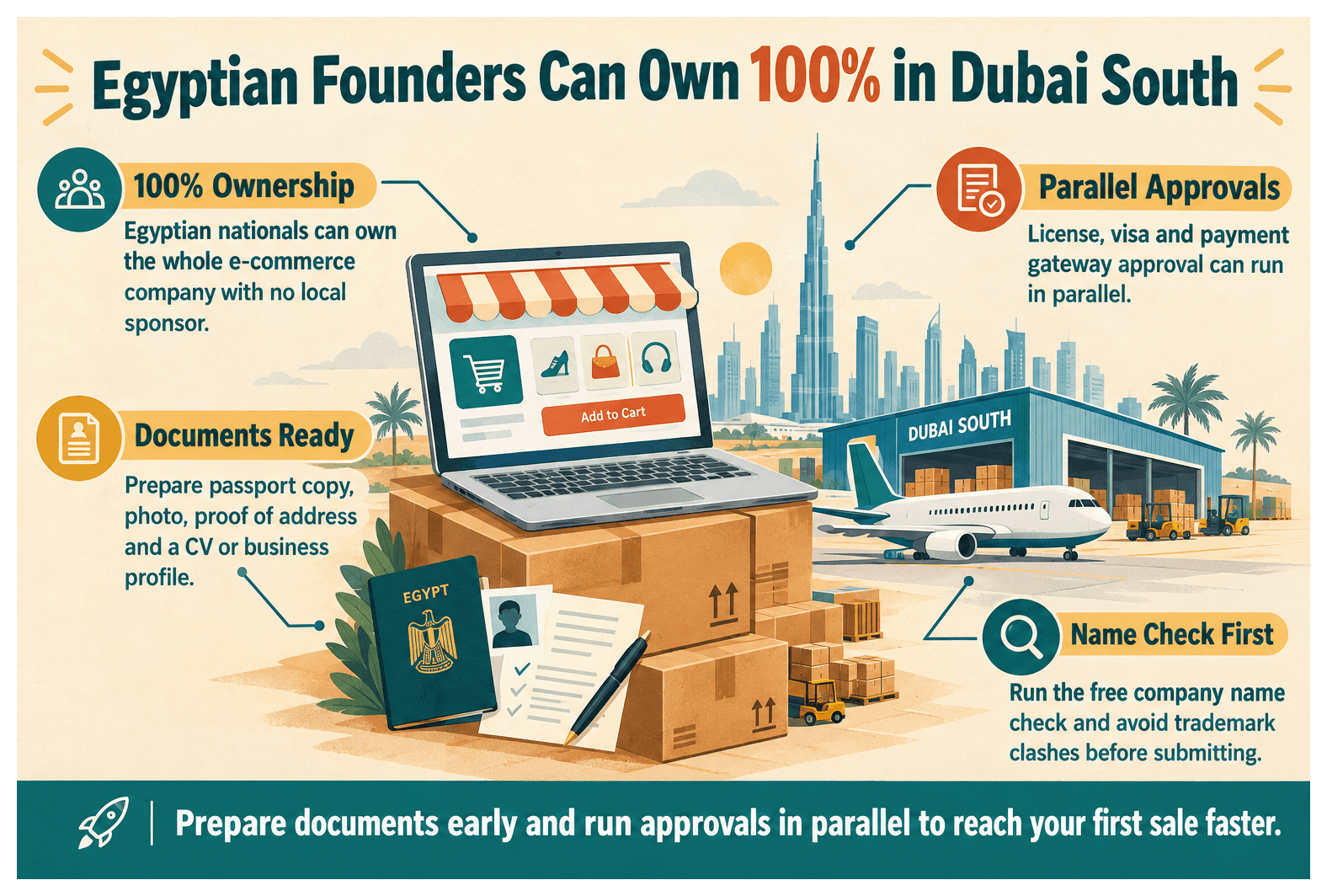
Egyptian entrepreneurs need a valid passport, a clear business activity, a proposed company name and shareholder details. Shareholders must be 18 or older, and no local sponsor is required. Compliance checks and source-of-funds documents may be requested, so prepare early for business setup in Dubai from Egypt.
Documents Egyptian Applicants Should Prepare
Passport copy and photo.
Egyptian national ID where applicable.
Attested documents for corporate shareholders.
Proof of address and a CV or business profile.
A husband-and-wife team applying as co-shareholders moved faster because they had a corporate profile ready.
Choosing and Checking Your Company Name
Avoid prohibited terms and trademark clashes. One founder dropped a name that conflicted with an existing trademark before submission, saving a rejection. Run the free company name check first, and match the name to your domain.
What Egyptian Founders Need to Know Before Applying
Visa, tax and banking rules differ for non-UAE nationals. One applicant lost a week to an unclear passport scan. Read what Egyptian founders need to know before setting up in Dubai to avoid similar Mistakes.
Step-by-Step Guide to Setting Up Your Dubai South E-Commerce License
Setting up takes six stages: define your activity, check the name, submit the application, receive approval, sign the lease or flexi-desk agreement, and collect your license and visas. Payment gateway applications can start once the license is issued, or earlier using draft documents.
Step 1: Define Your E-Commerce Activity and Product Range
ISIC Rev.4 classifies activities by the goods or services provided, not the sales channel (UN Statistics Division). So a home goods seller falls under retail trade, not a separate "online" activity. Confirm restricted products and choose marketplace or own-site selling.
Step 2: Check Your Name and Submit the Application
Submit passport, shareholder and activity details with three name options to avoid rework.
Step 3: Sign Agreements and Pay Fees
Sign the license and facility agreements, then pay against a dated AED quote. Compare a flexi-desk with a larger office using the cost calculator.
Step 4: Collect the License, Apply for Visas and Open Banking
You'll receive the trade license and establishment card. One Egyptian founder started visa processing the same week the license arrived. Apply for the corporate bank account in parallel. The guide to setting up a company in Dubai South as an Egyptian national covers the paperwork.
How Payment Gateway Approval Runs Alongside Your License
Payment gateway approval doesn't have to wait until your license is printed. Prepare website policies, product listings and KYC documents during formation, then submit right after license issue. Running both tracks together can shorten time to first sale for your e-commerce company in Dubai South.
What Gateways Ask For
Trade license and passport.
Emirates ID or visa status.
Bank details.
Refund policy, terms, contacts and clear pricing.
One gateway rejected a site with no refund policy. The fix took a day.
Building a Parallel Timeline
In week one, build the site and policies while the license is processed. In week two, submit gateway KYC once the license lands. Keep the store in staging mode until approvals complete. Payment services are overseen by the Central Bank of the UAE.
Payment Setup Tips for Cross-Border Sellers
Plan for AED and USD card payments settled to a UAE account, and budget for cross-border fees and chargebacks. More detail is in e-commerce business setup in Dubai: licensing, platforms and payment setup.
How the UAE-Egypt Trade Agreement Supports Egyptian Online Sellers
The UAE-Egypt trade agreement strengthens bilateral trade ties and can ease tariff and market-access conditions on eligible goods. For Egyptian e-commerce founders, it supports sourcing from Egypt, re-exporting through Dubai South, and selling across the GCC. Always verify product eligibility before shipping.
Sourcing Egyptian Goods for Online Sale
Textiles, food, cosmetics and handicrafts are common categories. Keep rules-of-origin documents ready, since eligibility varies by product. Imagine an Egyptian cotton home textile brand shipping stock to Dubai South for GCC orders, against Dubai's AED 2.2 trillion non-oil trade backdrop (Dubai Chamber, 2024).
Using Dubai South as a Fulfilment and Re-Export Base
Consolidate Egyptian shipments in one warehouse and dispatch by order via air and road. Check import and export between Egypt and Dubai for license needs.
How Much Does It Cost and How Long Does It Take to Set Up
Costs depend on license type, visa count and office option, and are quoted in AED with a stated date. Timelines are typically days to a couple of weeks once documents are complete. Use the cost calculator for a current Dubai South e-commerce license estimate, and confirm all fees in writing.
Cost Breakdown in AED
A solo founder with one visa pays less than a two-partner team with three visas. Fees change, so every AED figure must carry its quote date.
Estimated Dubai South E-Commerce Setup Costs in AED (Fee Date Stated)
Feature | Cost Item | Estimated Amount in AED (as of fee date) |
|---|---|---|
E-commerce trading license | Annual online retail license | AED amount shown on dated calculator quote |
Company registration and approvals | One-time registration and approvals | AED amount shown on dated calculator quote |
Office or flexi-desk facility | Flexi-desk or larger office | Varies by option; confirm in writing |
Residency visa package | Per visa, tied to the license | Scales with visa count |
Payment gateway setup (third-party fees vary) | Provider onboarding and transaction fees | Set by the gateway provider |
Realistic Timeline From Application to First Sale
Run formation, visas, banking and gateway approval together and you can reach a first order within a few weeks. Delays usually come from unclear scans and missing refund policies.
Which Regulations in the UAE Apply to an E-Commerce Company in Dubai South
E-commerce companies in Dubai South must follow UAE corporate tax, VAT, consumer protection and data rules. Registration with the Federal Tax Authority may be required depending on revenue and activity. Free zone benefits are conditional, so confirm qualifying income and substance with a tax adviser.
Corporate Tax and Free Zone Conditions
The standard UAE corporate tax rate is 9% above the threshold (Federal Tax Authority). A free zone setup isn't tax free. A founder with mixed qualifying and non-qualifying income should review treatment with an adviser.
VAT, Consumer Protection and Customs
VAT registration threshold: AED 375,000.
Honour return and refund rules for buyers.
Keep customs papers for goods moved in and out.
Apply VAT correctly on GCC deliveries.
See setting up an e-commerce business in Dubai for more.
What Should You Do Next to Start Re-Exporting From Dubai South
Start by checking your name, estimating costs and preparing documents. Then submit your application, begin gateway preparation in parallel, and plan fulfilment. Speaking with a Dubai South adviser early helps avoid delays.
Your 7-Day Action Plan
Days 1-2: name check, cost estimate, documents.
Days 3-5: application and site policies.
Days 6-7: license follow-up and gateway KYC.
Where to Go for Deeper Guidance
Review warehousing options before choosing activities, starting with the e-commerce warehousing and storage license.
Conclusion
A Dubai South e-commerce license for Egyptian entrepreneurs offers 100% ownership, nearby fulfilment, UAE-Egypt trade agreement support and parallel gateway approval. Check your company name, run the cost calculator, and speak with a Dubai South Business Hub adviser to begin your application.
References
Statista, UAE e-commerce market outlook, 2025.
Dubai Chamber, non-oil foreign trade figures, 2024.
Federal Tax Authority, corporate tax and VAT guidance, 2025.
Central Bank of the UAE, payment services oversight, 2025.
United Nations Statistics Division, ISIC Rev.4, 2008.
Frequently Asked Questions