
Topic Summary
What Is Profit Repatriation for South African Nationals Financial UAE Planning and Why It Matters
Profit repatriation is the lawful transfer of earnings from your Dubai free zone company to you in South Africa. It usually takes the form of dividends, salary or director loan repayments. South African nationals financial UAE planning matters because each route carries different UAE and SARS tax consequences and documentation requirements.
Corporate Tax, Dividends and What the UAE Takes Before You Repatriate
Corporate Tax, Dividends and What the UAE Takes Before You Repatriate
Step-by-Step Process to Repatriate Profits From Your Dubai Company
To repatriate profits, close your financial year, confirm distributable profit, pass a shareholder resolution, pay corporate tax due, transfer funds by bank wire, and declare the receipt to SARS. Keep documents for each stage so SARB and your bank can trace the source of funds.
Comparing Dividends, Salary and Loan Repayment Costs in AED
Dividends carry no UAE withholding tax, salary requires payroll and visa alignment, and loan repayments return capital you previously lent without UAE tax. Each route has different SARS treatment, as the table above shows. Compare total cost in AED, then run your own numbers in the Dubai South Business Hub cost calculator .
SARS Tax Residency and Compliance When Profits Reach South Africa
SARS taxes South African tax residents on worldwide income, so Dubai dividends must be declared. Non-residents are generally taxed only on South African-source income. The UAE-South Africa double tax treaty helps prevent paying twice, but South African nationals financial UAE records must prove residency, accounts and tax paid.
Using Dubai as a SADC Distribution Base Without Trapping Your Cash
A Dubai company can act as a SADC distribution base, buying goods, invoicing South African and regional customers, and holding margin in AED or USD. Plan payment flows so profit returns on schedule, and invoice correctly to control VAT and SARS exposure in your UAE business from South Africa.
Common Mistakes South African Founders Make and What to Do Next
The most common errors are paying out before settling corporate tax, skipping shareholder resolutions, ignoring SARS declarations and mixing personal and company funds. Fix them with clean records, a deliberate payout route, and a confirmed company name and structure before you scale.
South African entrepreneurs repatriate profits from a Dubai free zone company mainly through dividends, salary or loan repayments, paid by bank transfer to a South African account. The best route depends on your SARS tax residency, your UAE corporate tax position and how you document the funds.
In 2026, the UAE charges 0% withholding tax on dividends [1]. Corporate tax is 9% only on taxable income above AED 375,000 [1]. South Africa's top personal rate is 45% [2]. Individuals can send ZAR 1 million offshore a year under the Single Discretionary Allowance [3]. The UAE has over 140 double tax treaties in force [4], and trade with South Africa exceeds USD 10 billion [5]. This guide is for South African nationals financial UAE planning: you'll learn how to pick a route, follow the steps and stay compliant.
What Is Profit Repatriation for South African Nationals Financial UAE Planning and Why It Matters
Profit repatriation is the lawful transfer of earnings from your Dubai free zone company to you in South Africa. It usually takes the form of dividends, salary or director loan repayments. South African nationals financial UAE planning matters because each route carries different UAE and SARS tax consequences and documentation requirements.
How Profit Repatriation Works for a Dubai Free Zone Company
Your company earns revenue, pays UAE corporate tax if applicable, then distributes retained earnings. Distributions need accounts that support the available profit. Picture a Johannesburg-born consultant with a Dubai South Business Hub license who pays herself AED 180,000 in dividends once year-end accounts are approved. The money moves from the company account to her personal or South African account.
Why South African Founders Face a Different Equation
SARS taxes tax residents on worldwide income.
SARB exchange control governs money leaving and returning.
Resident versus non-resident status changes the tax on the same AED 200,000 profit.
When Repatriating Makes Sense and When to Leave Cash in the Company
Distribute only what you need personally. A trading founder who keeps AED 120,000 in the company to fund the next SADC shipment often does better than one who sweeps everything home. Keep healthy bank balances too, since a thin account can raise questions about substance. Our guide to repatriating profits from a Dubai company covers more scenarios.
Corporate Tax, Dividends and What the UAE Takes Before You Repatriate
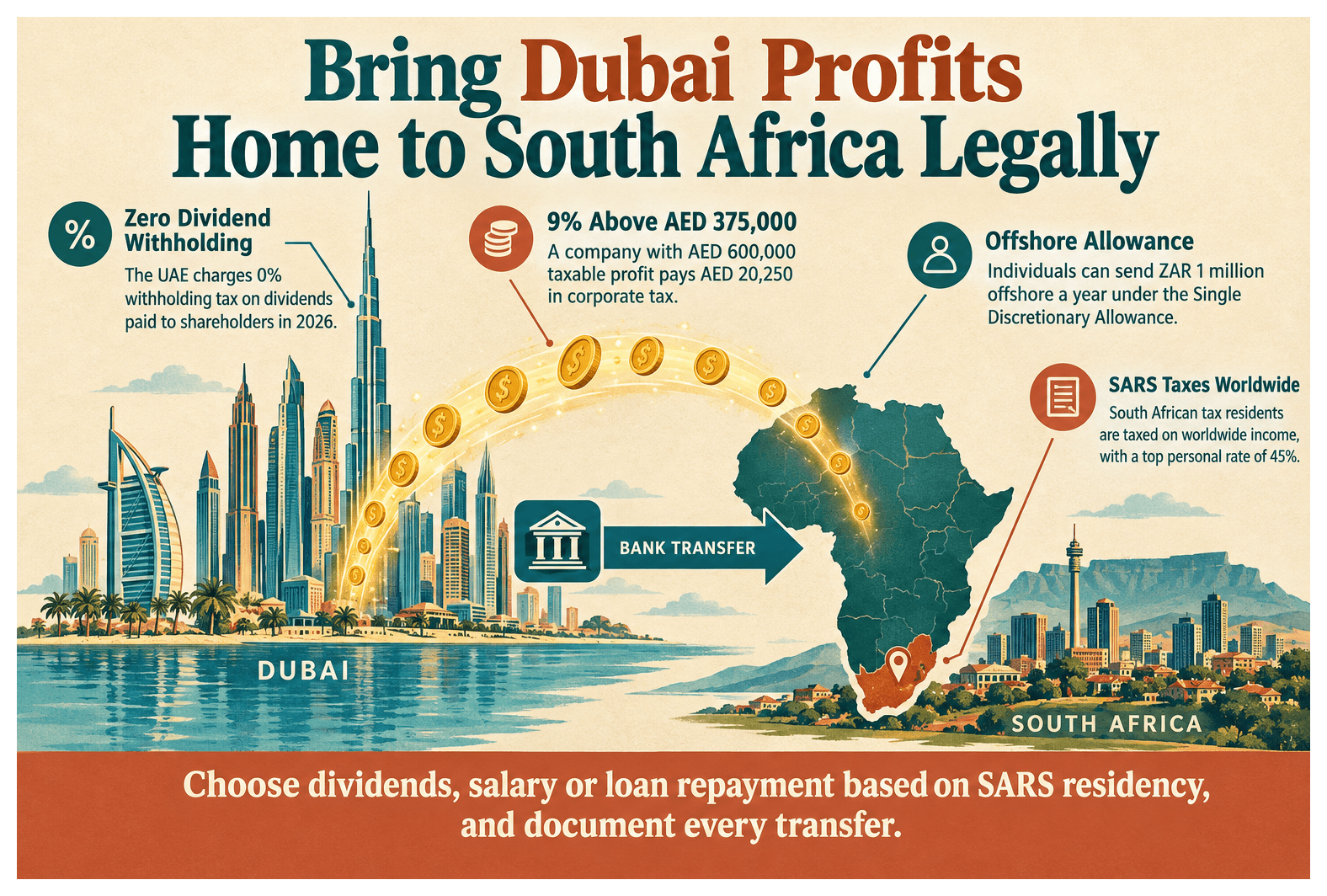
The UAE charges 9% corporate tax on taxable income above AED 375,000 and no withholding tax on dividends, so profit leaves the country without a UAE exit levy. Qualifying free zone income may be taxed differently, so confirm your company's status with the Federal Tax Authority before distributing.
The 9% Corporate Tax Threshold Explained in AED
The first AED 375,000 is taxed at 0%. A company with AED 600,000 taxable profit pays 9% on AED 225,000, which is AED 20,250 (illustrative, 2026 rates). Register for corporate tax and file on time.
Why Dividends Face No UAE Withholding Tax
No withholding applies to resident or non-resident shareholders.
Dividends must come from distributable reserves.
Keep a shareholder resolution on file, such as one approving AED 150,000.
VAT and Other UAE Obligations That Affect Distributable Profit
VAT registration becomes mandatory above AED 375,000 in taxable supplies, and late registration costs AED 10,000 (FTA, 2026). That penalty shrinks your dividend pool. Read our note on VAT obligations for South African entrepreneurs before you plan a payout.
Step-by-Step Process to Repatriate Profits From Your Dubai Company
To repatriate profits, close your financial year, confirm distributable profit, pass a shareholder resolution, pay corporate tax due, transfer funds by bank wire, and declare the receipt to SARS. Keep documents for each stage so SARB and your bank can trace the source of funds.
Step 1: Close the Books and Confirm Distributable Profit
Prepare accounts for the financial year.
Settle corporate tax and VAT first.
Confirm retained earnings (for example, AED 260,000 after tax).
Step 2: Pass a Shareholder Resolution and Choose the Payout Route
Choose dividend, salary or loan repayment.
Document the decision in writing.
Match the route to your SARS residency position, such as AED 100,000 salary plus AED 80,000 dividend.
Comparison of Profit Repatriation Routes From a Dubai Company (AED, fee figures dated)
Feature | Dividends | Salary or Loan Repayment |
|---|---|---|
UAE withholding tax | 0% on dividends (FTA, 2026) | None on salary or on loan principal returned |
SARS treatment | Foreign dividend declared by residents; partial exemptions may apply | Salary taxed at marginal rates up to 45%; a documented loan repayment is generally capital, not income |
Paperwork required | Accounts and shareholder resolution | Payroll records and visa alignment, or a signed loan agreement |
Typical transfer cost in AED | Wire fee plus FX spread; 1.5% on AED 100,000 is AED 1,500 (illustrative, 2026) | Same wire and FX costs, plus payroll admin for salary |
Best suited for | Owners drawing surplus profit after year-end | Salary for visa-linked roles; loan repayment for founders who funded the company |
Step 3: Transfer Funds and Declare Them in South Africa
Send a bank wire with a clear narrative, such as "dividend distribution FY end", and attach the resolution.
Check SARB reporting and your ZAR 1 million Single Discretionary Allowance.
Declare foreign dividends in your SARS return.
Sort your UAE corporate bank account early, and see our guide to moving capital to Dubai from South Africa for the reverse flow. Bank rules are published by the Central Bank of the UAE.
Comparing Dividends, Salary and Loan Repayment Costs in AED
Dividends carry no UAE withholding tax, salary requires payroll and visa alignment, and loan repayments return capital you previously lent without UAE tax. Each route has different SARS treatment, as the table above shows. Compare total cost in AED, then run your own numbers in the Dubai South Business Hub cost calculator.
Hidden Costs Founders Overlook
Bank wire charges and the FX spread.
Accounts or audit fees.
Accountant time for SARS declarations.
Model payout scenarios before year-end. A founder might compare a license renewal against an extra salary draw, and the answer changes once fees are dated and added up.
SARS Tax Residency and Compliance When Profits Reach South Africa
SARS taxes South African tax residents on worldwide income, so Dubai dividends must be declared. Non-residents are generally taxed only on South African-source income. The UAE-South Africa double tax treaty helps prevent paying twice, but South African nationals financial UAE records must prove residency, accounts and tax paid.
Resident Versus Non-Resident: Why Status Decides Your Tax
SARS applies the ordinarily resident and physical presence tests. A founder spending 200 days in Dubai can still be ordinarily resident in South Africa. Formal emigration is a separate step, so speak to a South African tax adviser. Our summary of South Africa tax rules for Dubai company owners explains more.
How the UAE and South Africa Tax Treaty Reduces Double Taxation
The UAE has over 140 treaties in force (Ministry of Finance, 2026). Treaty relief and foreign tax credits can offset tax paid abroad. Keep your UAE tax residency certificate.
Records to Keep for Seven Years
Resolutions and annual accounts.
Bank statements and wire confirmations.
One audit-ready folder per financial year.
Using Dubai as a SADC Distribution Base Without Trapping Your Cash
A Dubai company can act as a SADC distribution base, buying goods, invoicing South African and regional customers, and holding margin in AED or USD. Plan payment flows so profit returns on schedule, and invoice correctly to control VAT and SARS exposure in your UAE business from South Africa.
Structuring Invoicing and Payment Flows From Dubai to SADC
Choose your invoice currency deliberately. UAE VAT is 5% on most supplies (FTA, 2026), while qualifying exports may be zero-rated. Think of a Dubai trader selling to buyers in Gauteng and Zambia. Our guide on how to invoice South Africa clients legally helps. Bilateral trade tops USD 10 billion (World Bank, 2024).
Balancing Reinvestment and Repatriation
Hold working capital for stock, say AED 150,000.
Repatriate the surplus, say AED 90,000.
Review the split every year.
Common Mistakes South African Founders Make and What to Do Next
The most common errors are paying out before settling corporate tax, skipping shareholder resolutions, ignoring SARS declarations and mixing personal and company funds. Fix them with clean records, a deliberate payout route, and a confirmed company name and structure before you scale.
Five Repatriation Mistakes to Avoid
Distributing without distributable reserves.
Wiring without documents (one founder sent AED 80,000 with no resolution and the bank froze it).
Leaving foreign income undeclared to SARS.
Missing VAT or corporate tax registration.
Ignoring SARB reporting.
What to Do Next to Start Repatriating Safely
Run your company name through the name check tool.
Confirm your license and residency package.
Map your first dividend before year-end.
South African nationals financial UAE planning comes down to choosing the right payout route, paying UAE tax first, declaring income to SARS and keeping records. Run your numbers in the cost calculator and speak with Dubai South Business Hub about a free zone license and residency package.
References
Frequently Asked Questions