Topic Summary
What Approval for a Food Trading Business in Dubai Means and Why It Matters
To get approval for a food trading business in Dubai, you need your free zone trade license plus separate clearance from the food safety regulator, mainly Dubai Municipality. Without it, you can't register products, clear shipments or store and distribute goods legally.
Which Regulator Decides Whether You Can Trade Food
Which Regulator Decides Whether You Can Trade Food
Who Needs Approval for a Food Trading Business in Dubai From a Free Zone
Any Dubai South company that imports, stores, re-exports or distributes foodstuff needs regulator approval. That includes general traders, wholesalers, juice and frozen goods traders, and specialists in baby food, bakery, organic and confectionery.
Stage-by-Stage Process to Get Approval for a Food Trading Business in Dubai
First secure your Dubai South license with the right food activity. Then register as an importer, register each product, pass premises inspection and obtain shipment permits through Dubai Trade. Keep documents consistent throughout.
Documents Required to Get Approval for a Food Trading Business in Dubai
Expect to provide your license, shareholder passports and Emirates IDs, storage details, labels, ingredient lists, origin certificates and health or halal certificates. Incomplete paperwork is the most common reason approvals stall.
Typical Timelines and Costs for Food Trading Approvals
Free zone licensing can complete within days. Regulator registration often takes one to several weeks, depending on product count and document quality. Budget beyond the license fee.
Common Mistakes That Delay Food Trading Approval in Dubai
The biggest delays come from the wrong license activity, incomplete labels, ignored storage rules and stock ordered before registration. Plan the sequence first to avoid port holds in your food trading business in Dubai.
Dubai's non-oil trade has passed AED 2.2 trillion, and food remains one of the busiest import categories (Dubai Chamber of Commerce, 2024). This guide shows entrepreneurs at Dubai South how to get approval for a food trading business in Dubai, step by step, so your license and regulator clearance don't trip over each other.
What Approval for a Food Trading Business in Dubai Means and Why It Matters
To get approval for a food trading business in Dubai, you need your free zone trade license plus separate clearance from the food safety regulator, mainly Dubai Municipality. Without it, you can't register products, clear shipments or store and distribute goods legally.
License Versus Regulatory Approval Explained
Your license authorizes the activity. Regulator approval authorizes the specific products and premises. Picture a new trader who receives a Dubai South license within days, then watches a first container of rice sit idle because importer registration isn't active yet.
The two processes run in parallel but depend on each other. The UAE food and beverage market is worth over USD 30 billion (Statista, 2025), which explains the scrutiny. Read our foodstuff trading license in Dubai guide for the licensing side.
Why Regulators Scrutinize Food Traders Closely
Public health, shelf life and halal rules apply.
Importers must show traceability.
Unregistered trading risks shipment holds, fines and license action.
Labels missing Arabic details or expiry dates get consignments held at port.
Which Regulator Decides Whether You Can Trade Food
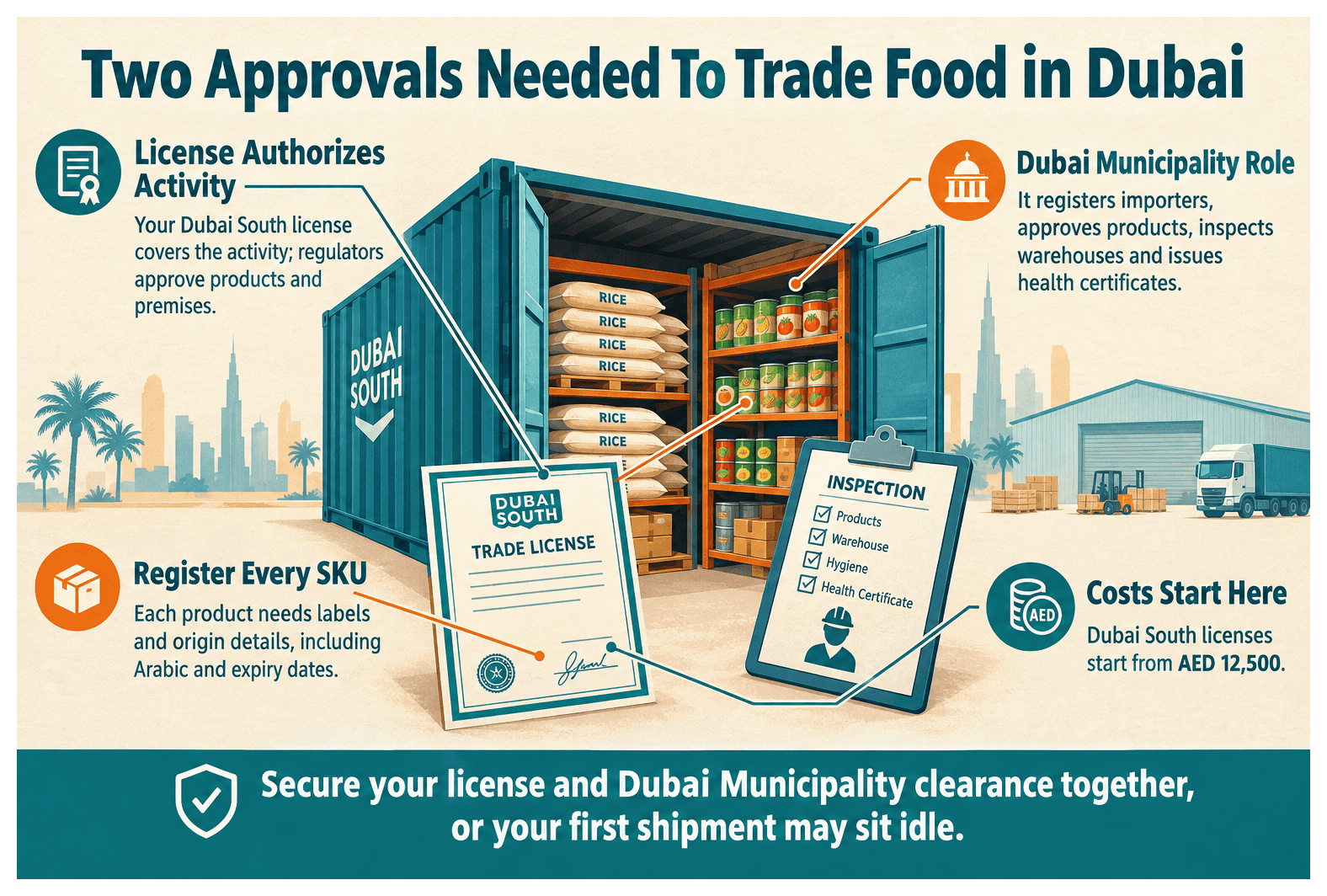
Dubai Municipality is the main food safety authority in Dubai. It handles importer registration, product registration and premises inspection. Federal bodies may join for some categories, so confirm the regulator for your exact food trading business approvals.
Dubai Municipality's Role in Food Control
It registers importers, approves products, inspects warehouses and issues permits and health certificates linked to shipments. Approvals are activity-specific, not company-wide. A frozen poultry trader, for instance, needs cold-chain inspection before storage is approved.
When Other Authorities Get Involved
Federal ministries cover plant, animal and pesticide products.
Customs clearance runs through Dubai Trade.
Halal and labeling checks may apply.
Fresh produce and pesticides follow separate paths.
Our guide on starting a food import business in Dubai covers the import angle.
Who Needs Approval for a Food Trading Business in Dubai From a Free Zone
Any Dubai South company that imports, stores, re-exports or distributes foodstuff needs regulator approval. That includes general traders, wholesalers, juice and frozen goods traders, and specialists in baby food, bakery, organic and confectionery.
Business Types That Must Apply
Importers, exporters and re-exporters.
Wholesalers holding warehouse stock.
Specialists such as baby food or frozen poultry traders.
A baby food trader faces stricter labeling and composition checks than a dry-goods trader. Dubai South licenses start from AED 12,500.
Food Trading Approval Stages at a Glance
Feature | Stage | Authority and Output |
|---|---|---|
Free zone license | Select the exact food activity | Dubai South Business Hub: trade license with food activity |
Importer registration | Submit license, owner IDs, premises details | Dubai Municipality: approved importer profile |
Product registration | Register each SKU with labels and origin | Dubai Municipality: approved SKUs |
Premises inspection | Inspector checks storage and hygiene records | Dubai Municipality: storage approval |
Shipment permit and clearance | Request a permit per shipment | Dubai Trade: cleared consignment |
Traders Who Have Lighter Obligations
Pure brokers who never take possession of goods may face fewer duties. Still, confirm scope with the regulator before assuming exemption. The activity wording on your license drives the approval route.
Stage-by-Stage Process to Get Approval for a Food Trading Business in Dubai
First secure your Dubai South license with the right food activity. Then register as an importer, register each product, pass premises inspection and obtain shipment permits through Dubai Trade. Keep documents consistent throughout.
Step 1: Secure the Right License Activity
Pick the exact activity: general foodstuff, beverages, frozen or bakery.
A mismatch causes rejections, such as choosing general foodstuff for frozen poultry.
Licenses start from AED 12,500 per year.
Residency visa packages can be arranged together.
Compare options in our food and beverages wholesale trading license page.
Step 2: Register With Dubai Municipality and Dubai Trade
Create company accounts and link customs codes.
Submit license, warehouse details and owner IDs.
Register products with ingredients, origin and labels.
Registration is per item. A trader submitting 40 snack SKUs needs complete artwork and origin certificates for each.
Step 3: Pass Premises Inspection and Obtain Shipment Permits
Inspectors check temperature logs and pest control records.
Permits are requested per shipment.
Keep health certificates and invoices ready for customs.
Documents Required to Get Approval for a Food Trading Business in Dubai
Expect to provide your license, shareholder passports and Emirates IDs, storage details, labels, ingredient lists, origin certificates and health or halal certificates. Incomplete paperwork is the most common reason approvals stall.
Company and Premises Documents
Free zone license and establishment card.
Lease or storage agreement with layout.
Pest control and hygiene records.
Third-party cold stores still need proof: the storage contract plus the facility's own approval.
Product and Shipment Documents
Labels with production and expiry dates, plus Arabic details where required.
Origin and health certificates.
Halal certification for meat and poultry.
Everything must match invoice and permit data exactly. A juice trader, for example, submits lab analysis and label proofs per flavor. See the general food trading license cost for budgeting.
Typical Timelines and Costs for Food Trading Approvals
Free zone licensing can complete within days. Regulator registration often takes one to several weeks, depending on product count and document quality. Budget beyond the license fee.
Realistic Time Expectations at Each Stage
A trader with 5 products clears faster than one registering 200 SKUs, and rework adds weeks. Timelines are indicative, so check official portals for current processing times.
Budgeting Beyond the License Fee
Registration, product and inspection fees.
Storage setup, including cold-chain upgrades.
VAT registration if you qualify, via the Federal Tax Authority.
Visa and staffing costs under MOHRE rules.
One startup budgeted AED 12,500 for its license and forgot the cold storage upgrade.
Common Mistakes That Delay Food Trading Approval in Dubai
The biggest delays come from the wrong license activity, incomplete labels, ignored storage rules and stock ordered before registration. Plan the sequence first to avoid port holds in your food trading business in Dubai.
Paperwork and Labeling Errors
Product names differ between invoices and registrations.
Dates or language details are missing from labels.
Certificates have expired.
A confectionery shipment held for label fixes after arrival piles up storage and demurrage costs.
Sequencing and Planning Errors
Some traders sign supplier contracts before product approval and end up holding unsellable stock. Start approvals before your first purchase order, and confirm regulator scope for specialist categories. Our guide to setting up a food trading business in Dubai South shows the order.
Final Thoughts
To get approval for a food trading business in Dubai, pair the right Dubai South license with importer registration, product approval, inspection and shipment permits. Match activity to products, keep documents consistent and apply before ordering.
Speak with the Dubai South Business Hub team to choose your food trading activity, arrange your residency visa package and plan approvals in the right order.
References
Frequently Asked Questions