
Topic Summary
What Is a Statutory Register Dubai Free Zone Company Must Maintain
A statutory register is an official, regularly updated record of who owns, directs and ultimately controls a company. For a Dubai free zone company, it typically covers shareholders, directors or managers, and ultimate beneficial owners. You must be able to produce it to the free zone authority, banks and regulators on request.
Which Company Registers a Free Zone Entity Must Keep
Which Company Registers a Free Zone Entity Must Keep
Step-by-Step Process to Set Up and Update Your Registers
Collect founder documents, build a template per register, enter initial details from the Memorandum of Association, assign a custodian, and log every change with dates and evidence. Review quarterly and after each share, director or license event.
How to Maintain the UBO Register UAE Regulators Expect
A UBO register lists every individual who ultimately owns or controls 25% or more of the company, or controls it by other means. Under Cabinet Resolution No. 58 of 2020, changes must be filed within 15 days, and records must be available to authorities on request ( Central Bank of the UAE ).
Retention Periods, Storage and Penalties for Missing Registers
UAE companies should retain registers and supporting records for at least five years, longer if under audit or investigation. Store them securely and accessibly. Missing records can trigger penalties of AED 10,000 or more, blocked license renewals or bank restrictions (Federal Tax Authority, 2024).
Common Mistakes When Keeping Company Registers
The most common Mistakes are delayed updates, registers conflicting with the Memorandum of Association or bank mandate, missing identity evidence, ignoring indirect owners and relying on one person's laptop. Each can trigger renewal delays, penalties or account reviews.
What Should You Do Next to Keep Your Registers Compliant
Audit your registers against the license, Memorandum of Association and bank mandate. Fix gaps, assign a custodian and set quarterly reviews. If you're restructuring, budget changes and confirm the name first.
A statutory register dubai free zone company must keep covers shareholders, directors and ultimate beneficial owners. Update it promptly after every change and store it for at least five years.
The stakes are real. A missing document can mean an AED 10,000 penalty or a blocked renewal (Federal Tax Authority, 2024). UBO changes must be filed within 15 days, with first-offence penalties up to AED 100,000 under Cabinet Resolution No. 58 of 2020. This guide is for compliance officers and managers who need to build, update and defend their registers.
What Is a Statutory Register Dubai Free Zone Company Must Maintain
A statutory register is an official, regularly updated record of who owns, directs and ultimately controls a company. For a Dubai free zone company, it typically covers shareholders, directors or managers, and ultimate beneficial owners. You must be able to produce it to the free zone authority, banks and regulators on request.
Definition and Legal Purpose of Company Registers
Registers prove ownership and control on a given date. They tie back to your Memorandum of Association and free zone regulations, and they support AML, KYC and bank due diligence.
Picture a bank asking a newly licensed company for proof of shareholding before opening an account. A current shareholders' register answers that in one document. Without it, you're hunting through emails.
Who Is Responsible for Keeping the Registers
The manager or director holds legal accountability.
The compliance officer makes day-to-day entries.
A corporate service provider can assist, but responsibility stays with the company.
Name a custodian in a board resolution. A two-founder company might appoint its finance manager.
For background, read what a shareholders' register is and who can view it.
Which Company Registers a Free Zone Entity Must Keep
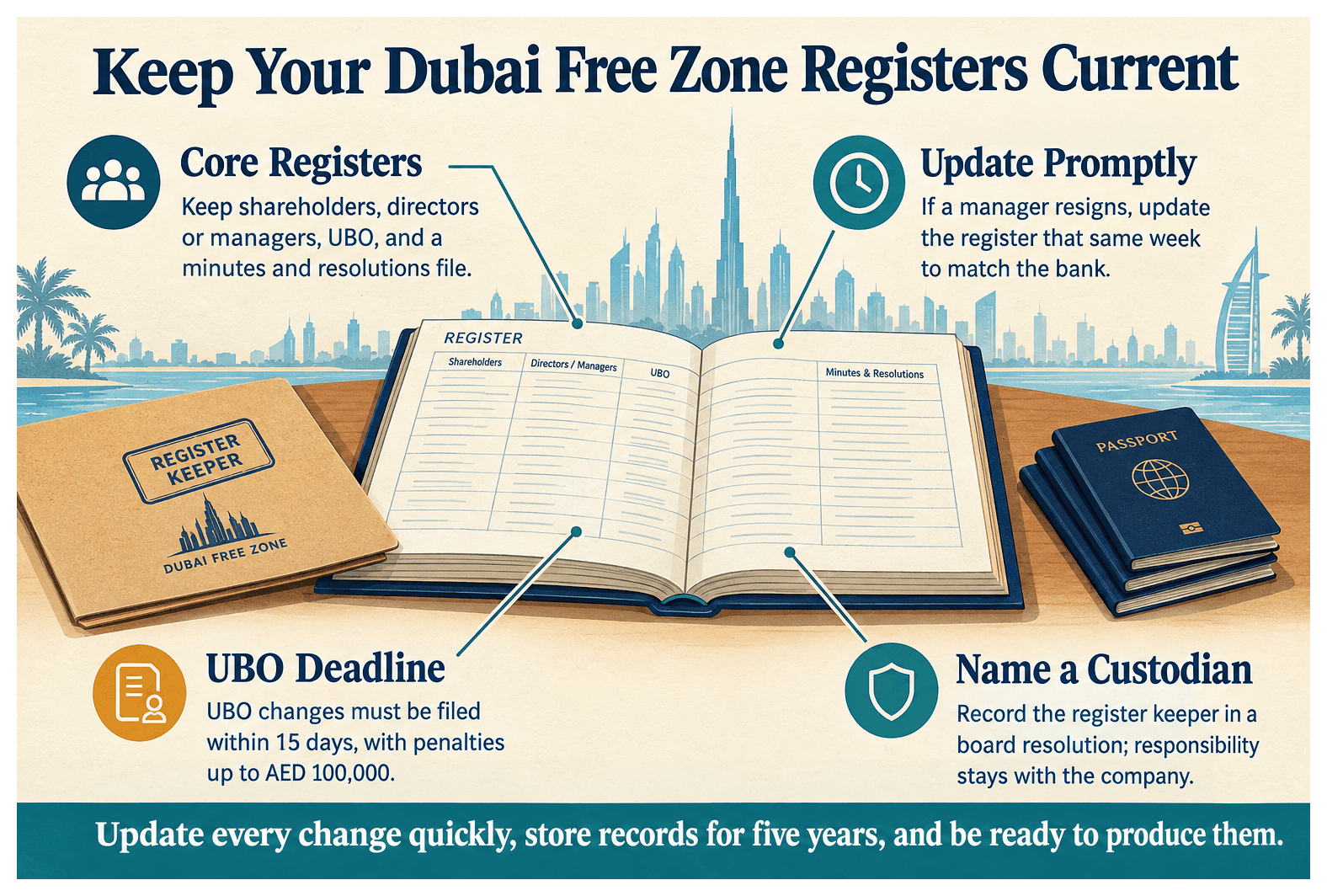
Core company registers free zone entities keep are the shareholders' register, the register of directors or managers, the UBO register, and a minutes and resolutions file. Many also hold a signatory list and share certificate record, because banks and authorities request them at renewals and audits.
Shareholders' Register and Share Certificates
Record names, nationalities, passport details, share counts and percentages.
Log the entry date and the date of any transfer.
Corporate shareholders must supply extra incorporation documents, such as a certificate of incorporation and register extract.
The shareholder documents every Dubai company must keep on file are the evidence behind each entry.
Register of Directors, Managers and Signatories
Record appointment and resignation dates, signing limits and copies of passports and Emirates IDs. Keep signing authority consistent with board resolutions. If a manager resigns, update the register that same week so it matches the bank mandate.
Minutes, Resolutions and Supporting Records
File resolutions in date order.
Link them to Memorandum of Association amendments.
Put a share transfer resolution beside the updated register entry.
Step-by-Step Process to Set Up and Update Your Registers
Collect founder documents, build a template per register, enter initial details from the Memorandum of Association, assign a custodian, and log every change with dates and evidence. Review quarterly and after each share, director or license event.
Step 1: Gather Incorporation and Identity Documents
License, Memorandum of Association and proof of address.
Passports and Emirates IDs.
Corporate shareholder documents, where relevant.
A new Dubai South Business Hub company can build this file on license issuance day.
Step 2: Build Each Register With Required Fields
Use a spreadsheet or governance software with locked history.
Add fields for dates, percentages and an evidence reference.
Include an audit trail column showing who changed what.
Step 3: Record Changes Promptly and Reconcile With Filings
Update within days of any change.
Match entries to free zone and UBO filings.
Sign off a quarterly review.
Say a 30% share transfer happens. Log it, pass the resolution, and file the UBO update inside the 15-day window.
Step 4: Check Costs and Name Details Before Changes
Budget amendments with the cost calculator, and confirm any new name through the name check before it changes your registers. Fees move, so verify any AED figure against the current schedule (checked May 2026).
How to Maintain the UBO Register UAE Regulators Expect
A UBO register lists every individual who ultimately owns or controls 25% or more of the company, or controls it by other means. Under Cabinet Resolution No. 58 of 2020, changes must be filed within 15 days, and records must be available to authorities on request (Central Bank of the UAE).
Identifying Beneficial Owners Through Ownership Chains
Look through corporate shareholders to the natural person. Say two holding companies sit above your operating company: the register must trace to the individual with 40% indirect control. If nobody passes 25%, record the senior managing official as a fallback. See UBO registration in the UAE for the full mechanics.
Register Types, Update Triggers and Penalty Exposure (AED, dated at publication)
Feature | Register | Update Trigger and Exposure |
|---|---|---|
Shareholders' register - update on share transfer or issuance | Names, nationalities, share counts, percentages | Update when a transfer or issuance is approved; mismatch can stall renewal |
Register of directors or managers - update on appointment or resignation | Appointment dates, signing limits, ID copies | Update the same week; stale entries conflict with the bank mandate |
UBO register - update within 15 days; up to AED 100,000 first offence | Individuals holding 25% or more, or control by other means | 15-day filing window; up to AED 100,000 first-offence penalty |
Minutes and resolutions file - update after each decision | Dated board and shareholder resolutions | File after every decision; gaps weaken evidence for register entries |
Supporting records - retain at least 5 years; AED 10,000 missing record exposure | IDs, certificates, filings, correspondence | Keep five years minimum; AED 10,000 exposure or blocked renewal |
Update Triggers and Filing Deadlines
Share changes, director changes and passport renewals all trigger updates.
File within 15 days.
First-offence exposure reaches AED 100,000.
Example: a founder sells 10% to an investor, who crosses 25%. That demands a UBO update.
Our guide to updating your UBO register after a share change covers the filing sequence.
Retention Periods, Storage and Penalties for Missing Registers
UAE companies should retain registers and supporting records for at least five years, longer if under audit or investigation. Store them securely and accessibly. Missing records can trigger penalties of AED 10,000 or more, blocked license renewals or bank restrictions (Federal Tax Authority, 2024).
How Long to Keep Records and Where to Store Them
Keep records five years minimum.
Hold signed originals in a fireproof cabinet.
Mirror scans in encrypted cloud storage with backup.
Restrict access and document custodian handover.
Preparing for Bank and Regulator Requests
Banks can ask for ownership proof within 48 hours. Keep an audit-ready pack: current registers, latest resolutions, ID copies and filing receipts. Align it with AML expectations, outlined in what records a UAE company must keep for AML purposes. A renewal can sit blocked until a missing shareholders' register is reconstructed, and that rebuild always costs more than steady upkeep.
Common Mistakes When Keeping Company Registers
The most common Mistakes are delayed updates, registers conflicting with the Memorandum of Association or bank mandate, missing identity evidence, ignoring indirect owners and relying on one person's laptop. Each can trigger renewal delays, penalties or account reviews.
Delayed Updates and Mismatched Records
A share transfer completes but nobody makes the entry.
The register says one thing and the filing says another.
A former manager still holds signing authority on paper.
Weak Evidence and Single-Point Storage
No resolution or ID copies back the entry.
No backup exists.
Records vanish when the only custodian leaves.
Strong corporate governance for a UAE free zone company prevents most of these.
What Should You Do Next to Keep Your Registers Compliant
Audit your registers against the license, Memorandum of Association and bank mandate. Fix gaps, assign a custodian and set quarterly reviews. If you're restructuring, budget changes and confirm the name first.
Run a 30-Minute Register Health Check
Compare each register with source documents.
Reconcile the shareholders' register to the latest share certificates.
List gaps with owners and deadlines.
Get Support From Dubai South Business Hub
Dubai South Business Hub handles free zone company formation, trade licenses and residency visa packages tied to a license. Contact the team to confirm requirements, and set up your registers at incorporation.
Final Thoughts
A statutory register dubai free zone company regulators and banks can trust means keeping shareholder, director and UBO records current, updating within days and storing evidence for five years. Audit your registers this week, then use the cost calculator and name check to plan amendments.
References
Frequently Asked Questions