Topic Summary
What Is Import and Export Between Brazil and Dubai: What License You Need and Why It Matters
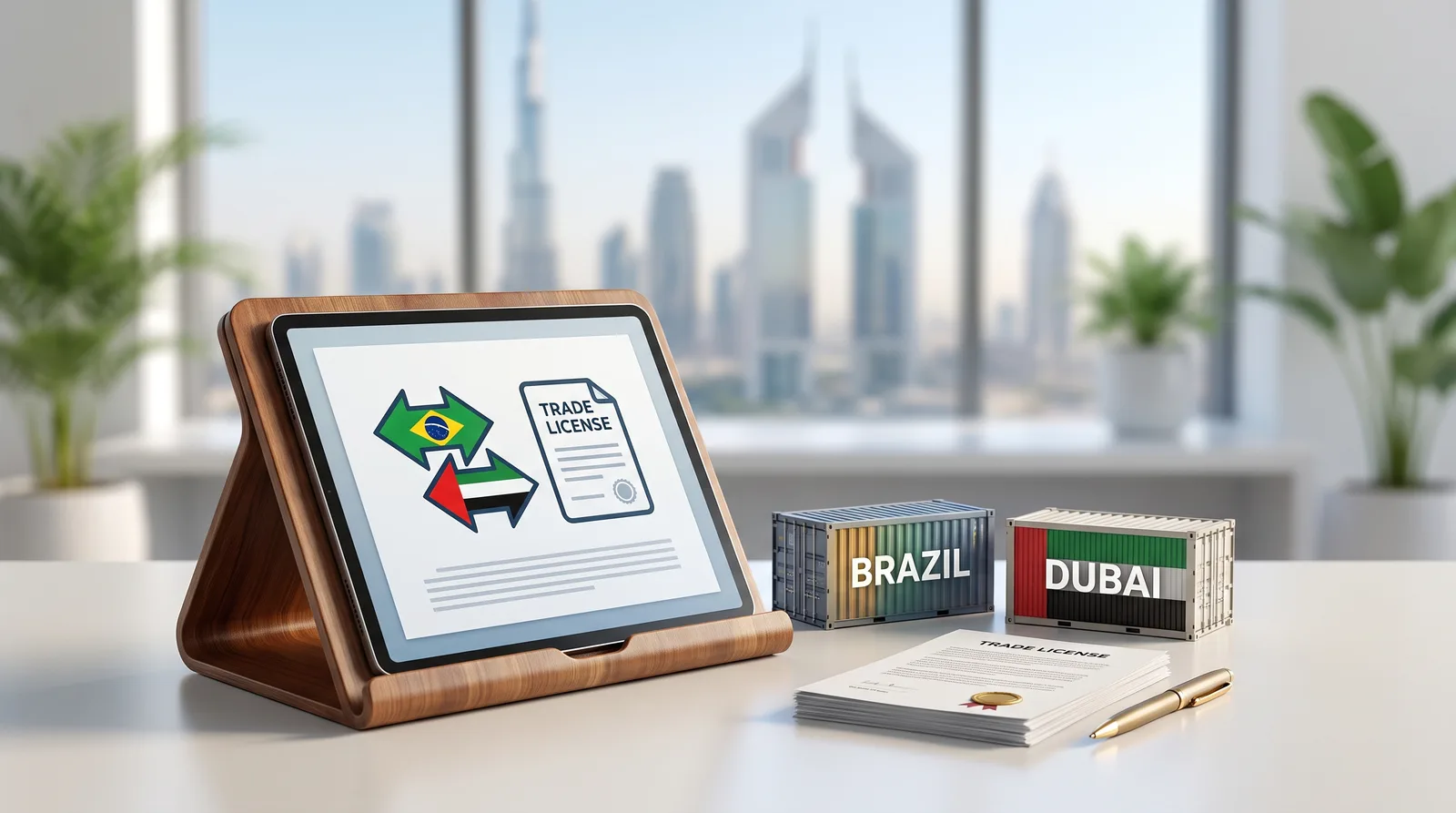
Import and export between Brazil and Dubai requires a UAE trade license listing your goods as approved activities, plus a Dubai Customs import-export code. A Dubai South Business Hub Free Zone company lets Brazilian founders hold both. Read our guide to an import export license in Dubai for more.
License Types and Activities Brazilian Traders Should Compare
License Types and Activities Brazilian Traders Should Compare
Step-by-Step Guide to Import and Export Between Brazil and Dubai: What License You Need
Define your goods, form a free zone company, get the license, register with Dubai Customs and Dubai Trade, then arrange logistics. Plan documents early. The full path is in setting up a trading, importing and exporting business in Dubai .
Customs Registration and Compliance for Brazil-Dubai Trade
Dubai customs registration means an active license, a customs code, correct HS codes and accurate declarations. Most imports face 5% duty ( UAE Ministry of Finance ).
Brazilian-Side Requirements for Exporters and Importers
Brazilian exporters generally need Receita Federal registration, Siscomex access and RADAR enablement. Any Brazil Dubai trade license plan should include these. Confirm current rules with a customs broker.
Logistics, Ports and Shipping Routes Between Brazil and Dubai
Import and Export Between Brazil and Dubai: What License You Need also shapes shipping. Cargo usually moves from Santos or Paranaguá to Jebel Ali in roughly three to five weeks.
Common Mistakes to Avoid When Trading Between Brazil and Dubai
Know What License You Need first. Common errors are the wrong activity, shipping before registration, wrong HS codes and missing export papers.
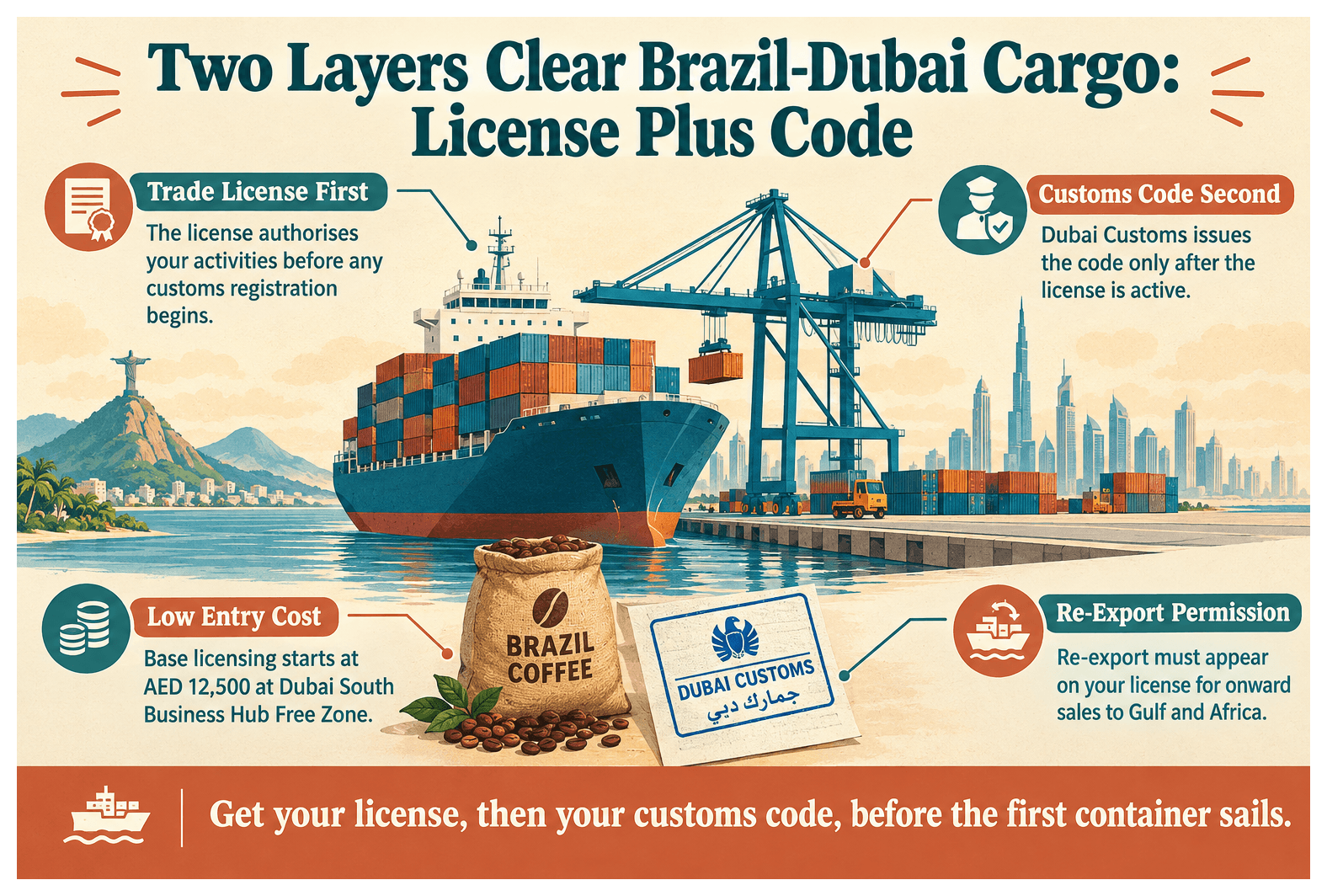
Dubai's non-oil foreign trade topped AED 2.2 trillion [1], and its ports handle 14 million TEUs a year [2]. Import and Export Between Brazil and Dubai: What License You Need is the first question Brazilian traders ask. The UAE charges 5% customs duty on most goods [3], and over 98% of declarations are digital [4]. Base licensing starts at AED 12,500 at Dubai South Business Hub Free Zone [5].
What Is Import and Export Between Brazil and Dubai: What License You Need and Why It Matters
Import and export between Brazil and Dubai requires a UAE trade license listing your goods as approved activities, plus a Dubai Customs import-export code. A Dubai South Business Hub Free Zone company lets Brazilian founders hold both. Read our guide to an import export license in Dubai for more.
The Two Layers: Trade License and Customs Code
The license authorises your activities. The customs code lets you clear cargo. Dubai Customs issues the code only after the license is active, and without both, containers can sit at port. A Brazilian coffee exporter, for instance, licenses a Dubai entity first, then registers before the first container sails.
Trade License Options for Brazil-Dubai Traders
Feature | General Trading License | Specialised Trading License |
|---|---|---|
Product scope | Several categories, such as coffee, beef and packaged food | One commodity group, such as juice or machinery |
Best suited for | Diversified portfolios | Single-commodity traders |
Flexibility to add activities | High, many goods already covered | Needs an amendment for new goods |
Typical approvals needed | Varies by each product line | Focused on one product type |
Re-export suitability | Strong when re-export is listed | Strong for one product's onward sales |
Why Brazilian Traders Use Dubai as a Hub
Dubai reaches the Gulf, Africa and South Asia. A sugar and juice trader can land Brazilian goods once, then redistribute them to Gulf buyers.
License Types and Activities Brazilian Traders Should Compare
A Brazil Dubai trade license is either general or specialised. Choose by goods, buyers and re-export plans.
General Trading Versus Specialised Wholesale Activities
A founder trading only coffee may prefer a specialised wholesale trading license. Someone adding beef later should see how to get general trading license Dubai. Confirm the current fee before applying.
Food, Beverage and Regulated Goods Approvals
Food needs Dubai authority approval.
Chilled beef needs halal certification.
Check labels and health certificates.
See starting a food import business in Dubai.
Re-Export Permissions for Onward Sales
Re-export must appear on your license. Brazilian juice concentrate sold on to East African distributors is a typical case. Read setting up a re-export business in Dubai.
Step-by-Step Guide to Import and Export Between Brazil and Dubai: What License You Need
Define your goods, form a free zone company, get the license, register with Dubai Customs and Dubai Trade, then arrange logistics. Plan documents early. The full path is in setting up a trading, importing and exporting business in Dubai.
Step 1: Define Your Goods and HS Codes
Match products to licensed activities.
Confirm the Harmonised System (HS) code.
Classify coffee beans before licensing.
Step 2: Set Up Your Free Zone Company and License
Submit passports and shareholder details.
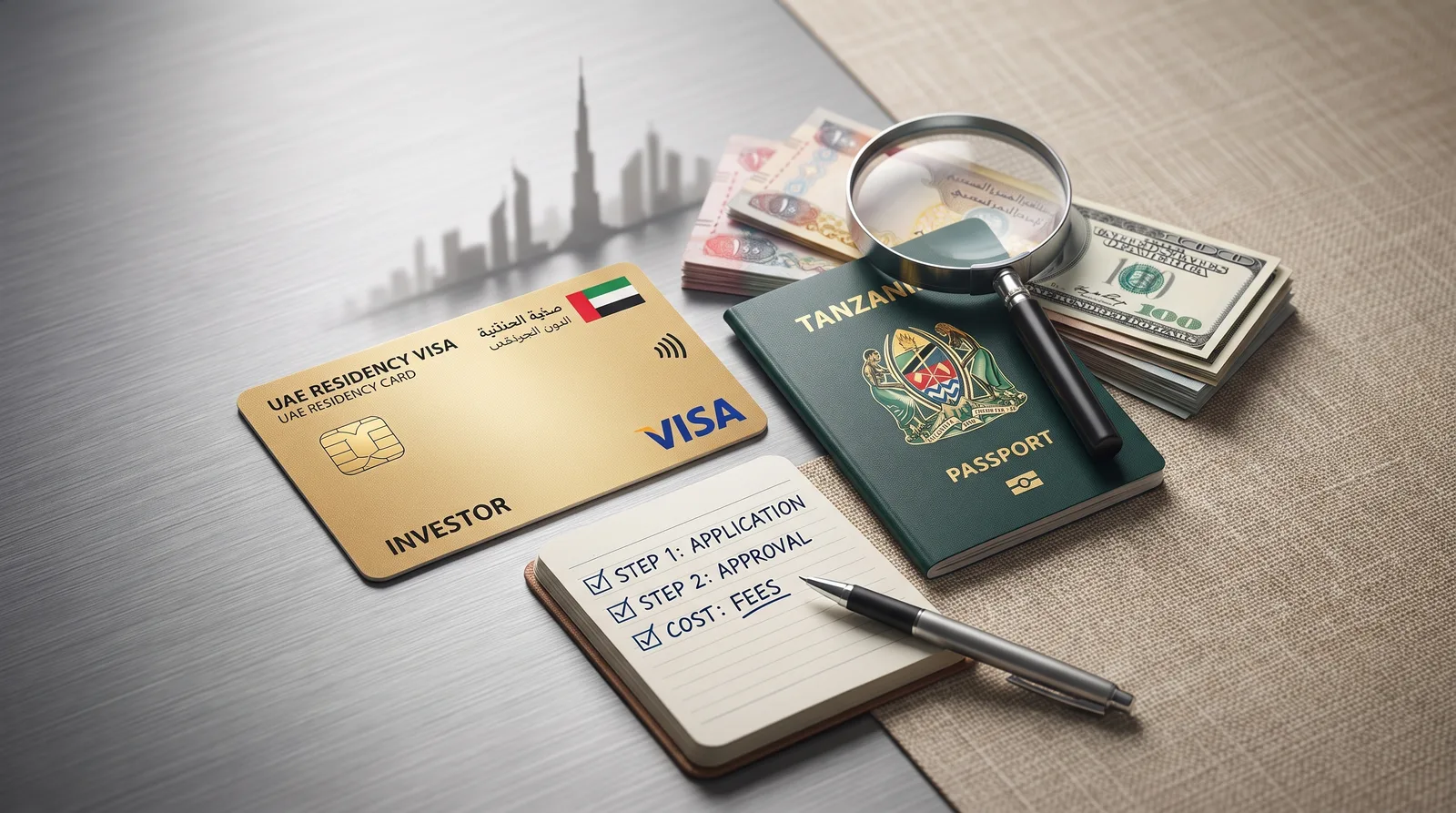
Include the residency visa package.
Incorporate remotely if needed.
Step 3: Register With Dubai Customs and Dubai Trade
Obtain your importer-exporter code.
File declarations through Dubai Trade.
Follow Dubai Trade portal registration.
Step 4: Arrange Shipping, Insurance and Documentation
Prepare the invoice, packing list and bill of lading.
Add a certificate of origin.
Price FOB Santos against CIF to Jebel Ali.
Customs Registration and Compliance for Brazil-Dubai Trade
Dubai customs registration means an active license, a customs code, correct HS codes and accurate declarations. Most imports face 5% duty (UAE Ministry of Finance).
Duties, VAT and Free Zone Treatment
Treatment depends on designated-zone status, so verify before assuming relief. Goods released into the mainland are treated differently from goods held in a designated zone. VAT registration runs through the Federal Tax Authority.
Record-Keeping and Audit Readiness
Keep invoices and declarations.
Reconcile entries quarterly.
Brazilian-Side Requirements for Exporters and Importers
Brazilian exporters generally need Receita Federal registration, Siscomex access and RADAR enablement. Any Brazil Dubai trade license plan should include these. Confirm current rules with a customs broker.
Siscomex, RADAR and Export Documentation
A beef supplier files its export declaration through Siscomex before loading at Santos.
Sanitary and Origin Certificates
Obtain veterinary certification.
Secure the certificate of origin.
Halal-certify poultry.
Logistics, Ports and Shipping Routes Between Brazil and Dubai
Import and Export Between Brazil and Dubai: What License You Need also shapes shipping. Cargo usually moves from Santos or Paranaguá to Jebel Ali in roughly three to five weeks.
Sea Freight, Reefer Cargo and Air Freight Options
Frozen beef travels in reefer containers, while fresh flowers go by air. DP World reports 14 million TEUs annually.
Warehousing and Last-Mile Distribution
Stock packaged food near Al Maktoum International Airport for weekly Gulf deliveries. See how to start an import business in Dubai step by step.
Common Mistakes to Avoid When Trading Between Brazil and Dubai
Know What License You Need first. Common errors are the wrong activity, shipping before registration, wrong HS codes and missing export papers.
Licensing Gaps That Block Shipments
Activity missing from the license.
Food approvals not obtained.
A juice importer had to amend its license.
Documentation and Classification Errors
Wrong HS code changes duty.
Invoice and packing list mismatch.
Invoice value differs from declared value.
Final Thoughts
Import and Export Between Brazil and Dubai: What License You Need comes down to three aligned pieces: the right trade license, a Dubai Customs code and compliant Brazilian documents. Speak with Dubai South Business Hub about a free zone trade license and residency visa package today.
References
Frequently Asked Questions