Topic Summary
What Import and Export Between Japan and Dubai Requires: What License You Need
Trading between Japan and Dubai requires a UAE trade license listing import, export or re-export activities, plus a Dubai Customs client code. The Dubai South Business Hub Free Zone license creates the legal entity. Customs registration clears your goods through UAE ports.
Which Trade License Fits Your Japan-Dubai Trading Model
Which Trade License Fits Your Japan-Dubai Trading Model
Customs Registration and Client Codes for Japan-Dubai Trade
Dubai Customs issues a client code once your license, tenancy contract and owner documents are verified. The code must match the activities on your license. Dubai processes over 16 million declarations annually.
Step-by-Step Guide to Import and Export Between Japan and Dubai: What License You Need
Licensing comes before customs, and customs before shipping. Follow this order:
Tax, VAT and Compliance Duties for Japan-Dubai Traders
Corporate tax is 9% on profits above AED 375,000, and VAT registration starts at AED 375,000 in taxable supplies. Qualifying free zone income may get 0%, but only if substance conditions are met. Trading isn't fully tax free. See the Federal Tax Authority for rules.
Residency and Visa Options for Japanese Founders Running a Trading Company
Your license can come with a residency visa package for you and eligible family. Applications run through GDRFA and ICP, with entry permit, status change, medical test and Emirates ID. Spouse and children can be sponsored. Staff visa quotas depend on your lease type.
Common Mistakes When Trading Between Japan and Dubai and How to Avoid Them
Most delays trace to paperwork, not freight. A trader with import-only wording can't re-export to Oman until the license is amended. Amendments cost time and fees.
Dubai's non-oil foreign trade runs past AED 2.2 trillion a year (Dubai Chamber, 2024). This guide to import and export between Japan and Dubai: what license you need is for Japanese entrepreneurs who want to trade legally from Dubai South. You'll leave knowing which license, customs code and tax registrations to line up.
What Import and Export Between Japan and Dubai Requires: What License You Need
Trading between Japan and Dubai requires a UAE trade license listing import, export or re-export activities, plus a Dubai Customs client code. The Dubai South Business Hub Free Zone license creates the legal entity. Customs registration clears your goods through UAE ports.
Dubai's ports handle over 14 million TEUs (twenty-foot equivalent container units) a year (DP World, 2025). That's why Japanese founders use it as a gateway to the Gulf, Africa and South Asia.
Picture a Tokyo founder listing auto parts, machinery and consumer goods on one license. The license sets permitted activities, and the customs code authorises clearance. You need both before a container leaves Yokohama, Nagoya or Osaka. Our guide to an import export license in Dubai covers the basics.
Which Trade License Fits Your Japan-Dubai Trading Model
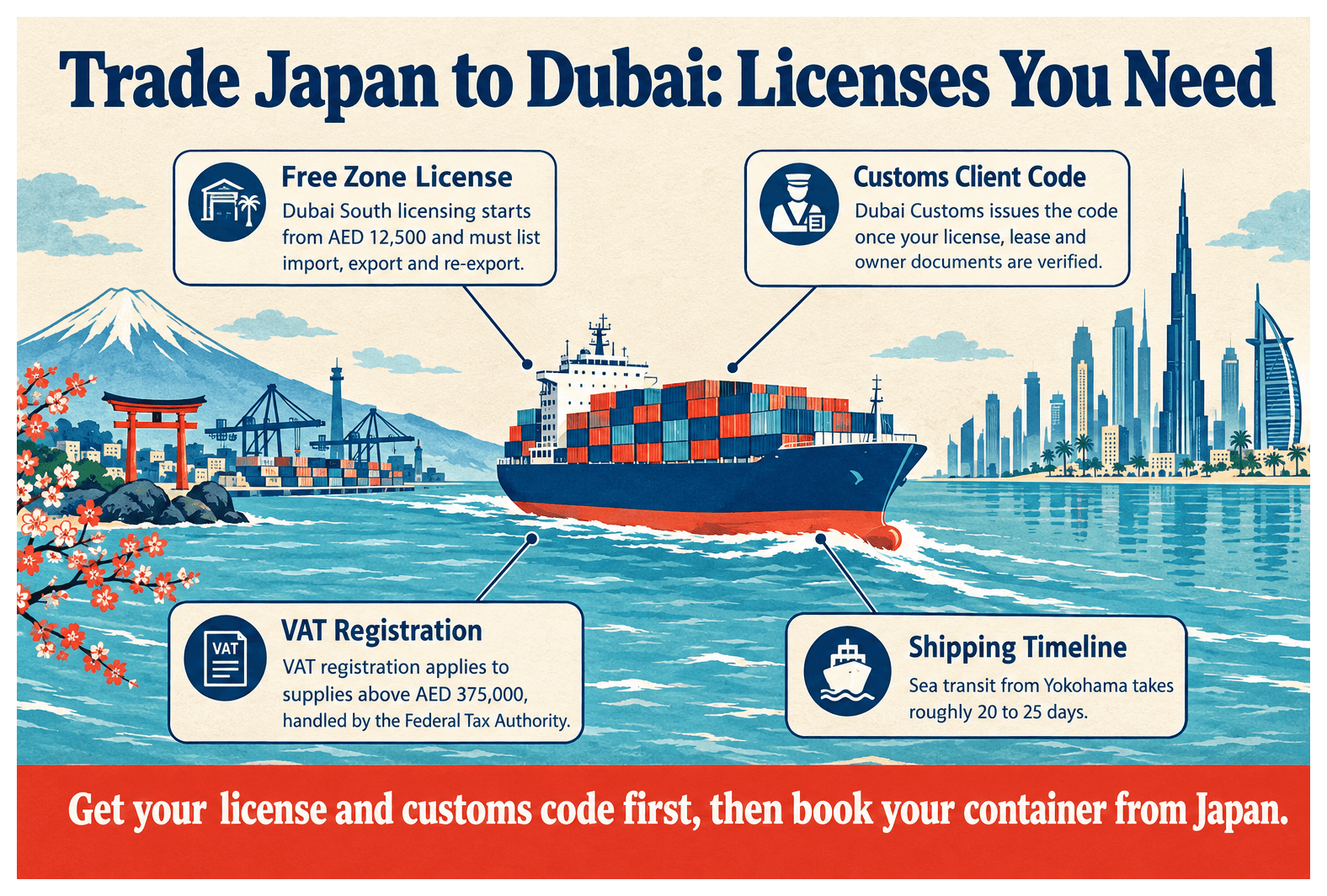
Pick a general trading license for mixed products, or a specific activity license for one sector. The wording must include import, export and re-export so Dubai Customs accepts your declarations. Licensing at Dubai South starts from AED 12,500.
A Kyoto tea producer, for example, is better off with a tea trading activity than general trading, because approvals for regulated goods move faster. See the trading, importing and exporting business page for options.
License and Registration Requirements for Japan-Dubai Trade
Feature | Requirement | Authority and Purpose |
|---|---|---|
Free zone trade license | Import, export, re-export wording; from AED 12,500 | Dubai South Business Hub: legal entity |
Customs client code | License, lease, owner passport | Dubai Customs: clearance rights |
Dubai Trade portal account | Active customs code | Dubai Trade: digital declarations |
VAT and corporate tax registration | Supplies above AED 375,000 for VAT | Federal Tax Authority: tax compliance |
Owner residency visa | Medical test, Emirates ID biometrics | GDRFA and ICP: residency |
Customs Registration and Client Codes for Japan-Dubai Trade
Dubai Customs issues a client code once your license, tenancy contract and owner documents are verified. The code must match the activities on your license. Dubai processes over 16 million declarations annually.
Valid free zone license and lease.
Owner passport and Emirates ID.
Bank details and signatory letter.
Choosing the wrong customs client code for a Dubai company causes delays. Use the correct HS (Harmonized System) chapter for Japanese goods. Most goods entering the UAE attract 5% duty.
Step-by-Step Guide to Import and Export Between Japan and Dubai: What License You Need
Licensing comes before customs, and customs before shipping. Follow this order:
Define products and HS codes. A Nagoya auto-parts exporter lists exact codes first.
Register with Dubai South Business Hub. A sole Japanese shareholder can hold 100% of a free zone company.
Apply for the customs code, then complete Dubai Trade portal registration. Over 98% of declarations are digital (Dubai Trade, 2026).
Hire a freight forwarder. Prepare the invoice, packing list, bill of lading and certificate of origin. Sea transit from Yokohama takes roughly 20 to 25 days.
Tax, VAT and Compliance Duties for Japan-Dubai Traders
Corporate tax is 9% on profits above AED 375,000, and VAT registration starts at AED 375,000 in taxable supplies. Qualifying free zone income may get 0%, but only if substance conditions are met. Trading isn't fully tax free. See the Federal Tax Authority for rules.
Standard VAT is 5%.
Qualifying exports to Japan are zero-rated.
Keep invoices and shipping proof for five years.
Residency and Visa Options for Japanese Founders Running a Trading Company
Your license can come with a residency visa package for you and eligible family. Applications run through GDRFA and ICP, with entry permit, status change, medical test and Emirates ID. Spouse and children can be sponsored. Staff visa quotas depend on your lease type.
Common Mistakes When Trading Between Japan and Dubai and How to Avoid Them
Most delays trace to paperwork, not freight. A trader with import-only wording can't re-export to Oman until the license is amended. Amendments cost time and fees.
Confirm export wording first; read do you need a separate license to export from Dubai.
Check HS codes to avoid duty disputes.
Attach origin certificates and translated labels.
Budget extra clearing days for corrections.
Your Next Move
Import and export between Japan and Dubai: what license you need comes down to three pieces: a free zone license with the right activities, a customs client code, and Federal Tax Authority compliance. Contact Dubai South Business Hub to confirm your activities and get a quote from AED 12,500.
References
Frequently Asked Questions