
Topic Summary
What Is Import and Export Between Qatar and Dubai: What License You Need and Why It Matters
To trade goods between Qatar and Dubai, you need a UAE trade license listing your goods as approved activities, a customs code, and Federal Tax Authority registration. A free zone company can hold all three, and Qatari nationals can own it fully.
How GCC Trade Rules Shape Goods Moving Between Doha and Dubai
How GCC Trade Rules Shape Goods Moving Between Doha and Dubai
Which Free Zone Trade License Fits Import and Export Between Qatar and Dubai: What License You Need
A Dubai South Business Hub Free Zone trade license suits most Qatari traders. It allows full foreign ownership, flexible premises, and access near Al Maktoum International Airport.
Step-by-Step Process to Get Licensed and Start Trading
Qatari nationals can start trading in about four stages. Timing depends mainly on how quickly attested documents are ready.
Customs Registration and Tax Obligations for Qatar-Dubai Trade
Once licensed, you register for a customs code through Dubai Trade, then handle VAT and corporate tax with the FTA. A 0% free zone rate applies only to qualifying income, so confirm your status first. You are never fully tax free.
Document Attestation and Banking Requirements for Qatari Nationals
Qatari documents are typically attested by Qatar's Ministry of Foreign Affairs, then the UAE Embassy in Doha. Confirm the current chain before travelling, and translate Arabic documents where needed.
Residency and Visa Considerations After You Relocate
A free zone license can carry residency visas for you, your family and staff, within your visa quota. Medical tests, Emirates ID and biometrics run through ICP and GDRFA channels.
Dubai handles over 16 million customs declarations a year [1], and its non-oil foreign trade tops AED 2.2 trillion [2]. Its ports move over 14 million TEUs annually [3]. This guide explains import and export between Qatar and Dubai: what license you need, so Qatari nationals relocating to Dubai can set up in the right order.
What Is Import and Export Between Qatar and Dubai: What License You Need and Why It Matters
To trade goods between Qatar and Dubai, you need a UAE trade license listing your goods as approved activities, a customs code, and Federal Tax Authority registration. A free zone company can hold all three, and Qatari nationals can own it fully.
The Three Pieces of a Compliant Trading Setup
First comes the license with your exact commodity list. Second, a customs code and a Dubai Trade account for filing declarations. Third, corporate tax and VAT registration where thresholds apply.
Take a Doha building materials distributor. It lists tiles, fittings and sanitaryware up front, so every shipment clears without amendments. For a deeper look, read our import export license in Dubai guide.
Why the License Activity Wording Matters
Customs rejects goods outside your licensed activities.
Food, cosmetics and medical items need extra approvals.
Re-exports and own-use imports are treated differently.
A Qatari founder adding food items later must amend the license and get municipality approval first.
How GCC Trade Rules Shape Goods Moving Between Doha and Dubai
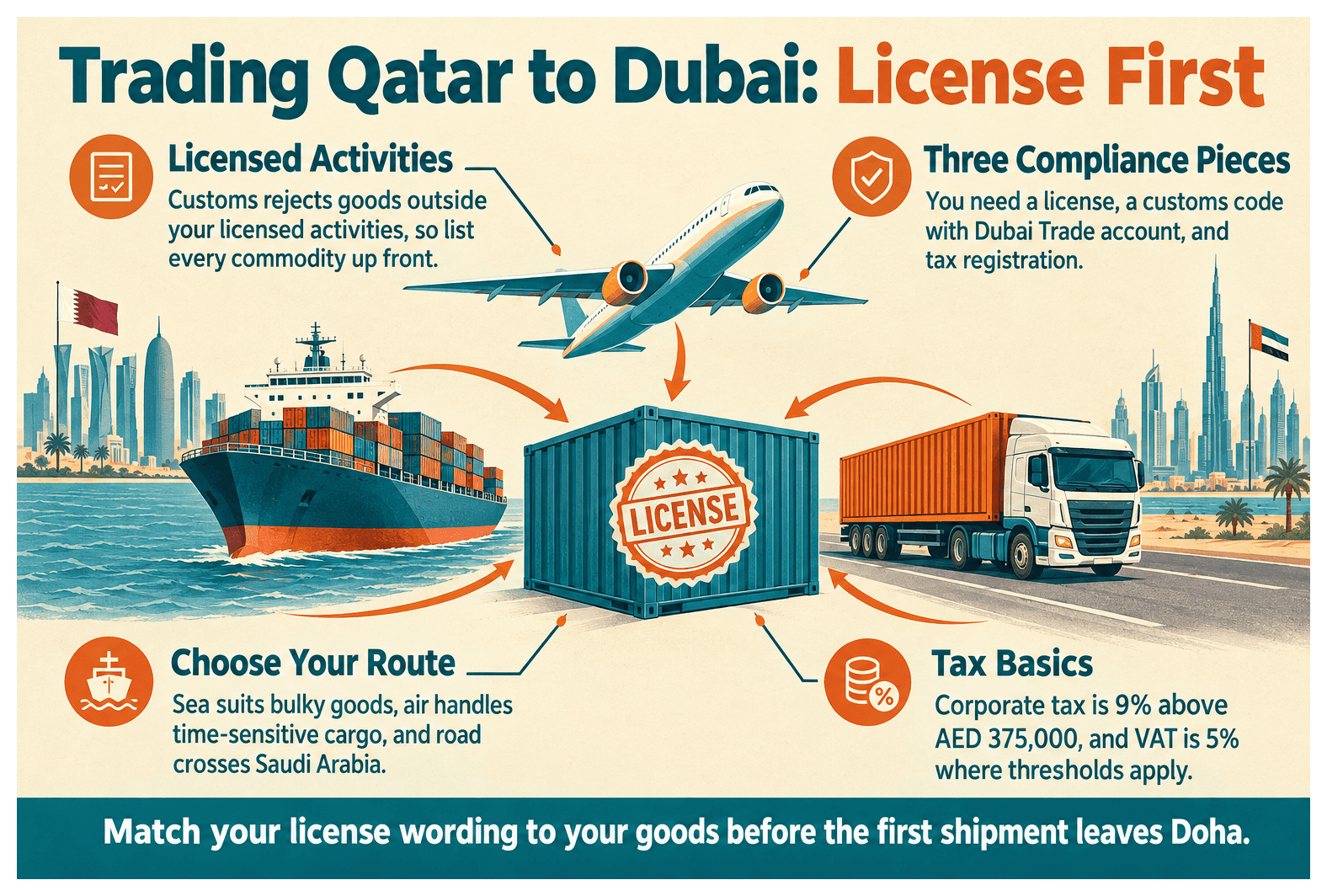
Qatar and the UAE are both GCC members under the GCC Customs Union, which aims at a unified external tariff. Goods still need declarations, origin documents and VAT treatment, so confirm current rules with customs before your first shipment.
Sea: Hamad Port to Jebel Ali-linked lanes suit bulky goods.
Air: Dubai South handles time-sensitive cargo.
Road: the route crosses Saudi Arabia into the UAE.
A Qatari electronics reseller should confirm tariff treatment and origin paperwork before its first consignment. Perishables go by air, construction materials by sea. Ports data comes from DP World.
Which Free Zone Trade License Fits Import and Export Between Qatar and Dubai: What License You Need
A Dubai South Business Hub Free Zone trade license suits most Qatari traders. It allows full foreign ownership, flexible premises, and access near Al Maktoum International Airport.
Licenses and Registrations Needed for Qatar-Dubai Trade
Feature | Requirement | Purpose |
|---|---|---|
Free zone trade license | Listed commodity activities | Legal basis to import, export and re-export |
Customs code and Dubai Trade account | Valid license and HS code list | Filing declarations for each shipment |
Corporate tax registration | FTA registration; 9% above AED 375,000 | Meeting filing duties and testing free zone rate eligibility |
VAT registration | 5% standard rate where thresholds apply | Correct invoicing and returns |
Residency visa package | Visa quota tied to license and premises | Living in the UAE with family and staff |
Matching Goods, Premises and Market
Choose general trading or named activities, and amend as your catalogue grows. A Qatari packaging trader might start with packaging materials and add distribution later. Start on a flexi-desk, then move to a warehouse as volume rises.
A free zone license suits cross-border trade. Selling directly to UAE retailers may need a local distributor, as one Qatari wholesaler does while keeping its free zone license.
Step-by-Step Process to Get Licensed and Start Trading
Qatari nationals can start trading in about four stages. Timing depends mainly on how quickly attested documents are ready.
Choose activities, HS codes and structure: an FZ-LLC (free zone limited liability company) or a branch of your Qatari company.
Submit your passport, QID, proof of address and business plan. Branches add an attested commercial registration and board resolution.
Sign agreements, pay fees, and collect your license and establishment card.
Apply for the customs code, then register with the Federal Tax Authority.
Customs Registration and Tax Obligations for Qatar-Dubai Trade
Once licensed, you register for a customs code through Dubai Trade, then handle VAT and corporate tax with the FTA. A 0% free zone rate applies only to qualifying income, so confirm your status first. You are never fully tax free.
Correct HS codes prevent duty disputes.
Use a clearing agent for early shipments.
Keep invoices, packing lists and origin certificates.
One misclassified pallet of cosmetics can sit for days. Similar rules apply in our Egypt guide.
Document Attestation and Banking Requirements for Qatari Nationals
Qatari documents are typically attested by Qatar's Ministry of Foreign Affairs, then the UAE Embassy in Doha. Confirm the current chain before travelling, and translate Arabic documents where needed.
For banking, expect KYC checks and source-of-funds questions. Banks answer to the Central Bank of the UAE. Supplier contracts and purchase orders strengthen your application. See how Lebanese traders handle it.
Residency and Visa Considerations After You Relocate
A free zone license can carry residency visas for you, your family and staff, within your visa quota. Medical tests, Emirates ID and biometrics run through ICP and GDRFA channels.
Compare routes in our Turkey and Pakistan guides.
Your Next Move on Import and Export Between Qatar and Dubai: What License You Need
Import and export between Qatar and Dubai: what license you need comes down to a free zone license with the right activities, a customs code, tax registration, attested documents and a UAE bank account. Sequence them well and shipments won't stall.
Bring your HS code list and contact Dubai South Business Hub for a free consultation today.
References
Frequently Asked Questions