Topic Summary
What Is Import and Export Between Thailand and Dubai: What License You Need and Why It Matters
Import and export between Thailand and Dubai requires a UAE trade license listing your goods as approved activities, plus a customs import-export code. Thai nationals usually get both through a free zone company, which also opens a residency visa tied to the license.
Which License Activities Fit Your Thai Product Line
Which License Activities Fit Your Thai Product Line
Step-by-Step Guide to Import and Export Between Thailand and Dubai: What License You Need
Define your goods and HS codes, pick a Dubai South Business Hub package, submit documents, get your license, register a customs code, open a bank account, then apply for your visa. Most steps overlap once documents are attested.
Customs Codes, Permits and Product Approvals for Thai Goods
Food, cosmetics, medical devices and chemicals need registration with the relevant UAE authority. Shipments also need a commercial invoice, packing list, bill of lading and certificate of origin.
Document Attestation and Thai Export Requirements
Thai nationals usually need passport copies, and sometimes attested personal or corporate papers. Attestation runs through the Thai Ministry of Foreign Affairs and the UAE Embassy in Bangkok. On the Thai side, confirm export rules with the Department of Foreign Trade.
Tax, VAT and Trade Agreement Considerations for Thailand-UAE Trade
UAE VAT is 5%, and corporate tax is 9% on profits above AED 375,000 ( Federal Tax Authority ). Most goods carry 5% customs duty, with exemptions for many free zone and re-export flows.
Banking and Residency Visa Setup for Thai Nationals Relocating to Dubai
Thai nationals can open corporate accounts once licensed. Banks review business plans, trading partners and source of funds. Visas follow through GDRFA and ICP.
Dubai's non-oil foreign trade runs above AED 2.2 trillion a year (Dubai Chamber, 2024), and its ports handle over 14 million TEUs annually (DP World, 2025). This guide is for Thai traders relocating to Dubai. You'll learn which licenses, codes and documents you need for import and export between Thailand and Dubai, and in what order.
What Is Import and Export Between Thailand and Dubai: What License You Need and Why It Matters
Import and export between Thailand and Dubai requires a UAE trade license listing your goods as approved activities, plus a customs import-export code. Thai nationals usually get both through a free zone company, which also opens a residency visa tied to the license.
Trade License vs Customs Code Explained
The license authorises the activity, such as food trading or electronics trading. The customs code is a separate registration with Dubai Customs that lets you clear cargo. You need both before your first container lands.
Picture a Bangkok rice and sauce exporter. She registers a food trading activity, then applies for a customs code to clear shipments into Jebel Ali and Dubai South logistics zones.
Why Thai Traders Choose Dubai as a Hub
Re-export access to the Middle East, Africa and Central Asia.
Strong demand for Thai food, cosmetics and auto parts.
Air, sea and road links from one base.
A Thai herbal cosmetics brand, for example, can serve GCC and East Africa buyers from one Dubai base. Compare this with import and export between Singapore and Dubai, which follows a similar path.
Which License Activities Fit Your Thai Product Line
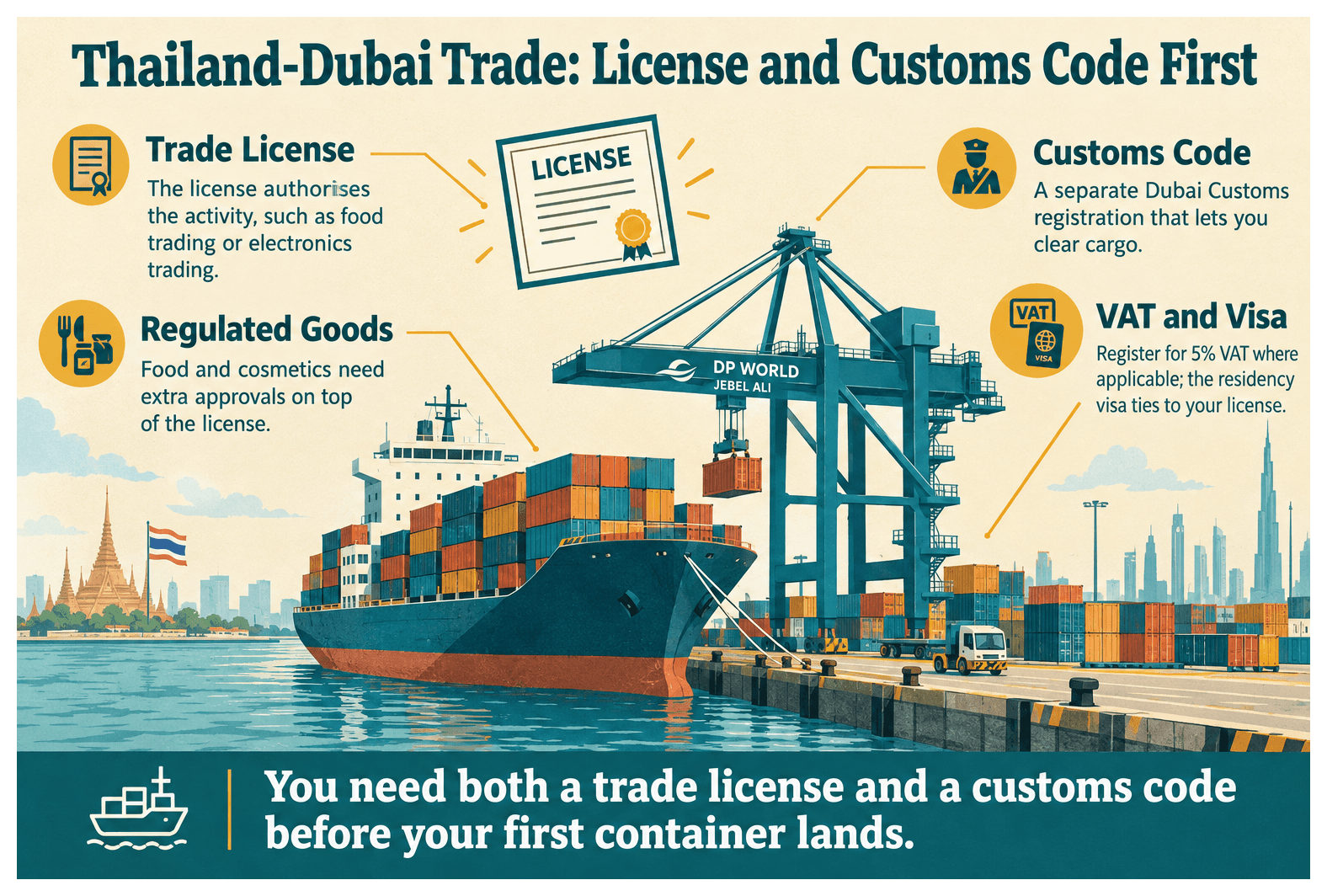
Choose activities that match the exact goods you ship. General trading covers mixed products, while specialised activities suit focused exporters. Regulated goods like food and cosmetics need extra approvals on top of the license.
General Trading vs Specialised Activities
Here's my view: if you sell food, skip general trading. A Phuket seafood supplier who picks a food trading activity usually gets product registration moving faster. Your activity list must also match the HS codes on your invoices.
Licenses and Registrations Needed for Thailand-Dubai Trade
Requirement | Purpose |
|---|---|
Free zone trade license | Authorises your listed trading activities |
Dubai Customs import-export code | Lets you clear sea and air shipments |
Product approvals for regulated goods | Covers food, cosmetics and health items |
VAT registration where applicable | Handles 5% VAT on taxable supplies |
Residency visa tied to company license | Lets you live and work in the UAE |
Thai Export Categories in Demand
Rice, canned fruit, sauces and snacks.
Auto parts, electronics components and rubber.
Cosmetics, wellness and herbal products.
Re-Export and Transit Considerations
Re-exports need accurate origin documents. Thai garments stored in Dubai South and sent on to Kenya are a typical case. Keep clean records for customs audits.
Step-by-Step Guide to Import and Export Between Thailand and Dubai: What License You Need
Define your goods and HS codes, pick a Dubai South Business Hub package, submit documents, get your license, register a customs code, open a bank account, then apply for your visa. Most steps overlap once documents are attested.
Step 1: Define Your Goods, HS Codes and Activity
List products and match them to HS codes.
Pick license activities to suit.
Estimate volumes and storage needs.
A Chiang Mai handicraft exporter might map everything to one general trading activity.
Step 2: Register Your Free Zone Company
Submit passport copies, application form and a business plan summary.
Choose a flexible desk or warehouse-linked package.
Receive your license and establishment card.
Step 3: Get Your Customs Code and Bank Account
Apply through Dubai Trade for the code.
Prepare KYC documents for the bank.
Register for VAT when thresholds apply.
Get the code approved before sea freight leaves Laem Chabang.
Step 4: Apply for Your Residency Visa
Entry permit, status change and medical test.
Emirates ID biometrics.
Plan family sponsorship afterwards.
The process mirrors import and export between South Korea and Dubai.
Customs Codes, Permits and Product Approvals for Thai Goods
Food, cosmetics, medical devices and chemicals need registration with the relevant UAE authority. Shipments also need a commercial invoice, packing list, bill of lading and certificate of origin.
Core Shipping Documents Checklist
Commercial invoice and packing list.
Bill of lading or air waybill.
Certificate of origin from Thailand.
Dubai Trade processes over 16 million customs declarations a year (Dubai Trade, 2025). A canned fruit shipment missing its origin certificate can sit in port and rack up demurrage.
Halal, Health and Labelling Requirements
Food needs halal documentation where applicable, plus Arabic labelling and shelf-life compliance. A Thai sauce brand should add Arabic labels before shipping, not after.
Document Attestation and Thai Export Requirements
Thai nationals usually need passport copies, and sometimes attested personal or corporate papers. Attestation runs through the Thai Ministry of Foreign Affairs and the UAE Embassy in Bangkok. On the Thai side, confirm export rules with the Department of Foreign Trade.
Attestation Route Through Bangkok
Thai Ministry of Foreign Affairs legalisation.
UAE Embassy attestation.
Extra time for translations.
Thai-Side Export Compliance
Register as an exporter.
Get origin certificates from authorised bodies.
Check product permits, such as phytosanitary papers for agricultural goods.
Philippine traders face similar steps, covered in import export between Philippines Dubai license need.
Tax, VAT and Trade Agreement Considerations for Thailand-UAE Trade
UAE VAT is 5%, and corporate tax is 9% on profits above AED 375,000 (Federal Tax Authority). Most goods carry 5% customs duty, with exemptions for many free zone and re-export flows.
VAT, Corporate Tax and Duty Basics
Check VAT thresholds and designated zone rules.
Test Qualifying Free Zone Person conditions.
Expect 5% duty, with exceptions.
Double Tax Treaty and Trade Framework
Thailand and the UAE have a double tax agreement that limits duplicate tax on income. Trade partnership talks continue, so verify rules-of-origin benefits with official sources before relying on them.
Banking and Residency Visa Setup for Thai Nationals Relocating to Dubai
Thai nationals can open corporate accounts once licensed. Banks review business plans, trading partners and source of funds. Visas follow through GDRFA and ICP.
Corporate Bank Account Tips
Bring invoices, supplier contracts and buyer lists.
Explain Thai-to-UAE payment flows clearly.
Expect enhanced due diligence.
Residency Visa and Family Sponsorship
Your visa package links to the license. After the medical test, biometrics and stamping, you can sponsor a spouse and children. Indian founders follow a similar route, outlined in import and export between India and Dubai.
Your Next Step
Import and export between Thailand and Dubai comes down to a free zone license with the right activities, a customs code, correct documents and a clear tax and banking plan. Sequence them well and you can trade and relocate within weeks. Contact Dubai South Business Hub for a free consultation to confirm your activities, customs registration and visa package.
References
Frequently Asked Questions